
Resource Hub
Childcare for Every Family: Special Circumstances
Published · Last updated · 19 min read

Contents
How can NZ families find childcare when their circumstances are not straightforward?
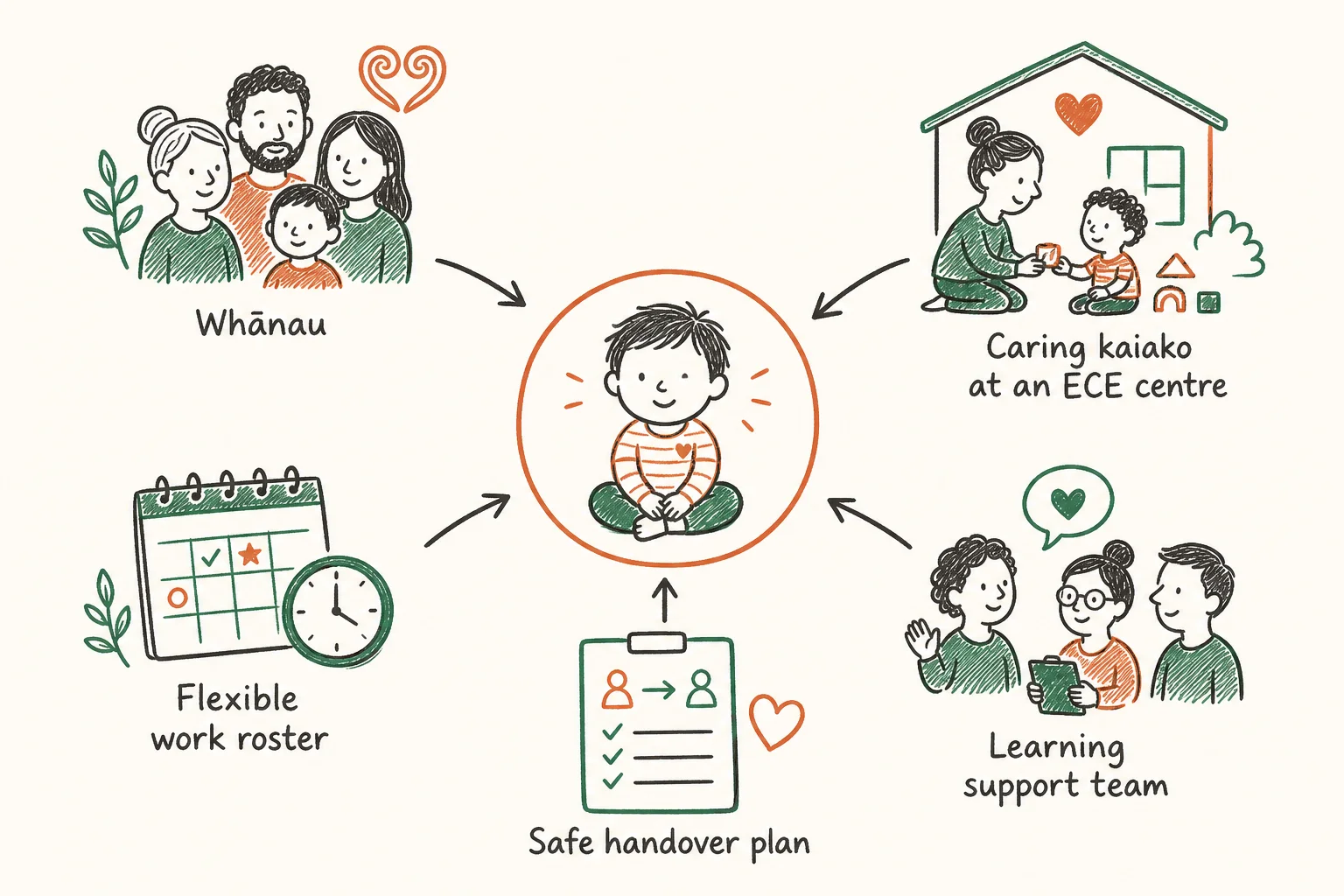
Start by naming the non-negotiables: your child's support needs, the hours you actually work, who may collect them, and the help you can call on when plans change. Then ask each service how it handles those practical details, in writing where safety or care arrangements are involved. A good fit is not the most polished tour. It is the service that can explain its plan for your child and communicate reliably with your whānau.
Every family's childcare plan looks different
Childcare advice often assumes a tidy weekly routine: two parents, predictable work hours, one healthy child, and a centre five minutes away. Plenty of New Zealand families are working with something more complicated. A child may need extra support. A parent may be rostered overnight. Two homes may need the same enrolment information. A grandparent might collect on most days, until they cannot.
None of that makes your family difficult. It means your childcare decision needs a little more planning than a standard checklist can offer. The useful question is not whether a service looks best. It is whether a service can meet your child's needs and cope safely when the week changes.
This guide covers the situations that tend to make childcare decisions feel urgent or lonely. It is practical rather than prescriptive. Your family knows its routines, culture, budget and capacity better than anyone else. Use the sections below to ask sharper questions and make a plan that does not collapse the first time someone gets sick.
Begin with a one-page family brief before you contact providers. Write down your required days and latest pick-up time, your child's sleep, food or communication needs, every adult authorised to collect them, and the backup arrangements you genuinely have. If there is a court order, medication plan or specialist recommendation, bring the current document to the enrolment conversation rather than relying on a verbal summary.
It also helps to separate a preference from a requirement. A forest-school feel may be a preference. A provider that can follow an asthma action plan is a requirement. A place near work may be convenient. A place that can accept a 6.30am drop-off could be the thing that keeps a rostered job workable. That distinction stops families from talking themselves into a beautiful centre that cannot make the week function.
For a broad starting point, see our guide to types of childcare in NZ and questions to ask when visiting a childcare centre.

Video
When your child has additional learning, development or communication needs
Inclusion starts with a real conversation, not a label on a brochure. Tell a prospective service what helps your child participate: perhaps visual prompts, a quieter arrival, a predictable handover, support with communication, or extra time to join a group. Ask what the kaiako have already done for children with similar needs, who will coordinate the plan, and how they will review it with you. Listen for specific answers. A general reassurance is nice. A team that can describe a visual arrival routine, regular whānau meetings and a consent-based learning-support referral tells you much more.
Te Whāriki is intended to support all children, including children with diverse needs. The Ministry of Education's Early Intervention Service supports children with additional developmental, communication or behavioural needs. From Term 1 2026, it covers children from birth through the end of Year 1. Depending on the child and referral, support can involve an early intervention teacher, speech-language therapist, teacher aide, kaitakawaenga and others working across home, early learning and school transition. Read the Ministry's early-years learning support guidance for the current service pathway.
A diagnosis is not the only reason to start the conversation. If you or the service notice that your child is finding communication, sensory regulation, behaviour or participation hard, ask what observations have been made and what support could help. Parents can speak with their early learning service about the Early Intervention Service. The service can contact the Ministry's learning support team with your permission.
For a closer look at finding and assessing an inclusive setting, read our guide to childcare for children with additional needs.
Bring people together early, but keep the plan usable. A meeting that includes whānau, the lead kaiako and relevant specialists can agree on the important details: goals for participation, communication methods, sensory or medical considerations, who does what, and how progress will be reviewed. Ask for the plan in plain language. It should make a Monday morning easier for the teacher who opens the room, not sit untouched in a folder.
Visit at the time your child would actually attend. Notice the entrance, noise level, bathroom access, outdoor transitions and whether adults get down to children at eye level. Ask how the service handles a difficult day without isolating your child. Ask whether relief teachers will be told the essentials. If food, medicine or mobility equipment is involved, ask to see the practical routine rather than accepting a general assurance.
There is no single inclusion badge that settles the decision. Capacity varies between services and even between rooms. A smaller service with a thoughtful team and a clear plan may be a better fit than a larger one that has heard the right vocabulary but cannot explain what happens at drop-off.
- Ask who will be your day-to-day contact and how urgent updates are shared.
- Ask whether the service has worked with the support professionals already involved with your child, with your consent.
- Ask what the service needs from you before the first day, including medication, communication or safety plans.
- Ask how it documents incidents, successful strategies and changes to routine.
- Ask how it will prepare for the move to school or kura, rather than leaving transition planning until the final month.
Care around shift work and non-standard hours
For nurses, hospitality workers, tradies, emergency-service staff and parents on rotating rosters, the hard part is often not finding childcare. It is finding care that opens early enough, stays open late enough and does not turn every roster change into a crisis. Do not assume an all-day centre will cover your shift. Opening hours, holiday closures, late-pickup rules and casual-day availability vary service by service. The Ministry advises parents to check these points directly with each provider.
Home-based education and care can be worth investigating for families whose hours sit outside a standard centre day. Licensed home-based care may take place in the educator's home, your home or another parent-nominated home. Each educator can care for up to four children under six. It does not guarantee evening, overnight or weekend availability, but local providers may offer a different pattern from a centre. Read the Ministry's overview of early learning types, then confirm exact hours and backup arrangements before enrolling.
A patchwork plan can be sensible when it is written down. One caregiver might cover the regular day, another the early start, and a family member the occasional late finish. What makes it safe is not heroic improvisation. It is clear authorisation, transport arrangements, consent to share information, and a backup person who has agreed before the phone rings at 5.15am. For a detailed plan for early starts, late finishes and changing rosters, read our childcare for shift workers guide.
Talk to your employer as well as providers. Every employee can request flexible working arrangements from their first day of work. A request can cover hours, days or place of work, and an employer must consider it. That does not mean every request will be approved, but it can be useful to ask for a fixed roster, a later start on one day, a compressed week or enough notice to book care. Employment New Zealand explains how to make a flexible-work request.
Be cautious about paying for a full-time place purely as a standby solution if your roster is irregular. First ask the provider what absence, booking and cancellation rules apply. Some families do better with a regular base booking plus a reliable informal arrangement for shifts that fall outside it. Others need a provider with a longer daily window and a backup collector. The answer depends on local availability, not an idealised care model.
If you receive a Work and Income payment or think you may qualify for help with care costs, check your individual circumstances with Work and Income. Subsidy rules, approved activities and required evidence matter, so get a current answer rather than relying on a colleague's old arrangement.
Shift-work reality check
Single parents and one-adult households
When there is one adult carrying the daily load, reliability matters more than a theoretically perfect routine. A centre close to home might be the safest choice because a sick child can be collected quickly. A provider near work might reduce commute pressure. A home-based option may offer a smaller handover. There is no badge for choosing one kind of care over another. Choose the setup that gives you enough margin to get through a normal bad week.
Make the emergency plan at enrolment, not after your child has a fever. Nominate authorised collectors who can realistically arrive, make sure their phone numbers stay current, and tell them what identification the service will expect. Ask about sick-child policies, closure notices and late-pickup fees. Keep a small bag of essentials at the service if that reduces frantic mornings. These boring details are a form of care for your future self.
Costs deserve an early conversation too. Children aged three, four and five may receive up to 20 hours a week of government-funded early learning, but families may still pay for hours outside that allocation, optional charges or service-specific minimum bookings. Our 20 Hours ECE guide and WINZ Childcare Subsidy guide explain the starting points. Confirm your own eligibility directly with the service and Work and Income.
For a closer look at funding, backup care and flexible-work planning, read our single parent childcare guide.
A support network does not have to be large to be useful. One neighbour who can collect in an emergency, a relative who knows the routine, another parent from the centre, or a workplace colleague who can cover a short handover may each solve a different problem. Be specific when you ask for help. Asking one person to be an emergency collector on a particular day is easier to answer than a vague request for help.
If no personal backup is available, be honest with the provider and ask what its procedures are. Services cannot replace a parent indefinitely, and they need current contacts, but they may be able to point you to local parenting, budgeting or community support. Do not wait until a crisis to tell the service you have no second adult to call. A good provider would rather understand the risk than discover it during a delayed collection.
Single-parent families also need room for rest. Build a small buffer where you can: a repeat grocery order, an overnight bag already packed, a calendar reminder for fees and enrolment forms, and one person who can receive a panicked text. It is not glamorous. It is what makes the system less brittle.
Twins, siblings and children at different stages
Two children do not simply double the logistics. They can have different sleep needs, rooms, educators, drop-off reactions and start dates. Start the search for childcare for twins and multiples early if you need more than one place, especially if one child is under two. Ask providers whether siblings can be enrolled on the same days, how room moves are handled, whether one adult can complete a single drop-off, and what happens if only one child is unwell.
Same room or separate rooms is a family decision. Some siblings settle better together. Others need space to build separate relationships and identities. Ask the service what it observes, then decide based on your children rather than a rule. You can review the arrangement after a few weeks. If they are separated, make sure both rooms know the practical details about pickup, food and comfort strategies so you are not repeating the same story twice every day.
Budget for the real arrangement. Government-funded early learning is assessed for each eligible child, but service fees, minimum hours, food and extras can still add up. Our childcare cost guide and budgeting guide can help you ask the right questions before you accept two places.
A shared calendar reduces mistakes when more than one adult handles childcare. Include rostered days, authorised collectors, room phone numbers, medication dates, laundry needs and any change in pickup. Keep the service's messages in one place. If one child is collected by a grandparent while another stays for an activity, state that clearly in the daily handover rather than assuming staff can infer it from last week.
If you are considering a nanny or home-based arrangement because two centre fees feel steep, compare the whole picture: hourly cost, employment obligations where relevant, annual leave cover, sick-day cover, travel, and whether the arrangement has a licensed provider behind it. Our nanny versus daycare versus home-based comparison covers the trade-offs. The cheapest quote is not automatically the least stressful option.
Separation, illness, bereavement and other family transitions
Children often notice a family change long before adults have found the right words for it. Childcare can give them continuity: familiar kaiako, predictable meals, friends and a normal rhythm. It can also become stressful if staff are left to interpret adult conflict. Tell the service what it needs to know for your child's care, not every detail of the dispute. A short written update is usually better than two competing verbal versions.
If parents are living apart, give the service current contact details, collection permissions and any parenting agreement or court order that affects access. The Ministry's professional practice guidance for separated parents and guardians says parents are responsible for informing the service about these arrangements. Unless a court order says otherwise, parents and guardians can receive reports about their child's participation, engage with the service and access official records. ECE staff are not there to mediate disputes or enforce a private agreement.
Ask what happens if an unauthorised person arrives, what identification collectors need, and where documents are stored. Update the file as soon as arrangements change. This is one area where a polite but vague conversation is not enough. Clear written information protects your child, the service and both parents.
Illness, bereavement, family violence, housing instability and caring for another relative can all disrupt attendance. Keep the service informed about changes that may affect your child's mood, sleep, pickup or safety. You do not need to disclose private details to every staff member. Ask who needs to know and how confidentiality is handled.
For your child, simple continuity helps: the same comfort item, a predictable goodbye, a photo in their bag, or a short note about a changed routine. Let kaiako know which words your family is using. Avoid asking them to carry messages between adults. If a child is distressed or their behaviour changes sharply, talk together about what the service is seeing and whether outside support would help.
There are times when childcare cannot be the solution on its own. If there is immediate safety risk, contact emergency services. For legal or parenting-order questions, use qualified legal advice. For financial, family or wellbeing support, speak with the relevant public agency or local community organisation. A centre can be an important part of the support circle, but it should not be asked to become the whole circle.
Families whose work serves everyone else
Military, emergency-service, agricultural and seasonal-work families can face long absences, sudden callouts, relocation or an intense harvest period. The practical answer is often the same as for other unpredictable work: build a plan with named people, exact pickup rules and a service that understands what your week can look like. The emotional piece is different. Children may need extra warning before a parent leaves, a familiar photo or message, and a calm handover when routines change.
Ask a prospective provider whether it can accommodate a changing but planned roster, whether it requires fixed minimum days, and how much notice is needed for swaps. Do not overpromise availability to secure a place. A transparent conversation early can prevent fees or resentment later. Where a family relocates, start with regional childcare guidance and contact services before the move date.
For rural and seasonal work, travel distance may be the first constraint. Home-based care, local playgroups, family arrangements and a longer commute can all be part of the answer. Our rural childcare guide has more ideas. Check every provider's licensing, hours and transport expectations rather than treating a neighbourly arrangement as automatically suitable for regular paid care.
Health, food and daily-care requirements
Some needs are not visible on a first visit. Your child may have an allergy, asthma, diabetes, a feeding plan, regular medication, a sleep need, or a history that means a particular trigger matters. Put the practical facts in front of the service before the start date. Describe what happens, what helps, what staff must never do, the signs that mean you need a phone call, and who can make decisions if you cannot be reached. A vague note about dairy sensitivity is less useful than a current health plan with the food, symptoms and response clearly stated.
Ask where medication is stored, who is trained to administer it, how expiry dates are checked, and how relief staff receive the information. Ask how food is managed during shared celebrations, lunches, excursions and cooking activities. If your child needs an action plan from a clinician, give the service the latest copy and update it when treatment changes. It is reasonable to ask to walk through a routine, such as arrival with an inhaler or a lunchtime allergy check. The aim is not to catch anyone out. It is to make sure the plan works when the usual teacher is away.
The Ministry's licensing criteria contain health and safety requirements for early learning services, but a licence is only the baseline. The right service can explain its own procedure in everyday language, introduce you to the people who will use it, and agree on the communication you want after an incident. For more detailed questions, use your health professional for clinical advice and ask the service how it manages the needs relevant to your child.
Daily care requirements also deserve respect. A child who naps at a particular time, uses a communication board, needs a slower handover, or eats familiar food is not asking for a luxury service. The service may not be able to reproduce home exactly, but it should explain what can be consistent and where a compromise is needed. Some children settle best when their parent stays for ten minutes. Others need a brisk, familiar goodbye. Agree on the plan, try it for a week, then review what is happening rather than judging the first hard morning.
Make room for culture and language in this conversation. Share the name your child uses at home, important words in te reo Māori or another language, food practices, comfort rituals and people who matter to them. Whānau knowledge helps kaiako understand behaviour that might otherwise look confusing. It also lets your child see that their home identity has a place in the service.
If a provider says it cannot meet a particular health or support requirement, ask for the reason, whether the barrier is temporary, and what other local services or supports it knows. A clear no may be disappointing, but it is better than an arrangement that quietly relies on staff taking risks they are not equipped to manage.
Make the first month easier
The first month tells you more than a showroom-style visit. Keep a short record of drop-off, pickup, sleep, meals, big feelings and anything that differs from the agreed plan. You are looking for patterns, not perfect days. Does your child recover after a difficult goodbye? Are messages answered? Does the staff member at pickup know what happened in the room? Are the same details being lost between the adults who care for your child?
Book a short check-in after the settling period. Bring three observations, not a long list of worries. For example: your child has stopped eating lunch on Tuesdays; the new early shift means pickup is now a different person; the visual schedule is working at home but has not appeared at the centre. A focused conversation makes it easier for the service to respond. If the plan needs changing, agree on who will update the record and when you will review it again.
There is a useful difference between normal settling and a mismatch. Tears at drop-off can happen with a caring, appropriate service. Repeated failures to communicate, ignored safety instructions, unexplained incidents or a team that dismisses your concerns deserve action. Read childcare red flags for NZ parents before you decide whether a concern is one to work through or a reason to look elsewhere.
Keep the information portable. Put essential contacts, medical instructions, pickup rules and routine notes in one document that both authorised adults can find. Check it after a move, a new job, a separation, a diagnosis or a change in medication. Remove people who should no longer collect your child. Update the service in writing, then confirm it has changed the record. This is a small administrative habit with a large safety payoff.
It is also worth planning for the ordinary disruptions that make special circumstances feel impossible: a closed service day, a car that will not start, a child who is too sick to attend, or the adult who normally collects getting stuck at work. Choose one backup action for each scenario. It might be a leave arrangement at work, a trusted authorised collector, a taxi account, a relative who can stay overnight, or a provider's casual-day policy. A plan does not eliminate stress. It means you are not inventing every answer under pressure.
Give yourself permission to revisit the decision. Your child may grow into a setting that initially felt too busy. Your work hours may settle. A support need may change. Childcare is a relationship, not a once-and-done purchase. The best arrangements evolve with the child and the people around them.
A practical plan for choosing and reviewing care
Use a visit to test the service against your real life. Bring the questions that are awkward to ask: What happens when my shift finishes late? Can my child's communication device stay with them? Who may collect during a separation? What does the service do when two siblings need different rooms? How quickly will you call me, and what happens if I cannot answer? Clear, calm answers are a good sign. Defensiveness is information too.
After enrolment, review the plan after the first two weeks and again after a change such as a new roster, diagnosis, separation or room move. Ask your child what they enjoy, watch their energy at pickup, and check whether the written plan still matches daily practice. Families are allowed to change their minds when a setup is not working. Changing services can be disruptive, but staying in a poor fit simply because the paperwork is done can be harder.
The Parent Circle has listings across more than 1,000 NZ suburbs. Search locally, compare the practical details, then trust the evidence from your own visits. The right provider will not have a magical answer for every scenario. It will have a team that listens, communicates and follows through.
| Situation | Ask the provider | Put in writing |
|---|---|---|
| Additional needs | Who coordinates support and how are strategies shared? | Support plan, medication or safety information, review dates |
| Shift work | What are the exact opening, pickup and booking rules? | Regular days, authorised backup collectors, late-change process |
| Separated parents | Who can collect and who receives updates? | Current contacts, parenting order or agreement where relevant |
| Multiple children | Can siblings attend on the same days and how are room moves managed? | Collection instructions, room contacts, individual care needs |
| Family crisis | Who should staff contact and what information is confidential? | Emergency contacts, safety instructions, agreed communication method |
Frequently asked questions
Can an early learning service refuse a child because they have additional needs?
Talk directly with the service about your child's needs and the support required. Te Whāriki includes diverse learners, and the Ministry's learning support services may help. A provider still needs to be honest about what it can safely deliver day to day. Ask for specific reasons and discuss a support plan rather than relying on a general answer.
Is there childcare in NZ for parents who work nights or weekends?
Availability is local and limited. Check exact opening hours with each service. Licensed home-based care may offer different hours from centre-based care, but it does not automatically mean overnight or weekend places are available. Build a backup collection plan before you enrol.
Can both separated parents get information from childcare?
Unless a court order says otherwise, Ministry guidance says parents and guardians can receive information about their child's participation and access official records. Give the service current arrangements and any relevant order. Staff should not be asked to mediate between adults.
Do twins each get 20 Hours ECE?
Eligible children aged three, four and five can each receive up to 20 funded hours a week through a participating service. Fees may still apply for hours outside the funded allocation, optional charges or service-specific booking requirements. Confirm the details with the provider.
How do I find childcare when I have no emergency contact?
Tell the provider early that you do not have a second adult available. Ask about illness, closure and late-pickup procedures, then look for a realistic local backup such as a trusted friend, relative, neighbour or another authorised adult. Do not assume the service can keep a child indefinitely.
What should I take to a childcare visit when my child has a medical or support plan?
Take a short summary of what helps your child, current medical or specialist information where relevant, and questions about daily routines. Ask how the service stores and follows important instructions. Keep the formal documents current once you enrol.
A good childcare plan is not a promise that life will stay orderly. It is a set of shared details that helps your child feel safe when life is messy. Start with the facts, ask the uncomfortable questions, and choose the service that can meet you in the real week you have.
Before you sign an enrolment agreement, take one final look at the things that are easy to miss when you are relieved to find a vacancy. Read the fee schedule and notice period. Check whether holidays, public holidays and sickness change the charges. Save the main office number as well as the room number. Confirm who has authority to change enrolment days, who receives invoices and which email address will get an urgent message. If English is not the language your whānau uses most comfortably, ask whether information can be explained in a way that makes the important decisions clear.
Then visit again if you can, ideally at arrival or collection rather than the quiet middle of the day. Watch how staff greet children, how they handle a child who does not want to separate, and whether parents seem able to speak with them. One visit will not tell you everything, but it will show you the tone of the place. You are choosing a group of people who will share ordinary, vulnerable moments in your child's day. That is worth taking seriously.
If the fit is not right, leaving is allowed. A childcare arrangement should support your family, not consume all of its energy. Keep the notes from your visits, ask for the information you need, and make the next decision with the benefit of what you have learned.
Find a childcare service that fits your family
Compare local options, opening hours and care types across New Zealand.
Search providersRelated guides
Your Child's First Illness from Daycare: What NZ Parents Need to Know
A calm NZ guide to the first daycare illness season: what is normal, when children need to stay home, when to call Healthline, and how working parents can plan for sick days.
The Childcare Settling-In Process: What NZ Centres Offer and What to Expect
A practical NZ guide to settling visits, key kaiako relationships, week-by-week transitions, and questions to ask before your child starts childcare.
Starting Childcare in NZ: A Complete Guide to Preparing Your Family
A practical NZ guide to preparing your child, yourself, and your daily routine for the first day, first week, and first month of childcare.
Rural Childcare in NZ: Options for Families Outside Major Cities
Rural childcare in NZ takes more planning, but there are workable options: small centres, Playcentre, home-based care, kōhanga reo, and local whānau networks.
Find childcare near you
Search and compare providers by suburb, care type, cost, and availability.