
Resource Hub
30 Questions to Ask When Visiting a Childcare Centre
Published · Last updated · 9 min read

What should I ask when visiting a childcare centre in NZ?
Ask about teacher-to-child ratios (the legal minimum is 1:5 for under-2s and 1:10 for over-2s), whether the centre has opted into Pay Parity, which Te Whāriki pathway they follow, their 48-hour illness exclusion policy, how they communicate with parents (Storypark or Educa), settling-in procedures, and how 20 Hours ECE and FamilyBoost apply to your fees. Check their ERO report at ero.govt.nz before you visit.
Why the right questions matter
You can tell a lot about a childcare centre in the first five minutes. The smell of the kai cooking, whether teachers are down on the floor with kids or standing over them, the volume of the room. But your gut feeling only gets you so far.
The right questions cut through the glossy brochure version of a centre and get to what actually matters: how they treat your child when you're not there. This checklist gives you 30 specific questions grounded in current NZ regulations, plus what to watch for during your visit.
If you're still figuring out what type of childcare suits your family, start with our complete guide to choosing childcare in New Zealand. This article goes deeper on what to ask once you've narrowed your shortlist.
Before the visit: 5 questions to ask over the phone
Save yourself a trip. These five questions will quickly tell you whether a centre is worth visiting in person.
- "Do you have spaces available for my child's age group, and what's the current waitlist?" Some centres have 12-month waitlists for under-2 places. Get the real number.
- "What are your fees, and how do 20 Hours ECE and optional charges work?" If your child is 3-5, the government subsidises 20 hours per week. Centres cannot force you to pay top-ups for those hours, but they can charge for extras like food or sunscreen. Ask what those extras actually cost.
- "What are your opening hours and session options?" Some centres require minimum days. Check this matches your work schedule before falling in love with the place.
- "Are you licensed and what was your most recent ERO rating?" You want to hear "Well Placed" or "Very Well Placed." Anything else deserves a closer look at the ERO report before you visit.
- "Can I book a visit during a normal session, not a scheduled open day?" Open days are the centre's best performance. You want to see a regular Tuesday morning.
About the staff
The people looking after your child matter more than the building. These questions get at staff quality and stability.
- "What is your actual adult-to-child ratio, and does it exceed the Ministry minimums?" The legal minimums are 1:5 for under-2s and 1:10 for over-2s. Good centres aim for better — 1:3 or 1:4 for babies, 1:8 for toddlers.
- "Have you opted into Full Pay Parity for your teachers?" This is a big one for 2025-2026. Centres had to make a binding decision by June 9, 2025. If they opted in, their teachers earn kindergarten and primary school rates. That means less turnover, more experienced staff, and better continuity for your child. If they didn't opt in, ask why.
- "What percentage of your staff are fully qualified and registered teachers?" Regulations require 50%, but the best centres run at 80-100%. Higher qualified staff means better teaching, not just supervision.
- "What's your staff turnover been like in the past year?" High turnover is hard on small children who form attachments to their teachers. If three teachers left last term, that tells you something.
- "Do all your teachers hold current First Aid certificates?" The legal minimum (HS25) is just one trained person per 25 children. If a toddler is choking, you want the nearest adult to know what to do — not have to run and find the one qualified person.
About the programme
New Zealand's early childhood curriculum, Te Whāriki, is world-regarded. But how a centre actually implements it varies enormously.
- "Which curriculum pathway do you follow — Te Ara Whānui or Te Ara Māori?" Recent changes require centres to choose a specific interpretation of Te Whāriki. Asking this shows you've done your homework and tells you about the centre's philosophical direction.
- "How do you make children's learning visible to parents?" Look for more than art on the wall. Good centres write "learning stories" that describe the skills and dispositions your child is developing, not just what activity they did.
- "What does a typical day look like?" Ask for the actual routine. How much time is structured versus free play? When do children eat, sleep, and go outside? A rigid schedule with kids marching between activities is a red flag.
- "How is te reo Māori integrated beyond mat time?" You're looking for authentic use throughout the day — teachers using te reo for greetings, praise, comfort, and instructions, not just singing a waiata at 10am.
- "How much time do children spend outdoors, and what does outdoor play look like?" NZ kids need space to take risks — climbing, jumping, getting muddy. A playground that feels "too safe" (flat, rubberised, nothing to climb) can actually limit development.
About health and safety
This is where you get specific. Vague answers here should worry you.
- "What is your exclusion period for vomiting and diarrhoea?" The right answer is 48 hours after the last symptom. If they say 24 hours, expect your household to catch every bug going around.
- "How do you handle medication — what's your process for Category 1 and Category 2 medicines?" Non-prescription items (like teething gel) need a general authority form. Prescription medicines need a daily parent signature. Best practice is two staff members checking the dosage together.
- "What is your sleep monitoring process for under-2s?" Regulation HS9 requires checks every 5-10 minutes for warmth, breathing, and well-being. Ask whether staff physically enter the sleep room or just look through a window. The best centres keep a staff member in the room whenever babies are sleeping.
- "How do you prepare high-risk choking foods like grapes, sausages, and apple?" Under HS22, grapes and cherry tomatoes must be quartered, sausages skinned and sliced lengthwise, and raw apple grated or cooked for under-3s. If you see whole grapes on the lunch table, walk away.
- "How often do you practise fire and earthquake drills?" The requirement is at least every three months. Ask about their lockdown protocol too — what happens if there's a police operation nearby?
About communication
- "Which app do you use for parent updates?" Most NZ centres use Storypark or Educa. These let you see photos, videos, and learning stories during the day. If a centre has no digital communication system, ask how they keep you informed.
- "How often will I get updates about my child's learning and development?" Daily photos are nice, but you also want regular learning stories and at least two formal parent-teacher conversations per year.
- "How do you handle concerns or complaints from parents?" A good centre has a clear process and doesn't get defensive. Ask for an example of how they've responded to parent feedback.
About settling in
- "What does your settling-in process look like?" Good centres offer several visits where you stay with your child, then gradual time apart. Be cautious of any centre that suggests dropping your child off on day one and "they'll be fine."
- "How do you support children who are upset at drop-off?" Ask about their attachment approach. You want to hear about a primary caregiver system, comfort routines, and honest communication — not "we just distract them."
- "Can I call or check in during the day?" The answer should be yes, always.
About fees and subsidies
- "Can you give me a full fee breakdown, including all optional charges?" Get the actual weekly cost in writing. Ask what happens if you don't pay the optional charges — your child should still receive the same care during their 20 Hours ECE.
- "Are you registered for the FamilyBoost tax credit?" FamilyBoost lets families claim up to 40% of childcare fees back, capped at $1,560 per quarter. Your household income needs to be under approximately $140,000 for the full amount, with reduced rates above that. The centre needs to provide proper invoices for you to claim.
- "Do you accept WINZ childcare subsidies?" If your family qualifies, this can make a real difference. Not all centres process WINZ payments smoothly, so ask about their experience with it.
Use our cost estimator to get a personalised breakdown of what childcare will actually cost your family after subsidies.
What to observe during your visit
Questions are half the picture. The other half is what you see, hear, and feel when you walk through the door. Put your phone away and pay attention to these things.
| Area | What to look for |
|---|---|
| Teacher interactions | Are teachers on the floor at children's level? Are they having conversations with children, or giving instructions at them? |
| Noise level | Is it a "happy hum" of engaged play, or chaotic shouting? A constantly loud room can be stressful, especially for younger or sensitive children. |
| Environment | Is the space calm and organised, or cluttered? Look for open-ended resources like blocks, shells, and fabric that spark imagination — not just plastic toys with one function. |
| Children's engagement | Are kids busy and focused on their play, or wandering aimlessly? Are they waiting in long lines for food or the toilet? |
| Outdoor area | Is the playground challenging enough? NZ children need opportunities for risk-taking play — climbing, jumping, digging. A flat, rubberised space with nothing to explore is a missed opportunity. |
| Gates and security | Test the gate. Does the maglock engage instantly? Is the release button out of reach of a resourceful four-year-old? |
| Sleep room | Can you see into the sleep room from the play area? Is the glass clear, not covered in posters? This matters for monitoring. |
| Hazard checks | Look for the Daily Hazard Check sheet near the entrance. Is today's date filled in? If it's blank at 10am, they're not doing their checks. |
| Nappy changing | If you see a change happen, watch the hygiene. Does the teacher clean the mat afterwards? Do both the teacher and child wash their hands? |
Your observation checklist
The ERO report check
Before you sign anything, look up the centre on ero.govt.nz. The Education Review Office visits every centre and publishes a report.
Here's what the ratings mean:
- Very Well Placed (next review in 4 years) — the centre is doing an excellent job across the board.
- Well Placed (next review in 3 years) — solid performance with good standards.
- Requires Further Development — this is a red flag. It usually means the reviewers found significant issues with compliance, safety, or teaching quality.
Read the full report, not just the rating. Sometimes a "Well Placed" centre has one area of concern that matters to you specifically. And pay attention to the date — a glowing report from 2019 may not reflect the centre you'd be sending your child to today.
Your printable checklist
Take this with you
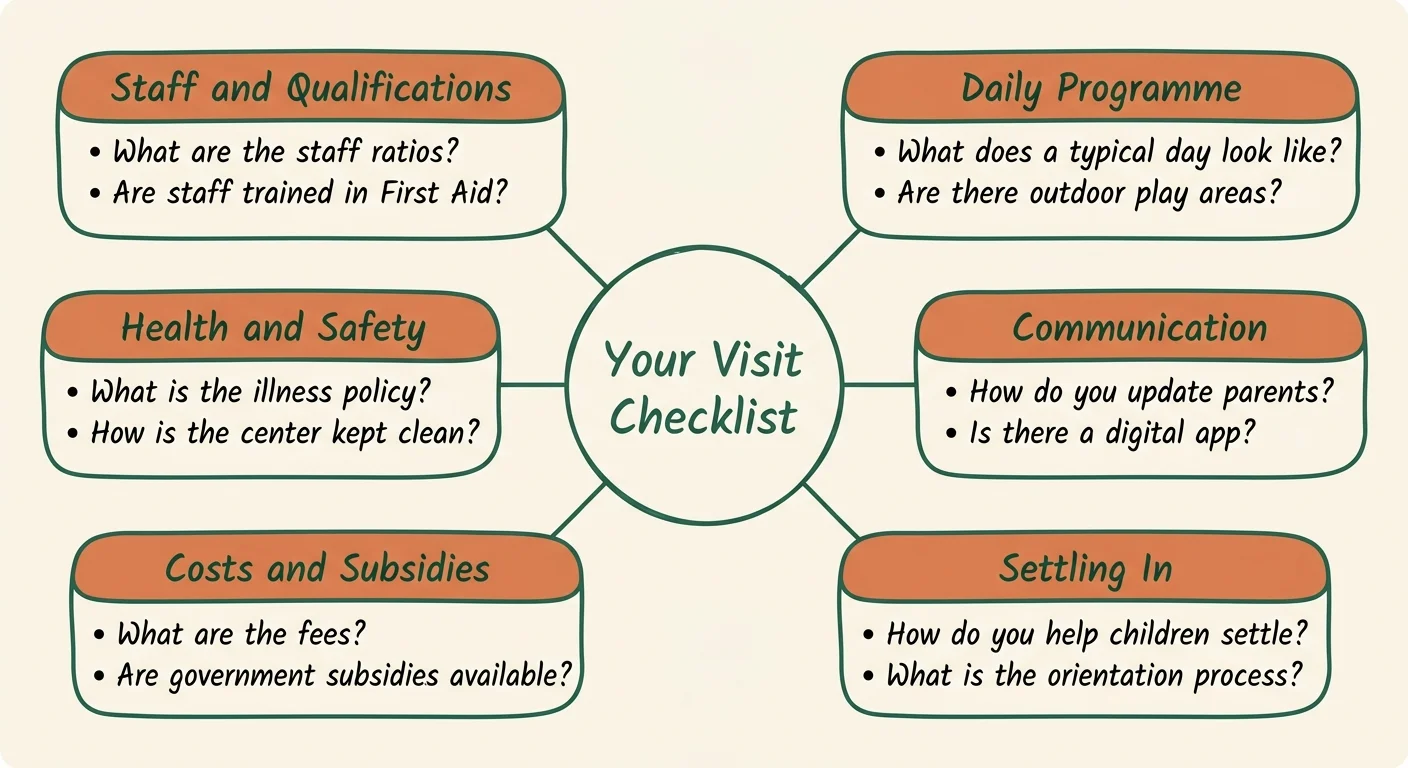
Staff: Actual ratios | Pay Parity opt-in | % qualified teachers | Staff turnover | First Aid training
Programme: Te Whāriki pathway | Learning stories | Daily routine | Te reo integration | Outdoor play philosophy
Health and safety: 48-hour illness rule | Medication process | Sleep monitoring | Choking food preparation | Drill frequency
Communication: Parent app | Update frequency | Complaints process
Settling in: Transition process | Attachment approach | Checking in policy
Fees: Full breakdown | FamilyBoost registration | WINZ subsidy acceptance
Observe: Teacher-child interactions | Noise | Environment | Engagement | Outdoor area | Gates | Sleep room | Hazard sheet | Hygiene
Frequently asked questions
How many childcare centres should I visit before deciding?
At least three. Visiting multiple centres gives you a baseline for comparison. You'll quickly notice differences in atmosphere, teacher engagement, and how staff respond to your questions. Use our [compare tool](/compare) to keep track of what you liked and didn't like at each one.
What is Pay Parity and why does it matter for my child?
Pay Parity means the centre's teachers are paid at the same rates as kindergarten and primary school teachers. Centres had to opt in by June 9, 2025. Centres that opted in typically have lower staff turnover, which means your child builds stable relationships with their teachers instead of adjusting to new faces every few months.
Can a centre charge me extra on top of 20 Hours ECE?
Centres cannot charge compulsory fees for the 20 funded hours. They can request voluntary "optional charges" for things like meals, sunscreen, or excursions. The key word is optional — if you decline, your child must still receive the same level of care and education during those hours.
How do I find a centre's ERO report?
Go to ero.govt.nz and search for the centre by name or location. Each report includes a rating (Very Well Placed, Well Placed, or Requires Further Development), detailed findings, and the date of the last review. You can also use our [search tool](/search) to find centres and link directly to their ERO reports.
What if I'm not happy with the centre after my child starts?
Talk to the centre manager first — good centres want to resolve concerns. If the issue is serious (safety, neglect, or licensing breaches), you can contact the Ministry of Education's licensing team or make a complaint through ERO. You can also move your child to another centre, though giving notice (usually 2-4 weeks) is standard.
Choosing childcare is one of the biggest decisions you'll make as a parent, and it's okay to feel overwhelmed. Take this list with you, trust what you observe, and remember: the right centre is one where your child is safe, happy, and genuinely known by the people caring for them.
For more guidance on types of childcare, costs, and what to expect, head back to our complete guide to choosing childcare in New Zealand.
Compare childcare centres side by side
Use The Parent Circle's compare tool to evaluate centres based on fees, ratios, ERO ratings, and more.
Compare centres nowFind childcare near you
Search and compare providers by suburb, care type, cost, and availability.