
Resource Hub
WINZ Childcare Subsidy: A Step-by-Step Application Guide for NZ Parents
Published · Last updated · 9 min read

Contents
What is the WINZ Childcare Subsidy and how much can you get?
The WINZ Childcare Subsidy pays up to $6.52 per hour (from April 2025) towards approved early childhood education for children under five. How much you get depends on your household income and number of children. A family earning under $1,196/week with one child gets the full rate — worth up to $326 per week for 50 hours of care. The subsidy is income-tested and paid directly to your provider.
How the WINZ Childcare Subsidy actually works
Work and Income (WINZ) runs three separate childcare payments, and most parents only know about one of them. The Childcare Subsidy is the main one, covering pre-school children under five at licensed ECE services. But there's also the OSCAR Subsidy for school-age kids and the Guaranteed Childcare Assistance Payment for teen parents.
All three are paid directly to your childcare provider, not to you. Your provider bills WINZ for the subsidised hours and charges you the difference. You don't handle any of the payment yourself.
The subsidy won't cover all your fees. It chips away at the hourly rate, and the gap between what WINZ pays and what your centre charges is still yours to cover. But for families earning under the thresholds, it takes a real bite out of weekly costs. Our complete guide to childcare costs in NZ breaks down the full picture.
Three types of WINZ childcare assistance
Childcare Subsidy (under-5s)
This is the one most parents mean when they say "WINZ childcare subsidy." It covers children under five (or under six if you receive a Child Disability Allowance for them) attending a licensed ECE service — kindergarten, daycare centre, home-based care, playcentre, or kōhanga reo.
The hours you can claim depend on what you're doing:
- Up to 9 hours per week if you're not working, studying, or training. This is the baseline — even stay-at-home parents can access some subsidised ECE.
- Up to 50 hours per week if you're working, studying, on an approved training course, seriously ill or disabled, or caring for a hospitalised child.
OSCAR Subsidy (school-age, 5-13)
The Out of School Care and Recreation (OSCAR) Subsidy covers before-school, after-school, and holiday programmes for children aged 5 to 13 (or under 18 with a Child Disability Allowance). It pays the same hourly rates as the Childcare Subsidy but with different hour caps: up to 20 hours per week during term time and up to 50 hours per week during school holidays.
One catch: you can't get the OSCAR Subsidy if your child's other parent or caregiver is available to look after them. Both parents need to be working, studying, or otherwise unavailable.
Guaranteed Childcare Assistance Payment (teen parents)
GCAP is specifically for parents under 20 who are in full-time education, training, or work-based learning. It's more generous than the standard Childcare Subsidy — it covers the actual fees charged by your provider, up to $6.38 per hour or $319 per week (as of April 2024). Unlike the Childcare Subsidy, GCAP is not income-tested. If you're a teen parent in study, you qualify.
You need to be getting a Young Parent Payment, or be under 18 and attending secondary school full-time.
Income thresholds and payment rates (April 2025)
Both the Childcare Subsidy and OSCAR Subsidy use the same rate table. Your household's gross weekly income determines which band you fall into. As income rises, the hourly subsidy drops in steps until it hits zero.
These rates were last updated on 1 April 2025. Previous thresholds were lower — for example, the cutoff for one child rose from $2,257 to $2,336 per week.
One child
| Gross weekly household income | Hourly rate per child | Max per 50-hour week |
|---|---|---|
| Under $1,196 | $6.52 | $326.00 |
| $1,196 – $2,096 | $5.20 | $260.00 |
| $2,096 – $2,169 | $3.64 | $182.00 |
| $2,169 – $2,336 | $2.03 | $101.50 |
| $2,336 or more | Nil | Nil |
Two children
| Gross weekly household income | Hourly rate per child | Max per 50-hour week |
|---|---|---|
| Under $1,264 | $6.52 | $326.00 |
| $1,264 – $2,303 | $5.20 | $260.00 |
| $2,303 – $2,485 | $3.64 | $182.00 |
| $2,485 – $2,670 | $2.03 | $101.50 |
| $2,670 or more | Nil | Nil |
Three or more children
| Gross weekly household income | Hourly rate per child | Max per 50-hour week |
|---|---|---|
| Under $1,416 | $6.52 | $326.00 |
| $1,416 – $2,569 | $5.20 | $260.00 |
| $2,569 – $2,800 | $3.64 | $182.00 |
| $2,800 – $3,004 | $2.03 | $101.50 |
| $3,004 or more | Nil | Nil |
How abatement works
Who qualifies: eligibility in plain English
The official eligibility page lists the requirements, but here's what they mean in practice:
- You're the principal caregiver of the child. This means the child lives with you most of the time.
- You're a New Zealand citizen or permanent resident. Visa holders on work or student visas generally don't qualify.
- Your household income is below the threshold for your family size (see tables above).
- You normally live in New Zealand and plan to stay here.
- Your child attends an approved programme for at least 3 hours per week. This includes licensed ECE centres, kindergartens, home-based care networks, and kōhanga reo.
- For more than 9 hours per week, you need to be working, studying, training, seriously ill, or caring for a hospitalised child.
Even if you're not working
How to apply: step by step
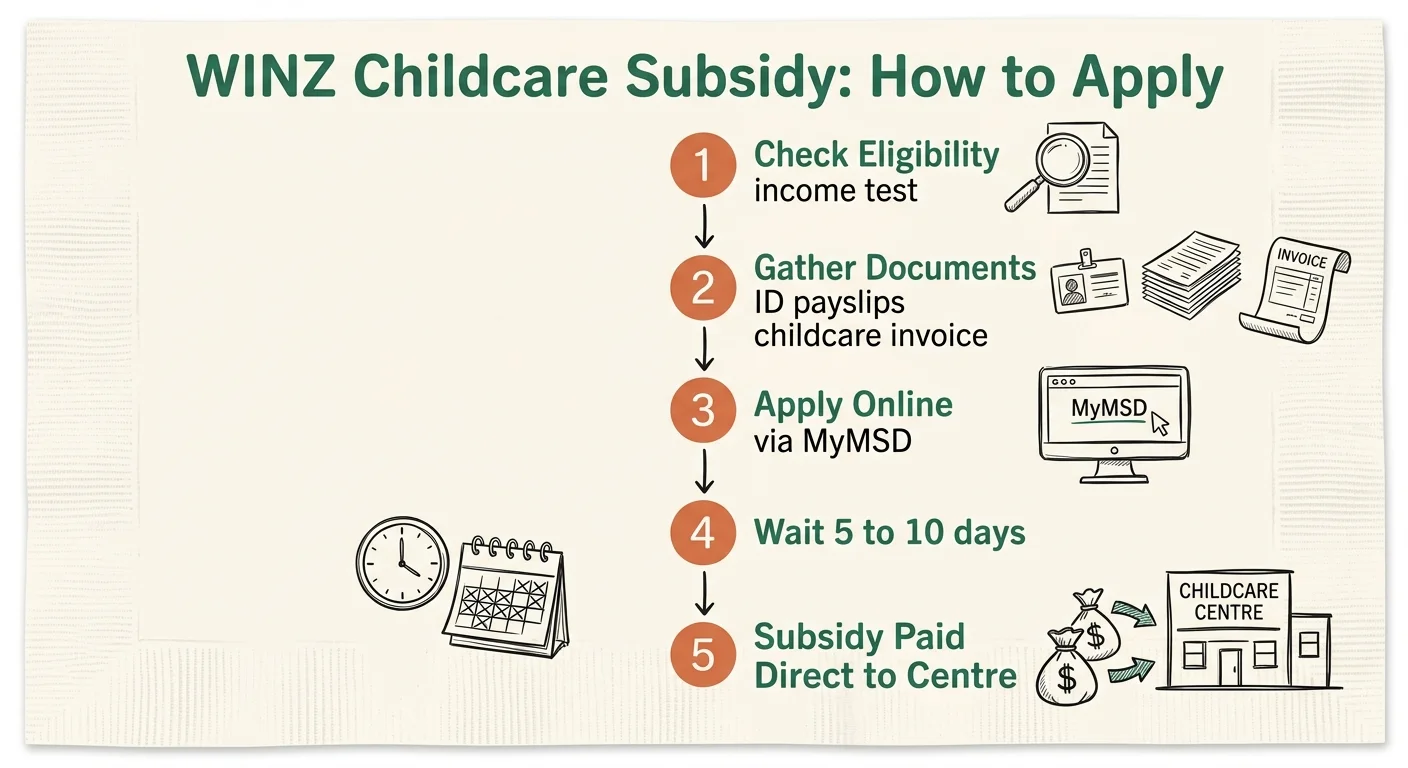
The process differs depending on whether you already get payments from Work and Income. Either way, WINZ recommends applying 3 to 4 weeks before you need the subsidy to start.
If you already receive WINZ payments
- Log into the SmartStart website using your RealMe account.
- Select "Apply for Childcare Subsidy" and fill in your details — income, child's information, and your provider.
- Upload your supporting documents (payslips, birth certificates).
- WINZ will assess your application and start paying the subsidy directly to your provider.
If you're a new WINZ client
- Download and complete the Childcare Assistance application form. Your childcare provider needs to fill in the supervisor's section of this form.
- Email the completed form and supporting documents to [email protected] — or ask your provider to send it on your behalf.
- If this is your first-ever WINZ application, you need to verify your identity in person at a Work and Income service centre. Bring your original government-issued ID (passport or NZ driver licence).
- WINZ processes the application and begins paying your provider directly.
The 20-working-day rule
What documents you need
- Proof of identity — passport, NZ driver licence, or birth certificate (new clients must verify in person)
- Income verification — recent payslips for you and your partner
- Children's birth certificates
- IRD number
- Work and Income client number (existing clients)
- Proof of work or study — employment contract, letter from employer, or course enrolment confirmation
- Provider details — your childcare provider completes the supervisor's section of the application form
- Medical evidence — if applying based on illness or disability
Gather everything before you start the application. Missing documents are the most common reason for delays. Your provider can help with their section — most ECE centres do this regularly and know exactly what's needed.
Changes you must tell WINZ about
Once your subsidy is running, you're required to report changes promptly via MyMSD or by phone. Failing to report changes can lead to overpayments that WINZ will recover — sometimes by deducting from future payments.
- Your income changes (new job, pay rise, reduced hours, partner starts or stops working)
- Your work or study situation changes (you stop working, change courses, finish training)
- Your child changes providers or stops attending
- Your child starts school
- Your relationship status changes (new partner, separation)
- You're leaving New Zealand
WINZ also reviews childcare assistance periodically. It usually stops or gets reviewed when your job or course ends, after 12 weeks of not working due to illness, or when your child reaches the age limit.
Stacking subsidies: WINZ + 20 Hours ECE + FamilyBoost
Yes, you can use all three. But they can't overlap on the same hours.
Here's how they stack for a three-year-old in full-time care (say, 40 hours per week):
- 20 Hours ECE covers the first 20 hours (free, no income test, available to all 3-5 year-olds at participating providers).
- WINZ Childcare Subsidy covers the remaining 20 hours at your income-tested rate. At the full $6.52/hour, that's $130.40 per week off your bill.
- FamilyBoost reimburses 25% of whatever fees remain after both 20 Hours ECE and the WINZ subsidy, up to $75 per week. You claim this quarterly through IRD's myIR portal.
A worked example
The critical rule: you cannot claim the WINZ subsidy and 20 Hours ECE for the same hours. The subsidy only applies to hours your child attends beyond the 20 funded hours. Your provider handles this split — you don't need to calculate it yourself.
What's changed recently
The April 2025 update brought the biggest rate increase in several years. The maximum hourly rate went from $6.28 to $6.52, and income thresholds were lifted across all family sizes. For a one-child family, the cutoff rose from $2,257 to $2,336 per week — bringing roughly 5,000 more families into eligibility.
Budget 2023 also allocated $35.2 million over four years to improve childcare assistance access, including enabling online applications (previously paper-only for new clients) and expanding flexible childcare assistance options. These changes are still rolling out through 2026.
The GCAP rate for teen parents, however, was not increased in April 2025. It remains at $6.38/hour, unchanged since April 2024.
Common mistakes that delay or reduce your subsidy
- Applying after care has started without contacting WINZ first. You lose the backdating window.
- Incomplete applications. Missing the provider's supervisor section is the most common hold-up.
- Not reporting income changes. If your income drops, you might be entitled to a higher rate. If it rises, you could face an overpayment recovery.
- Assuming you don't qualify. The thresholds are higher than many parents expect. A household earning $120,000/year ($2,308/week) with two children still qualifies for $5.20/hour.
- Not combining with other subsidies. Many families use 20 Hours ECE but don't realise they can also get the WINZ subsidy for additional hours, plus FamilyBoost on top.
Frequently asked questions
Can I get the Childcare Subsidy if I'm not working?
Yes. You can receive up to 9 subsidised hours per week even if you're not working, studying, or training. To get more than 9 hours, you need to be in paid work, approved training, or have another qualifying reason like serious illness.
How long does a Childcare Subsidy application take?
Work and Income recommends applying 3 to 4 weeks before you need the subsidy. Existing clients applying through SmartStart tend to get processed faster. The subsidy is backdated to when care started, provided you complete the application within 20 working days of first contacting WINZ.
Is the WINZ Childcare Subsidy income-tested?
Yes. Your gross household weekly income determines both whether you qualify and how much you receive. The thresholds vary by family size — for one child, you get the full rate below $1,196/week and nothing above $2,336/week. Check the rate tables above for your specific bracket.
Can I use the Childcare Subsidy at any childcare provider?
Only at approved providers — licensed ECE centres, kindergartens, home-based care services, playcentres, and kōhanga reo. Your provider must complete the supervisor's section of the application form. You can search for approved providers near you on The Parent Circle.
What happens if my income changes after I'm approved?
You must report income changes to WINZ promptly via MyMSD or by phone. If your income drops, you may qualify for a higher subsidy rate. If it rises above the threshold, your subsidy will be reduced or stopped. Unreported changes can result in overpayments that WINZ will recover.
Can I get both the Childcare Subsidy and 20 Hours ECE?
Yes, but not for the same hours. 20 Hours ECE covers 20 hours per week for children aged 3-5 at participating providers. The WINZ Childcare Subsidy can cover additional hours beyond those 20. You can also claim FamilyBoost on the remaining fees after both subsidies.
The WINZ Childcare Subsidy won't make childcare free, but combined with 20 Hours ECE and FamilyBoost, it can cut your weekly bill by more than half. The biggest barrier isn't eligibility — it's knowing the option exists and applying before care starts. Find a provider near you and get your application in early.
See how subsidies reduce your childcare costs
Search across 4,394+ licensed providers in NZ. Filter by location, care type, and subsidy eligibility to find the right fit for your family and budget.
Find Providers Near YouVideo
Related guides
Nanny vs Daycare vs Home-Based Care: Cost Comparison NZ (2026)
Compare the true weekly cost of a nanny, daycare centre, and home-based care in NZ for 2026. See how 20 Hours ECE, FamilyBoost, and WINZ subsidies affect each option.
How to Budget for Childcare: A Financial Planning Guide for NZ Families
Budget childcare properly: calculate true fees, stack 20 Hours ECE, FamilyBoost and WINZ support, run a return-to-work break-even check, then build a monthly cashflow plan.
Childcare Costs for Under-2s: Why Infant Care Is More Expensive and What You Can Do
Infant care costs more in NZ because under-2 rooms must staff to a 1:5 ratio. See 2026 price ranges, regional estimates, subsidy options, and ways to cut the bill.
Find childcare near you
Search and compare providers by suburb, care type, cost, and availability.