
Resource Hub
20 Hours ECE Explained: Everything NZ Parents Need to Know in 2026
Published · Last updated · 8 min read

Contents
What is 20 Hours ECE in New Zealand?
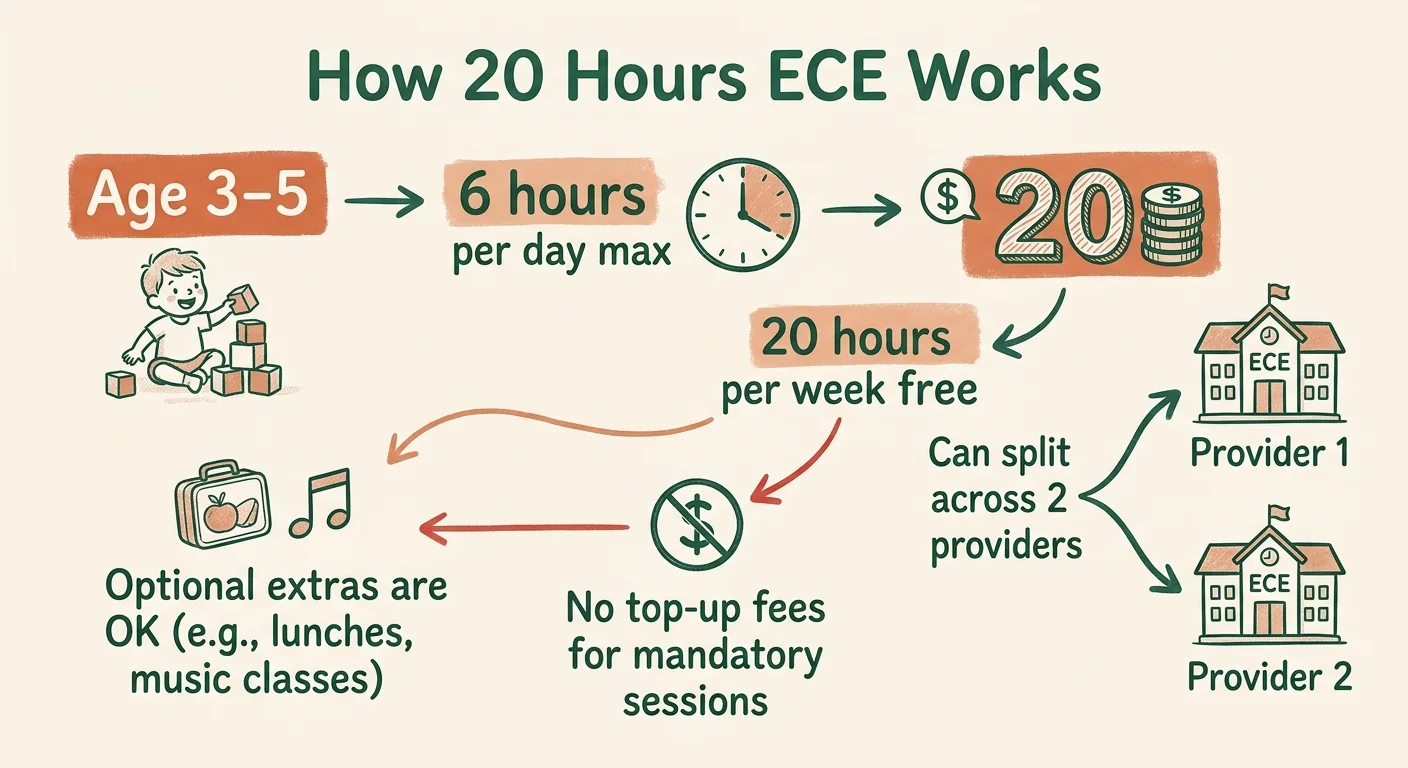
20 Hours ECE is a government-funded programme that pays for up to 6 hours per day and 20 hours per week of early childhood education for every 3, 4, and 5-year-old in New Zealand. There's no income test. The funding goes directly to your child's ECE service, reducing the fees you pay. You'll still pay for any hours beyond 20 per week, plus optional charges like food and resources.
How 20 Hours ECE actually works
The name is a bit misleading. 20 Hours ECE isn't a childcare benefit, a subsidy you apply for, or a voucher you hand over. It's a higher funding rate the Ministry of Education pays directly to ECE providers for each eligible child. The provider then reduces your fees accordingly.
When you enrol your child, you nominate which hours — up to 6 per day, 20 per week — you want covered by the programme. The provider claims those hours from MOE through their regular funding return (called the RS7). Payments arrive three times a year: on the first working day of March, July, and November.
In 2026, the government pays all-day centres with fully qualified teachers around $17.77 per child-hour under 20 Hours ECE. Kindergartens receive up to $18.55, and home-based services get $11.87. These rates are higher than the standard ECE funding subsidy — which is the whole point. The extra money is supposed to cover the full cost of those hours so parents pay nothing.
Funding goes to the service, not to you
Who qualifies
Every child aged 3, 4, or 5 who is a New Zealand citizen or resident qualifies. That's it. No income threshold. No work requirement. No means testing. A family earning $200,000 gets the same 20 Hours ECE as a family earning $40,000.
Your child becomes eligible the day they turn 3 and stays eligible until the day before their sixth birthday, or their last day at an ECE service before starting school — whichever comes first.
There is one requirement beyond age: your child must attend a participating provider. Not every service offers 20 Hours ECE, since participation is voluntary. Most teacher-led centres, kindergartens, Te Kōhanga Reo, and licensed home-based services do participate, but check before you enrol. You can search for 20 Hours ECE providers on The Parent Circle to filter specifically for participating services across 4,394+ licensed providers.
The 6-hour daily limit explained
This trips up a lot of parents. You get 20 funded hours per week, but you can only claim a maximum of 6 in any single day. So you can't do two 10-hour days and call it done.
If your child attends 8 hours a day, 5 days a week (40 hours total), here's what you'd pay for: 20 hours are covered by 20 Hours ECE. The remaining 20 hours are charged at your provider's normal rate. Some providers also receive the standard ECE funding subsidy for hours beyond the 20, which can reduce your cost further — the government subsidises up to 30 hours per week total.
| Weekly schedule | Funded hours | Hours you pay for |
|---|---|---|
| 3 days × 6 hours | 18 hours | 0 hours |
| 4 days × 5 hours | 20 hours | 0 hours |
| 5 days × 6 hours | 20 hours (capped) | 10 hours |
| 5 days × 8 hours | 20 hours (capped) | 20 hours |
| 5 days × 10 hours | 20 hours (capped) | 30 hours |
Strategic scheduling saves money
What you still pay for
20 Hours ECE covers education hours. It doesn't cover everything. Here's what providers can and can't charge you.
Fees for extra hours
Any hours your child attends beyond the 20 funded hours are charged at the provider's standard rate. Some centres set minimum attendance — you might have to enrol for at least 7 hours a day. You'd pay for that seventh hour out of pocket.
Optional charges
Providers can ask you to pay for specific extras — sunscreen, clothing, food, and resources. These must be genuinely optional. According to MOE's funding rules, your provider must tell you that you won't be penalised for declining. But if you don't pay, they can withdraw the specific item or activity the charge covers.
In practice, most parents pay optional charges, particularly for food. A centre that provides morning tea, lunch, and afternoon tea might charge $8 to $15 per day for meals. That adds up to $40 to $75 per week on top of your supposedly free hours.
Donations
Donations are always voluntary. Your provider cannot call them fees or require payment. If you do donate to a charitable ECE service, you may be able to claim a tax credit through Inland Revenue.
Home-based educator top-ups
Home-based care works slightly differently. The funding goes to the licensed service (e.g., PORSE or Barnardos), which passes a portion to the individual educator. Educators can charge a top-up for the gap between what they receive and their actual hourly fee. This only applies to hours outside the 20 Hours ECE allocation.
Splitting hours across providers
Your child can use 20 Hours ECE at more than one service. If they attend a kindergarten three mornings a week and a daycare centre two afternoons, you can split the funded hours between both providers — as long as the total doesn't exceed 6 hours per day and 20 hours per week.
This also works during school holidays. If your regular service closes for the term break, you can use your 20 Hours ECE at another provider for that period. Just make sure you update your enrolment agreement at each service.
What changes when your child turns 3
If your child is already in care as a toddler, their third birthday is a milestone for your wallet. Before they turn 3, you're paying for every hour (minus any WINZ subsidy you might receive). After they turn 3, 20 Hours ECE kicks in and your fees drop — sometimes by $200–$300 per week depending on your hours.
Eligibility starts on your child's actual birthday. If they turn 3 in the middle of a term, the provider can begin claiming 20 Hours ECE from that date. Talk to your centre a month or two before the birthday so they can adjust your enrolment paperwork and update the funding claim.
For a full breakdown of what childcare costs look like at every age, including the under-2 premium and how subsidies stack up, see our complete guide to childcare costs in NZ.
Combining 20 Hours ECE with other subsidies
20 Hours ECE isn't the only financial help available. You can stack it with two other programmes to reduce your out-of-pocket costs further.
WINZ Childcare Subsidy
The Work and Income childcare subsidy helps with fees for hours outside 20 Hours ECE. Unlike 20 Hours ECE, it's income-tested and requires you to be working, studying, or engaged in an approved activity. You can receive both — 20 Hours ECE for your nominated hours and the WINZ subsidy for additional hours — but you can't claim both for the same hours.
FamilyBoost
FamilyBoost is a tax credit from Inland Revenue that reimburses 25% of your out-of-pocket ECE costs, up to $975 per child per year. It applies to whatever you're actually paying after 20 Hours ECE and any WINZ subsidy. You claim it quarterly through myIR. If your child attends full-time and you're paying for 20 hours out of pocket each week, FamilyBoost can save you around $75 per month.
Stack all three for maximum savings
Five myths about 20 Hours ECE
"It's free childcare"
It's funded education for up to 20 hours. If your child attends more than 20 hours (most do), you pay for the extra. Optional charges for food and resources add up. The sector advocacy group Tiny Nation reports that the funding rates don't cover actual delivery costs for many providers, which is why optional charges are common.
"Every centre has to offer it"
Participation is voluntary. Most do — but some don't, particularly newer or smaller private centres. Always check before enrolling.
"You need to apply through the government"
There's no government application form. You nominate your 20 Hours ECE hours on your child's enrolment form at the service. The provider handles the rest.
"It's only for low-income families"
There's no income test. Every 3, 4, and 5-year-old who is a citizen or resident qualifies, regardless of household income.
"I can bank unused hours"
You can't carry hours over. If your child only uses 12 hours this week, you don't get 28 next week. It resets every week: up to 6 per day, 20 per week, non-cumulative.
Frequently asked questions
Can my child use 20 Hours ECE at a home-based service?
Yes. If the educator is part of a licensed home-based early learning service, your child can access 20 Hours ECE. The funding goes to the service, not the individual educator. The educator may charge a top-up for hours outside the funded 20.
What happens if my child is absent during their nominated hours?
The provider can still claim funding for absent hours, up to a limit set by MOE's absence rules. You generally won't be charged extra for sick days during your 20 Hours ECE allocation, but check your provider's absence policy for hours outside the funded 20.
Do I need to re-apply each year?
No. Once you've nominated your 20 Hours ECE on the enrolment form, it continues until your child leaves the service or starts school. You only need to update the form if you change your nominated hours or days.
Can both parents claim 20 Hours ECE for the same child?
There's only one allocation of 20 hours per child per week. It doesn't matter which parent signs the enrolment form — the child gets one set of 20 funded hours, not one per parent.
What if a centre says 20 Hours ECE doesn't cover their costs?
Some providers argue the government funding rate (around $17.77 per hour for all-day centres in 2026) doesn't cover their actual operating costs. They can't charge fees for the 20 funded hours, but they may encourage optional charges or donations. These must be genuinely voluntary — you can't be penalised for declining.
20 Hours ECE is one of the biggest cost reducers available to NZ parents with children aged 3–5. But it works best when you understand the rules — the daily cap, the optional charges, and how it stacks with WINZ subsidies and FamilyBoost. For the full picture of what childcare costs in 2026 and every way to bring those numbers down, start with our complete guide to childcare costs in NZ.
To see how 20 Hours ECE affects your specific situation, try our cost estimator. And if you're still looking for the right provider, search across 4,394+ licensed services on The Parent Circle.
Find 20 Hours ECE providers near you
Search across 4,394+ licensed providers on The Parent Circle. Filter by 20 Hours ECE participation, location, and care type to find the right fit for your whānau.
Search providersVideo
Related guides
Understanding Te Whāriki: How NZ's National Curriculum Shapes Every ECE Centre
A parent's guide to Te Whāriki, New Zealand's early childhood curriculum, and how its principles and strands shape daily learning at ECE.
ECE Philosophies Explained: Montessori, Reggio Emilia, Steiner, and More in NZ
A practical NZ guide to Montessori, Reggio-inspired, Steiner, play-based, nature-based, RIE, and faith-based early learning.
Understanding Learning Stories: A Guide for NZ Parents
Learning stories are how kaiako document your child's learning at their ECE centre. This guide explains what they are, what good ones look like, and how to use them at home.
The Benefits of Play-Based Learning in ECE
Play is not a break from learning in early childhood, it is the learning. Here is what the research says about play-based education in NZ ECE, how Te Whariki supports it, and what to look for at a centre.
Find childcare near you
Search and compare providers by suburb, care type, cost, and availability.