
Resource Hub
Nanny vs Daycare vs Home-Based Care: Cost Comparison NZ (2026)
Published · Last updated · 10 min read

Contents
What's the cheapest childcare option in NZ: nanny, daycare, or home-based care?
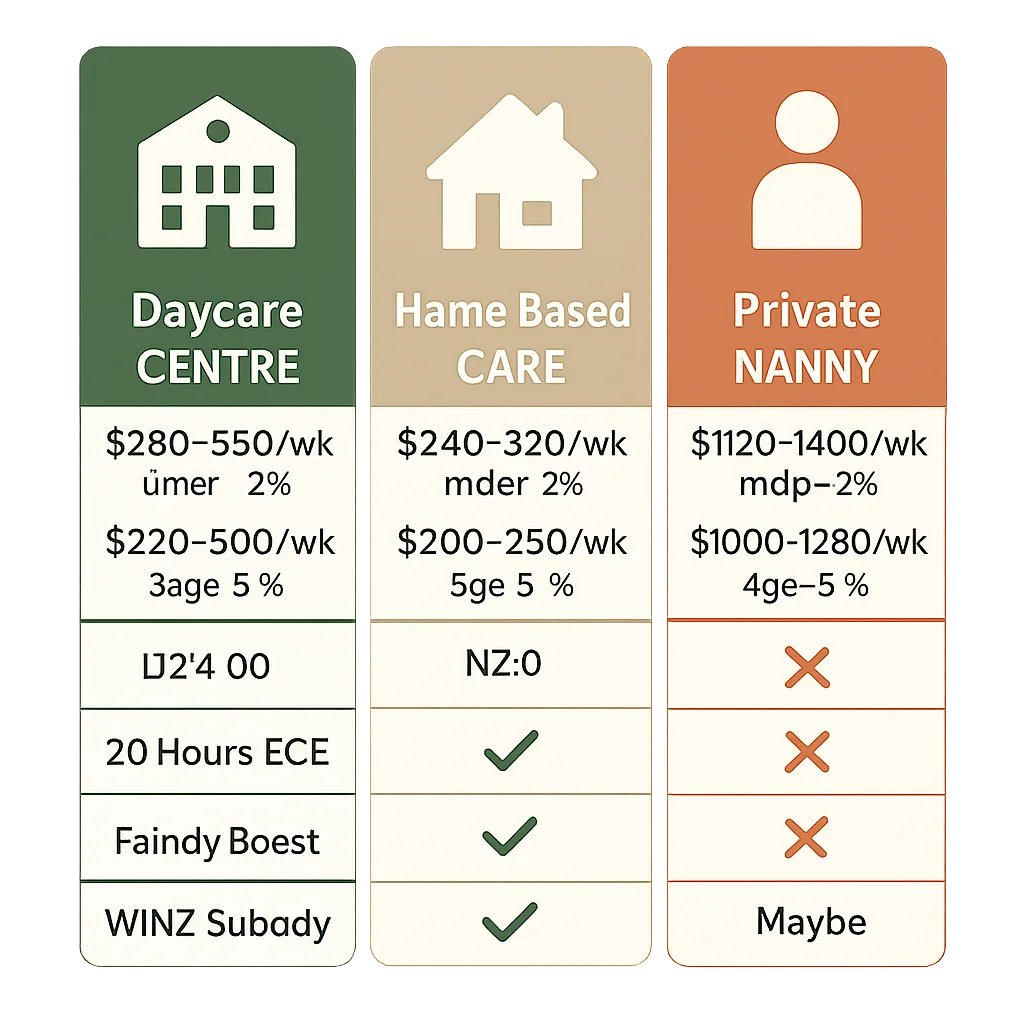
For one child, home-based care is usually the most affordable at $200-$320 per week, followed by daycare centres at $250-$400 per week. Nannies cost $1,000-$1,400 per week for 40 hours. But with two or more children, a nanny's flat rate can beat paying double daycare fees. Subsidies like 20 Hours ECE and FamilyBoost apply to centres and home-based care but generally not to private nannies.
What this comparison covers
Three types of paid childcare dominate in New Zealand: daycare centres, home-based care, and private nannies. Each has a different cost structure, different subsidy eligibility, and different trade-offs around flexibility, socialisation, and convenience. This guide breaks down what you'll actually pay for each option in 2026, after accounting for 20 Hours ECE, FamilyBoost, and WINZ subsidies.
We're using 2025-2026 figures throughout, based on data from across 4,394+ providers on The Parent Circle and current government rates. Your actual costs will depend on your region, your child's age, and how many hours you need.
The raw numbers: what each option costs
Before subsidies or tax rebates, here's what you're looking at for full-time care (40 hours per week) in 2026. These are national averages — Auckland and Queenstown tend to run 5-15% higher, while smaller centres in regions like Southland or Gisborne can be noticeably cheaper.
| Daycare centre | Home-based care | Nanny | |
|---|---|---|---|
| Hourly rate (under 2) | $6-$8 | $6-$8 | $28-$35 |
| Hourly rate (age 3-5) | $5-$7 | $5-$7 | $25-$32 |
| Weekly cost, under 2 (40 hrs) | $280-$350 | $240-$320 | $1,120-$1,400 |
| Weekly cost, age 3-5 (40 hrs) | $220-$300 | $200-$280 | $1,000-$1,280 |
| Weekly cost, 2 children under 2 | $560-$700 | $480-$640 | $1,120-$1,400 |
| Typical inclusions | Meals, nappies (varies) | Meals (varies) | Negotiable |
| Government-funded (licensed) | Yes | Yes | No (usually) |
The sibling tipping point
Daycare centres: the most common choice
About 70% of NZ children in ECE attend a centre-based service. There are roughly 4,800 licensed centres nationwide — everything from large chains like BestStart and Lollipops to small community-run operations. Centres are regulated by the Ministry of Education with strict adult-to-child ratios: 1:3 for under-2s, 1:5 for two-year-olds, and 1:10 for children aged three and over.
Most centres charge between $250 and $400 per week for full-time care. Under-2 fees run 20-30% higher than over-3 fees because of the tighter ratios and the extra staffing that requires. Large chains publish their rates online — BestStart, for example, charges around $350-$400 per week for infants in Auckland, dropping to $280-$320 for three-year-olds.
How subsidies reduce daycare costs
Centres benefit from the full stack of government support. If your child is three or four, 20 Hours ECE covers up to 20 hours per week of teacher-led ECE at no charge (though centres can still charge "optional" fees for food, resources, and extra hours). For the remaining fees, FamilyBoost gives you back 40% up to $120 per week — and if your household income qualifies, WINZ Childcare Subsidy can cover a further portion.
Worked example: 3-year-old in Auckland daycare
When daycare works best
- Structured routines and qualified teachers — centres must employ registered ECE teachers
- Built-in socialisation with other tamariki the same age
- Full subsidy eligibility (20 Hours ECE + FamilyBoost + WINZ)
- ERO reviews and licensing give parents a quality benchmark — check ERO reports for any centre
The downsides: rigid hours (typically 7am-6pm, Monday to Friday), closure during public holidays, and the illness merry-go-round. Young children in group care pick up bugs frequently — expect a rough first winter. Late pickup fees of $1-$2 per minute are standard. And for under-2s, you're paying premium rates without any 20 Hours ECE offset.
Home-based care: the middle ground
Home-based care sits between daycare and a nanny. An educator looks after a small group of children (maximum four, including their own under-6s) in the educator's own home. They work through licensed networks — around 500 across NZ — with a visiting coordinator who checks in regularly, plans curriculum, and ensures the service meets MOE licensing standards.
Fees are typically 10-15% less than centres: $200-$320 per week for full-time care, depending on the child's age and region. The smaller group size means your child gets more individual attention than in a 30-child daycare room, but the educator is still looking after several children, keeping costs per family manageable.
Subsidy eligibility for home-based care
Licensed home-based networks qualify for the same government funding as centres. That means 20 Hours ECE (for three- and four-year-olds), FamilyBoost, and WINZ Childcare Subsidy all apply. Some parents don't realise this — they assume "home-based" means informal and unfunded. It doesn't. If the network is licensed by MOE, you get the same financial support as a centre.
When home-based care works best
- Smaller group size (max 4 children) — great for under-2s who benefit from calm, consistent environments
- Slightly more flexible hours than centres, depending on the educator
- Full subsidy access (20 Hours ECE, FamilyBoost, WINZ)
- Less illness exposure than large group settings
- Often more affordable than centres, especially for infants
The trade-offs: if your educator gets sick, you may have no backup (some networks arrange cover, others don't). There's less structured programming than a centre with dedicated learning spaces. And availability can be patchy — in high-demand areas like central Auckland, finding a home-based spot can be just as hard as getting into a daycare centre.
Nanny care: premium cost, maximum flexibility
A nanny works in your home, on your schedule. That flexibility comes at a price — $25-$35 per hour in 2026, depending on experience, qualifications, and location. For 40 hours a week, that's $1,000-$1,400 before you factor in employer costs.
The true cost of employing a nanny
A nanny is your employee. That means legal obligations beyond their hourly rate. You must deduct and pay PAYE tax, cover ACC levies, provide at least four weeks' annual leave (or 8% loading), 10 days' sick leave after six months, and contribute to KiwiSaver if they're enrolled. The minimum wage is $23.50 per hour as of 2025.
- PAYE: you deduct income tax from their pay and send it to IRD
- ACC: employer levy of roughly 0.7-1.5% of gross pay
- Holiday pay: 8% gross as pay-as-you-go, or 4 weeks' annual leave
- Sick leave: 10 days per year after 6 months' employment
- KiwiSaver: 3% employer contribution if they're enrolled
- Total on-costs: add roughly 15-20% on top of the gross hourly rate
Subsidy eligibility for nanny care
This is where nannies lose out. Private nannies are not licensed ECE providers, so 20 Hours ECE does not apply. FamilyBoost only covers fees paid to licensed ECE services — a private nanny doesn't qualify. WINZ Childcare Subsidy can apply if the nanny is an approved carer, but the process is more complex and rates are lower than for licensed services.
No 20 Hours ECE, no FamilyBoost for private nannies
When a nanny makes financial sense
- Two or more children — the nanny rate stays flat while daycare fees multiply per child
- Non-standard hours — shift workers, freelancers, or anyone who needs care outside 7am-6pm
- Children with additional needs who benefit from one-on-one attention in a familiar setting
- When you factor in commute time, sick-day cover, and school-holiday care, the total cost gap narrows
An au pair is a cheaper alternative at around $220 per week (pocket money), but they're limited to 30 hours per week under Working Holiday visa rules, and they're not subject to minimum wage because it's classified as a cultural exchange. Au pairs work best as supplementary care, not a full-time replacement for daycare or a nanny.
Subsidy eligibility at a glance
| Subsidy | Daycare centre | Home-based care | Private nanny |
|---|---|---|---|
| 20 Hours ECE (age 3-4) | Yes | Yes (licensed networks) | No |
| FamilyBoost (40% rebate) | Yes | Yes | No |
| WINZ Childcare Subsidy | Yes | Yes | Possible (approved carer) |
| Employer subsidy/salary sacrifice | Possible | Possible | Possible |
The subsidy gap is dramatic. A family with a three-year-old in a $300/week centre could pay as little as $50-$80 after stacking 20 Hours ECE, FamilyBoost, and WINZ. The same family with a nanny at $1,200/week might get a small WINZ offset but is still paying over $1,000 out of pocket. For under-2s, the gap is smaller because 20 Hours ECE doesn't apply to anyone — but FamilyBoost still favours licensed services.
Real-world cost scenarios
Numbers only make sense in context. Here are three common family situations and how the costs compare.
Scenario 1: One child under 2, full-time working parents
No 20 Hours ECE at this age. The choice comes down to daycare ($280-$350/week), home-based ($240-$320/week), or nanny ($1,120-$1,400/week). After FamilyBoost (40% of fees at a licensed service, up to $120/week) and any WINZ subsidy, daycare and home-based costs can drop to $150-$250 per week. A nanny stays north of $1,000. For one child, centre or home-based care wins on cost alone.
Scenario 2: 3-year-old using 20 Hours ECE
20 Hours ECE wipes out a large chunk of centre or home-based fees. A $300/week daycare bill drops to roughly $120 after the 20-hour funding. FamilyBoost takes another $48 off. WINZ could reduce it further. You might pay $50-$80 per week. A nanny at $1,000-$1,280 per week gets none of that funding. The cost difference is roughly 15:1.
Scenario 3: Two children (one under 2, one aged 3), full-time
This is where it gets interesting. Two daycare spots: ~$330/week (infant) + ~$120/week after 20 Hours ECE (3-year-old) = ~$450/week before FamilyBoost. After subsidies, maybe $250-$350 per week total. A nanny at $30/hour for 40 hours = $1,200/week, no subsidies, plus employer costs. Daycare still wins on raw numbers, but the nanny covers holidays, sick days, and mornings before 7am. Some families split the difference: daycare for the 3-year-old (to get 20 Hours ECE) and a nanny for the infant.
Beyond the dollar signs: what else matters
Cost is the loudest factor in this decision, but it's not the only one. Here's what parents consistently flag when comparing these options.
- Socialisation: Centres offer daily interaction with 15-30 children. Home-based care has 2-4 tamariki. Nanny care is mostly one-on-one. For children aged 3+, group settings help build school-readiness skills.
- Consistency: A nanny means one caregiver your child bonds with deeply. Centres have staff turnover. Home-based educators can be very stable, but if they leave the network, you start over.
- Illness: Children in large group settings get sick more often, especially in the first year. Home-based care exposes them to fewer germs. Nanny care at home means almost no cross-infection.
- Flexibility: Only nannies can realistically cover shift work, early starts, or late finishes. Some home-based educators offer slightly extended hours. Centres are locked to their opening times.
- Quality assurance: Centres and licensed home-based services are reviewed by ERO and regulated by MOE. Private nannies have no external oversight — you're relying on your own vetting.
- Te Whāriki curriculum: Licensed centres and home-based networks deliver programmes based on Te Whāriki, NZ's early childhood curriculum. Private nannies might follow it informally, but there's no requirement.
Which option suits your family?
There's no universally right answer. But some patterns hold.
| Your situation | Best fit | Why |
|---|---|---|
| One child, age 3-5, standard hours | Daycare centre | Maximum subsidy benefit, structured learning, socialisation |
| One child under 2, budget-conscious | Home-based care | Lower fees than centres, small group, full subsidy access |
| Two+ children, mixed ages | Consider a nanny (or hybrid) | Flat rate beats double fees; mix with daycare for 20 Hours ECE |
| Shift worker or irregular hours | Nanny | Only option that covers non-standard schedules |
| Want small group + licensed curriculum | Home-based care | Max 4 children, Te Whāriki delivered, ERO reviewed |
How to run the numbers for your family
- Work out how many hours of care you need per week (including buffer for commute and unexpected overtime)
- Get quotes from 2-3 providers of each type in your area — use The Parent Circle's search tool to find and compare centres near you
- Check your 20 Hours ECE eligibility (only applies to 3-4 year olds at participating providers)
- Calculate your FamilyBoost entitlement — 40% of remaining fees up to $120/week
- Check WINZ Childcare Subsidy eligibility based on your income and hours
- For nannies, add 15-20% on top of the hourly rate for employer costs (PAYE administration, ACC, leave entitlements)
- Use our cost estimator to model different scenarios side by side
Frequently asked questions
Is a nanny ever cheaper than daycare in NZ?
Yes, when you have two or more children. A nanny's hourly rate stays the same regardless of how many children they watch, while daycare charges per child. With two children in full-time centre care at $300/week each ($600 total), a nanny at $28/hour ($1,120/week) is still more expensive — but once you add employer costs to daycare (late fees, sick-day backup, holiday programmes) and remove subsidy eligibility differences, the gap can narrow to a few hundred dollars.
Can I get 20 Hours ECE with home-based care?
Yes, as long as the home-based service is licensed by the Ministry of Education and operates through an approved network. Most licensed home-based networks in NZ participate in 20 Hours ECE for children aged 3 and 4.
Do I have to pay tax for a nanny?
Yes. A nanny working in your home is your employee under NZ law. You must deduct PAYE income tax, pay ACC levies, provide minimum holiday and sick leave entitlements, pay at least the minimum wage ($23.50/hour in 2025), and contribute to KiwiSaver if they're enrolled. IRD has a household employer guide that walks you through the process.
Does FamilyBoost apply to nanny care?
No. FamilyBoost only covers fees paid to licensed early childhood education services. Private nannies are not licensed ECE providers, so their fees are not eligible. If your nanny works through a licensed home-based network (rare but possible), then FamilyBoost would apply to the network's fees.
What's the maximum number of children in home-based care?
A home-based educator can care for a maximum of four children under the age of six at any time, including their own children. This limit is set by MOE licensing regulations and is one reason home-based care fees are slightly lower — the small group size keeps overheads manageable while still generating enough income for the educator.
Can I combine care types to save money?
Absolutely, and many families do. A common setup is daycare or kindergarten for the 3-year-old (to access 20 Hours ECE) plus home-based care or a part-time nanny for a younger sibling. You can also use a nanny for before/after-hours care around a daycare placement. Each arrangement qualifies for subsidies independently where eligible.
The right childcare type depends on your family's mix of budget, schedule, and priorities. Start by comparing providers in your area using The Parent Circle, then run the numbers with our cost estimator to see what each option looks like after subsidies. For a broader view of what childcare costs across NZ, check our complete 2026 cost guide.
Compare childcare costs for your family
Use our cost estimator to see what you'll actually pay for daycare, home-based care, or a nanny — after all subsidies are applied.
Try the cost estimatorRelated guides
Montessori vs Play-Based vs Reggio: Which Philosophy Is Right for Your Child?
A practical NZ parent's guide to Montessori, play-based and Reggio-inspired ECE, with temperament fit, centre questions and a plain-English comparison table.
Childcare in Waikato: Hamilton and the Greater Waikato Region (2026)
Looking for childcare in Waikato? This practical 2026 guide breaks down Hamilton, Cambridge, Te Awamutu, northern Waikato, Taupo, and smaller regional markets so you can build a shortlist that actually fits your week.
Childcare in Wellington: A Practical Guide for Wellington Families (2026)
Looking for childcare in Wellington? This practical 2026 guide breaks down Wellington City, the Hutt Valley, Porirua, Kapiti Coast, and Wairarapa so you can build a shortlist that actually fits your week.
Childcare in Auckland: The Complete Guide for Auckland Parents (2026)
Looking for childcare in Auckland? This practical 2026 guide breaks down costs, suburbs, commute logic, waitlists, and how to search Auckland without wasting weeks on the wrong shortlist.
Find childcare near you
Search and compare providers by suburb, care type, cost, and availability.