
Resource Hub
Starting Childcare in NZ: A Complete Guide to Preparing Your Family
Published · Last updated · 15 min read

Contents
How do you prepare for starting childcare in NZ?
Start four weeks out: confirm enrolment details, plan settling visits, practise the daily routine, label clothing, and build a short goodbye ritual. Most tamariki need a few weeks to feel secure, so treat the first month as a transition for the whole whānau, not a one-day test.

Starting childcare is a family transition
Starting childcare is rarely just a logistics change. It is a change in attachment, routine, sleep, meals, work, money, and trust. Your child is learning that another safe adult can care for them. You are learning to hand over part of the day without hovering at the window or refreshing the centre app every six minutes.
In New Zealand, licensed early learning services care for children from birth until they start school. Services must work within the Education (Early Childhood Services) Regulations 2008, follow Te Whāriki, and meet licensing criteria for health, safety, curriculum, premises, governance, and staffing. That does not make every centre identical. The feel of a room, the steadiness of the kaiako, the way they handle tears, and the match with your whānau matter a lot.
This guide is for the nervous bit between choosing a provider and getting through the first month. If you are still deciding where to enrol, start with our types of childcare guide and use The Parent Circle to search 4,394+ licensed ECE providers across 1,026 NZ suburbs. If the place is chosen and the start date is real, this is the plan.
The short version
The four-week preparation timeline
A smoother start usually begins before the first booked day. You do not need a military schedule, but you do need fewer surprises. Young children cope better when the new routine is introduced in small, predictable pieces.
| When | What to do | Why it helps |
|---|---|---|
| 4 weeks before | Confirm enrolment, fees, hours, start date, settling visits, emergency contacts, and immunisation details. Start talking about childcare in ordinary language. | You clear the admin early and make childcare feel like part of normal family life. |
| 2 weeks before | Visit the centre, meet kaiako, practise the morning drive or walk, adjust nap times if needed, and choose a comfort item if the centre allows one. | Your child starts recognising the place, the people, and the rhythm. |
| 1 week before | Label clothing, pack a test daycare bag, practise lunchboxes or bottles, write down care notes, and agree on a goodbye routine. | The daily handover becomes practical rather than frantic. |
| First day | Keep the goodbye short, warm, and honest. Leave when you say you will. Ask the centre when and how they will update you. | Predictable goodbyes build trust faster than long, uncertain exits. |
| First month | Review sleep, eating, illness, mood, and teacher relationships weekly. Make small adjustments with kaiako. | Settling is a process. The first month gives you better evidence than the first day. |
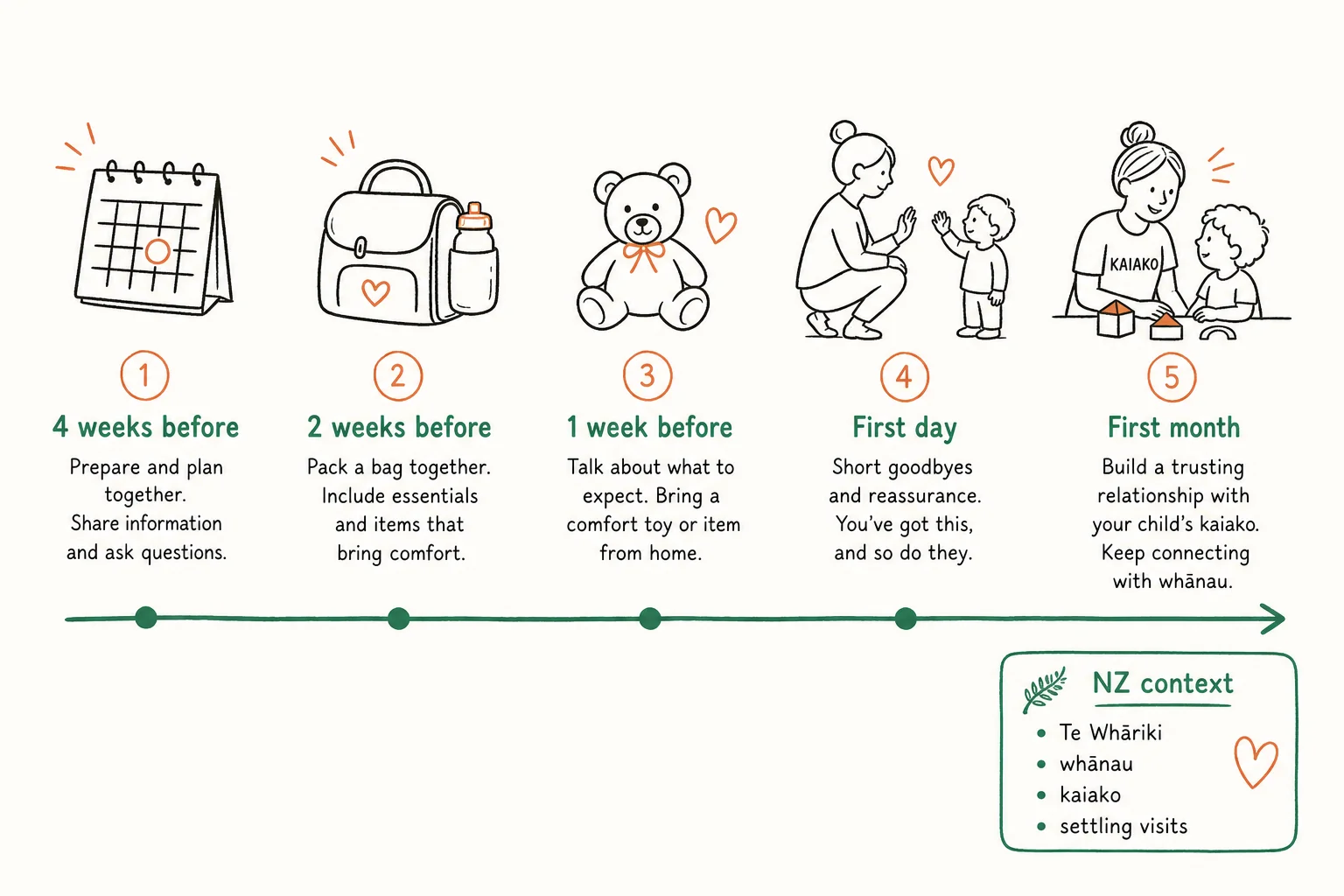
Four weeks before: get the basics locked in
Four weeks out is when you want to remove friction. Check the exact enrolled days, arrival and pick-up windows, public holiday rules, absence charges, notice period, meals, nappies, sunscreen, sleep arrangements, bottle storage, and whether fees are weekly, fortnightly, or monthly. If you are comparing costs, our childcare cost guide explains how fees, 20 Hours ECE, WINZ Childcare Subsidy, and FamilyBoost can sit together.
Ask the centre for its settling policy in writing. Some centres offer several short visits with you present. Others prefer one or two orientation sessions and a gradual increase in hours. There is no single national settling template, but licensed services should be able to explain how they support attachment, communication, routines, sleep, kai, and whānau involvement.
- Who will be my child's main kaiako or primary contact during settling?
- How do you comfort a child who is upset after drop-off?
- How soon do you message parents if a child is distressed?
- Can we do short visits before the official start date?
- What should we bring on day one, and what stays at the centre?
- What are your illness exclusion rules for fever, vomiting, diarrhoea, conjunctivitis, hand foot and mouth, and COVID-like symptoms?
- How do you handle naps for babies and toddlers who are used to home routines?
- What happens if my child refuses food or milk in the first week?
Ask boring questions now
Two weeks before: make the centre familiar
Two weeks before starting, shift from admin to familiarity. Drive past the centre. Point out the gate. Say the kaiako names if you know them. If the centre allows settling visits, use them. The aim is not to make your child perform happiness on command. The aim is recognition: I have been here, I know this room, Mum or Dad came back last time.
For babies, familiarity may mean the smell of a sleep sack, the sound of a familiar lullaby, and kaiako knowing the tired signs before a full meltdown. For toddlers, it may mean finding the trucks, water trough, dolls, or climbing frame. For preschoolers, it may mean knowing where the toilets are, where bags go, and who to ask for help.
Prepare by age, not by fantasy child
| Age | What they may need | What parents can do |
|---|---|---|
| Under 12 months | Consistent feeding and sleep information, a gentle handover, familiar bedding if allowed, and patient kaiako. | Write down bottle amounts, settling cues, sleep words, comfort positions, allergies, and what usually works when they are overtired. |
| 12 to 24 months | A predictable goodbye, a safe attachment figure at the centre, and help naming feelings. | Use the same short phrase each morning: "I love you. Kaiako Ana will look after you. I will come back after afternoon tea." |
| 2 to 3 years | Simple choices, movement, toilet support, and reassurance that you return. | Practise shoes, bag, lunchbox, and a goodbye wave. Keep choices small: red jumper or green jumper, not the whole wardrobe. |
| 3 to 5 years | Information, agency, and social confidence. | Talk through the day, visit the room, practise asking for help, and let them help pack. |
Do not oversell childcare as a magical place where every second will be fun. Children notice when the promise does not match the room. Better wording is calm and true: "You might feel shy at first. The teachers will help you. I will come back after your sleep." Truth builds trust.
One week before: pack, label, and practise the routine
The week before starting is when the daycare bag becomes real. Every centre has its own list, so use theirs first. Then add the practical NZ layer: spare clothes for muddy play, a named sun hat, warm layers in winter, wet bag, bottles or lunch items if needed, nappies and wipes if not supplied, and any medication forms required by the service.
- Named bag that your child can recognise
- Two or three full changes of clothes, more for toilet learning
- Named sun hat for terms with UV risk, plus winter hat or raincoat when needed
- Nappies, wipes, cream, and sleep sack if the centre asks for them
- Bottles, formula, expressed milk, or labelled food if meals are not supplied
- Comfort item, only if the centre allows it and you can tolerate it getting lost for an afternoon
- Medication, action plans, and signed forms for asthma, allergies, eczema, or other health needs
- Wet bag or plastic bag for damp clothes
- Family photo if the centre uses whānau books or photo walls
Label everything. Not just the jumper. Label socks, gumboots, hats, drink bottles, lunch containers, dummy caps, sleep sacks, and the spare clothes you forgot were in the bottom pocket. Childcare lost property has its own ecosystem.
How settling-in usually works in NZ centres
Settling-in is the bridge between home and care. In many NZ centres, it starts with short visits where you stay with your child, then short separations, then longer sessions. The pace depends on your child, your work timeline, the centre policy, and how much time you have before the official start.
Good settling is not about preventing every tear. It is about helping your child form a reliable relationship with kaiako. Te Whāriki talks about children growing as competent and confident learners, secure in their sense of belonging. For a child starting childcare, belonging begins in tiny moments: someone remembers their name, notices their tired face, saves their painting, or knows they like to hold a spoon in each hand.
- The centre asks about your child as a real person, not just an enrolment form.
- A kaiako takes responsibility for helping your child connect in the first weeks.
- You receive honest updates, including hard moments and good recovery moments.
- Your child is given time to observe before being pushed into group play.
- Sleep, food, toileting, and comfort are discussed without judgement.
- The centre welcomes whānau knowledge, culture, language, and routines.
Primary caregiver does not mean only one adult
The first day: keep the goodbye kind and short
The first day can feel brutal, especially if your child cries and another parent seems to glide out with a cheerful wave. Do not use another child as the benchmark. Some children cry loudly and settle quickly. Some walk in happily and wobble at nap time. Some seem fine for three days, then realise this is the new pattern and protest in week two.
The best goodbye is warm, clear, and brief. Tell your child what is happening, who will care for them, and when you will return in terms they understand. "I am going to work now. Mere will help you. I will come back after afternoon tea." Then leave. Lingering usually feeds uncertainty. Sneaking away can break trust because your child learns you might disappear without warning.
- Arrive with enough time to avoid rushing, but not so much time that the goodbye stretches forever.
- Help your child put their bag away and connect with a kaiako or activity.
- Use the same short phrase every day.
- Offer one hug, one kiss, or one wave routine.
- Leave when you say you will leave.
- Ask the centre to message once your child has settled, especially in the first few days.
Do not sneak out
The first week: expect wobbles
The first week is not a clean data set. Sleep can go sideways. Appetite may dip. Your child may be clingier at home, more tired by dinner, or suddenly furious about shoes. That does not automatically mean childcare is wrong. It means their brain is doing a lot of work.
Ask for specific updates, not vague reassurance. "He was fine" is less useful than "He cried for eight minutes after you left, then sat with Ana, ate half his morning tea, slept for 50 minutes, and played outside with the water tray." Specifics help you see whether distress is easing and whether the centre is noticing your child properly.
| What you might see | Usually normal when | Worth discussing when |
|---|---|---|
| Crying at drop-off | It reduces after the handover and your child engages during the day. | Your child stays distressed for long periods most days with little improvement. |
| Sleep changes | Naps are shorter while the environment is new. | Your child is exhausted for weeks and the centre has no adjustment plan. |
| Eating less | They pick at food for a few days but drink and have some kai. | They regularly refuse most food or milk and no one can explain the pattern. |
| Clinginess at home | They reconnect intensely after separation. | They seem withdrawn, fearful, or unlike themselves across settings. |
| More illness | They catch common bugs after joining group care. | Illness policies are unclear or hygiene practices look poor. |
Illness is part of the first year in group care for many families. Close contact, shared toys, and developing immune systems mean colds, coughs, gastro bugs, and hand foot and mouth can circulate. Ask the centre for its illness policy before you need it. Public health advice usually requires children to stay home with fever, vomiting, diarrhoea, or infectious symptoms until the exclusion period has passed.
The first month: build the parent-teacher relationship
By the first month, the question changes from "Did we survive drop-off?" to "Is my child building a life here?" Look for small signs of belonging: they know where things are, a kaiako understands their cues, they mention another child, they bring home messy clothes from actual play, or they show you something at pick-up.
This is also when you should adjust routines with the centre. If your child crashes at 5pm, ask about nap timing. If they are starving at pick-up, ask how much lunch they eat. If drop-off is still rough, ask which kaiako is best placed to receive them and whether a different arrival time would avoid a noisy transition.
If a place no longer fits your family, our guide to changing childcare providers in NZ walks through notice, records and settling at a new centre.
- Who does my child go to when they need comfort?
- What part of the day seems easiest for them?
- What part of the day is still hard?
- Are they eating, sleeping, toileting, and joining play in ways that seem healthy for their age?
- What have you noticed about their interests?
- Is there anything we can do at home to make the routine easier?
If you are back at work, the first month is your transition too. Many parents underestimate the mental load: packing, commuting, guilt, invoices, sick days, app notifications, and the strange quiet after drop-off. If possible, avoid making your first workday the same day as your child's first long childcare day. A buffer week is boring advice. It is also excellent advice.
If work location is part of the decision, our guide to childcare near work versus near home walks through the trade-offs. Near work can help with breastfeeding, emergencies, and shorter separation windows. Near home can help with commute resilience, local friendships, and easier pick-ups by another whānau member.
When settling takes longer than expected
Some children take longer. Temperament, age, previous care experiences, sleep, language, neurodiversity, health needs, family stress, and the centre environment all affect settling. A longer transition is not a failure. But it does need a plan, not vague waiting.
- Ask the centre for a written pattern from the last two weeks: crying duration, eating, sleep, play, comfort, and triggers.
- Choose one consistent drop-off kaiako where staffing allows.
- Simplify the goodbye routine and use the same words every day.
- Shorten days temporarily if your work situation allows it, then increase again.
- Send a family photo or comfort item if the centre permits it.
- Book a meeting if distress is not improving after three to four weeks.
Trust your pattern recognition
Fees, subsidies, and the money conversation
Money stress can make the childcare transition feel heavier than it already is. Before the first invoice arrives, ask the service to show the full fee pattern in writing: enrolled hours, minimum sessions, optional charges, food charges, late pick-up fees, absence charges, holiday rules, and how much notice you must give to change days. A parent who understands the invoice is less likely to panic when the first month looks uneven.
For children aged three to five, 20 Hours ECE may reduce the cost of up to 20 hours a week at participating services. It does not always mean free childcare, because some centres charge optional fees or have conditions around session length. Families may also be able to use WINZ Childcare Subsidy, FamilyBoost, or both depending on income, hours, and eligibility. Ask the centre what they can help with, but check the official agency rules yourself.
If your child is under three, the cost shock can be sharper because 20 Hours ECE does not apply yet. Under-two care often costs more because ratios and staffing needs are higher. If you are returning to work, look at the weekly net picture, not just the centre fee: income after tax, childcare, fuel or public transport, parking, lunches, sick leave pressure, and whether a shorter work week for the first month would actually protect the whole system.
Do the first-month budget before day one
Returning to work while your child starts childcare
Returning to work at the same time your child starts care can feel like two separate lives crashing into each other. One part of you is trying to be professional, answer email, and remember passwords. Another part is wondering whether your child slept, ate, cried, or noticed you were gone. That split attention is normal. It does not mean you are doing work badly or parenting badly.
If you can, start childcare before your first full workday back. Even two or three shorter sessions can help you learn the drop-off rhythm, test the commute, and deal with the emotional punch without walking straight into a meeting. If that is not possible, lower the ambition for week one. This is not the week to volunteer for extra work, book late meetings, or pretend you will be at full capacity by Tuesday.
- Confirm who does drop-off and who does pick-up for each day of the first fortnight.
- Share the centre phone number and app login with the right adults at home.
- Keep one spare set of work clothes or child clothes in the car if your commute allows it.
- Block your calendar around pick-up until the routine is stable.
- Agree in advance who leaves work if the centre calls about sickness.
- If breastfeeding or expressing, discuss storage, bottle timing, and your workplace needs before the first day back.
- Tell one trusted person at work that you are in a transition week, without overexplaining.
New Zealand employees can request flexible working arrangements, although the practical outcome depends on the role and employer. If you need a temporary change, be specific. "For the first four weeks I would like to start at 9:30 on childcare days and make up the time later" is easier to consider than a vague statement that mornings might be hard. Specific asks are kinder to everyone.
Involve your whānau without creating confusion
Grandparents, aunties, uncles, older siblings, and close friends can make starting childcare easier, but only if the adults are aligned. Children do not need five different goodbye scripts or one adult saying "poor baby, you have to go to daycare" while another is trying to build confidence. Before the first day, agree on the story: childcare is safe, kaiako will care for you, and your grown-ups come back.
If more than one adult may pick up your child, make sure the centre has their legal name, phone number, relationship, and any ID requirements. Do not assume a grandparent can collect because the kaiako has met them once. Licensed services are rightly strict about authorised pick-ups. It can feel annoying until you remember the rule exists to protect children.
Culture matters here too. If your child uses te reo Māori, Nepali, Hindi, Samoan, Mandarin, or another home language for comfort, tell the centre the exact words. A kaiako who can say "paani", "aama is coming back", "moe", or a familiar family phrase may settle a child faster than a perfect policy document. Whānau knowledge is not a bonus. It is part of the care plan.
What to watch during the first visits
Settling visits help your child, and they also give you a chance to watch the adults. Notice whether kaiako greet children by name, whether crying children are responded to quickly, whether babies are held with patience, whether toddlers have room to move, and whether preschoolers can choose meaningful play rather than being herded from one adult-led activity to another.
| Watch for | Good sign | Question to ask if unsure |
|---|---|---|
| Handover | Kaiako come close, use your child's name, and listen to your notes. | Who will usually receive my child in the morning? |
| Distress | Upset children are comforted without being shamed or ignored. | What is your usual plan when a child cries after drop-off? |
| Belonging | Children know routines and adults speak about them warmly and specifically. | How will you help my child build a connection in the first month? |
| Communication | Updates are honest and specific, not just a photo with a generic caption. | What will you tell me at pick-up during settling? |
| Environment | The room feels calm enough for children to focus, with real play options. | How do you balance group routines with individual needs? |
If you are still unsure after the visits, compare the centre with other options before you are under pressure. The Parent Circle lets you compare centres side by side and shortlist providers near home, work, or whānau support. Sometimes the best decision is the centre you already chose. Sometimes a comparison gives you permission to keep looking.
NZ rules and official checks parents should know
Licensed ECE services in NZ must meet national rules, but parents still need to check the details. The Ministry of Education has information for parents on enrolling and starting early learning. ERO publishes review reports that can help you understand how a service is performing. Te Whāriki explains the curriculum principles behind early learning: empowerment, holistic development, family and community, and relationships.
For practical parent checks, look at the centre licence, latest ERO report, adult-child ratios, teacher stability, health policies, sleep monitoring, emergency procedures, sun safety, medication forms, food allergy rules, and how complaints are handled. None of this replaces the feeling you get in the room, but it gives that feeling a backbone.
- Ministry of Education: starting early learning
- Ministry of Education: types of early learning services
- Education Review Office reports
- Te Whāriki early childhood curriculum
- 20 Hours ECE information
- FamilyBoost childcare payment
FAQ: starting childcare in NZ
How long does it take a child to settle into childcare?
Many children settle within two to four weeks, but some need longer. Look for the direction of travel: shorter crying, better eating, improved sleep, and a growing relationship with kaiako. If there is no improvement after three to four weeks, ask for a meeting and a clear settling plan.
Is it better to start with short days or full days?
Shorter days can help if your work schedule allows it, especially for babies and toddlers. A common pattern is a few short visits, then half days, then full sessions. If you must start full days quickly, ask the centre for extra communication and a consistent kaiako during the first fortnight.
Should I stay if my child cries at drop-off?
Stay long enough to connect them with a kaiako, then use a warm, clear goodbye and leave. Returning repeatedly or hovering can make the separation harder. Ask the centre to update you once your child has settled so you are not left imagining the worst.
What should I pack for the first day of daycare?
Follow your centre's list first. Most children need labelled spare clothes, hat, nappies or toilet-learning supplies, bottles or lunch if required, wet bag, comfort item if allowed, and any medication or health forms. Label more than you think you need to.
Will my child get sick more often after starting childcare?
Often, yes. Group care increases exposure to common childhood infections, especially in the first year. Ask for the centre's illness exclusion policy and plan sick-day cover before you return to work. Keep children home with fever, vomiting, diarrhoea, or infectious symptoms according to public health and centre guidance.
How do I know if the centre is not the right fit?
Watch the pattern over time. Concerns include distress that does not ease, poor communication, high staff turnover, unclear safety or illness policies, lack of warmth, or kaiako who cannot describe your child's needs and interests. If direct conversations do not improve things, it may be time to compare other centres.
Starting childcare asks a lot from everyone. Your child has to trust new adults. You have to trust a system you cannot fully see during the day. The centre has to earn that trust through steady care, specific communication, and a room where tamariki are known properly.
Prepare what you can, then give the transition time. A shaky goodbye does not cancel a good day. A hard first week does not predict the year. Stay observant, ask direct questions, and keep the adults working together around the child.
If you are still deciding when to begin, our age-by-age guide to starting childcare can help you weigh your child's temperament, care quality and family timing.
Find the right centre for your child
Search licensed NZ childcare providers, compare options, and build a shortlist that fits your whānau, work, and commute.
Search childcare near youRelated guides
Childcare During Family Transitions: A NZ Parent's Guide
A practical NZ guide to supporting your child through separation, moving, grief and other family changes at childcare.
Childcare for Every Family: Special Circumstances
A practical NZ guide to finding childcare around additional needs, shift work, single parenting, siblings and family change.
Age-by-Age Guide: When Is the Best Time to Start Childcare?
There is no universal best age to start childcare. This NZ guide helps you weigh your child, care quality and family timing at every stage.
Your Child's First Illness from Daycare: What NZ Parents Need to Know
A calm NZ guide to the first daycare illness season: what is normal, when children need to stay home, when to call Healthline, and how working parents can plan for sick days.
Find childcare near you
Search and compare providers by suburb, care type, cost, and availability.