
Resource Hub
Childcare for Shift Workers in NZ: Finding Care Outside 9-to-5 Hours
Published · Last updated · 7 min read

How can shift workers find childcare in NZ?
Start by mapping the hours you actually need covered, including travel, handover and sleep after a night shift. Most centre-based early learning follows daytime hours, so many shift-working whānau combine a regular licensed service with home-based care, a nanny, family support or an approved OSCAR programme for school-aged children. The safest arrangement is one each adult can follow when the roster changes.
Shift work turns childcare into a logistics problem
A 7 am start can mean leaving home before a centre opens. A late hospitality finish can land after the usual pickup window. Nurses, emergency-service staff, cleaners, drivers, retail workers and parents on rotating rosters are often trying to fit care around hours designed for a different kind of job. The hard part is rarely finding a single perfect service. It is building a routine that still works when a shift changes, a child is sick, or the person who normally collects them is delayed.
Begin with the week you really work, not the version you wish you worked. Put every shift, commute, handover and sleep recovery block on one page. Then mark the moments where an adult must be awake, available and responsible for your child. This makes the gap visible. It also stops you paying for care that looks flexible in theory but leaves a 45-minute hole at 5.30 am.
If you share care with another parent or trusted adult, make the plan explicit. Who takes a child to care after a night shift? Who is the backup if a rostered person is called in? Which adult gets the first call when a child is unwell? A shared calendar is less romantic than "we will figure it out", but it is much kinder to everyone at 3 am.

Video
Start with the care options that match the hours
A daytime centre can still be the anchor of the week, even if it cannot cover every shift. It may suit your child's regular days while another arrangement covers the edges. Ask each provider for its exact opening, closing and late-pickup policy, then test it against your door-to-door travel time. Do not assume an advertised opening hour includes a relaxed handover or that a late pickup can be treated as a standing arrangement.
Licensed home-based ECE is worth asking about when a smaller setting or different handover location would make the week easier. Under the Ministry of Education framework, this care can happen in an educator's home, your child's home, or another parent-nominated home. The licensed provider remains responsible for standards. That matters because the service has oversight responsibilities, educators need first-aid qualifications, and safety checking is part of the model. It is not the same thing as simply finding an individual babysitter through a noticeboard.
A nanny may be more practical for a narrow early-morning, evening or overnight gap, especially if siblings need care at the same time. It can also be the most expensive option because you are buying dedicated time. If the relationship is one of employment, treat it as employment: agree the hours, pay, duties, notice arrangements and what happens when your child is sick. Employment New Zealand says every employee needs a written employment agreement, and the adult minimum wage is $23.95 an hour from 1 April 2026.
Family or trusted friends can be a valuable part of a plan, but make the arrangement fair and specific. Agree pickup authority, car-seat rules, food, medication, screen use, sleep routines and what happens if they cannot help. A favour that depends on a grandparent routinely waking at 4.30 am may not stay a favour for long.
- A regular centre or home-based service for predictable daytime blocks
- A nanny or trusted adult for the early, late or overnight edge of a shift
- An approved before- or after-school programme for school-aged children
- A written backup plan for call-ins, overtime and a child who cannot attend their usual care
Do not build the plan around promised extended hours
Extended-hour, weekend and overnight early learning options exist in some places, but availability is local and can change. Treat any claim of "24-hour childcare" as something to verify directly with the service. Ask which rooms are open, whether the hours apply to your child's age group, how sleep is handled, whether the provider has a waitlist, and what happens on public holidays or when staffing changes.
For school-aged children, check approved before-school, after-school and holiday programmes rather than assuming a regular ECE centre can bridge the school day. Work and Income's OSCAR Subsidy may help eligible low- and middle-income families with approved programmes. It specifically includes night shift workers among the situations that may qualify, subject to its full eligibility rules. The subsidy can cover before- and after-school care up to 20 hours a week and holiday programmes up to 50 hours a week.
The provider must be approved for OSCAR, and the subsidy is paid to that provider. If your hours vary because you are casual or on call, tell Work and Income rather than guessing an average. Its current guidance says it will discuss options with people who do not know their weekly care hours. Apply before the child's first day where possible, especially for school holidays.
Use support without assuming it covers every hour
For children aged three and over, 20 Hours ECE can reduce fees at participating services. It is not a promise that every care hour will be free. The Ministry says the hours available depend on the service's operating hours, places and your child's enrolled hours. A licensed home-based educator can be part of a service offering the funding, so ask the provider how it applies to your actual timetable and which hours must be recorded on the enrolment agreement.
Childcare assistance and OSCAR support are also shaped by your income, family circumstances and the care you use. Do not make a roster decision based on an old payment amount. Work and Income requires people receiving childcare assistance to report changes such as casual, part-time or full-time work, income, provider and attendance changes. That is especially relevant when a rotating roster changes the number of care hours from one fortnight to the next.
If you are negotiating at work, flexible arrangements can be part of the solution. Employment New Zealand says employees can request a change to work arrangements from their first day, for a set period or permanently. An employer must consider the request, although it can decline for a valid business reason. Be concrete: ask whether you can swap a start time, compress hours, give more notice of rosters, job share, or avoid a particular shift on the days your usual care is unavailable.
Make a patchwork arrangement feel predictable to your child
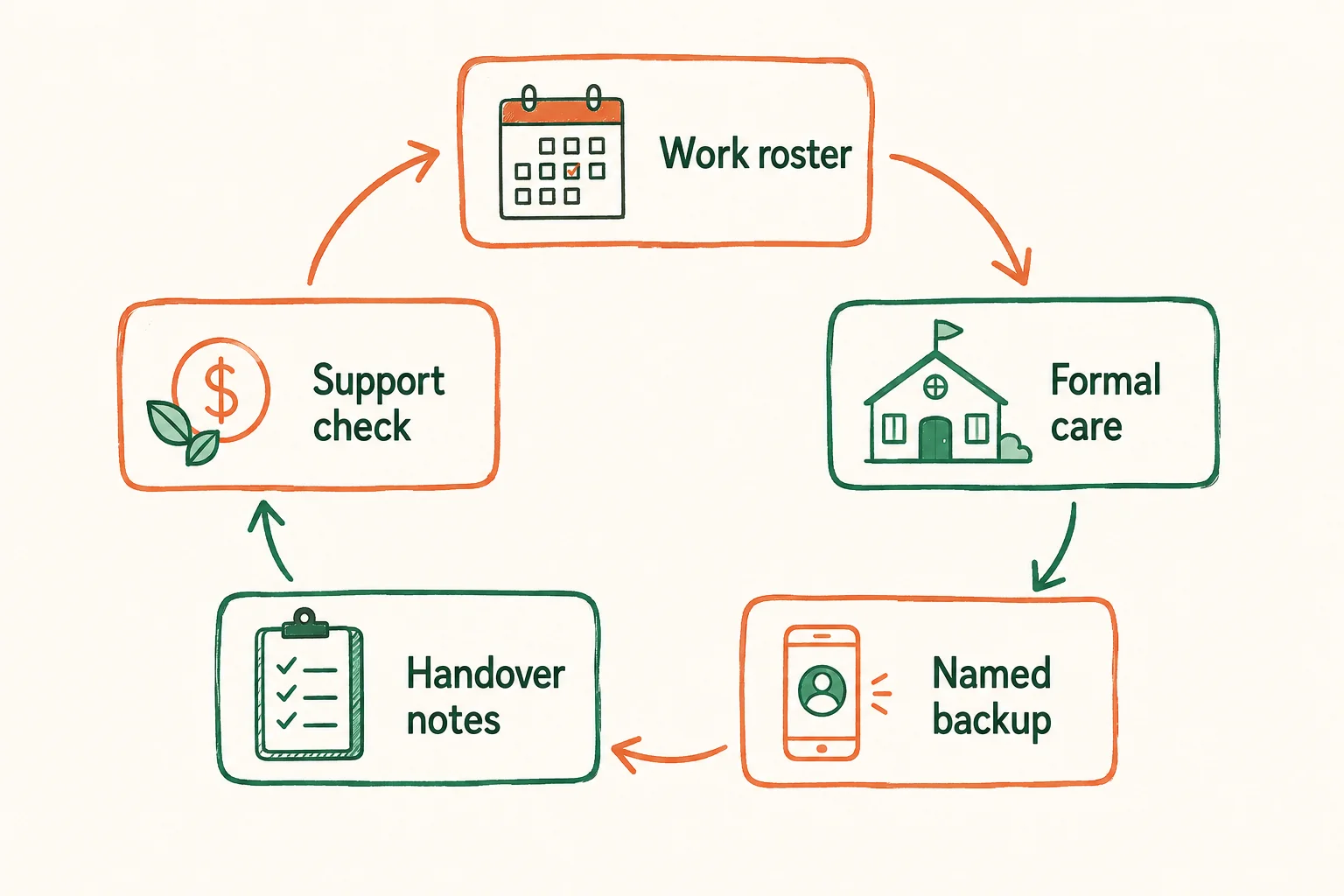
Several carers do not automatically mean an unsettled child. What makes a mixed arrangement hard is unpredictability and mismatched routines. Keep the non-negotiables consistent where you can: the goodbye ritual, a comfort item, food restrictions, sleep cues, medication instructions and the words you use for each part of the day. Give every regular carer the same short handover sheet, rather than relying on a hurried text after a long shift.
Introduce a new arrangement on an ordinary day before you need it for a 5 am start. If possible, do a short visit, a practice handover and a pickup while you are nearby. Watch what happens at transitions, rather than only whether the child enjoys the room. The practical test is whether the carer knows how your child settles, how they contact you, and when they would use the backup contact.
There will still be rough weeks. A sick child, cancelled programme or unexpected overtime can break a plan that looked solid on Sunday night. Keep one backup option that does not depend on phoning six people in a panic. If there is no suitable backup, say that clearly when you choose shifts or discuss flexibility with your employer. That constraint is real. It is better to plan around it than pretend it will disappear.
Ask the question that reveals the real fit
Questions to take on a visit
| Ask this | Why it matters |
|---|---|
| What are your exact opening, closing and late-pickup rules? | You need the real handover window, not an approximate advertised day. |
| Can my child attend on the days and hours we need, and how much notice is required for changes? | Rosters and waitlists can make nominal availability meaningless. |
| Who can collect my child, and how do you check a last-minute change? | Shift handovers need a secure, simple collection process. |
| What happens when my child is sick or the service is short staffed? | This tells you whether your backup plan needs another layer. |
| Do you offer 20 Hours ECE or work with childcare assistance, and how would it apply to our enrolment? | Funding rules depend on the provider and the hours you use. |
Frequently asked questions
Is there 24-hour childcare in New Zealand?
Some providers may offer extended, weekend or overnight care, but it is not common enough to assume it is available in every area. Contact the provider directly and confirm the hours, your child's age group, sleep arrangements, staffing and waitlist before relying on it.
Can shift workers get help with after-school care?
Possibly. Work and Income lists night shift workers among people who may qualify for the OSCAR Subsidy, subject to its other eligibility rules. The programme must be approved, and the payment depends on family income and care hours.
Can I use 20 Hours ECE if I work shifts?
Yes, shift work does not itself prevent a child from receiving 20 Hours ECE. Your child must be enrolled with an eligible service and the usable hours depend on that service's operating hours, spaces and enrolment arrangements.
Is home-based childcare regulated in NZ?
Licensed home-based ECE is regulated through a Ministry-licensed service. The provider is responsible for compliance, educator support and safety requirements. Check that any arrangement you are considering is part of a licensed service if that is the type of care you want.
What should I put in a shift-work childcare backup plan?
Name the adults who can collect or care for your child, record their contact details and collection authority, and agree the circumstances in which they will be asked. Include illness, overtime, cancelled care and a failure to wake after a night shift. Review it whenever the roster changes.
Shift work does not require you to settle for vague arrangements. It requires a more honest plan. Use the special circumstances childcare guide for the wider picture, and our guide to starting childcare for settling and first-day preparation. Then search for providers and take your actual roster to the conversation.
Find childcare that fits your real hours
Search local providers, then confirm the operating hours and handover rules that matter for your whānau.
Search providersFind childcare near you
Search and compare providers by suburb, care type, cost, and availability.