
Resource Hub
How Much Does Childcare Cost in NZ? The Complete 2026 Guide
Published · Last updated · 15 min read

Contents
How much does childcare cost in New Zealand in 2026?
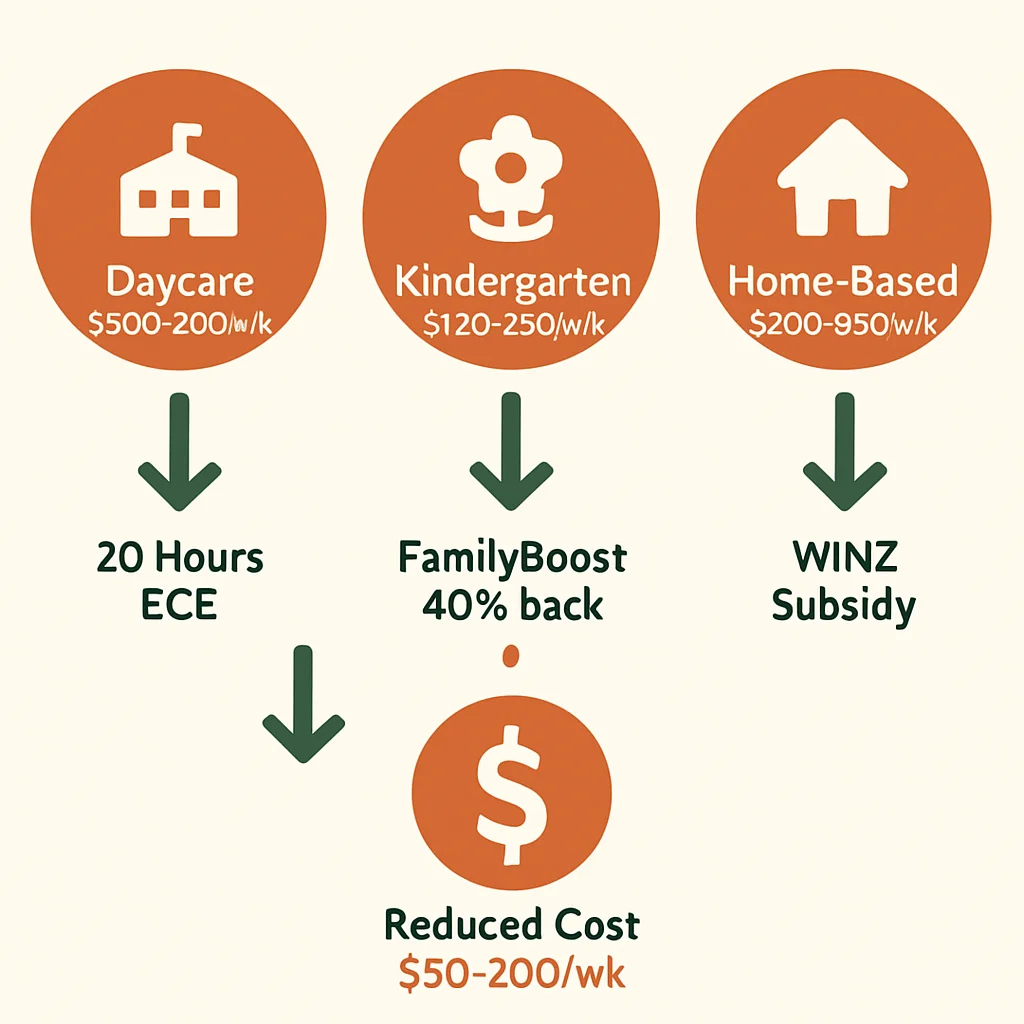
Full-time childcare in New Zealand costs between $150 and $450 per week in 2026, depending on the care type, your child's age, and where you live. Centre-based daycare runs $300-$400 per week on average, kindergarten $120-$240, and home-based care $200-$360. Government subsidies — including 20 Hours ECE (free for ages 3-5), FamilyBoost (up to $6,240/year back), and the WINZ Childcare Subsidy — can cut your out-of-pocket cost by 50-80%.
What childcare actually costs in NZ right now
Let's skip the preamble. You're here because you've just discovered that childcare might cost as much as your rent — and you need real numbers, not vague reassurances.
Here's the honest picture: New Zealand has some of the least affordable childcare in the developed world. An OECD analysis found that NZ families spend around 35% of a couple's net income on childcare — putting us near the bottom of the affordability rankings alongside the UK and Ireland.
But those headline numbers don't tell you what you'll actually pay. Your bill depends on three things: the type of care you choose, how old your child is, and where you live. A two-year-old in a Ponsonby daycare and a four-year-old at a Dunedin kindergarten are living in completely different cost realities.
This guide gives you all the numbers — actual 2026 rates across 4,394+ providers on The Parent Circle, every government subsidy you can stack, and the hidden fees that inflate your bill. Whether you're planning ahead or already feeling the pinch, you'll leave knowing exactly where you stand.
If you're still deciding what kind of care to choose, start with our guide to choosing childcare in NZ — it covers everything from ERO reports to visit checklists.
Cost breakdown by care type
The single biggest factor in your weekly bill is which type of care you use. Here's what each option costs for full-time care (roughly 30-40 hours per week) before subsidies.
| Care type | Hourly rate | Weekly cost (full-time) | Subsidy eligible? |
|---|---|---|---|
| Centre-based daycare | $7.50 – $12.00 | $300 – $480 | Yes (20 Hrs ECE, FamilyBoost, WINZ) |
| Kindergarten | $3.00 – $6.00 | $120 – $240 | Yes (20 Hrs ECE covers most/all) |
| Home-based care | $8.00 – $15.00 | $200 – $360 | Yes (20 Hrs ECE, FamilyBoost, WINZ) |
| Nanny (employed) | $23.50 – $35.00 | $940 – $1,400 base | FamilyBoost only (if licensed) |
| Au pair | $4.50 – $8.75 | $180 – $350 + board | No |
Centre-based daycare is what most parents think of — a licensed centre with qualified kaiako (teachers), structured programmes, and set hours. It's the most popular option and covers everything from small community centres with 30 children to large corporate chains with 150+. Across The Parent Circle's database, centre-based fees average $7.50-$12 per hour depending on your region and the centre's staffing qualifications.
Kindergarten is the most affordable licensed option. Many kindergartens charge nothing at all for children using their 20 Hours ECE entitlement, though some ask for a voluntary donation of $3-$6 per hour for additional hours. The catch: most kindergartens run sessional hours (mornings or afternoons, not full days), so you may need to combine them with another care type if you work full-time.
Home-based care means your child goes to a licensed educator's home (or the educator comes to yours) in small groups of up to four children. Rates sit between kindergarten and centre-based, typically $8-$15 per hour. It suits families who want a smaller, more domestic setting.
Nanny care is the premium option — and the costs are steeper than they first appear. The minimum wage in 2026 is $23.50/hour, but once you add PAYE, ACC levies (~1.5%), 8% holiday pay, 3% KiwiSaver employer contribution, and sick leave, the true cost jumps 25-35% above the base wage. A nanny on $25/hour actually costs you around $32-$34/hour. We break this down fully in our nanny vs daycare vs home-based cost comparison.
Use our cost estimator
Why your child's age changes the price
Your child's age is the second-biggest cost factor, and the reason is straightforward: legal staffing ratios. Under the Education (Early Childhood Services) Regulations 2008, centres must maintain different teacher-to-child ratios depending on age.
| Age group | Minimum ratio | Cost impact |
|---|---|---|
| Under 2 years | 1 teacher : 5 children | +20-30% premium over standard rates |
| 2-3 years | 1 teacher : 10 children | Standard rate |
| 3-5 years (with 20 Hrs ECE) | 1 teacher : 10 children | Lowest out-of-pocket (free hours apply) |
The maths is simple. A room of 20 toddlers (aged 2+) needs two teachers. A room of 20 infants (under 2) needs four. That doubles the wage bill for the under-2 room, and centres pass that cost on to parents. If you're paying $350/week for a toddler at a given centre, expect to pay $420-$450/week for an infant in the same building.
Government funding reflects this too. The Ministry of Education pays centres $20.27 per funded child hour for under-2s at a fully certified service, versus $11.58 for children aged 2 and over. The gap exists because the ministry recognises the higher staffing cost — but it doesn't fully close the gap for parents.
The good news: costs drop in two stages. The first drop comes at age 2, when your child moves to the higher-ratio room. The second — and bigger — drop comes at age 3, when 20 Hours ECE kicks in and wipes out up to 20 hours of weekly fees. For a detailed look at infant care pricing and strategies to manage it, see our under-2 childcare costs guide.
Childcare costs by region
Where you live matters almost as much as what type of care you choose. A parent in Queenstown pays roughly double what a parent in Southland pays for the same quality of centre-based care. Here's how costs stack up across the country, based on data from 4,394+ providers on The Parent Circle.
| Region | Typical daily rate (centre-based) | Weekly estimate (5 days) | Cost level |
|---|---|---|---|
| Auckland | $80 – $150 | $400 – $750 | High |
| Wellington | $80 – $120 | $400 – $600 | High |
| Queenstown-Lakes | $85 – $150 | $425 – $750 | Highest |
| Canterbury / Christchurch | $80 – $120 | $400 – $600 | High |
| Waikato / Hamilton | $60 – $80 | $300 – $400 | Medium |
| Bay of Plenty / Tauranga | $60 – $80 | $300 – $400 | Medium |
| Hawke's Bay | $50 – $70 | $250 – $350 | Medium-Low |
| Nelson / Tasman | $50 – $70 | $250 – $350 | Medium-Low |
| Manawatū-Whanganui | $50 – $70 | $250 – $350 | Medium-Low |
| Otago / Dunedin | $50 – $70 | $250 – $350 | Low |
| Taranaki | $50 – $70 | $250 – $350 | Low |
| Northland | $50 – $70 | $250 – $350 | Low |
| Southland | $50 – $65 | $250 – $325 | Lowest |
| Gisborne | $50 – $65 | $250 – $325 | Lowest |
| West Coast | $50 – $65 | $250 – $325 | Lowest |
| Marlborough | $50 – $65 | $250 – $325 | Lowest |
Three factors drive these differences. First, property costs — a centre in central Auckland pays four to five times the rent of one in Invercargill, and that gets baked into fees. Second, demand — cities with high proportions of working parents (Auckland, Wellington, Queenstown) have waitlists, which means centres can charge more. Third, workforce — qualified ECE teachers are harder to recruit in expensive cities, pushing wages up.
Queenstown-Lakes is a special case. Tourism-driven property costs mean childcare fees rival or exceed Auckland's, despite it being a small town. Parents there regularly report paying $130-$150 per day for under-2 care.
At the other end, regions like Southland, Gisborne, and the West Coast have lower fees — but fewer options. Some rural areas qualify as "childcare deserts" where there simply aren't enough licensed providers to meet demand. If you're moving to a new area, check provider availability on The Parent Circle before you commit.
For a deep dive into every region's options, waitlists, and best-value suburbs, see our childcare costs by region guide.
Three subsidies that cut your bill
New Zealand has three main childcare subsidies, and the best part is you can stack all of them. Used together, they can reduce your out-of-pocket costs by 50-80% depending on your income and your child's age.
20 Hours ECE: free childcare for 3-5 year olds
Every child aged 3 to 5 in New Zealand is entitled to 20 hours of free early childhood education per week at a participating licensed service. There's no income test — it's universal. The entitlement runs from your child's third birthday until they start school.
Here's how it works in practice: you tell the centre which hours you want covered (up to 6 hours per day, 20 hours per week), and the Ministry of Education pays the centre $11.87 per hour for those hours. The centre cannot charge you fees for those specific hours.
What they can charge for: any hours beyond the 20, and "optional" extras like meals, excursions, or resources. Some centres roll these into a blanket daily fee, which means you still get a bill even with 20 Hours ECE. A centre charging $80/day might break it down as $50 for the funded hours (no charge) plus $30 for food, resources, and the remaining hours. Your "free" day actually costs $30.
You can split your 20 hours across two providers — useful if you use a kindergarten in the morning and a daycare in the afternoon. For the full breakdown of how to maximise this entitlement, read our 20 Hours ECE guide.
FamilyBoost: get 40% of your fees back
FamilyBoost is a quarterly tax rebate that refunds 40% of your ECE costs, up to $1,560 per quarter ($6,240 per year). It launched in July 2023 and is administered by Inland Revenue through the myIR portal.
The income threshold is generous: households earning up to $229,100 per year are eligible. Abatement starts at $140,000 (quarterly equivalent $35,000) at a 7% rate, so even families well above the median income qualify for a partial rebate.
The claiming process is simple but manual. After each quarter ends (e.g., July-September), you log into myIR, upload your childcare invoices, and submit. The refund hits your bank account within a few weeks. Around 60,000 families had claimed by mid-2025, which was below the government's projections — meaning there's money being left on the table.
Don't leave money on the table
WINZ Childcare Subsidy: income-tested support
The WINZ (Work and Income) Childcare Subsidy is an income-tested payment for families who need childcare while working, studying, or training. Unlike 20 Hours ECE, it's means-tested — your household income determines how much you get.
There are three types of assistance: the standard Childcare Subsidy (for children under 5), the OSCAR Subsidy (for school-age children in out-of-school programmes), and Guaranteed Childcare Assistance (for parents on specific benefits). Rates go up to $6.03 per hour, and you can claim up to 50 hours per week — including 30 hours beyond your 20 Hours ECE entitlement.
Applying takes a bit of paperwork: you'll need proof of income, your work or study hours, and your provider's details. Payments go directly to the provider in most cases. For the full eligibility criteria and application walkthrough, see our WINZ Childcare Subsidy guide.
Stacking all three together
This is where it gets good. All three subsidies can be used together, and the savings compound. Here's a worked example for a 3-year-old in centre-based daycare at $80/day (8 hours), 5 days a week:
| Line item | Weekly amount |
|---|---|
| Gross fees (40 hours) | $400 |
| Less: 20 Hours ECE (20 hrs × $0) | −$190 (approx.) |
| Net fees after 20 Hrs ECE | $210 |
| Less: WINZ Subsidy (20 hrs × $6.03) | −$120 |
| Net fees after WINZ | $90 |
| Less: FamilyBoost (40% × $90) | −$36 |
| Your actual weekly cost | $54 |
That's $54 per week instead of $400 — an 87% reduction. Not every family will qualify for all three at the maximum rates, but even partial eligibility makes a massive difference. The key is to actually apply for all of them, which an alarming number of eligible families don't do.
Hidden costs that inflate your bill
The advertised weekly rate at most centres is a starting point, not the final number. Several additional charges can add 10-20% to your bill, and some of them catch parents off guard.
- Enrolment or registration fees — one-off charges of $50-$200 when you first sign up. Some centres also require a bond (typically one to two weeks' fees) refunded when you leave.
- Food and meal levies — $3-$8 per day for morning tea, lunch, and afternoon tea. Some centres include meals in the base rate; others charge separately. Ask before you enrol.
- Nappies and sunscreen — most centres for under-2s charge $3-$5 per day for consumables, or ask you to supply your own.
- Excursion fees — $5-$20 per trip for zoo visits, museum outings, and swimming lessons. These can add $50-$100 per term.
- Late pickup penalties — typically $1-$5 per minute after closing time. Pick up ten minutes late three times and you've added $90-$150 to your quarterly bill.
- Absence and holiday charges — most centres charge for your booked days whether your child attends or not. Going on a two-week holiday? You're still paying.
- "Optional" charges under 20 Hours ECE — centres legally cannot charge fees for the 20 funded hours, but they can charge for resources, food, and extras during those hours. Some centres set these "optional" charges at $20-$30 per day, which adds up fast.
Before you sign an enrolment agreement, ask for the total cost breakdown — not just the headline rate. Our hidden costs of childcare guide includes a checklist of questions to ask your provider.
Nanny vs daycare vs home-based: the full cost comparison
Parents often assume a nanny is a luxury they can't afford. Sometimes that's true — but with two or more children, the numbers can actually tip in the nanny's favour. Here's how the three main options compare for one child and for two children.
| Centre-based daycare | Home-based care | Nanny (employed) | |
|---|---|---|---|
| Hourly rate | $7.50 – $12 | $8 – $15 | $23.50 – $35 (base) |
| True hourly cost* | $7.50 – $12 | $8 – $15 | $30 – $47 (incl. obligations) |
| Weekly cost: 1 child | $300 – $480 | $200 – $360 | $1,200 – $1,900 |
| Weekly cost: 2 children | $600 – $960 | $400 – $720 | $1,200 – $1,900 (same) |
| 20 Hours ECE eligible? | Yes | Yes (if licensed) | No |
| FamilyBoost eligible? | Yes | Yes | Yes (if through licensed service) |
| WINZ eligible? | Yes | Yes | Limited |
*True hourly cost for nannies includes PAYE, ACC levies (~1.5%), holiday pay (8%), KiwiSaver employer contribution (3%), and sick leave provisions. These are legal obligations — if you employ a nanny, you're an employer.
The breakeven point for a nanny is typically at two children. Two kids in centre-based daycare at $350/week each costs $700/week. A nanny at $28/hour for 40 hours costs around $1,500/week with obligations — still more expensive, but the gap closes. If you add a third child, the nanny pulls ahead. Nanny sharing with another family is another option that halves the cost.
For a full side-by-side comparison including non-financial factors (socialisation, flexibility, one-on-one attention), see our nanny vs daycare vs home-based guide.
Ten ways to reduce your childcare costs
- Claim everything you're entitled to. Apply for all three subsidies: 20 Hours ECE, FamilyBoost, and the WINZ Childcare Subsidy. Many eligible families miss at least one.
- Use 20 Hours ECE strategically. You can split the 20 hours across two providers. Use free kindergarten in the morning and pay for afternoon care only. This can save $100-$150/week compared to full-day centre fees.
- Ask about sibling discounts. Many centres offer 5-15% off for second and third children. It's rarely advertised — you have to ask.
- Go part-time if the numbers work. Three days of care instead of five cuts your bill by 40%. If your employer offers flexible hours or compressed weeks, this can be the single biggest saving. See our part-time vs full-time childcare guide.
- Negotiate your start date around your child's birthday. If your child turns 3 in March, starting care then (instead of January) means you get 20 Hours ECE from day one — saving you two months of full fees.
- Compare centres on total cost, not just the daily rate. A centre charging $75/day with meals included may be cheaper than one at $65/day that charges $8/day for food and $200/term for excursions. Use The Parent Circle to compare centres side by side.
- Consider home-based care for under-2s. It's typically $50-$100/week cheaper than centre-based care for the same hours, with smaller group sizes.
- Nanny-share with another family. Splitting a nanny's cost with a neighbour or friend cuts each family's bill by 40-50% while keeping the convenience of in-home care.
- Time your return to work. If you can extend parental leave until your child turns 3, you skip the expensive under-2 and under-3 period entirely. The paid parental leave entitlement is currently 26 weeks.
- Budget quarterly, not weekly. FamilyBoost refunds arrive quarterly. Build that into your cash flow so you're not paying full fees and feeling the squeeze while waiting for the rebate.
For a complete financial planning approach, including templates and worked examples, see our childcare budgeting guide.
Other financial support worth knowing about
Beyond the big three subsidies, a few other sources of financial help exist — though they're less well-known.
- Working for Families tax credits — these aren't childcare-specific, but the extra income they provide helps cover fees. They don't reduce your FamilyBoost eligibility.
- Employer childcare support — some employers offer subsidised childcare, on-site centres, or flexible spending accounts. It's not common in NZ, but it's worth asking your HR department.
- KiwiSaver hardship withdrawal — in genuine financial hardship, you can apply to withdraw KiwiSaver funds early. Childcare costs alone probably won't qualify, but combined with other financial pressure, it's an option of last resort.
- Community and charitable grants — organisations like the Salvation Army, budgeting services, and some iwi provide one-off grants for families in financial difficulty. Your local Work and Income office can point you in the right direction.
- Young Parent Payment — parents aged 16-19 can access additional childcare assistance through Work and Income, including the Guaranteed Childcare Assistance Payment that covers most or all fees.
What your actual bill looks like: three family scenarios
Abstract numbers only get you so far. Here's what childcare actually costs for three different NZ families after subsidies.
Scenario 1: Single income, one child under 2, Auckland
Sarah earns $65,000 and puts her 14-month-old in a Manurewa daycare at $85/day. She works four days, so her gross weekly fee is $340. No 20 Hours ECE (child is under 3). She claims the WINZ Childcare Subsidy ($6.03/hr × 32 hrs = $193/week) and FamilyBoost (40% of remaining $147 = $59/week equivalent). Her actual cost: about $88 per week.
Scenario 2: Dual income, one child aged 3, Wellington
Tom and Priya earn $160,000 combined. Their 3-year-old goes to a Petone centre at $90/day, five days a week ($450/week gross). 20 Hours ECE covers $237/week. They earn too much for WINZ but qualify for FamilyBoost at 40% of remaining $213 = $85/week equivalent. Their actual cost: about $128 per week.
Scenario 3: Part-time, two children, Christchurch
Megan and Reuben earn $110,000 combined. Their 4-year-old goes to kindergarten three mornings (free under 20 Hours ECE), and their 18-month-old goes to home-based care three days at $65/day ($195/week). With WINZ ($6.03/hr × 24hrs = $145/week) and FamilyBoost on the remainder, their combined actual cost for two children: about $20 per week.
Your numbers will be different. Use our cost estimator to model your specific situation — it factors in all three subsidies automatically.
How costs have changed (and where they're heading)
Childcare fees have risen sharply over the past three years. Between 2023 and 2026, many families reported their monthly bills doubling — driven by a combination of wage pressure on ECE teachers, rising commercial rents, and general inflation flowing through to centre operating costs.
Government funding hasn't kept pace. The Ministry of Education funding rate increased from $11.81 to $11.87 per hour for 20 Hours ECE between 2025 and 2026 — a 0.5% rise while the CPI rose roughly 3%. That gap gets passed to parents through higher "optional" charges and above-subsidy fees.
The FamilyBoost expansion (raising the income threshold to $229,100 and the rebate to 40%) partially offsets this, but it only helps families who claim it — and around half of eligible families still haven't signed up. The ECE teacher shortage continues to push wages up, which is a good thing for teachers but means centres keep raising fees to cover payroll.
The short version: childcare is getting more expensive, but the subsidy system is also getting more generous. Families who actively use all available support are better insulated from fee hikes than those who don't.
Frequently asked questions about childcare costs in NZ
What is the average weekly childcare cost in New Zealand in 2026?
Full-time centre-based daycare averages $300-$400 per week before subsidies, depending on your region. After applying 20 Hours ECE (for children 3-5), FamilyBoost, and the WINZ Childcare Subsidy, most families pay between $50 and $200 per week out of pocket.
Is kindergarten free in NZ?
For children aged 3-5, kindergarten is mostly free thanks to 20 Hours ECE. You may be asked for a voluntary donation of $3-$6 per hour for additional hours or resources, but the core 20 hours per week cost nothing. Kindergarten is the most affordable licensed care option in NZ.
Why is childcare for under-2s so expensive?
Legal staffing ratios. Centres must maintain 1 teacher for every 5 children under 2, compared to 1:10 for children over 2. This doubles the staffing cost for infant rooms. Under-2s also don't qualify for 20 Hours ECE, so there's less subsidy relief.
Can I use 20 Hours ECE, FamilyBoost, and the WINZ Childcare Subsidy together?
Yes. All three subsidies stack. 20 Hours ECE covers the first 20 hours for 3-5 year olds, WINZ can cover additional hours, and FamilyBoost refunds 40% of whatever you pay out of pocket after the other two. Used together, they can cut costs by 50-87%.
How much does a nanny cost in NZ?
A nanny's base pay starts at the minimum wage of $23.50/hour in 2026, with experienced nannies earning $28-$35/hour. But as an employer, you also pay PAYE, ACC levies, holiday pay (8%), KiwiSaver (3%), and sick leave — adding 25-35% on top. True weekly cost for full-time nanny care: $1,200-$1,900.
What is the cheapest childcare option in NZ?
Kindergarten is the cheapest licensed option — most sessions are fully covered by 20 Hours ECE for children aged 3-5. For under-3s, home-based care is typically the most affordable at $8-$15/hour. Playcentre (parent-led, cooperative model) is the cheapest of all, requiring only a small annual membership fee.
Do childcare fees cover food and meals?
It depends on the centre. Some include meals in the daily fee, while others charge $3-$8 per day separately for morning tea, lunch, and afternoon tea. Always ask about food charges before enrolling — they can add $15-$40 per week to your bill.
Where is childcare most expensive in New Zealand?
Queenstown-Lakes, Auckland, and Wellington are the most expensive regions, with centre-based daily rates of $80-$150. The cheapest regions are Southland, Gisborne, and the West Coast, where daily rates typically run $50-$65.
Making it work
Childcare in New Zealand is expensive. There's no way around that. But the cost you see on a centre's website is rarely the cost you'll actually pay once subsidies are applied.
The families who pay the least are the ones who do the homework: they apply for every subsidy they're eligible for, they compare centres on total cost rather than headline rate, and they structure their care around the 20 Hours ECE entitlement. None of that requires earning more money — just knowing the system.
Start by searching for providers in your area, then run your numbers through our cost estimator. The difference between what you fear you'll pay and what you'll actually pay might surprise you.
Calculate your real childcare cost
Plug in your region, care type, child's age, and household income to see your estimated weekly cost after all subsidies.
Try the cost estimatorRelated guides
Faith-Based Childcare in NZ: What Parents Should Know
A practical guide to faith-based childcare in New Zealand, including licensing, Te Whariki, inclusion and questions to ask before enrolment.
Nature-Based and Forest Kindergartens in NZ: A Parent Guide
Curious about forest kindergarten or nature-based ECE in NZ? Learn how it works, what to ask, safety checks, costs, gear and whether it fits your child.
Childcare in Waikato: Hamilton and the Greater Waikato Region (2026)
Looking for childcare in Waikato? This practical 2026 guide breaks down Hamilton, Cambridge, Te Awamutu, northern Waikato, Taupo, and smaller regional markets so you can build a shortlist that actually fits your week.
Childcare in Wellington: A Practical Guide for Wellington Families (2026)
Looking for childcare in Wellington? This practical 2026 guide breaks down Wellington City, the Hutt Valley, Porirua, Kapiti Coast, and Wairarapa so you can build a shortlist that actually fits your week.
Find childcare near you
Search and compare providers by suburb, care type, cost, and availability.