
Resource Hub
Types of Childcare in NZ: Complete Guide (2026)
Published · Last updated · 16 min read

Contents
What types of childcare are available in New Zealand?
New Zealand has eight main childcare types: education and care centres (daycare), kindergartens, home-based care, Te Kōhanga Reo, Playcentre, nanny or au pair care, Pacific language immersion services, and casual or drop-in care. Most licensed services qualify for 20 Hours ECE funding once your child turns three, and families can stack this with WINZ subsidies and the FamilyBoost tax rebate to reduce costs further.
Eight childcare types, one big decision
Aotearoa New Zealand has more than 4,394 licensed early childhood services spread across 1,026 suburbs. That is both a blessing and a headache. Unlike countries where you choose between daycare and a nanny, NZ's ECE system offers eight distinct care types, each with different philosophies, hours, costs, and vibes.
Every licensed service follows Te Whāriki, the national early childhood curriculum, which weaves together four principles: empowerment (whakamana), holistic development (kotahitanga), family and community (whānau tangata), and relationships (ngā hononga). But how each service delivers that curriculum varies wildly, from purpose-built centres with 150 tamariki to a single educator caring for four children in her lounge.
This guide breaks down every option available to NZ families in 2026: what each type actually looks like day to day, what it costs, and who it works best for. No type is objectively "best." The right one depends on your child's temperament, your work schedule, your budget, and what matters most to your whānau.
Education and care centres (daycare)
Education and care centres, usually just called daycares, are the most common ECE service in NZ. They are teacher-led, typically open from 7 am to 6 pm on weekdays, and accept children from birth through to school age. Centres can be privately owned, community-run, or part of a corporate chain.
The Ministry of Education sets minimum teacher-to-child ratios: 1:5 for under-2s and 1:10 for children aged two and over. At least 50% of staff must hold a recognised ECE qualification, though many centres exceed this. Full-time fees range from $250 to $450 per week depending on age and region, with under-2 care sitting at the higher end because of the tighter ratios required.
Once your child turns three, 20 Hours ECE kicks in and covers up to 20 hours per week at no charge. You can also claim the FamilyBoost tax rebate on out-of-pocket fees and apply for a WINZ childcare subsidy if your household income qualifies.
A typical day at a daycare centre follows a loose routine: free play and mat time in the morning, a group kai (meal) around midday, rest time for younger tamariki, then outdoor play and smaller group activities in the afternoon. Centres usually divide children into rooms by age: an infant room for under-2s, a toddler room, and a preschool room for 3-to-5-year-olds. Transitions between rooms happen as your child reaches developmental milestones, which the teaching team discusses with you.
Best for: Families who need consistent, full-day care with structured group learning. Read our full guide to daycare in NZ for a deeper look at what a typical day involves and how to spot a good centre.
Kindergarten
Kindergartens, or "kindy" in everyday NZ English — have been around since the 1880s. They are not-for-profit, run by regional associations like Auckland Kindergarten Association, Kidsfirst (South Island), and WEKA (Wellington), and are staffed by 100% qualified, registered kaiako (teachers). That 100% qualified rate is the standout difference from most daycare centres.
Traditionally, kindergartens ran short sessional hours: mornings for older tamariki, afternoons for younger ones. Many have shifted to full-day or mixed models, but sessional kindergartens still exist, typically running four to six hours per day. For families not needing full-day care, this can feel like a good fit: a focused, teacher-led session without the full-time price tag.
Costs are low. Many kindergartens operate largely on government funding through 20 Hours ECE, asking only for a voluntary contribution of $5 to $10 per session. Some charge nothing at all. Ages accepted typically range from two to five, though this varies by association.
NZ has several kindergarten associations, each operating independently across their region. Auckland Kindergarten Association (AKA) is the largest, running over 100 kindergartens across Tāmaki Makaurau. Kidsfirst covers much of the South Island. Wellington Early Childhood Association (WEKA) manages kindergartens in the capital region. Each association sets its own enrolment policies and session times, so check directly with your local one. Waitlists are common, especially in popular suburbs, so put your name down early, ideally before your child turns two.
Best for: Families wanting shorter sessions with highly qualified teachers, especially as a bridge to primary school. Our kindergarten guide covers enrolment timing, waitlists, and how the "free" model actually works.
Home-based childcare
Home-based care is exactly what it sounds like: a licensed educator looks after a small group of children (a maximum of four under the age of six) in a home environment. That home can be the educator's house or, in some arrangements, your own home.
Educators work within a licensed network (sometimes called a coordinating service). The network employs qualified visiting teachers who check in regularly, ensure Te Whāriki is being delivered, and support the educator's practice. This gives you the warmth of a home setting with the safety net of professional oversight.
Flexibility is the big draw. Home-based educators can offer non-standard hours: early starts, late finishes, even overnight care for shift workers. Fees typically run from $200 to $350 per week, and 20 Hours ECE applies for tamariki aged three and over. WINZ subsidies and FamilyBoost also apply.
The visiting teacher is a key part of the home-based model. They are fully qualified and registered ECE teachers employed by the network. They visit each educator regularly, typically monthly, to observe practice, support planning, and ensure the service meets licensing requirements. They also act as a bridge between the educator and your whānau, helping to develop individual learning goals for your child. It is worth asking how often the visiting teacher comes and what their background is when choosing a home-based provider.
Best for: Families wanting a smaller, home-like environment with flexible hours, particularly shift workers or those with very young babies. See home-based childcare in NZ for more on how networks operate and how to vet an educator.
Te Kōhanga Reo
Te Kōhanga Reo are total immersion te reo Māori services, established in 1982 as a grassroots response to the declining use of the Māori language. The name translates to "the language nest," and the model is built around whānau (extended family) rather than professional teachers alone. Kaumātua (elders) and whānau members lead the programme alongside qualified kaiako.
Around 450 Kōhanga Reo operate across Aotearoa, overseen by the Te Kōhanga Reo National Trust. Children from birth to six attend, and every interaction (songs, stories, mealtimes, play) happens in te reo Māori. Tikanga Māori (customs and values) underpins everything, from how children are greeted to how meals are shared.
Kōhanga Reo are open to all children, not just those from Māori whānau. Fees are significantly lower than mainstream centres, often between $50 and $150 per week, because the kaupapa (purpose) prioritises access. 20 Hours ECE, WINZ subsidies, and FamilyBoost all apply.
Best for: Whānau wanting their tamariki to grow up speaking te reo Māori and grounded in tikanga. Read our Te Kōhanga Reo guide for a closer look at the history, the daily routine, and how to find one near you.
Puna Reo and bilingual (Reo Rua) services
Puna Reo are centre-based Māori immersion services that sit between mainstream daycare and Te Kōhanga Reo. Unlike Kōhanga Reo, they are teacher-led rather than whānau-led, and they operate under standard centre-based licensing. Reo Rua (bilingual) services deliver education in both te reo Māori and English, giving children grounding in both languages.
For whānau who want their tamariki to learn te reo but need the structure and hours of a mainstream centre, Puna Reo and Reo Rua services offer a middle ground. They follow Te Whāriki with a strong te ao Māori (Māori worldview) emphasis and qualify for all the same subsidies as other licensed services.
Playcentre
Playcentre is uniquely New Zealand. It is a parent-led cooperative where mums, dads, and whānau do not just drop their children off. They stay and participate as the educators. The model has been running for over 80 years and remains one of the most affordable ECE options in the country.
Sessions typically run three to four hours, several days a week. Parents take turns on roster duty, and Playcentre Aotearoa provides free training so families can develop their facilitation skills. The philosophy centres on free play across 16 areas, from water and sand to carpentry and science. Children from birth to school age attend together in mixed-age groups.
Costs are minimal. Expect $50 to $200 per year in membership fees, plus a small session charge. 20 Hours ECE applies. The trade-off is time: you are expected to show up and be involved, which does not work for every family, especially those with two full-time working parents.
Best for: Families where a parent or caregiver is available during sessions and wants to be actively involved in their child's learning alongside other families. More on how the model works in our Playcentre guide.
Nanny and au pair care
Hiring a nanny means your child stays home while a carer comes to them. This is the most personalised option and the most expensive. Nanny care is not licensed by MOE, which means it does not qualify for 20 Hours ECE, WINZ subsidies, or FamilyBoost. All costs come out of your pocket.
Expect to pay between $22 and $32 per hour for a qualified nanny, depending on experience and location. A full-time, live-out nanny typically costs $800 to $1,200 per week once you factor in PAYE, KiwiSaver, and ACC levies. Yes, you are the employer, with all the legal obligations that involves. A written employment agreement is required under NZ law.
Au pairs are a lower-cost alternative. They are typically young people on a working holiday visa who live with your family and provide childcare in exchange for a modest weekly stipend ($200 to $300) plus room and board. Hours are capped at around 30 to 35 per week. The arrangement is more cultural exchange than professional childcare.
A nanny share (two families splitting one nanny) brings the cost down to roughly $500 to $700 per family per week, though you lose some flexibility on scheduling.
Finding a good nanny takes effort. Agencies like Nannies on the Go, Nannies Incorporated, and Kiwi Nannies handle vetting, police checks, and reference checking for a placement fee (typically one to two weeks' wages). Going private through platforms like Trade Me Jobs or Facebook groups is cheaper but means you handle all the due diligence yourself. Either way, insist on a written employment agreement, check references thoroughly, and make sure your nanny has a current first aid certificate.
Best for: Families who need maximum flexibility, have non-standard schedules, or have multiple children where the per-child cost of a nanny starts to compete with centre fees. Our nanny care guide covers employment law, vetting, and nanny share arrangements in detail.
Pacific language immersion ECE
Pacific language immersion services, known as A'oga Amata (Samoan), Punanga Reo (Cook Islands Māori), and similar names for Tongan, Niuean, Tokelauan, and Fijian programmes, operate on a similar principle to Te Kōhanga Reo: total or partial language immersion to preserve heritage languages while delivering quality ECE.
These services are concentrated in Auckland, Wellington, and Christchurch, where NZ's Pacific communities are largest. They are licensed by MOE, follow Te Whāriki, and qualify for 20 Hours ECE, WINZ subsidies, and FamilyBoost. Costs vary but generally fall between $150 and $300 per week, with subsidies reducing that significantly.
A 2023 University of Auckland study found that Pacific children in immersion ECE settings scored higher on measures of vocabulary development in both their heritage language and English by age five. For Pacific families, these services do something mainstream daycares cannot: they connect tamariki to their language, culture, and community from the start.
Services vary in their immersion level. Some operate in full immersion, where every word spoken is in Samoan, Tongan, or Cook Islands Māori. Others run bilingual programmes where the heritage language is used alongside English. The best way to understand what a service offers is to visit and ask: what percentage of the day is in the heritage language? How do kaiako support children who arrive with little or no exposure to the language?
Best for: Pacific families wanting their children to grow up speaking their heritage language and connected to their culture. Read our Pacific language immersion guide for a breakdown of available languages and where to find services.
Casual and drop-in care
Not every family needs regular, weekly childcare. Casual or drop-in care covers the gaps: a few hours at the gym crèche while you work out, a shopping centre play facility while you run errands, or a community-based occasional care programme for parents who work freelance or irregular hours.
Availability is patchy. Most casual care options are in larger cities and towns, and many are unlicensed, which means no subsidies apply. Licensed casual care services do exist; some community centres run them — and those can accept 20 Hours ECE. Costs are typically $5 to $20 per hour or $10 to $25 per session.
Some parents piece together casual care as a regular arrangement, using a gym crèche three mornings a week while they exercise, for example. This works for some, but it is not a substitute for consistent ECE. Tamariki benefit from building relationships with the same kaiako and peers over time, which is harder to achieve with ad hoc arrangements. If you find yourself relying on casual care regularly, it might be time to look at a part-time enrolment at a licensed service.
Best for: Families who need occasional, flexible care without a permanent enrolment commitment. Our casual care guide maps out what is available across NZ and how to find options near you.
The numbers: who goes where
Over 96% of NZ children attend some form of ECE before starting school, one of the highest participation rates in the OECD. Education and care centres take the largest share, roughly 60% of all enrolments, followed by kindergartens at around 15% and home-based care at about 10%. Te Kōhanga Reo, Playcentre, and Pacific immersion services make up the remaining enrolments.
The trend over the past decade has been toward full-day education and care centres, driven by both parents working. Kindergarten enrolments have declined as families move to all-day options, and Playcentre numbers have dropped as fewer parents have the flexibility to attend sessions. Te Kōhanga Reo enrolments have stabilised after years of decline, while Pacific immersion services have grown modestly.
All types side by side
Here is how NZ's childcare types stack up on the things that matter most to families making a decision. Costs shown are before subsidies. Use our cost estimator to see what you would actually pay after 20 Hours ECE, WINZ, and FamilyBoost.
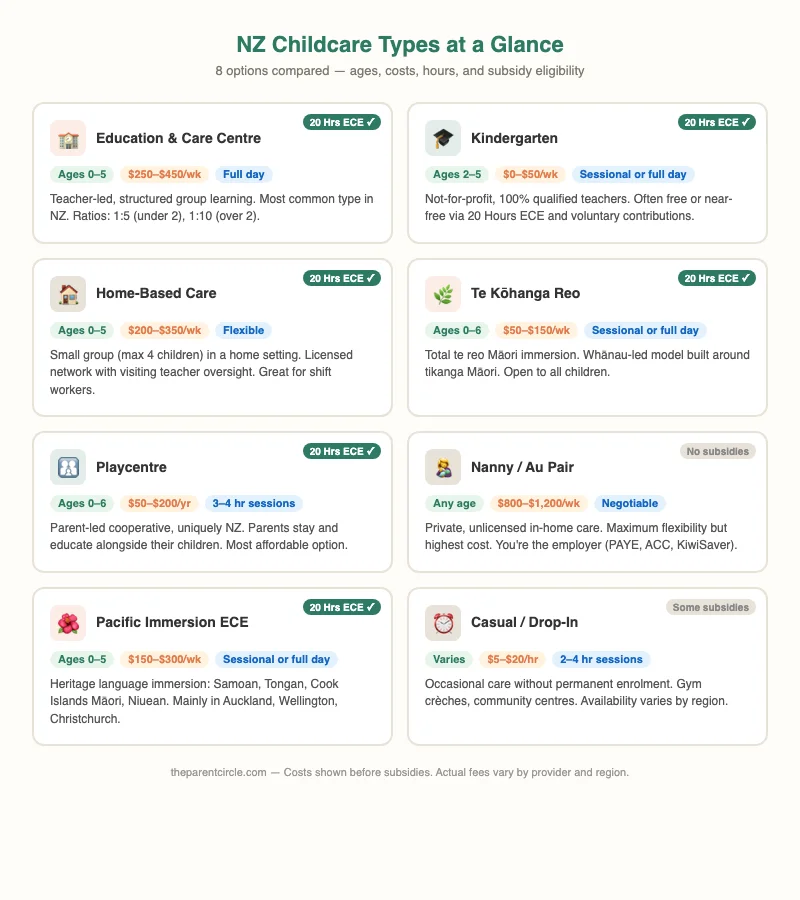
| Type | Ages | Typical hours | Weekly cost (pre-subsidy) | 20 Hrs ECE? | Licensed? |
|---|---|---|---|---|---|
| Education and care centre | 0–5 | 7 am – 6 pm (full day) | $250–$450 | Yes (age 3+) | Yes |
| Kindergarten | 2–5 | 4–6 hrs (sessional) or full day | $0–$50 (voluntary) | Yes | Yes |
| Home-based | 0–5 | Flexible (incl. non-standard) | $200–$350 | Yes (age 3+) | Yes |
| Te Kōhanga Reo | 0–6 | Sessional or full day | $50–$150 | Yes (age 3+) | Yes |
| Playcentre | 0–6 | 3–4 hrs (sessional) | $1–$5/session | Yes (age 3+) | Yes |
| Nanny / Au pair | Any | Negotiable | $800–$1,200 (nanny) | No | No |
| Pacific immersion | 0–5 | Sessional or full day | $150–$300 | Yes (age 3+) | Yes |
| Casual / Drop-in | Varies | 2–4 hrs per session | $5–$20/hr | Some | Some |
How NZ keeps childcare standards up
MOE licensing
Any service calling itself an early childhood education provider in NZ must be licensed by the Ministry of Education. Licensing criteria cover the physical environment (space, safety, outdoor areas), governance, curriculum delivery, staffing qualifications, and adult-to-child ratios. The minimum ratios are 1:5 for children under two and 1:10 for those aged two and over in centre-based services. Home-based educators can care for a maximum of four children under six.
At least 50% of teaching staff in centre-based services must hold a recognised ECE qualification and be registered with the Teaching Council. Kindergartens often exceed this at 100%. Services that meet higher staffing thresholds receive better government funding rates, which creates a financial incentive to employ qualified kaiako.
ERO reviews
The Education Review Office (ERO) independently reviews every licensed service. Reviews look at how well the service implements Te Whāriki, whether children are making progress, and how the centre responds to its community. ERO publishes its reports online, and any parent can look up a centre and read the findings. It is one of the most useful (and underused) tools available to parents. We wrote a full guide on how to read an ERO report if you want to know what to look for.
Licensed vs unlicensed
How to choose the right type for your whānau
Forget about finding the "perfect" childcare type. There is no such thing. What works brilliantly for one family might be a disaster for another. Instead, start with your non-negotiables and work from there.
- Your schedule: Do you need full-day care five days a week, or just a few mornings? Full-day centres and home-based care suit working parents. Kindergarten and Playcentre suit families with a parent available during the day.
- Your budget: Kindergarten and Playcentre are the cheapest options. Nannies are the most expensive. Everything else falls between $200 and $450 per week before subsidies. Use our cost estimator to model your actual out-of-pocket costs.
- Your child's age: Under-2 care is only available at daycare centres, home-based services, Te Kōhanga Reo, and Playcentre. Kindergartens typically start at age two.
- Group size preference: Some tamariki thrive in busy centres with lots of other children. Others do better in the quiet of home-based care with three or four peers. Watch your child, they will tell you what they need.
- Language and culture: If raising your child bilingual matters to you, Te Kōhanga Reo, Pacific immersion services, and some bilingual centres offer something mainstream services cannot replicate.
- Location and commute: A centre 40 minutes from home might be rated highly, but the daily drive will grind you down. Start by searching for providers near you and work outward.
- Philosophy: Montessori, Steiner, Reggio Emilia, play-based, nature-based, if a specific approach resonates with you, some centres specialise. Most NZ ECE services default to play-based learning under Te Whāriki.
Once you have narrowed down the type, visit at least two services in person. Watch how kaiako interact with tamariki. Are they down on the floor, engaged? Or standing around chatting to each other? The atmosphere in the first five minutes tells you more than any brochure. We have a list of 30 questions to ask on a visit and a guide to childcare red flags that can help you compare.
Try before you commit
Subsidies that apply across most types
NZ has three main funding mechanisms that reduce what families actually pay. All three apply to licensed services, and you can stack them.
- 20 Hours ECE. 20 free hours per week for children aged three to five at any participating licensed service. Funded directly to the provider. Universal. no income test.
- WINZ Childcare Subsidy. Income-tested subsidy for families who meet work, training, or health criteria. Covers children from birth to five at licensed services. Can be used alongside 20 Hours ECE to cover hours beyond the free 20.
- FamilyBoost. A tax rebate of up to 25% of out-of-pocket ECE fees, capped at $975 per quarter ($3,900 per year). Available to families with household income under $180,000. Claimed through IRD after paying fees.
A family earning $90,000 with a three-year-old in full-time daycare might pay $350 per week in gross fees, but after 20 Hours ECE covers roughly $150, and WINZ subsidises another $80, the actual out-of-pocket drops to around $120, and FamilyBoost rebates a further $30 of that at tax time. For a detailed breakdown, see our complete guide to childcare costs in NZ.
Mixing and matching childcare types
Plenty of NZ families use more than one type of care. A common arrangement is kindergarten three mornings a week (covered by 20 Hours ECE) combined with a grandparent or home-based carer on the other days. Others do three days at a daycare centre and two days at Te Kōhanga Reo to give their child both mainstream socialisation and te reo immersion.
20 Hours ECE can be split across a maximum of two licensed services, which gives families room to mix. The practical challenge is logistics: different drop-off locations, different routines, and different communication systems. But if it means your child gets the best of two worlds without blowing your budget, it is worth the juggle.
Frequently asked questions
What is the cheapest type of childcare in NZ?
Playcentre is the most affordable, with annual fees of $50 to $200 plus small session charges. Kindergartens are also very low-cost, with most relying on 20 Hours ECE funding and asking only for small voluntary contributions. Te Kōhanga Reo fees are typically $50 to $150 per week, well below mainstream centre rates.
Can I use 20 Hours ECE at any childcare type?
20 Hours ECE is available at any licensed and participating ECE service for children aged three to five. This includes daycare centres, kindergartens, home-based care, Te Kōhanga Reo, Playcentre, and Pacific language immersion services. It does not apply to unlicensed care like nannies or most casual drop-in options.
What age can my child start childcare in NZ?
Licensed education and care centres, home-based services, Te Kōhanga Reo, and Playcentre all accept children from birth. Kindergartens typically start from age two. Most children begin some form of ECE between six months and two years, with participation rates above 96% by age three.
Is Te Kōhanga Reo only for Māori families?
No. Te Kōhanga Reo is open to all families, regardless of ethnicity. The programme operates in te reo Māori, so children will learn the language through full immersion. Any whānau wanting their tamariki to grow up bilingual in te reo Māori is welcome.
How do I find childcare near me?
The Parent Circle lists over 4,394 licensed providers across NZ. You can search by location, care type, and features using our search tool at theparentcircle.com/search. The Ministry of Education also maintains a register of licensed services on Education Counts.
Can I combine different types of childcare?
Yes, and many families do. A common setup is kindergarten in the mornings plus a grandparent or home-based carer in the afternoons. Or three days at a daycare centre plus two days with a nanny share. The key is that 20 Hours ECE can be split across up to two licensed services.
Choosing childcare is one of the first big parenting decisions, and it can feel overwhelming when you see how many options exist. Start by ruling out what clearly does not fit. If both parents work full time, Playcentre is off the table. If your budget is tight, nannies probably are too. Then visit the shortlisted options and trust your gut. The right service for your whānau will feel right when you walk through the door. Use our compare tool to put your top picks side by side, or search all 4,394+ providers across NZ to find what is available in your area. To understand how each type of ECE supports your child's cognitive, social, and language development, read our child development and ECE guide.
Find the right childcare for your family
Search over 4,394 licensed ECE providers across New Zealand. Filter by care type, location, and the features that matter to your whānau.
Search providers near youRelated guides
Rural Childcare in NZ: Options for Families Outside Major Cities
Rural childcare in NZ takes more planning, but there are workable options: small centres, Playcentre, home-based care, kōhanga reo, and local whānau networks.
Nanny Care in NZ: Costs, Legalities, and How to Find the Right Nanny (2026)
Full guide to hiring a nanny in NZ: hourly rates ($23.50-$50/hr), employer obligations (PAYE, KiwiSaver), finding and vetting candidates, nanny shares, au pairs, and subsidy eligibility.
Daycare in NZ: Everything Parents Need to Know About Centre-Based Care (2026)
A practical guide to daycare centres in New Zealand — what they cost in 2026, how they're regulated, what a typical day looks like, and how to choose the right one for your child.
Childcare Costs for Under-2s: Why Infant Care Is More Expensive and What You Can Do
Infant care costs more in NZ because under-2 rooms must staff to a 1:5 ratio. See 2026 price ranges, regional estimates, subsidy options, and ways to cut the bill.
Find childcare near you
Search and compare providers by suburb, care type, cost, and availability.