
Resource Hub
Childcare Across New Zealand: A Region-by-Region Guide for 2026
Published · Last updated · 15 min read

Contents
How different is childcare from one NZ region to another?
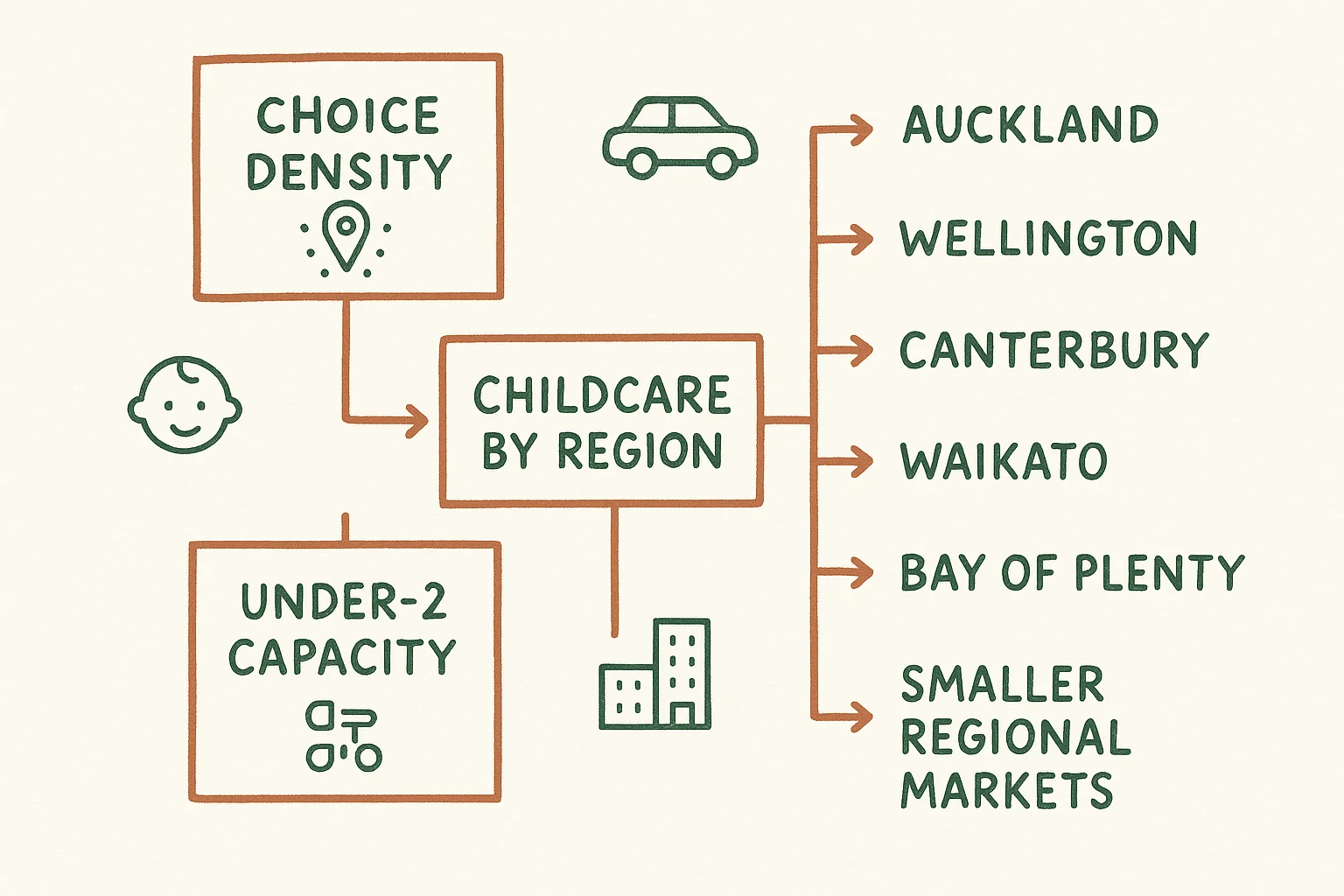
Very different. The Parent Circle database currently lists 4,394 active licensed providers across 1,026 suburbs, but they are not spread evenly. Auckland alone has 1,412 providers across 207 suburbs, while the West Coast has 20 across 10 suburbs. For parents, cost is only one part of the decision. The bigger issue is how much choice you have near home, near work, and for your child's age.
Why a regional guide matters
A lot of childcare advice in New Zealand gets flattened into one national story. That is not how it feels when you are actually trying to enrol a child. Looking in central Auckland is a different exercise from looking in Southland, Gisborne, or a small town in Northland. The number of nearby centres changes. The mix of care types changes. The odds of finding under-2 spaces change. Even the shape of your week changes if you are dealing with motorway commutes, hilly city travel, or long drives between towns.
This guide uses The Parent Circle's live provider dataset as the starting point. That gives us a useful view of provider density by region and suburb. It does not magically solve every fee and waitlist question, because regional fee data in New Zealand is still patchy. Where exact numbers are thin, I will say that plainly rather than pretend there is precision that does not exist.
If you want the shortest version, here it is. Auckland gives you the most choice, but that does not automatically mean the easiest search. Large markets often come with heavier demand and more neighbourhood-level variation. Regions with fewer providers may feel simpler on paper, but a small market can become stressful fast if you need under-2 care, unusual hours, or a specific philosophy.
How to use this guide
Read your region with three filters in mind: choice, convenience, and flexibility. Choice means how many realistic options sit within your daily travel pattern. Convenience means whether those options line up with school drop-off, work, and traffic. Flexibility means whether the market gives you backups if your first-choice centre has no space.
If you are still at the broad comparison stage, open search in another tab and keep this guide beside it. If you are down to a shortlist, use compare. If cost is your main pressure point, pair this article with our deeper breakdown on childcare costs by region and the cost estimator.
A national snapshot of childcare across NZ
The Parent Circle currently tracks 4,394 active licensed providers across 1,026 suburbs. That scale matters because it tells us two things at once. First, New Zealand families do have real choice overall. Second, that choice clusters heavily in a handful of larger regions. Auckland, Canterbury, Waikato, Wellington, and Bay of Plenty account for most of the national market.
Policy settings are national, even when local pressure is not. Children aged 3, 4, and 5 can use up to 20 Hours ECE each week, up to 6 hours a day, and services cannot charge fees for those funded hours. All licensed ECE services also receive a broader subsidy for up to 30 hours a week. For some families, FamilyBoost now matters too. For quarters ending after 1 July 2025, households under $35,000 quarterly income can claim up to 40% of ECE costs, capped at $1,560 a quarter, with abatement above that threshold.
Those subsidies help, but they do not erase geography. A family in a high-demand Auckland suburb may still be making decisions months earlier than a family in a lower-pressure town. A family in a smaller region may face the opposite problem: fewer total providers, fewer under-2 places, and less room to pivot if the first centre does not feel right.
One 2026 change worth knowing
Regional comparison at a glance
| Region | Providers | Suburbs covered | Avg licensed capacity | Avg under-2 capacity |
|---|---|---|---|---|
| Auckland | 1,412 | 207 | 55.7 | 22.0 |
| Canterbury | 494 | 134 | 51.7 | 18.2 |
| Waikato | 489 | 108 | 47.7 | 17.7 |
| Wellington | 408 | 112 | 45.0 | 18.3 |
| Bay of Plenty | 356 | 83 | 45.6 | 16.9 |
| Manawatu-Wanganui | 236 | 57 | 45.3 | 18.5 |
| Hawke's Bay | 214 | 52 | 42.3 | 20.3 |
| Northland | 208 | 77 | 40.0 | 14.8 |
| Otago | 178 | 63 | 47.6 | 20.2 |
| Taranaki | 106 | 34 | 46.8 | 17.6 |
| Southland | 83 | 30 | 46.2 | 23.2 |
| Gisborne | 66 | 25 | 39.4 | 13.5 |
| Tasman | 47 | 13 | 41.6 | 17.1 |
| Marlborough | 39 | 11 | 43.7 | 22.6 |
| Nelson | 37 | 9 | 44.2 | 18.0 |
| West Coast | 20 | 10 | 41.8 | 14.8 |
Source: The Parent Circle provider database, April 2026. Capacity figures are region-level averages across active licensed providers.
Do not read this table as a league ladder. Bigger is not always better. A large market gives more options, but also more noise. A smaller market may give fewer choices, but some families prefer the shorter decision list and tighter community feel. The useful question is how much slack the market gives you if your first plan falls apart.
Auckland: the biggest market, and the most uneven
Auckland is in its own category. With 1,412 providers across 207 suburbs, it has by far the largest childcare market in the country. That is good news if you want options across care types, operating styles, and neighbourhoods. It is less comforting if you assumed a big market would make the search easy. It usually does not. Auckland is really dozens of childcare markets sitting side by side.
Suburb-level variation matters a lot here. Our current data shows Henderson and Manurewa with 54 providers each, followed by Otara with 42, Mangere with 41, Papatoetoe with 39, and Papakura with 37. That tells you there is serious volume in the wider market. It does not tell you whether the centre that suits your route, your budget, and your child's age has a place next month. In Auckland, 'lots of centres nearby' and 'lots of actual options for us' are not the same sentence. For a suburb-by-suburb shortlist, see our Auckland childcare suburb guide.
Commuting is the hidden variable. A centre that looks perfect on paper can be useless if it adds forty minutes in the wrong direction. Parents working in the CBD, Greenlane, Penrose, Albany, or the airport corridor should usually search two maps at once: one around home, one around work. If both adults commute in different directions, you need a pickup backup plan early, not after enrolment. Start with the Auckland hub, then zoom into suburbs rather than treating the whole region as one pool.
- Expect the most choice in the country, but also the most suburb-level variation.
- If you need under-2 care, start early. Big markets still get tight in the age groups that need smaller ratios.
- Search around both home and work before booking visits.
- Use travel time as a hard filter, not a nice-to-have.
Wellington: compact geography, concentrated pressure
Wellington has 408 providers across 112 suburbs. That is a healthy market, but it behaves differently from Auckland. Distances are shorter on paper, yet the city can still be awkward because of terrain, traffic bottlenecks, and work patterns. Parents commuting into the CBD, hospital precincts, tertiary campuses, or government offices often care more about route logic than raw provider count.
The Wellington decision is often a corridor decision. Do you want care close to home in Lower Hutt, Upper Hutt, Porirua, or the Kapiti Coast? Or close to work in the city? The answer changes your shortlist completely. A centre that is only fifteen kilometres away can still feel punishing if the pickup happens at the wrong hour in the wrong direction.
The other thing I would watch in Wellington is routine resilience. Wind, weather, hill suburbs, and packed roads can all take a normal day and make it messy. Families who need precision should lean toward centres that sit inside the route they already drive. Start with the Wellington hub, then check whether the shortlist still makes sense on a rainy Thursday, not only in a quiet planning moment.
Canterbury: broad choice and room to compare
Canterbury has 494 providers across 134 suburbs, which makes it the second-largest regional market in our current dataset. That usually gives families more room to compare without the same scale of network sprawl you get in Auckland. Christchurch and its surrounding growth areas still need suburb-level thinking, but the overall market gives you a decent amount of breathing room.
The practical split in Canterbury is between established Christchurch suburbs, newer growth areas, and satellite communities such as Selwyn and Waimakariri. If you live in a fast-growing pocket, do not assume supply has caught up cleanly with new housing. New developments bring new families before they always bring enough convenient ECE places.
Canterbury is often a good region for families who want a balance between choice and manageability. You can usually compare several realistic options within a workable radius, which is exactly what parents need. Not infinite choice, just enough choice to say no to a poor fit without panicking. Use the Canterbury hub to scan both urban and nearby satellite options.
Waikato: strong coverage beyond one city
Waikato has 489 providers across 108 suburbs, almost matching Canterbury on provider count while spreading across a different mix of city, town, and semi-rural communities. That matters because Waikato often works well for families who want options outside a single metro pattern. Hamilton is the obvious anchor, but the region's value is that it does not stop there.
For some families, Waikato is a serious affordability and lifestyle alternative to Auckland. I would still be careful with easy assumptions here. Lower housing pressure in one place does not guarantee effortless childcare access everywhere. What Waikato often offers is a wider spread of workable local markets, including town-based options where families can keep care close to home and avoid a heavy metro commute.
If you are choosing between suburbs or towns, look hard at your day shape. Cambridge, Te Awamutu, Matamata, and other centres can be great for families whose work and school patterns are local. If you are doing long cross-region commuting, that advantage fades quickly. Start with the Waikato hub and test your shortlist against the route you actually drive.
Bay of Plenty: growth, lifestyle, and pressure pockets
Bay of Plenty has 356 providers across 83 suburbs. That is a substantial market, but one that can feel tighter than the raw number suggests because growth is not evenly spread. Tauranga, Papamoa, Mount Maunganui, and nearby coastal growth areas attract families quickly. Fast growth is great until everyone starts needing childcare at roughly the same life stage.
This is one of those regions where lifestyle narratives can get in the way of realistic planning. A coastal move may look like a family upgrade, and often it is, but the childcare piece still needs old-fashioned legwork. Search availability early, especially if you need full-time care, under-2 places, or very close-to-home convenience.
Bay of Plenty also has useful variation inside the region. Rotorua, Whakatane, Katikati, and Te Puke bring different trade-offs around density, community, and travel. If you are relocating here, avoid treating the whole region as one childcare market. Use the Bay of Plenty hub and compare by town or corridor, rather than by regional label alone.
North Island smaller regions: less volume, more local context
The next group matters because this is where families can get caught by averages. Manawatu-Wanganui has 236 providers across 57 suburbs, Hawke's Bay has 214 across 52, Northland has 208 across 77, Taranaki has 106 across 34, and Gisborne has 66 across 25. None of those numbers are tiny in isolation. The real issue is how far that supply is spread and how many realistic substitutes exist near your exact home or workplace.
Manawatu-Wanganui often works well for families who want city services without major-city sprawl, especially around Palmerston North and Whanganui. Hawke's Bay can feel solid around Napier and Hastings, but choice naturally narrows as you move outward. Northland is a classic example of why regional totals can mislead. With 77 suburbs covered, supply is spread across a wide geography. That gives reach, but not necessarily dense choice in one immediate pocket.
Taranaki and Gisborne are more local still. Parents there should worry less about national averages and more about practical backup plans. If the first preferred centre does not fit, how many alternatives are still realistic without blowing up the school run, work hours, or fuel bill? That is the question. Use Northland, Hawke's Bay, Taranaki, Manawatu-Wanganui, and Gisborne pages as local maps, rather than plain directories.
What smaller regional markets often reward
Otago: distinct local markets inside one region
Otago has 178 providers across 63 suburbs. That sounds moderate until you remember how different Dunedin, Queenstown-Lakes, and smaller Central Otago communities feel in daily life. Otago is not one market. It is several local childcare stories that happen to share a regional label.
Dunedin tends to offer the most stable comparison environment because it has an established urban base. Queenstown and nearby growth areas can feel very different because housing pressure, tourism-driven labour patterns, and rapid population movement change what 'convenient care' looks like. In smaller Otago communities, the main issue may simply be choice density. If one provider is full or not the right fit, the next realistic option may be meaningfully farther away.
Families moving to Otago should avoid relying on a regional average. Search the exact town first, then the surrounding area, then the wider region. If your family depends on one parent working unusual hours or travelling between towns, that should drive the search from the start. The Otago hub is most useful when you treat it as a cluster of local markets.
South Island smaller regions: great fit for some families, little slack for others
Outside Canterbury and Otago, the South Island numbers get much smaller. Southland has 83 providers across 30 suburbs, Tasman 47 across 13, Marlborough 39 across 11, Nelson 37 across 9, and the West Coast 20 across 10. That does not make these regions poor choices. It simply means parents need to be honest about how much redundancy exists in the local market.
If you value shorter travel, stronger local community ties, and a less frantic metro feel, these regions can be very appealing. But a small market can tighten quickly. The difference between 'we have a few solid options' and 'we have one option and we need it to work' is smaller than many families expect. That is especially true if you need care before age three, non-standard hours, or a very specific philosophy.
Nelson and Tasman are a good example of adjacent markets that should often be searched together. The same goes for parts of Marlborough and nearby towns. On the West Coast, provider counts alone tell you what you need to know: flexibility and travel tolerance matter. Use Tasman, Nelson, Marlborough, Southland, and West Coast pages with a realistic radius in mind.
Where childcare choice gets thin
Parents sometimes use the term 'childcare desert' for areas where formal childcare options are limited relative to need. I would use it carefully, because demand moves faster than national reporting. Still, the risk is real in lower-density places, fringe growth areas, and towns where one or two providers carry most of the local load. The pattern to watch is low provider count combined with low backup value.
The West Coast is the clearest numerical example in our data with 20 providers across 10 suburbs. Gisborne, Marlborough, Nelson, and Tasman also run much smaller markets than the main metro regions. Parts of Northland can feel similar for a different reason: coverage is broad, but not necessarily dense where you live. Fast-growth outer suburbs in larger regions can create a different kind of thinness, where the region looks rich in supply while the local pocket still feels jammed.
- You only have one or two realistic providers within your daily route.
- You need under-2 care and nearby alternatives are limited.
- The next backup option adds a major travel penalty.
- Your family schedule depends on strict pickup times with little slack.
- Your move-in date and preferred start date are close together.
How to search by region and suburb on The Parent Circle
The easiest mistake is searching too wide for too long. Start broad at search, but narrow quickly. Pick your region first, then move to suburb or corridor. In a big region, use suburb names and travel logic. In a smaller region, widen the radius only after you have checked the closest realistic pocket.
If you are moving, do not wait until the house is finalised before starting the childcare search. Use this guide to shortlist the region, then compare nearby providers, then line that up with your likely commute. If you are choosing between two areas, compare and the Auckland, Wellington, or other region hubs will help you see the trade-off more clearly than a generic search ever will.
How to think about cost, under-2 places, and timing
Parents often ask for the cheapest region, but that question is too blunt to be useful on its own. What you really need is the likely net cost after national support, matched against the amount of choice you still have locally. A region can look cheaper overall and still cost you more in practice if the only workable centre forces extra travel, awkward hours, or backup care you had not budgeted for.
National rules create some consistency. Children aged 3 to 5 can use up to 20 Hours ECE, limited to 6 hours a day, and services cannot charge fees for those funded hours. That is a real help, especially for families comparing full-time and part-time attendance. It does not remove all extras, and it does not solve regional scarcity. Optional charges, hours outside the funded cap, and the daily logistics around pickup still shape the true cost of care.
Under-2 care deserves its own paragraph because this is where many families get surprised. Centres must run tighter ratios for younger children, so a large regional market can still feel constrained if your child is under two. Our current data shows average under-2 capacity around 22.0 in Auckland, 20.3 in Hawke's Bay, 20.2 in Otago, 18.5 in Manawatu-Wanganui, and 13.5 in Gisborne. Those figures are not availability counts, but they are a good reminder that the younger age group often behaves like a narrower market inside the wider one.
Timing matters just as much as price. If you are moving regions, do not wait until the address is locked in before asking questions. You can shortlist suburbs early, map nearby providers, ask about likely enrolment timing, and work out whether you need an interim plan. Families who move from a deeper market into a thinner one often discover too late that the second-choice option is not five minutes away. It is thirty.
If your budget is tight, look at the whole stack. Work out likely fees after 20 Hours ECE, check whether FamilyBoost could reduce your net outlay, and compare that against transport and time costs. Sometimes the cheaper centre is genuinely cheaper. Sometimes it only looks cheaper until you add the weekly driving, the missed flexibility, or the extra stress on pickup.
Three practical rules I would use in any region
- Pick the route before you pick the centre. A beautiful centre that breaks your week is not a good fit.
- Treat under-2 care as a separate search. Ratios are tighter and backup options are thinner.
- Make your shortlist sooner than feels necessary. Families who wait for certainty usually end up searching under pressure.
Frequently asked questions
Which NZ region has the most childcare choice?
Auckland has the most raw choice in The Parent Circle dataset, with 1,412 providers across 207 suburbs. But raw choice is not the same as easy choice. Commute patterns, suburb-level demand, and your child's age can still make the search feel tight.
Are childcare costs clearly lower outside Auckland?
Sometimes, but not neatly enough to rely on broad stereotypes. Regional fee data in New Zealand is still patchy. In general, larger metro areas often feel more expensive and more pressured, but families should compare actual providers and net costs after 20 Hours ECE and any FamilyBoost entitlement.
How early should I start looking if we are relocating?
Earlier than most people expect. If you are moving into a high-demand suburb or need under-2 care, start researching before the move is final. Our guide on [when to start looking for childcare](/blog/when-to-start-looking-for-childcare-nz-timeline) is a good next read.
What matters more, region or suburb?
Suburb usually matters more once you know the broad region. Regions help you compare the shape of the market. Suburbs tell you whether the search works for your actual day.
Can I use 20 Hours ECE in any region?
Yes, the funding rules are national. Children aged 3 to 5 can use up to 20 funded hours a week, up to 6 hours a day, at participating licensed services, and parents cannot be charged fees for those funded hours. The challenge is not the policy. It is finding the right place in the right location.
The right region is the one that still works on an ordinary Wednesday
Parents can get trapped chasing abstract bests. Best city. Best suburb. Best centre. Real life is rougher than that. The better question is whether your childcare setup still works when traffic is ugly, one parent is late, your child is tired, and the day is already running behind. That is why regional context matters so much. It changes what a realistic option looks like.
If you are choosing between regions, compare them on friction, not fantasy. How many credible options exist near where you will live? How exposed are you if the first option falls through? How hard is pickup in the worst part of the day? Those questions are more useful than generic claims about which city is 'best for families'.
Once you know your likely region, move from broad reading into practical search. Use search, compare local options, and cross-check anything that looks promising against your real routine. If you are starting from scratch, our complete guide to choosing childcare in NZ is the best companion piece to read next.
Find the right centre
Search 4,394+ licensed providers across 1,026 suburbs and compare the options that actually fit your family's route, budget, and age-group needs.
Start searchingRelated guides
Rural Childcare in NZ: Options for Families Outside Major Cities
Rural childcare in NZ takes more planning, but there are workable options: small centres, Playcentre, home-based care, kōhanga reo, and local whānau networks.
Childcare in Otago: Dunedin, Queenstown, Wānaka, and the Wider Region (2026)
Looking for childcare in Otago? This practical 2026 guide breaks down Dunedin, Queenstown-Lakes, Central Otago, Clutha, and Waitaki so you can build a shortlist that actually fits your week.
Childcare in Bay of Plenty: Tauranga, Rotorua, and the Wider Region (2026)
Looking for childcare in Bay of Plenty? This practical 2026 guide breaks down Tauranga, Papamoa, Rotorua, Western Bay, and Eastern Bay so you can build a shortlist that actually fits your week.
Childcare in Waikato: Hamilton and the Greater Waikato Region (2026)
Looking for childcare in Waikato? This practical 2026 guide breaks down Hamilton, Cambridge, Te Awamutu, northern Waikato, Taupo, and smaller regional markets so you can build a shortlist that actually fits your week.
Find childcare near you
Search and compare providers by suburb, care type, cost, and availability.