
Resource Hub
Childcare Red Flags: 15 Warning Signs Every NZ Parent Should Know
Published · Last updated · 7 min read

Contents
What are the red flags to watch for in a New Zealand childcare centre?
Watch for centres that can't produce a current ERO report, have constantly changing staff, maintain poor adult-to-child ratios (the legal minimum is 1:5 for under-2s), restrict parent access during the day, lack visible health and safety procedures, or become defensive when you ask questions. If your child shows behavioural regression, unusual anxiety, or unexplained injuries after starting care, treat these as serious warning signs.
Why red flags matter more than brochures
Every childcare centre in New Zealand has a website. Most have photos of smiling tamariki, a paragraph about Te Whāriki, and a reassuring blurb about qualified kaiako. None of that tells you what happens when the door closes behind you.
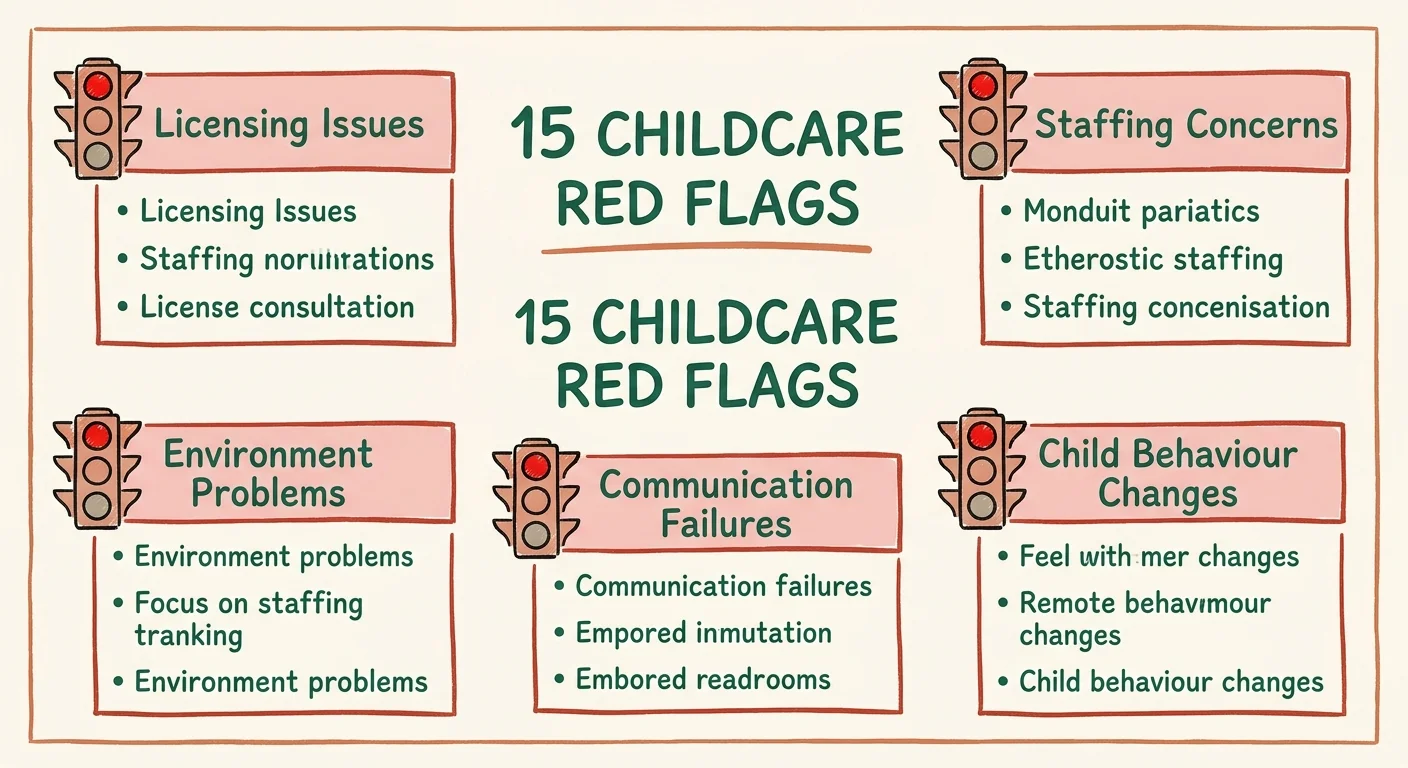
The real signals are in what you observe, what staff say when pressed, and how your child responds over time. This guide covers 15 specific red flags grounded in NZ regulations and ERO review findings — the kind of things that separate a centre doing the bare minimum from one that genuinely puts children first.
If you're still choosing between centres, our complete guide to choosing childcare in NZ covers the full decision framework.
Licensing and regulatory red flags
Every teacher-led ECE centre in New Zealand must hold a current licence from the Ministry of Education. You can verify any centre's licence status on the MOE Early Learning Services directory. If a centre isn't listed, that's not a minor issue — it's illegal operation.
- Red flag #1: No visible licence or ERO report. Licensed centres must display their licence. If you can't see it on the wall, ask. If they can't produce it, leave.
- Red flag #2: "Provisionally licensed" status. This means the centre has been flagged by MOE and is operating under conditions. Check the ERO website for the specific review — it will tell you exactly what went wrong.
- Red flag #3: The centre is licence-exempt. Some services (certain playgroups, some homebased arrangements) operate without a licence. That means no MOE oversight of teacher qualifications, ratios, or curriculum. It's legal, but you're trusting the provider entirely on their word.
- Red flag #4: Overdue ERO review. Centres rated "Well Placed" get reviewed every 3 years; "Very Well Placed" every 4. If the last review is older than that, something may have stalled the process.
Staffing red flags
NZ's ECE sector has a well-documented teacher shortage. The NZEI Te Riu Roa has repeatedly flagged burnout and low pay as driving qualified teachers out of the sector. For parents, the downstream effect is real: centres cutting corners on ratios, relying on unqualified relievers, and cycling through staff so quickly that children never form stable attachments.
- Red flag #5: High staff turnover. If you visit three months apart and half the faces have changed, that's a workforce problem. Children under three need consistent primary caregivers to develop secure attachments. Ask the centre directly: "How long has your longest-serving teacher been here?"
- Red flag #6: Poor adult-to-child ratios. The legal minimum is 1:5 for under-2s and 1:10 for over-2s. But these are minimums — the floor, not the standard. Quality centres aim for 1:3 or 1:4 for infants. Ask about "effective ratios" — what happens during lunch breaks, nappy changes, and non-contact time when teachers step off the floor.
- Red flag #7: Unqualified or underqualified staff. Current regulations require 50% of staff to hold a recognised ECE qualification. Top centres sit at 80-100%. Ask what percentage of their teachers are fully qualified and whether they've opted into Pay Parity — centres that pay teachers properly tend to keep them.
- Red flag #8: Reliance on relievers. Every centre needs relievers occasionally. But if the same room has a different adult every week, children experience that as instability. Ask how the centre handles teacher absences.
Environment red flags
You can read a lot about a centre in the first 60 seconds. Before anyone greets you, look around. Use your nose. NZ's licensing criteria and Code of Conduct set specific requirements for the physical environment — and a centre that doesn't meet the basics visually is unlikely to meet them behind the scenes.
- Red flag #9: Dirty or poorly maintained spaces. Sticky surfaces, overflowing nappy bins, stained carpets, broken equipment left in play areas. The Code of Conduct requires hazard identification and management. Visible neglect suggests systemic neglect.
- Red flag #10: No outdoor space or a token outdoor area. NZ children need challenging outdoor play — climbing, digging, running, getting muddy. A concrete yard with a plastic slide doesn't cut it. ERO reports consistently flag inadequate outdoor environments as a quality concern.
- Red flag #11: Overstimulating or chaotic environment. Constant noise, fluorescent lighting, plastic toys stacked to the ceiling. Quality centres use natural materials (blocks, shells, fabric), keep noise at a "happy hum," and create calm, defined spaces. If it feels like a warehouse, your child will feel that too.
Communication red flags
- Red flag #12: No parent access policy or restricted visiting. You should be able to visit your child at any time during operating hours without prior arrangement. A centre that discourages unannounced visits is hiding something. Full stop.
- Red flag #13: Defensive or evasive answers to questions. When you ask about ratios, qualifications, or ERO reports and get vague responses like "we meet all the requirements" without specifics — that's a dodge. Good centres are proud of their numbers and will share them openly.
- Red flag #14: No digital communication system. Most quality NZ centres use platforms like Storypark or Educa to share daily updates, learning stories, and photos. If a centre communicates only via a whiteboard in the hallway, they're not investing in parent partnership.
Behavioural red flags in your child
Some settling-in wobbles are completely normal — most tamariki take 2-4 weeks to adjust to a new environment. But there's a clear line between normal adjustment and signs that something is genuinely wrong.
Red flag #15: Persistent behavioural changes after the settling period
Any single incident deserves a calm conversation with the centre. A pattern of these signs warrants serious action.
What to do if you spot red flags
- Document everything. Dates, times, what you saw or your child said. Keep a written record — it matters if you need to escalate.
- Raise it with the centre first. Talk to the head teacher or manager. Most issues have explanations. How they respond tells you more than the issue itself — defensiveness is a red flag on top of a red flag.
- Check the ERO report. Go to ero.govt.nz and read the most recent review. If your concern aligns with existing findings, the pattern is real.
- File a complaint with the Ministry of Education. If the centre is breaching licensing conditions, contact MOE's early learning team. They have the power to investigate, issue conditions, or revoke licences.
- Contact ERO directly. You can request an out-of-cycle review if you believe children's safety is at risk. ERO takes parent-initiated complaints seriously.
- Start looking for alternatives. Use The Parent Circle's search tool to find licensed, reviewed centres near you. Don't wait until you've found the perfect replacement — knowing your options reduces the pressure to stay in a bad situation.
The trust test: a quick self-check
After every visit or interaction with your child's centre, ask yourself one question: "Would I be comfortable if a camera was recording everything that happens here today?"
If the answer is yes — even on a bad day — you're probably in the right place. If there's a flicker of doubt, pay attention to it. Parent instinct backed by the specific red flags above isn't paranoia. It's due diligence.
| Category | Red Flag | What to Check |
|---|---|---|
| Licensing | No visible licence | Ask to see it; check MOE directory |
| Licensing | Provisionally licensed | Read ERO report for specifics |
| Licensing | Licence-exempt service | Understand what oversight is missing |
| Licensing | Overdue ERO review | Check review date at ero.govt.nz |
| Staffing | High turnover | Ask how long staff have been there |
| Staffing | Poor ratios | Ask about effective ratios, not just legal minimums |
| Staffing | Unqualified staff | Ask % qualified; check Pay Parity status |
| Staffing | Reliance on relievers | Ask about absence management |
| Environment | Dirty/neglected spaces | Trust your eyes and nose |
| Environment | Inadequate outdoor area | Look for challenge, variety, natural elements |
| Environment | Chaotic/overstimulating | Listen for noise levels; look for calm zones |
| Communication | Restricted parent access | You should be able to visit anytime |
| Communication | Evasive answers | Good centres share data openly |
| Communication | No digital updates | Ask about Storypark/Educa or equivalent |
| Child behaviour | Persistent changes post-settling | Document and escalate if pattern emerges |
Frequently asked questions
How many red flags should I see before pulling my child out?
There's no magic number. A single serious red flag (restricted parent access, unexplained injuries, unlicensed operation) justifies immediate action. Multiple minor concerns (high turnover plus poor communication plus a tired outdoor area) create a pattern that's equally concerning. Trust the accumulation.
Can I visit my child's centre unannounced?
Yes. Licensed NZ childcare centres cannot refuse parent access during operating hours. If a centre tells you that you need to book visits in advance or limits when you can come, that's a significant red flag.
How do I check if a centre is licensed?
Search the Ministry of Education's Early Learning Services directory at educationcounts.govt.nz. Every licensed centre is listed with its licence type, location, and service details. If it's not there, it's either licence-exempt or operating illegally.
My child cries at drop-off — is that a red flag?
Not necessarily. Most children cry at drop-off during the first 2-4 weeks — that's normal separation anxiety. It becomes a red flag if the crying persists well beyond the settling period (6+ weeks), is accompanied by other behavioural changes, or if your child is specifically afraid rather than generally upset.
What happens when I file a complaint with MOE?
The Ministry of Education investigates complaints about licensed services. They can conduct unannounced visits, issue provisional licence conditions, require the centre to make changes within a set timeframe, or in serious cases, suspend or cancel the licence entirely. Complaints can be made by phone or through the MOE website.
Finding the right childcare is one of the hardest decisions NZ parents make. Knowing what to watch for makes you a better advocate for your child — and a better judge of where they'll actually thrive. Compare centres side by side using our comparison tool, or search for licensed providers near you to start fresh.
Search for verified, licensed providers
Find childcare centres near you with licensing status, ERO reports, and parent reviews — all in one place.
Search ProvidersRelated guides
Childcare During Family Transitions: A NZ Parent's Guide
A practical NZ guide to supporting your child through separation, moving, grief and other family changes at childcare.
Childcare for Twins and Multiples in New Zealand
A practical guide to finding childcare for twins and multiples, with questions on places, routines, staffing and support.
Steiner/Waldorf ECE in NZ: A Parent's Guide
A practical guide to Steiner/Waldorf early childhood education in New Zealand, including Te Whāriki, centre visits and questions for parents.
Reggio Emilia in NZ: Understanding the Reggio-Inspired Approach to ECE
A practical NZ guide to Reggio-inspired early learning, from inquiry and documentation to questions for your centre visit.
Find childcare near you
Search and compare providers by suburb, care type, cost, and availability.