
Resource Hub
ECE Philosophies Explained: Montessori, Reggio Emilia, Steiner, and More in NZ
Published · Last updated · 19 min read
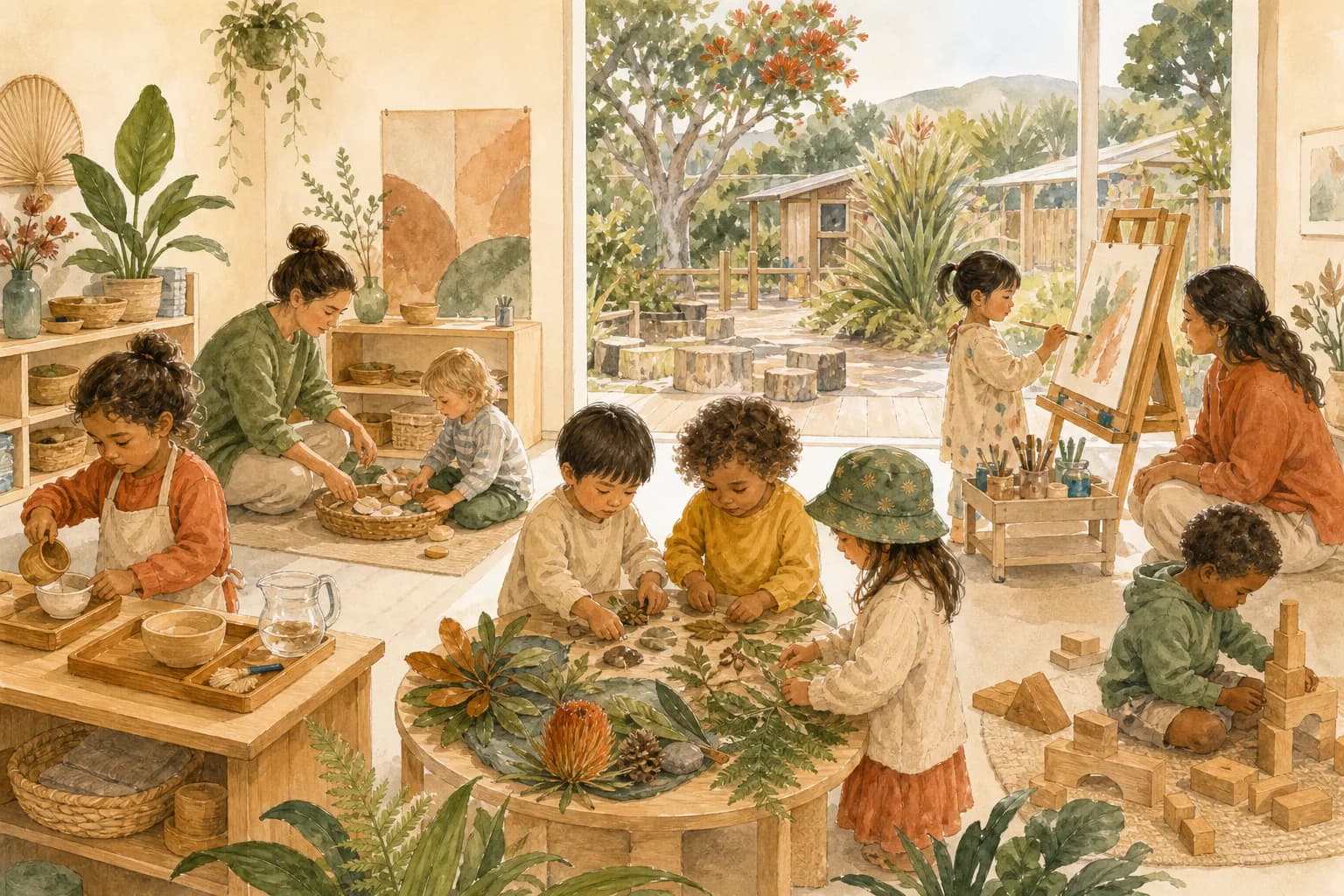
Contents
Which ECE philosophy is best for my child?
There is no single best philosophy. In New Zealand, every licensed early learning service must work within Te Whariki, so the practical question is how a centre turns its stated approach into relationships, routines, play, documentation, and the environment your child experiences each day. Visit more than one service, ask specific questions, and pay attention to whether your child can settle and participate.
ECE philosophies in New Zealand, in plain English
Choosing an early learning service can feel oddly high-stakes. You are not only comparing opening hours, fees, and a car-park situation that may test your patience. You are also trying to work out what your child will do all day, who will notice when they are quiet, and whether the centre's idea of learning makes sense for your whānau.
A philosophy is a set of beliefs about how children learn and how adults should support them. Montessori, Reggio-inspired, Steiner, play-based, nature-based, RIE, and faith-based services can look quite different on a tour. But a philosophy is not a quality rating and it is not a promise that every child will flourish there. The day-to-day practice matters more than the word on the sign.
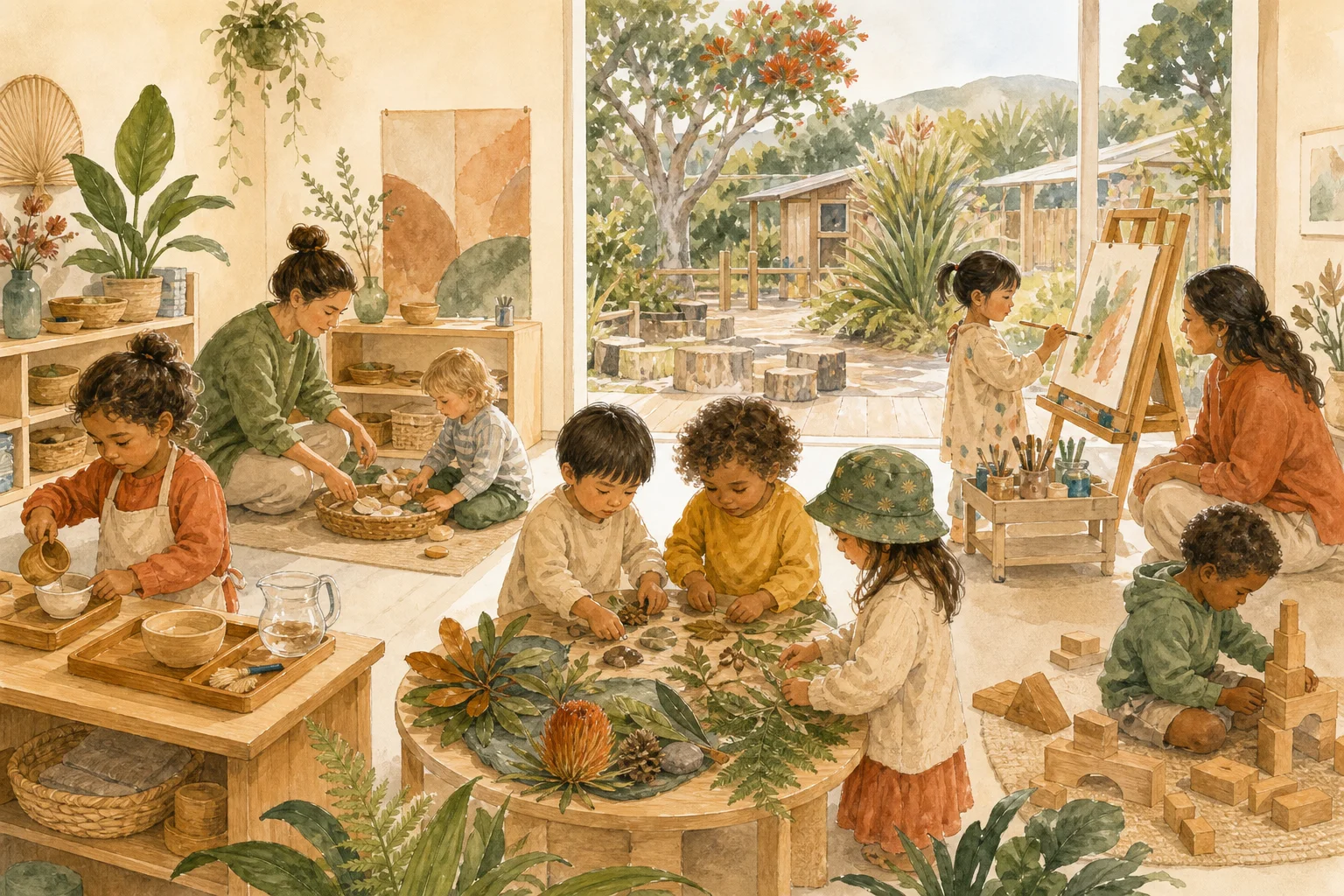
Video
The shared foundation: Te Whariki
Before comparing approaches, start with what they have in common. Licensed and regulated ECE providers in Aotearoa New Zealand work within the Early Learning Curriculum Framework. Te Whāriki, the national early childhood curriculum, gives practical guidance for that work. It is not a timetable that tells every centre what to do at 10.15 on Tuesday. It is a framework that each service weaves into a local curriculum with its community, culture, children, and values in mind.
That is why a good Montessori or Steiner visit should still feel recognisably New Zealand. You should see respect for identity, language, and culture; responsive relationships; and learning connected to children's interests and whānau aspirations. A philosophy can influence the furniture, materials, routines, teacher language, and assessment. It cannot opt a provider out of its legal and professional responsibilities.
| Te Whariki principle | What it can look like at a centre |
|---|---|
| Whakamana | Empowerment | Children have real choices and their ideas affect the programme. |
| Kotahitanga | Holistic development | Learning includes wellbeing, movement, communication, relationships, and thinking. |
| Whānau tangata | Family and community | Kaiako know family aspirations and make them part of planning. |
| Ngā hononga | Relationships | Adults respond warmly and children have time to build trust. |
All licensed approaches should be able to explain these principles in their everyday practice.
The five strands are wellbeing, belonging, contribution, communication, and exploration. They are woven with the four principles rather than taught as separate subjects. This matters when you hear a service say it is highly structured, child-led, outdoors all day, inspired by Italy, or rooted in a faith tradition. Ask how that approach supports all five strands, not just the parts that sound attractive in a brochure.
The Ministry of Education notes that different early learning services can have particular beliefs about teaching and learning, including Montessori and Rudolf Steiner. At the same time, licensing covers education and care, health and safety, premises, governance, and child protection. The label tells you where to begin asking questions. It does not replace checking the service's current ERO information, staffing, communication, and culture.
A useful tour question
Montessori: independence in a prepared environment
Montessori education is associated with Maria Montessori and is usually easy to spot. Rooms often have child-sized shelves, real tools for practical tasks, and carefully sequenced materials for activities such as pouring, sorting, matching, language, and early mathematics. Children are encouraged to choose work, repeat it, care for the space, and gradually do more for themselves. Adults tend to observe closely, introduce materials when a child is ready, and step back rather than constantly direct play.
In a strong Montessori setting, independence does not mean children are left to fend for themselves. It means the environment has been designed so a child can reach a cup, return a material, choose a task, ask for help, and feel capable. ERO reports on NZ Montessori services describe prepared environments, opportunities to make decisions, calm routines, and learning linked to Te Whariki. Those are useful things to look for, rather than assuming every centre that uses the name will feel the same. Read the full Montessori childcare guide for a closer look at choosing a centre.
Some Montessori services use mixed-age groups and longer uninterrupted work periods. Others adapt elements of the approach within a more conventional centre day. That variation is normal. Ask whether the educators have Montessori-specific training, how they support children who prefer social or imaginative play, and how they balance individual choice with group routines such as meals, outdoor time, and rest.
A Montessori environment may suit a child who enjoys choosing a task, concentrating, using hands-on materials, and repeating an activity until it feels mastered. It can also suit children who need a predictable, orderly room. But temperament is not destiny. A lively, highly social child can thrive there too if the adults make room for connection, movement, humour, and shared projects. Visit at a normal time rather than during a staged open day if you can.
Reggio-inspired: children, projects, and the environment
The Reggio Emilia approach began in the Italian city of Reggio Emilia after the Second World War. In New Zealand you are more likely to find a centre described as Reggio-inspired than one claiming to reproduce the original model exactly. Our detailed Reggio Emilia guide explains what to look for on a visit. The approach treats children as capable participants with ideas worth following. Educators often develop investigations from children's questions, document learning with photos and quotes, and use the environment as an active part of the programme.
You may hear the phrase "the environment as the third teacher". In practical terms, that can mean calm, thoughtfully arranged spaces; open-ended materials; displays that show children's theories developing; light, natural objects, drawing, clay, construction, and other ways to express ideas. Documentation is not just decoration. Done well, it helps kaiako revisit children's thinking, decide what to offer next, and share the learning with whānau.
Reggio-inspired practice can be rich and creative, but ask how the centre makes projects accessible to children who enter slowly, use different languages, or would rather participate through movement than drawing. Also ask how documentation is used in planning, not merely displayed. Te Whariki already expects a responsive, local curriculum, so a Reggio-inspired service should be able to explain the connection without treating Italian terminology as a substitute for good teaching.
This approach may appeal to families who enjoy seeing a child's ideas taken seriously and who value collaborative projects, art, conversation, and a strong visual record of learning. It can be a good fit for many children, not only the ones who appear obviously creative. The real test is whether the centre listens carefully and follows through.
Steiner or Waldorf: rhythm, imagination, and natural materials
Steiner, also called Waldorf, education draws on the work of Rudolf Steiner. Early childhood settings often place a strong emphasis on predictable rhythm, imaginative play, storytelling, music, movement, practical domestic activities, and time outdoors. You may notice wooden and natural materials, soft colours, simple open-ended toys, bread making, gardening, seasonal routines, and fewer commercial characters or screens.
The appeal for many families is the pace. A Steiner kindergarten may protect long stretches of play and everyday work instead of pushing formal academics early. That can feel grounding in a busy family life. At the same time, no family should assume a particular philosophy answers every question about literacy, communication, inclusion, transitions, or support needs. Ask how the service plans for your child's current strengths and needs, how it records progress, and how it partners with whānau.
For a closer look at visits, Te Whāriki and practical enrolment questions, read our Steiner/Waldorf ECE in NZ parent guide.
Steiner services still operate within the NZ framework. A good discussion will cover Te Whariki, bicultural practice, relationships, safety, and how children experience the five strands. Look for a calm environment, but also look for warmth and flexibility. A routine that reassures one child may feel restrictive to another. If your child needs a particular support plan, ask how the centre works with specialist services and how they would communicate with you when something is not working.
The label is also used with different levels of commitment. Some services follow a full Steiner philosophy and have a connected school pathway. Others borrow parts of the approach, especially rhythm, natural materials, and imaginative play. Neither is automatically better. You simply need a straight answer about what is actually offered.
Play-based learning: the common NZ approach
Play-based learning is not the absence of teaching. It is a way of learning through play, relationships, conversation, movement, materials, problems, stories, and real experiences. The Ministry of Education describes Te Whariki as a play-based curriculum. In a thoughtful programme, kaiako observe what children are trying to do, add a question or resource at the right moment, and create opportunities that extend learning without turning every activity into a lesson.
A play-based centre may have children building a bridge, negotiating roles in dramatic play, investigating worms, preparing kai, dancing, or making marks with paint. The adult's work is often less visible than a scheduled class, but it should be deliberate. Ask what kaiako notice, how they decide when to join in, and how they document learning. Good answers name real examples, not just a belief that children learn best by having fun.
Because play-based learning is widespread, the term alone does not tell you much about a service. One centre may offer abundant outdoor risk-taking and loose parts. Another may have a calm, highly resourced indoor programme. Some use more adult-led small groups, while others allow long periods of child-initiated activity. What matters is the quality of interaction, the range of experiences, and whether children are safe, engaged, and treated as competent.
Families sometimes worry that a play-based service will not prepare a child for school. That is the wrong frame. Te Whariki is designed for young children, not as a watered-down version of primary school. Ask how the service supports communication, early literacy, curiosity, self-regulation, and belonging. Those foundations matter when children move to school, whatever the centre calls its philosophy.
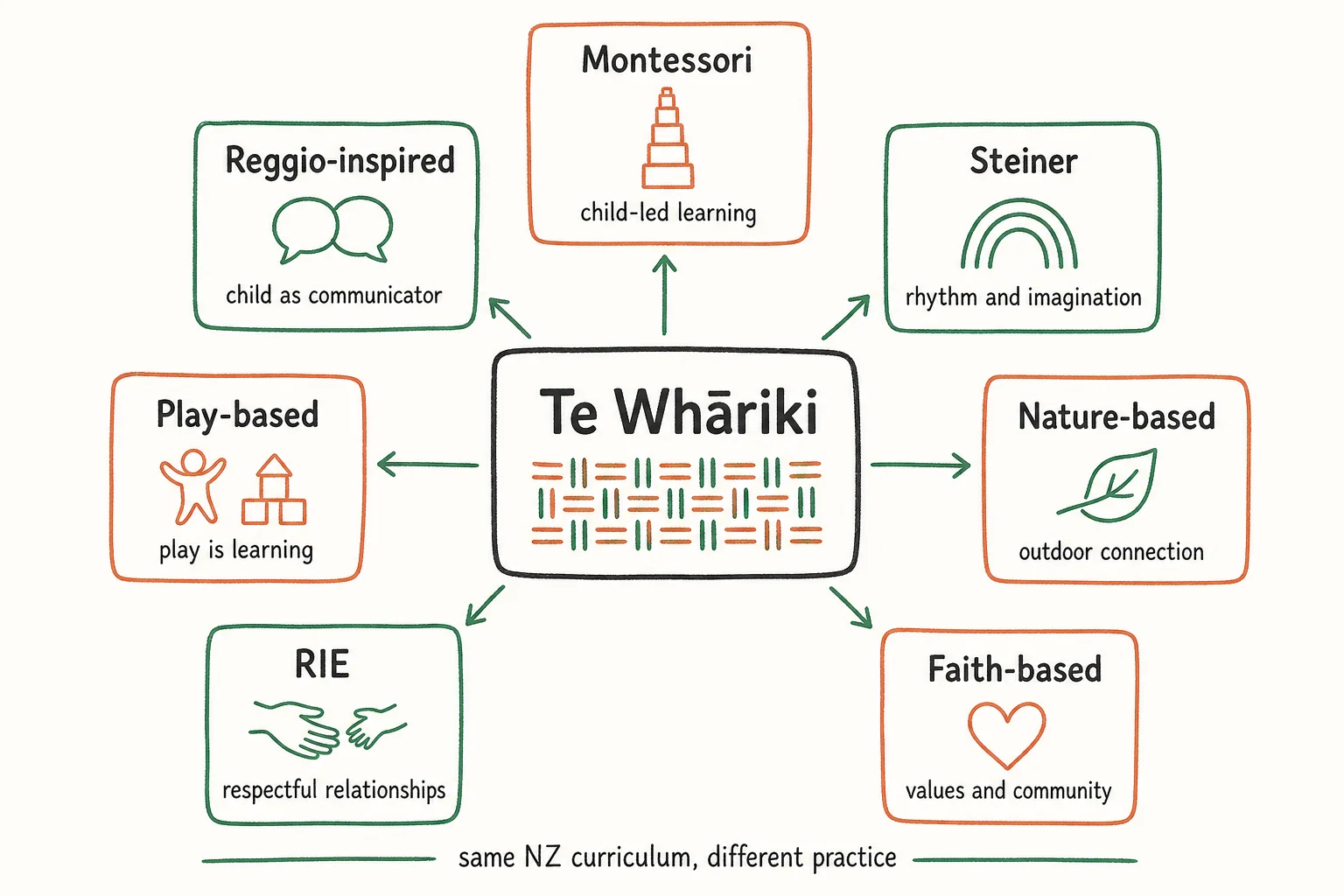
Nature-based and forest kindergarten programmes
Nature-based ECE gives the outdoors a central place in the programme. A forest kindergarten or bush programme may spend substantial time outside in most weather, using local parks, bush, beaches, gardens, or a deliberately naturalised centre environment. Children may climb, dig, carry, balance, build shelters, notice insects, manage mud, and return to a place across seasons.
The best question is not whether children get dirty. They probably will. Ask how the programme manages risk, supervision, weather, toileting, sleep, transport, allergies, and communication with parents. A robust programme has clear routines and risk-benefit thinking. It does not confuse adventure with avoidable danger. Families should also ask what happens on severe-weather days and how educators include a child who is hesitant, disabled, or sensitive to cold, noise, or uneven ground.
Nature-based learning can sit comfortably with the exploration strand of Te Whariki, but that is not a free pass. Children still need responsive relationships, opportunities to communicate, a sense of belonging, and care for their wellbeing. Notice whether kaiako can explain the learning behind an outdoor experience without turning it into a sales pitch. A child who spends an hour making a dam may be testing ideas about water, cooperating with friends, taking manageable risks, and building persistence. The explanation should be grounded in what the adults actually saw.
RIE: respectful care for infants and toddlers
RIE, short for Resources for Infant Educarers, is associated with respectful caregiving for babies and toddlers. Services influenced by RIE often slow down care moments such as nappy changes, meals, settling, and dressing. Adults explain what is happening, wait for a child's response, allow time for self-initiated movement and exploration, and avoid unnecessary entertainment or interruption.
The approach can be reassuring for families who want their infant's cues noticed rather than rushed past. It should never be presented as a rigid set of rules. Babies need warmth, responsiveness, safety, and individual care. Ask what the centre does when a child needs comfort, how primary caregiving works, whether familiar educators handle routine care where possible, and how parents are kept informed. These questions are useful at any under-two service, whether or not RIE appears on the website.
Faith-based early learning: values in daily practice
Faith-based services may be Christian, Muslim, Jewish, Hindu, or connected to another religious community. The level of religious content varies widely. Some centres begin the day with a prayer or include stories, songs, celebrations, and values drawn from their tradition. Others are community services with a light faith connection. Many welcome families who do not share the faith, but you should not assume that.
Our guide to faith-based childcare in NZ has a practical visit checklist. Ask direct questions before enrolment: What practices happen daily or weekly? Is participation expected? How are other beliefs and non-belief treated? How do the centre's values connect with Te Whariki's bicultural and inclusive framework? A good service should answer without defensiveness. The question is whether the centre is transparent, respectful, and a comfortable fit for your family.
A side-by-side comparison
| Approach | Adult role | Environment | Typical emphasis | Questions to ask |
|---|---|---|---|---|
| Montessori | Guide and observer | Prepared, child-sized, ordered | Independence and hands-on materials | How do choice, group life, and Te Whariki work together? |
| Reggio-inspired | Co-learner and researcher | Expressive, flexible, documented | Projects and children's theories | How is documentation used to plan next steps? |
| Steiner/Waldorf | Rhythm holder and storyteller | Natural, homelike, imaginative | Rhythm, practical life, imagination | How do you support individual needs and NZ curriculum? |
| Play-based | Responsive facilitator | Varied and resource-rich | Child-initiated play with intentional teaching | How do kaiako extend learning and assess it? |
| Nature-based | Companion and risk-aware guide | Outdoors in most weather | Movement, place, seasons, exploration | What are your supervision and weather plans? |
| RIE-influenced | Attuned caregiver and observer | Calm, uncluttered, infant-focused | Respectful care and self-initiated movement | How are care routines and settling handled? |
| Faith-based | Educator within stated values | Varies by service | Community, values, celebrations | What participation is expected and how is inclusion handled? |
These are broad patterns. A particular service may blend approaches.
How to match an approach with your family
Start with non-negotiables before aesthetics. Do you need full-day care, an under-two place, a particular location, a wheelchair-accessible environment, food provided, a sibling place, or support for a language and cultural connection? Those practical needs narrow the field. Then consider what helps your child feel secure. Some children love a busy, shared project. Others settle more easily when the room is predictable and they can choose a quiet activity.
Your own values matter too. You may want plenty of outdoor time, strong te reo Māori and bicultural practice, explicit faith connections, a calmer rhythm, or a centre where learning stories are part of an ongoing conversation. None of these preferences makes you demanding. They help you ask better questions. The trap is treating a philosophy as a personality test for a two-year-old after a 20-minute visit.
- Ask what a normal morning looks like, including arrivals, meals, care routines, outdoor time, and transitions.
- Watch how kaiako respond when a child is upset, waiting, or trying something difficult.
- Ask to see how recent planning or learning documentation connects to Te Whariki and whānau aspirations.
- Check the current ERO information and ask about any changes since the review.
- Return for a second visit if possible, preferably at a different time of day.
- Trust the practical details too. A beautiful room cannot compensate for a daily routine that will not work for your family.
Questions worth asking every centre
Centres are used to questions about fees and waiting lists. The questions below are not rude or overly academic. They tell staff that you are looking for a real partnership. Notice the quality of the answer, but also notice whether the person answering seems to know the children and can point to ordinary examples.
A centre does not need to have a perfect answer for every hypothetical situation. It should be able to tell you how it communicates, how it adapts, and who will take responsibility when your child needs something different. That is more reassuring than a claim that every child automatically thrives.
- How would you describe your philosophy to a new family without using jargon?
- What would I see on an ordinary day that shows this philosophy in action?
- How do you weave Te Whariki, te ao Māori, and our local community into the programme?
- How do you support a child who is slow to settle or whose needs differ from the group?
- Who will be my child's key contact, and how will you share concerns or progress with us?
- What training do kaiako have, and how do they continue learning?
- How do you decide when to follow a child's lead and when an adult should guide the activity?
- Can we speak with current families or arrange another visit at a busier time?
Common mistakes parents make when comparing philosophies
The first mistake is confusing a brand of education with the experience your child will have. Two services can use the same label and feel completely different because of their leadership, staffing stability, group size, environment, and relationships. The second is searching for the one approach that will guarantee an outcome. Early childhood learning is relational and messy in the best way. It depends on the child, the adults, the peer group, and the family context.
The third mistake is overlooking quality basics because a philosophy sounds appealing. Check licensing and ERO information. Ask about teacher turnover, key caregiving, communication, sickness policies, ratios, and how the service handles concerns. Philosophy is worth discussing, but safety, warmth, and responsive adults come first. If a centre cannot meet those basics, a lovely set of wooden materials will not fix the problem.
The bottom line
The best ECE philosophy is the one that a particular service carries out thoughtfully for your particular child and family. A Montessori room may be a relief for one child and a poor fit for another. A busy play-based environment may energise one toddler and overwhelm another. A nature programme may be magic in rain boots, or it may require more planning than your family can realistically manage.
Use philosophy as a way to ask sharper questions, not as a shortcut around visiting. If you are narrowing down Montessori, Reggio-inspired, and play-based options, read our philosophy comparison guide. Families considering an outdoor programme can also use our nature-based and forest kindergarten guide. Then compare practical options in your area through The Parent Circle's search or place shortlisted services side by side with our comparison tool.
What quality looks like across every philosophy
A philosophy gives a centre a language for its choices. Quality is whether those choices consistently help children learn and feel safe. ERO's quality indicators focus on outcomes for learners and the conditions that support them. That is a useful lens for parents too. Do children have equitable opportunities to participate? Are adults thoughtful about their teaching? Are leaders willing to examine what is working and what needs to change?
On a visit, quality can be surprisingly ordinary. It is an educator getting down to a child's level before speaking. It is a new child being given time to watch before being encouraged to join. It is a parent receiving a clear answer about a scraped knee, a missed sleep, or a hard drop-off. It is a room arranged so children can use it, not just admire it. These things matter in a Montessori room, a forest programme, a faith-based centre, and every other setting.
Staff stability deserves more attention than it usually gets in a philosophy comparison. Children can adapt to change, but frequent turnover makes it harder to build the responsive, reciprocal relationships at the centre of Te Whariki. Ask how long the teaching team has worked together, who covers breaks and absences, and what happens if your child's key teacher leaves. A centre may not be able to promise no change. It should be able to describe how it protects continuity of care.
Qualifications and specialist training are also worth discussing without turning the conversation into a checklist. The Ministry says at least 50% of adults working with children in teacher-led services must be qualified early learning teachers. Some services exceed that. A specialised approach may also employ educators with Montessori, Steiner, infant-care, or outdoor education study. Ask how those skills are shared across the team, how newer staff are mentored, and how professional learning changes everyday practice.
How philosophy affects assessment and learning stories
Parents sometimes see learning stories as the visible proof that a centre is paying attention. They can be valuable, but the format varies. A Reggio-inspired service may use photos, transcripts, and panels to show a project over time. A Montessori service may document a child's growing independence with specific materials and routines. A play-based centre may write a narrative about a child negotiating a game, persevering with a construction, or exploring a question.
The key question is what happens after the story is written. Does it help kaiako notice a pattern, decide what to offer next, and invite your perspective? Or is it a pleasant record that disappears into an app? Ask to see a sequence where an observation led to a meaningful next step. You are looking for assessment that respects the child as an individual and connects to the service's local curriculum, not a glossy report produced for parents.
A strong centre can also explain how it notices learning that is harder to photograph. Settling after separation, making a friend, finding a way into group play, communicating discomfort, resting well, or asking for help may be deeply important progress for a young child. These changes can be especially significant for infants, children who are neurodivergent, children learning English or te reo Māori, and children adjusting to a new family situation.
Ask how the service makes space for your knowledge. You know your child outside the centre. Kaiako know them in a different setting. When those two views are shared respectfully, planning becomes more accurate. The right service will not expect parents to be educational experts. It will want to know what comforts your child, what they are talking about at home, which languages matter, and what your whānau hopes for.
Bicultural practice is not an optional extra
Te Whariki is bicultural by design. It recognises Māori as tangata whenua and places identity, language, culture, whānau, and relationships at the heart of early learning. That applies whether a centre is Montessori, Reggio-inspired, Steiner, nature-based, or faith-based. A philosophy imported from another country needs to meet Aotearoa on Aotearoa's terms.
On a tour, look beyond a few Māori words on posters. Ask how the centre builds relationships with local iwi and community, how te reo Māori is used naturally, how Māori children and whānau see themselves in the environment, and how planning reflects the local place. A service may be at a different stage of this work, but it should be honest about its practice and committed to improving it. This is not a decorative addition to a philosophy. It is part of quality ECE here.
Inclusion, additional needs, and support
If your child has a diagnosed condition, is awaiting assessment, has sensory needs, uses a different communication style, or simply needs more time to settle, bring it up early. The right centre will not rush you into a decision or make promises it cannot keep. It will ask useful questions, explain the environment and routines, talk about ratios and staffing, and discuss how it works with specialist support where needed.
Philosophy can shape the tools a service reaches for. A Montessori environment may offer order and accessible materials. A nature programme may offer movement and sensory experiences. A Reggio-inspired setting may offer many ways to communicate. None of these removes the need for an individual plan and capable adults. Ask what adaptations the centre has made for other children, how it reviews them, and how it would include you in decisions.
Inclusion also includes cultural, linguistic, family, and economic realities. A centre that celebrates only the most visible version of its philosophy may miss the child in front of it. Ask how the programme reflects Pacific, Asian, migrant, rainbow, sole-parent, blended, and extended whānau. Ask about food, celebrations, clothing, rest, and communication arrangements if any of these are important to your family.
The answer does not have to be a rehearsed speech. In fact, a specific example is better. You might hear that a teacher learned key words from a grandparent, adjusted a transition plan for a child moving between homes, or changed a project after children shared their own family traditions. Those details suggest a service that can hold its philosophy lightly enough to respond to real people.
Making the decision without overthinking it
After a few tours, write down your observations while they are fresh. Separate facts from feelings. Facts include fees, hours, availability, group size, food arrangements, distance from home or work, and the centre's stated approach. Feelings include whether adults seemed present, whether the room felt manageable, and whether you could imagine handing your child over there on a difficult morning. Both matter.
If you are torn between two good options, ask for a short settling visit. See how staff greet your child, how they respond when you step back, and whether they notice what interests them. There is no shame in changing your mind after a second visit. Early learning is a relationship, not a lifetime identity. If the fit stops working, a thoughtful transition to another service can be the right call.
Availability, costs, and the practical reality
A philosophy may help you choose between comparable services, but it rarely removes the ordinary constraints of childcare. A highly regarded centre can have a long waitlist. A nature programme may operate only a few days a week. A Montessori or faith-based service may be outside your commute. A setting that feels ideal may not have an under-two space when you need it. Start enquiries early and ask exactly what is available, rather than waiting for every research question to be answered first.
Fees vary by provider, location, hours, age group, and what is included. Do not assume one philosophy is always more expensive than another. Ask for a written schedule that explains enrolment fees, deposits, public-holiday charges, meals, nappies, excursions, late-pickup charges, and any required contribution. If your child is eligible, ask how 20 Hours ECE is applied and whether the centre can help you understand other assistance you may be entitled to. Cost is part of fit. A cheaper place that creates impossible transport or work pressures may not be affordable in the wider sense.
Also remember that the search result does not tell you everything. Use it to build a shortlist, then phone or email with a few practical questions. A centre that is clear, kind, and prompt before enrolment often gives you a useful early signal about communication after enrolment. It is not foolproof, but you should not have to chase basic information for weeks.
Finally, leave room for the fact that your child may surprise you. The child who seems happiest at home may find confidence in a busy group. The child who loves the first tour may need a slower settling plan. Keep talking with kaiako in the first weeks. A good centre expects questions, shares what it is noticing, and adjusts with you rather than insisting that a philosophy has all the answers.
Frequently asked questions
Do all NZ early learning services follow Te Whariki?
Licensed and regulated ECE providers work within the Early Learning Curriculum Framework, with Te Whariki providing the national curriculum guidance. A service can have a special character such as Montessori or Steiner, but that sits alongside its NZ curriculum and licensing obligations.
Is Montessori better than play-based learning?
Neither is automatically better. Montessori often makes independence and structured hands-on materials more visible, while play-based programmes may offer a broader mix of child-initiated experiences. Compare how a specific service responds to children, plans learning, and works with whānau.
Are Reggio Emilia centres available in New Zealand?
You are more likely to see services described as Reggio-inspired. They may use projects, documentation, expressive materials, and an environment designed to invite investigation, while adapting the approach to Te Whariki and their local community.
Will a Steiner kindergarten prepare my child for school?
A Steiner setting should still support the learning outcomes of Te Whariki. Ask how the service supports communication, confidence, relationships, early literacy experiences, and transitions to the school your child is likely to attend.
How can I tell whether a centre really follows its philosophy?
Ask for ordinary examples, not slogans. Watch a normal session, ask how recent learning documentation connects to Te Whariki, and notice whether the environment, adult interactions, routines, and explanations all tell the same story.
Should I choose a philosophy before visiting centres?
Use your preferences to make a shortlist, then visit. Availability, location, staff relationships, support needs, opening hours, and your child's response all matter. A second visit often tells you more than the first.
Find an early learning service that fits your family
Compare providers, practical details, and locations before you book a visit.
Compare centresRelated guides
Childcare for Twins and Multiples in New Zealand
A practical guide to finding childcare for twins and multiples, with questions on places, routines, staffing and support.
Understanding Te Whāriki: How NZ's National Curriculum Shapes Every ECE Centre
A parent's guide to Te Whāriki, New Zealand's early childhood curriculum, and how its principles and strands shape daily learning at ECE.
Steiner/Waldorf ECE in NZ: A Parent's Guide
A practical guide to Steiner/Waldorf early childhood education in New Zealand, including Te Whāriki, centre visits and questions for parents.
Reggio Emilia in NZ: Understanding the Reggio-Inspired Approach to ECE
A practical NZ guide to Reggio-inspired early learning, from inquiry and documentation to questions for your centre visit.
Find childcare near you
Search and compare providers by suburb, care type, cost, and availability.