
Resource Hub
Nature-Based and Forest Kindergartens in NZ: A Parent Guide
Published · Last updated · 7 min read
Contents
Are nature-based and forest kindergartens a good option in NZ?
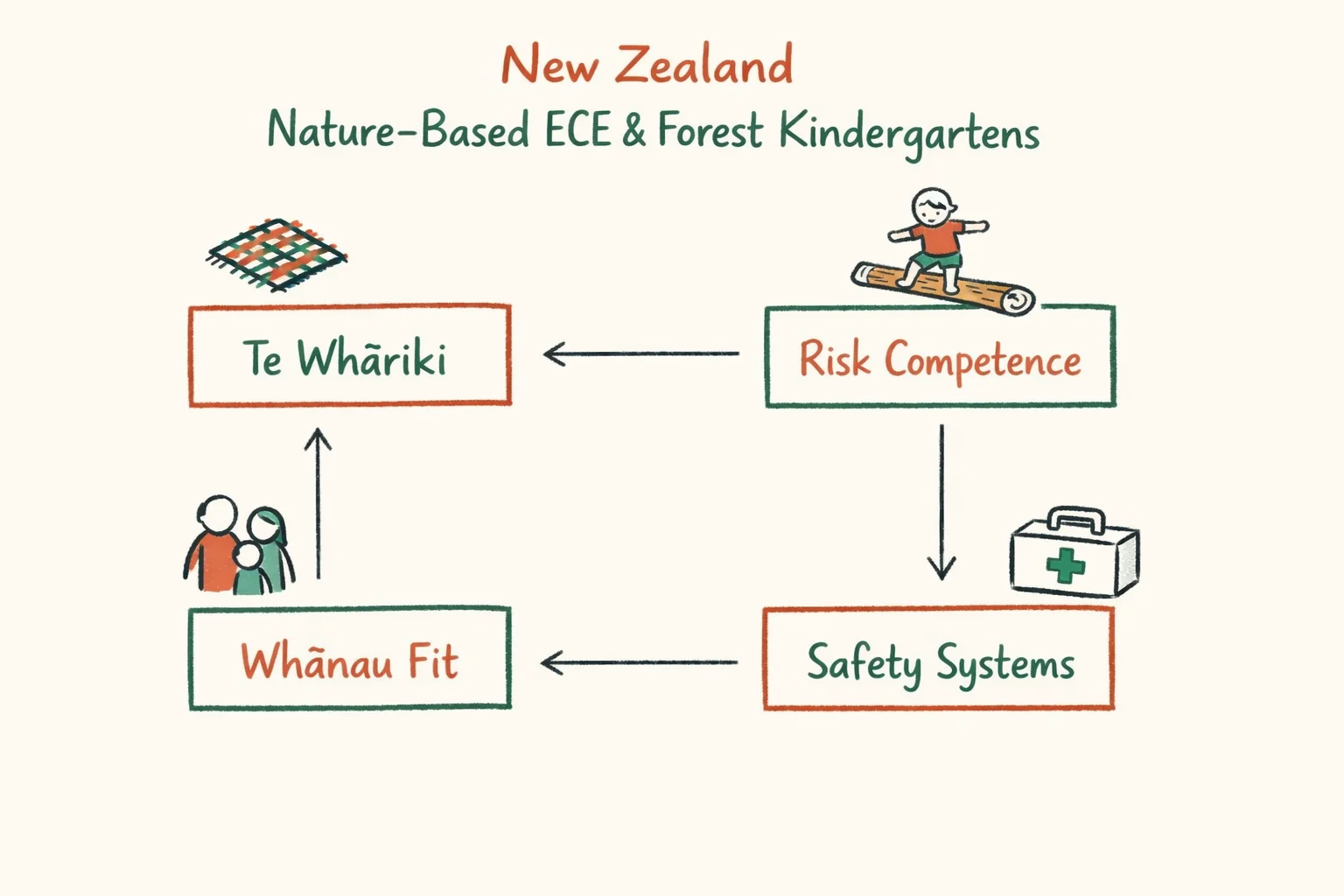
Nature-based ECE can be a strong fit for children who settle outdoors, enjoy physical play and learn well through exploration. In New Zealand, the important check is not the forest label. It is whether the service is licensed, well supervised, connected to Te Whāriki and honest about risk, weather, toileting, gear and emergency plans.
Start with the mud, then check the systems
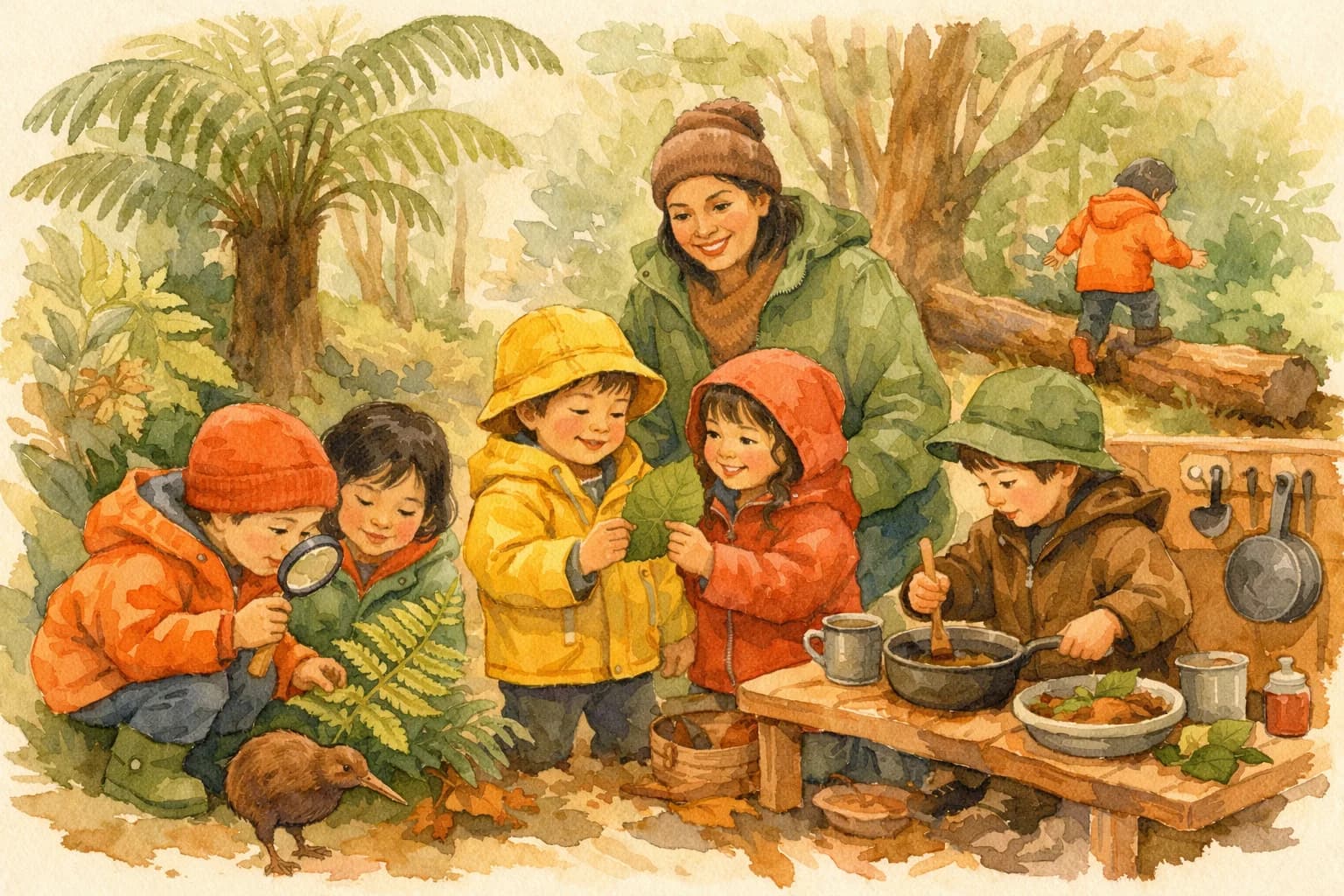
A good forest kindergarten is more than a childcare centre with gumboots. The outdoor environment does more of the teaching. Children climb, dig, carry sticks, watch insects, build huts, notice weather and negotiate with other children in a setting that changes every day. It is one of several approaches covered in our NZ guide to ECE philosophies.
That can be brilliant for some tamariki. It can also be a poor fit if the provider treats "nature" as branding while the safety planning is vague. Parents need to look at both sides: the learning value and the boring operational details that keep children safe.
In Aotearoa New Zealand, licensed early childhood services still sit under Te Whāriki and Ministry of Education licensing requirements. A bush setting does not remove those obligations. It makes the quality of supervision, planning and communication more visible.
What nature-based ECE means in New Zealand
You will hear several names: forest kindergarten, bush kindy, nature play, outdoor nursery, farm kindergarten and nature-based ECE. They are not all the same. Some are fully outdoor services. Others are ordinary centres that run a weekly bush programme or spend a large part of the day outside.
| Model | What parents usually see | What to check |
|---|---|---|
| Full nature or forest kindergarten | Most learning happens outdoors, often in bush, farm, coastal or park settings. | Confirm licensing, shelter, toilets, ratios, boundaries and emergency procedures. |
| Bush kindy attached to a centre | Children attend the main centre, then go off-site for regular nature sessions. | Ask about transport, permission forms, risk assessment and whether all children can attend. |
| Outdoor-rich childcare centre | The centre has a strong garden, loose parts, mud kitchen, trees or animals on site. | Check whether children have genuine outdoor choice or just a scheduled playground block. |
| Playgroup or holiday nature programme | Usually part-time and may not provide licensed ECE care. | Do not assume it replaces childcare. Ask exactly what registration and supervision apply. |
Do not skip the licensing question
How forest learning fits Te Whāriki
Nature-based ECE can fit Te Whāriki well when kaiako use the environment with intention. The curriculum is not a checklist of school skills. It is about children growing as competent, confident learners who are healthy in mind, body and spirit, secure in belonging and able to contribute.
Outdoor settings give children real material for that learning. A slippery bank teaches judgement. A group hut build teaches negotiation. A worm found under a log opens science, care, language and kaitiakitanga. The learning is not less serious because it looks like play.
- Wellbeing: children learn body awareness, weather judgement, confidence and calm risk taking.
- Belonging: repeated visits to the same whenua help children feel connected to place.
- Contribution: mixed-age outdoor play gives children useful work to do instead of only toys to consume.
- Communication: children build vocabulary through real objects, stories, songs and problem solving.
- Exploration: natural materials invite investigation without one correct answer.
The benefits are real, but ask for evidence
Outdoor play is linked with stronger gross motor development, better movement confidence and richer imaginative play. Many parents also notice practical changes: children sleep better after active days, become more comfortable with dirt and weather, and learn to handle frustration when a plan does not work.
The strongest claims are usually modest and practical. Nature play gives children more chances to move, test ideas, solve real problems and work with other children. Be cautious when a centre claims forest learning will automatically make children calmer, smarter or more resilient. Good teaching still matters.
| Benefit | What it can look like | Parent question |
|---|---|---|
| Risk competence | Children learn how high feels safe, how wet logs behave and when to ask for help. | How do kaiako decide when to step in and when to let children try? |
| Physical development | Balancing, climbing, lifting, digging, running and carrying happen naturally. | How do you support children who are cautious or have lower mobility? |
| Self-regulation | Children practise waiting, planning, coping with weather and recovering from small setbacks. | What happens when a child is overwhelmed outdoors? |
| Environmental connection | Tamariki learn names, seasons, care for living things and respect for place. | How do you include kaitiakitanga and local Māori perspectives respectfully? |
Safety should sound specific, not soothing
The best outdoor services do not pretend risk disappears. They explain it clearly. They can talk about boundaries, ratios, head counts, water, roads, dogs, toxic plants, allergic reactions, sudden weather, toilets, handwashing, first aid and how they contact parents if plans change.
Ask to see the latest ERO report and the service licence details. For licensed services, Ministry of Education rules still apply. That includes premises and facilities, health and safety, governance, management, curriculum and records. Outdoor delivery changes the setting, not the duty of care.
- What adult-to-child ratios do you use outdoors, and do you ever go above the legal minimum?
- How do you mark boundaries in bush, beach or farm settings?
- What is your weather policy for heavy rain, high wind, heat, cold or poor air quality?
- Which kaiako hold current first aid certificates, and what emergency kit is carried?
- How do you manage toileting, nappies, handwashing and food outdoors?
- What is the process for allergies, asthma, medication and insect stings?
- How often are risk assessments updated, and do parents get to read them?
- If children travel off site, who drives, how are car seats checked and what is the backup plan?
Costs and availability can vary a lot
There is no single forest kindergarten fee in NZ. A licensed nature-based service may charge like other childcare in the area, while a specialist outdoor programme may charge separately because it is not providing full childcare. If it is a licensed teacher-led service for 3 to 5 year olds, ask whether 20 Hours ECE applies.
Availability is uneven. Nature programmes need suitable land, trained kaiako, transport planning, insurance comfort and families willing to supply gear. That is easier in some communities than others. Rural families may have more natural space nearby but fewer licensed services to choose from.
Ask the boring money questions early
Which children tend to thrive
Nature-based care often suits children who need movement, dislike sitting still, enjoy sensory play or become more regulated outside. It can also help confident children learn patience, because outdoor work often takes time. You cannot force a hut to stand up by wanting it quickly.
For some children, the transition needs more care. A child who hates wet clothes, startles at insects, needs predictable toilets, naps heavily or has medical needs may still thrive, but the service has to show how it will support them. A good provider will not brush those concerns aside.
| Your child | What to ask |
|---|---|
| Cautious or anxious | Can they watch first, stay close to a kaiako and build confidence slowly? |
| Very active | How do you allow big movement while keeping boundaries clear? |
| Needs naps | Where do children rest, and what happens on off-site days? |
| Additional needs | How do you adapt terrain, communication, transitions and sensory load? |
| Allergies or asthma | What medication, avoidance and emergency processes are used outdoors? |
What parents usually need to pack
Gear matters more in outdoor-heavy care. The wrong clothing can turn a good programme into a miserable day. Ask what the service supplies and what must come from home, because waterproof layers and spare warm clothes can add real cost.
- Waterproof jacket and over-trousers or a puddle suit
- Warm layers that can get dirty
- Sunhat, warm hat and sunscreen, depending on season
- Closed-toe shoes or gumboots with spare socks
- At least one full change of clothes in a waterproof bag
- Named drink bottle and lunchbox if food is not provided
- Medication, allergy plan or inhaler where needed, handed over according to policy
Do not buy everything before you visit. Some services have strong preferences, and some have spare gear or loan systems. The practical question is whether your family can keep up with the washing, drying and replacement cycle without it becoming a weekly headache.
Red flags on a visit
- The provider talks vaguely about "letting kids be kids" but cannot explain risk assessment.
- You are told accidents are just part of outdoor learning, with no detail on prevention or reporting.
- Ratios are described as "flexible" rather than clearly stated.
- Children look cold, wet or distressed and adults seem casual about it.
- There is no clear plan for toilets, handwashing or food hygiene outdoors.
- Parents are discouraged from reading policies or the latest ERO report.
- The programme feels like a marketing label rather than a curriculum approach.
The opposite is also true. A strong provider will happily explain risk. They will talk about children as capable, but not invincible. They will have stories of learning, clear limits and a calm answer for what happens when the weather turns foul.
How to compare it with other ECE philosophies
Nature-based ECE is a philosophy of environment and relationship. Montessori is more structured around prepared materials. Reggio-inspired practice puts strong weight on projects, documentation and the environment as a teacher. Play-based centres can include excellent outdoor learning without using the forest label.
If you are still weighing philosophies, start with our Montessori vs play-based vs Reggio guide. Then visit local services and watch the adults. Labels matter less than the way kaiako respond when a child is muddy, unsure, excited, hurt, bossy, curious or tired.
A simple decision rule
Choose a forest or nature-based service when the outdoor approach fits your child and the operational systems are strong. Pass, or keep looking, if the centre relies on romance about childhood but cannot answer practical questions. Mud is wonderful. Mud plus poor supervision is not a philosophy.
A good final test is to visit in ordinary weather instead of only on a perfect day. Watch how kaiako help children manage discomfort, conflict and risk. That tells you far more than a sunny photo gallery.
FAQs about forest kindergartens in NZ
Are forest kindergartens licensed in NZ?
Some are licensed early childhood services and some are not. Ask the provider directly, then check the service details and latest ERO report. Licensing matters if you need regular childcare, 20 Hours ECE, formal complaints processes and Ministry of Education standards.
Does Te Whāriki allow outdoor or forest learning?
Yes. Te Whāriki is broad enough to support outdoor learning when kaiako plan intentionally around wellbeing, belonging, contribution, communication and exploration. The curriculum still needs thoughtful teaching, assessment and whānau partnership.
Is nature-based ECE safe for preschoolers?
It can be, if the service has clear ratios, trained kaiako, first aid, risk assessments, weather policies and emergency communication. The goal is not to remove all risk. It is to manage serious hazards while children learn safe judgement through supervised challenge.
What age is best for forest kindergarten?
Many programmes suit older toddlers and preschoolers, especially children aged 3 to 5 who can manage longer outdoor sessions. Younger children can still benefit, but toileting, naps, warmth, staffing and transport need closer checking.
Will my child still be ready for school?
School readiness is not about worksheets for four-year-olds. Outdoor ECE can build language, confidence, persistence, motor skills, social problem solving and self-care. Ask how the service documents learning and supports early literacy and numeracy through play.
What if my child does not like mud or rain?
That is not a deal-breaker, but it matters. Ask how the service introduces children gradually, what comfort options exist and whether children can opt into quieter spaces. A good programme respects temperament rather than treating toughness as the goal.
Use The Parent Circle to search childcare providers near you, then visit with sharper questions. A nature-rich childhood is a beautiful thing, but the right centre still has to work for your child, your whānau and your weekday reality.
Find nature-friendly childcare near you
Search licensed ECE providers across New Zealand and compare the details that matter for your whānau.
Search childcare centresRelated guides
Faith-Based Childcare in NZ: What Parents Should Know
A practical guide to faith-based childcare in New Zealand, including licensing, Te Whariki, inclusion and questions to ask before enrolment.
Montessori vs Play-Based vs Reggio: Which Philosophy Is Right for Your Child?
A practical NZ parent's guide to Montessori, play-based and Reggio-inspired ECE, with temperament fit, centre questions and a plain-English comparison table.
Screen Time and Young Children: An Evidence-Based Guide for NZ Parents
A practical NZ guide to screen time for babies, toddlers and preschoolers, including what the health guidance says, how to judge quality, what to ask early learning centres, and how to build calmer routines at home.
Understanding Learning Stories: A Guide for NZ Parents
Learning stories are how kaiako document your child's learning at their ECE centre. This guide explains what they are, what good ones look like, and how to use them at home.
Find childcare near you
Search and compare providers by suburb, care type, cost, and availability.