
Resource Hub
Reggio Emilia in NZ: Understanding the Reggio-Inspired Approach to ECE
Published · Last updated · 6 min read
Contents
What is Reggio Emilia childcare in New Zealand?
Reggio Emilia is an educational approach that treats children as capable, curious participants in their own learning. In Aotearoa, a Reggio-inspired early learning service still works within Te Whariki, its own licence conditions, and the everyday realities of its local community.
Reggio Emilia, in plain English
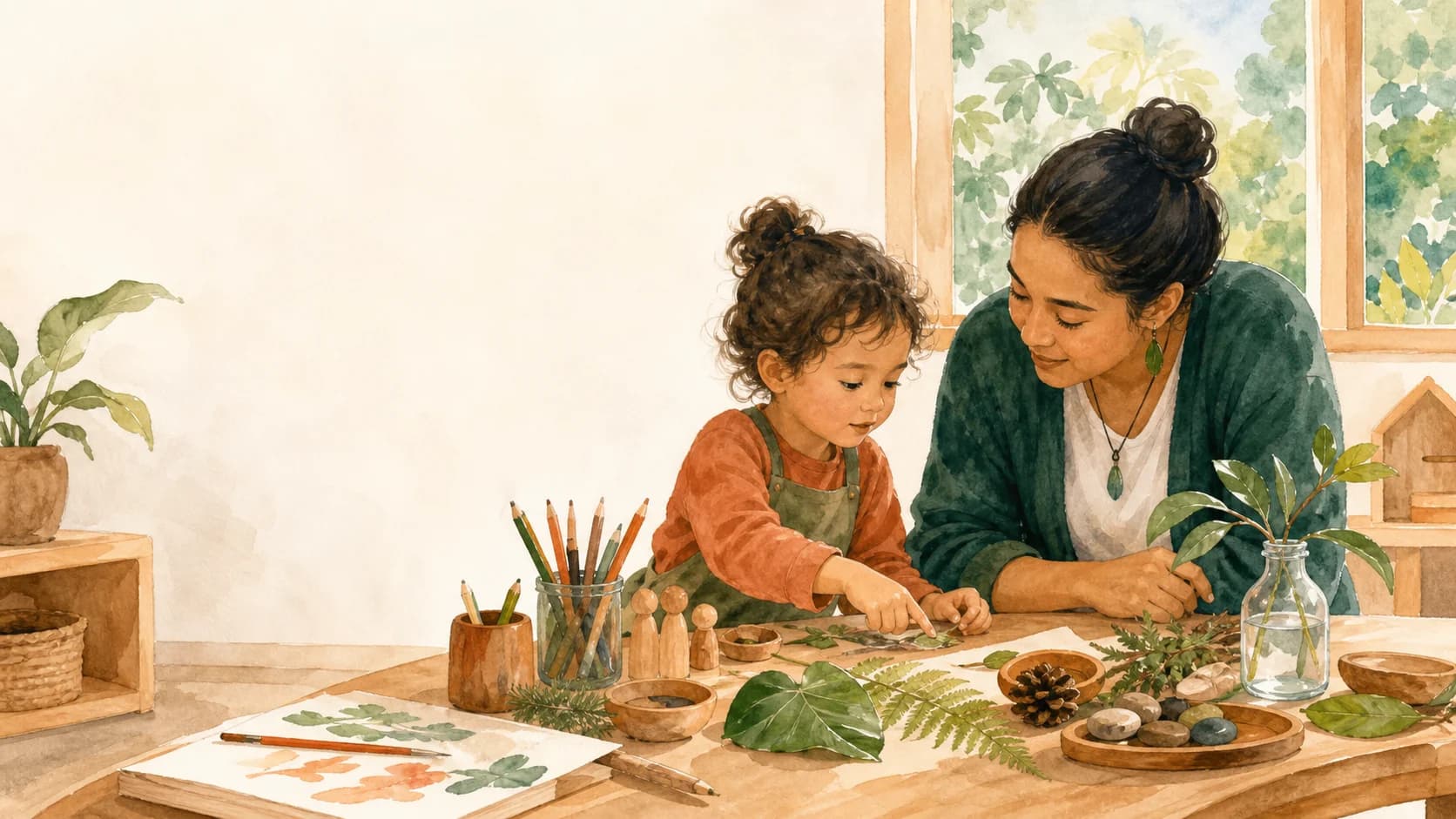
Reggio Emilia began in the northern Italian city of the same name after the Second World War. It is not a boxed curriculum or a branded set of activities. It is a way of paying attention: children have ideas worth pursuing, kaiako investigate alongside them, and the room is arranged to invite questions rather than rush everyone towards one answer.
For a parent, the label matters less than what happens on an ordinary Tuesday. You may see children returning to a question over several days, working with clay, paint, light, loose parts or the garden. The adults listen, record what children say and use those observations to decide what to offer next.
Video
The ideas behind a Reggio-inspired centre
Reggio Children, the organisation connected with the municipal schools in Reggio Emilia, describes the approach as grounded in an image of children with strong potential and rights. That sounds lofty until you see it in practice. Instead of assuming adults already know the best activity, a kaiako might ask what a child thinks will happen when a seed is planted, then stay with that question long enough for real discoveries and wrong guesses.
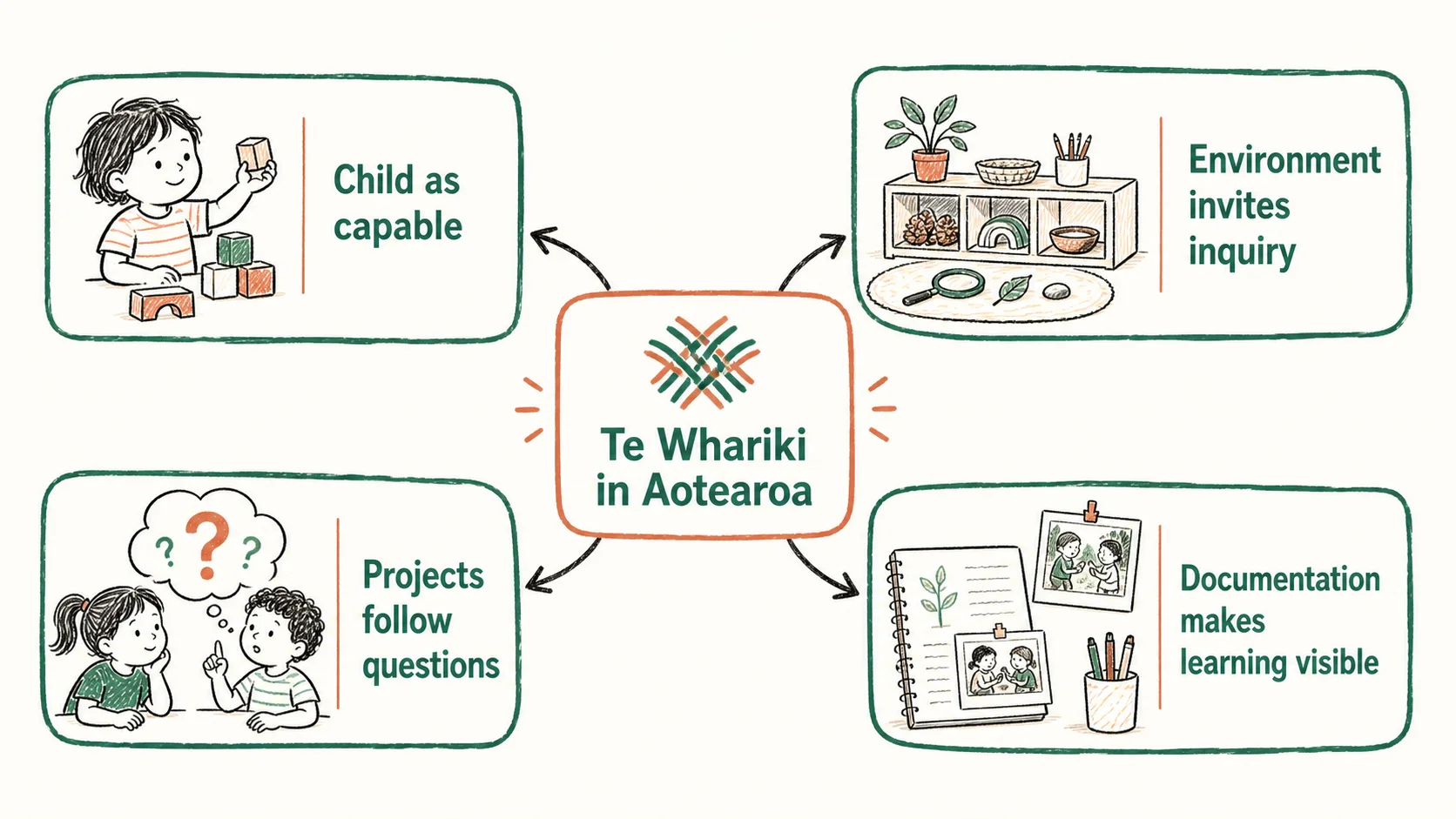
- Children are capable: tamariki are treated as thinkers, communicators and contributors, not empty vessels waiting to be filled.
- Relationships shape learning: children, kaiako and whānau influence the work together.
- The environment teaches too: materials, light, displays and accessible tools are arranged to make inquiry possible.
- Learning is made visible: notes, photos, children’s words and work samples help everyone revisit the thinking behind a project.
A useful distinction
The environment as a teacher
You will often hear the phrase "environment as the third teacher". In a strong Reggio-inspired setting, the room is not just storage for toys. There may be a long table for collaborative work, real drawing tools within reach, a light table, natural objects, mirrors, plants and spaces where children can return to unfinished ideas.
Do not judge this by aesthetics alone. A calm room with baskets and wooden blocks can still be adult-led from start to finish. Ask how the environment changes when children become interested in something. If a group keeps collecting feathers, for example, do kaiako help them compare, draw, research, make marks and share theories? Or is the display fixed before the children arrive?
The hundred languages of children
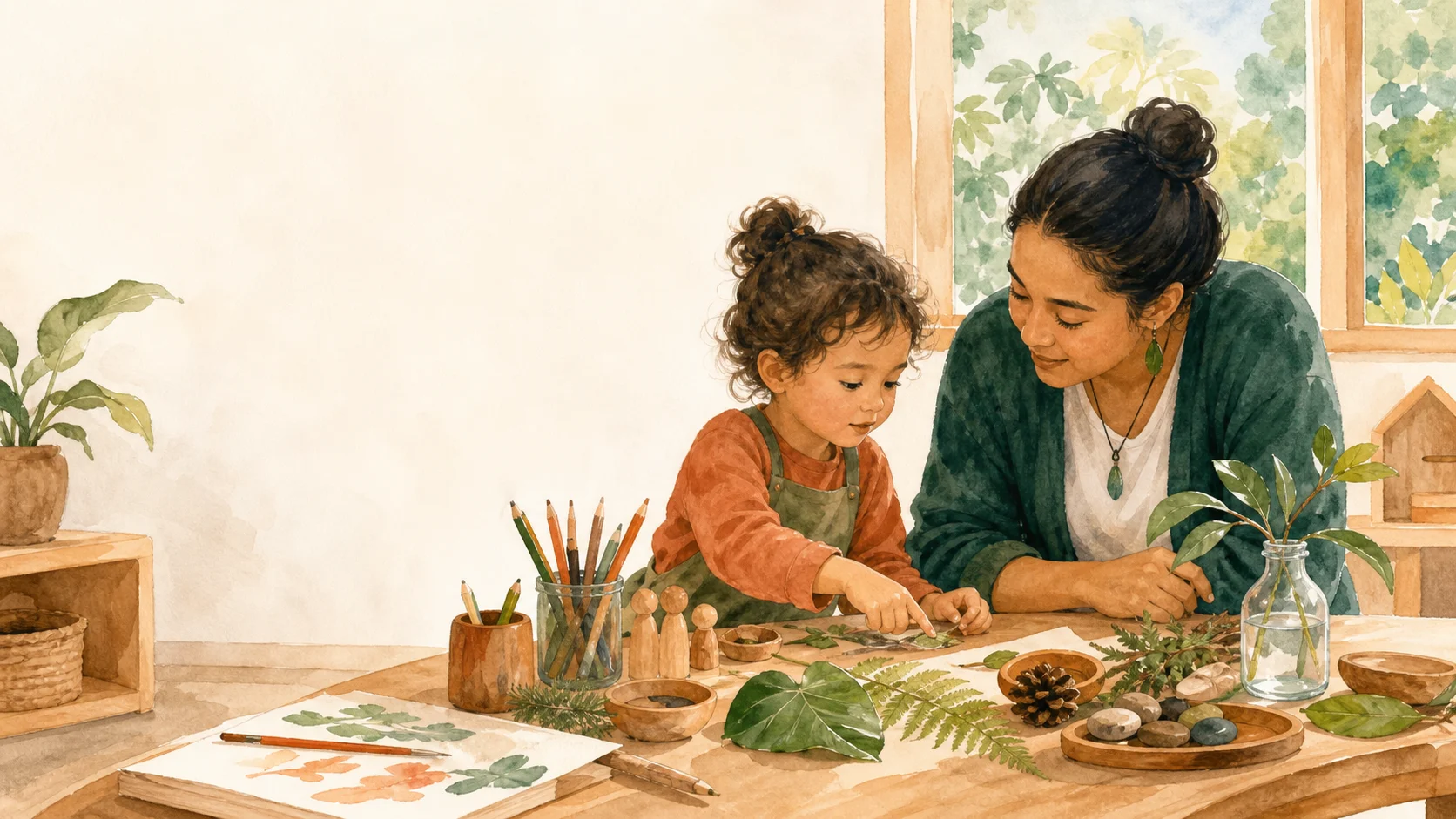
The "hundred languages" is a Reggio idea about expression, not a count of spoken languages. Children think and communicate through talk, movement, drawing, construction, music, drama, mark-making and many other forms. A child who cannot yet explain an idea in a long sentence may show it through a sculpture, a repeated game or a careful arrangement of objects.
That is why materials matter. Clay, wire, paint, shadow, water and recycled objects are not rewards after the serious learning. They can be the way children test a theory. If your child loves building, singing or making up stories, notice whether the centre sees those interests as a route into learning rather than a distraction from it.
How project work develops
A Reggio-inspired project often starts with a genuine question. Perhaps several children are fascinated by snails in the garden, shadows on the wall or why the rainwater disappears. Kaiako listen for the pattern, offer relevant materials, revisit earlier ideas and bring children together to compare their theories. The project can last a day, a week or longer. There is no useful timetable for curiosity.
| What you might see | What it can tell you |
|---|---|
| Children’s questions recorded beside photos or work | Kaiako are listening for ideas, not only collecting pictures. |
| Several versions of a drawing, model or theory | The group had time to revisit and change its thinking. |
| Materials placed where children can choose and return them | The environment supports agency within clear routines. |
| A project linked to local places, whānau stories or te ao Maori | The programme is grounded in Aotearoa rather than copied from overseas. |
| Kaiako explaining their next step | Documentation is informing planning, not decorating a wall. |
Documentation is more than a nice photo board
Pedagogical documentation is one of the most visible Reggio practices. It may include photos, children’s exact words, sketches, samples of work and a kaiako’s reflection. The point is not to prove that a busy day happened. It is to make the learning process available for children, families and educators to revisit.
Good documentation gives you something specific to talk about at pick-up. Instead of hearing only that your child had a good day, you might see how they tested a bridge design with friends, changed their plan and explained why. It should also be handled respectfully. Ask how the service gains consent, protects children’s privacy and includes your knowledge of your child in the story.
Reggio-inspired practice and Te Whariki
Every licensed early learning service in Aotearoa uses Te Whariki, the national early childhood curriculum. It sets a framework of principles, strands, goals and learning outcomes. The four principles are empowerment, holistic development, family and community, and relationships. Reggio Emilia is one possible influence on pedagogy. It does not replace Te Whariki or a service’s responsibility to honour Te Tiriti o Waitangi.
There are natural meeting points. Reggio’s focus on children’s agency sits comfortably beside whakamana, or empowerment. Its attention to relationships and family participation can support whānau tangata and ngā hononga. But a New Zealand service needs to do more than place te reo labels on an imported approach. Ask how local histories, whakapapa, tikanga, whānau aspirations and the languages children bring are woven into the programme.
Reggio Emilia or Reggio-inspired?
Most New Zealand services that use this language are Reggio-inspired. That is not a lesser version or a red flag. The original educational project developed in municipal infant-toddler centres and preschools in Reggio Emilia, Italy, with particular structures, professional roles and a local civic history. A centre on the other side of the world should adapt thoughtfully instead of pretending it has copied that context exactly.
The honest question is: inspired by which ideas, and how do they show up here? A useful answer names real practices, such as long-term project work, collaborative planning, an atelier-style creative space or documentation that changes the next day’s experience. A vague answer about being child-led tells you very little.
Questions worth taking on a visit
- What was a recent investigation children led, and how did it change the programme?
- How do kaiako decide when to step in, extend an idea or let children work it out together?
- Can you show me documentation that includes children’s words and the next teaching decision?
- How do you connect this approach with Te Whariki, local culture and our whānau’s aspirations?
- What will the first few weeks look like for my child, and who will be our regular contact?
- How do your practical routines work around meals, sleep, outdoor play, fees and communication?
Finding a Reggio-inspired option that fits
There is no national Reggio accreditation list for parents to treat as a shortcut. Start with services that fit your real commute, hours and child’s age, then look closely at their practice. Search for the terms "Reggio-inspired" and "inquiry-based", but take the website as an invitation to visit rather than proof of quality.
Read the service’s available ERO information and ask direct questions. You can also use our guide to ECE philosophies and comparison of Montessori, play-based and Reggio to put the approaches in context. The right setting is one where the philosophy shows up in relationships, not only in the marketing.
Frequently asked questions
Do Reggio-inspired centres in NZ follow Te Whariki?
Yes. Licensed early learning services in Aotearoa use Te Whariki. Reggio-inspired practice may influence how kaiako organise inquiry, the environment and documentation, but it does not replace the NZ curriculum.
Is Reggio Emilia the same as free play?
No. Children have agency and their interests matter, but kaiako plan carefully, offer materials, maintain safety and use observations to decide what to explore next.
What does documentation look like in a Reggio-inspired centre?
It can include photos, children’s words, work samples and a kaiako’s reflection. Good documentation makes the learning process visible and helps shape future planning.
Are there official Reggio Emilia accredited centres in New Zealand?
Most local services describe themselves as Reggio-inspired. Ask what that means in their daily practice rather than relying on the label alone.
Will a Reggio-inspired centre prepare my child for school?
Early learning is broader than formal academic drills. A good service supports communication, relationships, curiosity, confidence and learning habits within Te Whariki. Ask how it supports transitions for each child.
A Reggio-inspired approach can be a lovely fit for a child who wants time, materials and people to explore ideas with. It can also be a poor fit if the service cannot explain its practice clearly or meet your family’s practical needs. Visit, watch the relationships and ask for concrete examples. The small details usually tell you more than the label.
Related guides
Childcare During Family Transitions: A NZ Parent's Guide
A practical NZ guide to supporting your child through separation, moving, grief and other family changes at childcare.
Childcare for Twins and Multiples in New Zealand
A practical guide to finding childcare for twins and multiples, with questions on places, routines, staffing and support.
Steiner/Waldorf ECE in NZ: A Parent's Guide
A practical guide to Steiner/Waldorf early childhood education in New Zealand, including Te Whāriki, centre visits and questions for parents.
Montessori Childcare in NZ: What to Expect and How to Choose
A practical guide to Montessori early learning in NZ, from prepared environments and Te Whariki to questions for your centre visit.
Find childcare near you
Search and compare providers by suburb, care type, cost, and availability.