
Resource Hub
Understanding Te Whāriki: How NZ's National Curriculum Shapes Every ECE Centre
Published · Last updated · 8 min read
What is Te Whāriki in early childhood education?
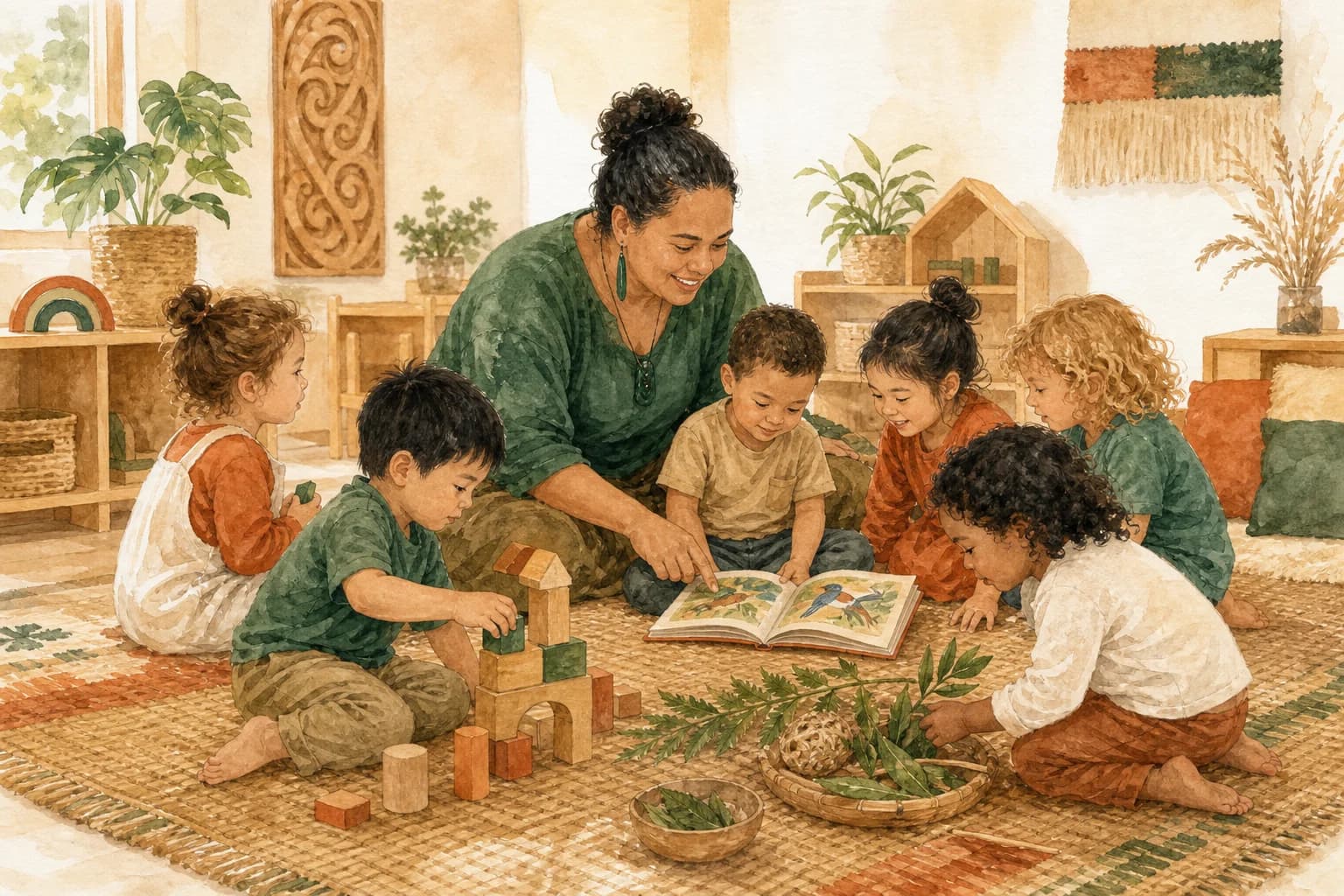
Te Whāriki is Aotearoa New Zealand's early childhood curriculum. It gives every licensed early learning service a shared direction for children's learning, while leaving room for each centre to build a local curriculum with its children, whānau and community.
Why Te Whāriki matters to parents
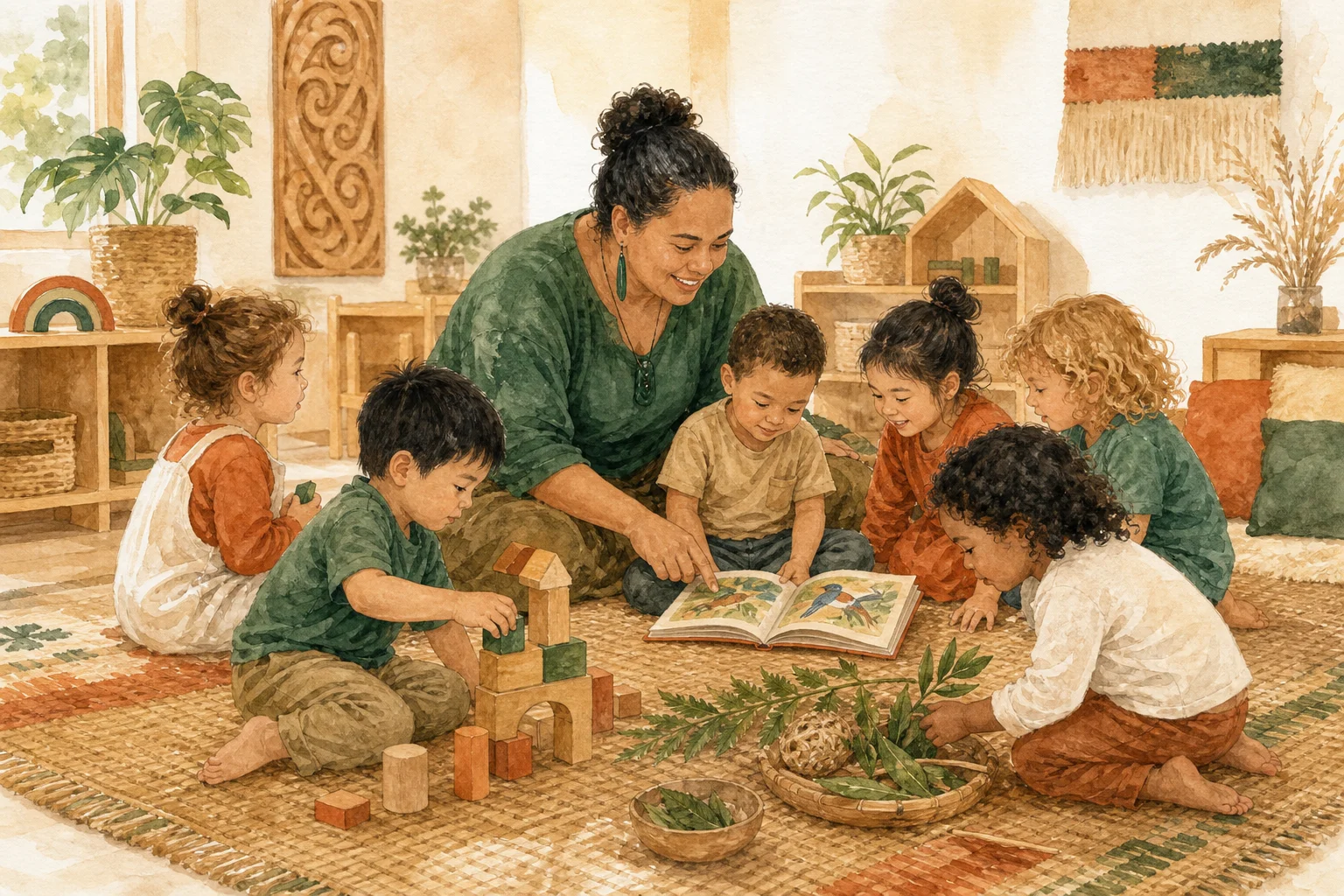
You will hear Te Whāriki mentioned at almost every early learning centre in New Zealand. It can sound like one more piece of education jargon. In practice, it is the framework that helps kaiako decide what to notice, what to offer next, and how to make your child's learning visible to you.
Te Whāriki does not tell a centre to run a particular activity at 10am or teach every child the same thing in the same week. It sets a direction: children should become confident learners and communicators, healthy in mind, body and spirit, secure in belonging, and aware that they can contribute. The framework then asks each service to weave that direction into its own place, people and culture.
That is why two good centres can feel different. A Montessori service, a play-based centre and a nature kindergarten can each use Te Whāriki. What matters is whether the adults can explain how their choices support your child's learning, identity and relationships.
Video
The woven mat is more than a nice image
A whāriki is a woven mat. Te Whāriki uses that image because learning in early childhood is not a neat set of separate subjects. Language, movement, friendships, curiosity, family stories and care all overlap. One child may be building confidence through climbing, another through joining a group game, and another through telling a story in the language spoken at home.
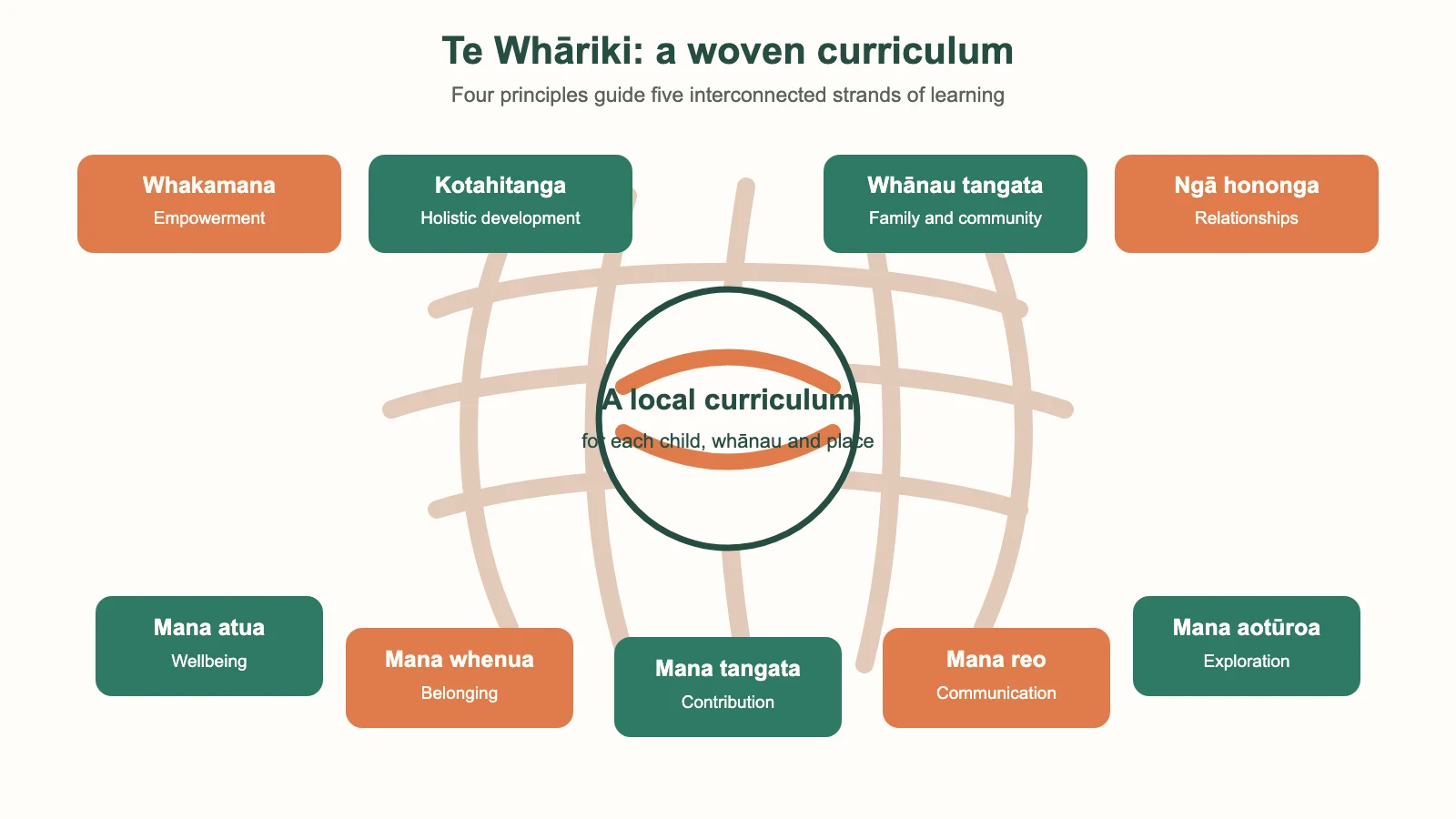
The framework has four principles, five strands, goals for kaiako and broad learning outcomes for tamariki. The outcomes are not a report-card checklist. They help kaiako plan, assess progress and decide what experiences might extend a child's thinking. The official Te Whāriki framework describes them as statements of valued learning that develop over time.
This approach is useful for parents because it shifts the question from asking whether a child can already do something to asking what the child is learning and what could help next. A thoughtful learning story should answer that second question, not just describe a cute moment.
The four principles in everyday centre life
The four principles are the foundation for curriculum decisions. You do not need to memorise the Māori names before a visit, but knowing what they mean gives you better questions to ask.
| Principle | Plain-English meaning | What you might notice |
|---|---|---|
| Whakamana | Empowerment | Children are supported to learn and grow with agency. | A kaiako offers choices, waits for a child to try, and adapts support rather than taking over. |
| Kotahitanga | Holistic development | Learning includes emotional, social, physical, spiritual and cognitive growth. | A messy art session, outdoor play and a conversation about feelings all count as learning. |
| Whānau tangata | Family and community | Whānau, culture and the wider community belong in the curriculum. | The centre asks about your child's home language, important people, routines and aspirations. |
| Ngā hononga | Relationships | Children learn through responsive, reciprocal relationships with people, places and things. | Kaiako know the children well, follow up on interests and help children connect with one another. |
Empowerment does not mean children are left to figure everything out alone. A child gains agency when an adult notices a small attempt, provides just enough help and gives them another chance. Holistic development means a centre should not treat social confidence, self-care or physical play as spare time around the real learning.
Family and community is where a centre's local curriculum becomes real. A service might use local stories, visit a nearby library, invite whānau knowledge into projects or make room for the languages that matter to its families. Relationships are equally practical: who comforts your child at drop-off, how continuity is managed, and whether kaiako remember yesterday's idea all matter.
The five strands are the learning you can see
The five strands are broad areas of learning and development. They weave together during ordinary moments, so a sandpit, shared lunch or block tower can touch several at once. A good centre does not force every activity into a label. It uses the strands to notice the learning already happening and to make intentional next steps.
| Strand | What it covers | A familiar example |
|---|---|---|
| Mana atua | Wellbeing | Health, safety, self-care and expressing needs. | A toddler practises asking for help, washes hands with support and finds a calm place after a hard morning. |
| Mana whenua | Belonging | Connections with people, places, routines and responsibilities. | A child knows where their bag goes, helps care for a garden and recognises the centre's shared routines. |
| Mana tangata | Contribution | Participation, fairness, problem-solving and making a valued contribution. | Children negotiate turns, include a new child in play and work out how to stabilise a block structure. |
| Mana reo | Communication | Language, symbols, stories, movement and expression in many forms. | A child uses te reo Māori, home language, drawing, music or dramatic play to share an idea. |
| Mana aotūroa | Exploration | Curiosity, play, working theories and making sense of the world. | Children test what floats, return to a bug found outside, or experiment with ramps and water. |
The strands do not set a race between children. A quiet child who watches closely may be exploring, communicating and building belonging before they choose to speak in a group. Kaiako should be able to describe progress in ways that respect your child's pace, strengths and identity.
The five strands also make room for different educational approaches. A Montessori centre may use a carefully prepared environment; a Reggio-inspired service may follow a long project; a play-based programme may change its resources as children's interests change. The shared question is whether the approach gives children meaningful opportunities across the learning outcomes. For the wider picture, see our guide to ECE philosophies in New Zealand.
How kaiako turn the framework into a local curriculum
Te Whāriki is deliberately broad. That is not a gap to be filled with random activities. It is an invitation to build a local curriculum that reflects a service's children, whānau, community and place. The Education Review Office explains that kaiako should work with colleagues, children, parents and whānau to interpret the strands, goals and learning outcomes in light of community values and family aspirations.
At one centre, that may lead to a project about the creek children walk past every day. At another, it may mean supporting children to use Samoan, Hindi, Mandarin, te reo Māori or another home language during play. A child fascinated by trucks may prompt questions about wheels, maps, building sites, safety signs and the people who work in the neighbourhood. The adult's job is to notice the thread and extend it with purpose.
Ask a centre what has shaped its local curriculum recently. A clear answer should include children and whānau instead of a glossy statement about philosophy. If staff can show how an interest was revisited over days or weeks, that is more useful evidence than a wall full of disconnected activities.
Learning stories should make thinking visible
Many New Zealand services use learning stories or other forms of narrative assessment. These are not meant to be a record of every activity your child did. Their job is to make learning visible, connect it to Te Whāriki outcomes, and help kaiako and whānau decide what might come next.
A useful story names the context, the capability or disposition the kaiako noticed, and the possible next step. For example, a child who spends ten minutes adjusting a bridge after it falls gives a kaiako evidence of persistence, testing ideas and asking for help. The possible next step might be to explore different supports with a friend. Your perspective matters too. You might recognise a related interest at home, share a word your child uses, or say what you hope they will feel more confident doing.
ERO's quality indicators say assessment should enhance mana and learner identity, involve children and whānau, and inform planning. That is a high bar. It is fair to ask how your centre uses a story after it has been written.
Te Tiriti, language and identity are part of the curriculum
Te Whāriki is grounded in the bicultural context of Aotearoa New Zealand. It recognises Māori as tangata whenua and makes space for children to see their language, culture and identity treated with respect. This is not a once-a-year cultural performance or a few labels on a wall. It should affect relationships, resources, pronunciation, stories, local knowledge and the way kaiako work with whānau.
Te Ara Māori is a te ao Māori expression of the principles, strands, goals and learning outcomes. The official guidance notes that its English text is an aid to understanding, not a direct translation. That distinction is worth respecting. If you are not sure how bicultural practice looks at a centre, ask what staff are learning, how local mana whenua knowledge is approached, and how te reo Māori is used meaningfully during the day.
The same principle applies to every family. Your child's home language and culture are assets for learning, not something to leave at the gate. Tell kaiako the words, songs, celebrations and family stories that matter in your home. A responsive curriculum has room for them.
What Te Whāriki does and does not guarantee
Curriculum and compliance are different checks
Every licensed service works within the national curriculum framework, but the quality of implementation varies. A centre can use the right words on its website and still struggle to give children consistent relationships or to use assessment well. That is why it helps to look at the lived experience: whether children are settled, whether kaiako know them, how adults respond to conflict, and how families are invited into planning.
ERO reviews early childhood services using learning outcomes from Te Whāriki alongside process indicators about the conditions that support quality. Its framework looks at far more than a display board. It considers curriculum, professional learning, internal evaluation, leadership, governance and how well a service promotes equitable outcomes. Reading an ERO report can add useful context, but it is still one piece of the picture. Visit, ask questions and notice how the centre responds to your family.
If you are choosing between services, compare what each says about the same practical questions: who will know your child best, how your voice becomes part of planning, how learning is documented, and how the curriculum works for children who need extra support. Our centre comparison tool can help you keep those notes in one place.
Questions worth asking at your next visit
- Can you show me a recent example of an interest children explored over time, and explain which learning outcomes guided the next step?
- How do you learn about a child's home language, culture, routines and family aspirations?
- How do learning stories or other assessment records change what kaiako plan next?
- How do you support children who are slow to settle, quiet in groups or needing extra help?
- How do you use te reo Māori and local knowledge in everyday practice?
- Who would be my child's key kaiako, and how do you maintain relationships when staff are away?
There is no need to quiz a centre as if you are conducting an inspection. Good questions open a useful conversation. Listen for specific examples instead of curriculum language alone. The right service for your whānau should be able to explain its approach plainly and be interested in what you know about your child.
When you are ready to shortlist options, search early learning providers near you and arrange a visit. Te Whāriki gives all services a common foundation. The day-to-day relationships are what make that foundation feel safe and useful for your child.
Frequently asked questions
Is Te Whāriki compulsory for early learning services?
Te Whāriki is New Zealand's early childhood curriculum framework. Licensed services use its principles, strands, goals and learning outcomes to guide curriculum planning, teaching and assessment. It is separate from the regulations that cover matters such as safety, staffing and premises.
Does Te Whāriki mean every centre teaches the same thing?
No. Te Whāriki provides shared principles, strands, goals and learning outcomes, then allows each service to develop a local curriculum with its children, whānau and community. That is why centres can look different while working within the same framework.
What are the five strands of Te Whāriki?
They are Mana atua or wellbeing, Mana whenua or belonging, Mana tangata or contribution, Mana reo or communication, and Mana aotūroa or exploration.
How can I tell whether a centre uses Te Whāriki well?
Ask for a specific example of learning that was noticed, documented and extended. Look for warm, responsive relationships, meaningful whānau input, and assessment that explains what your child is learning rather than simply listing activities.
Are learning stories required for every child?
Services may use learning stories or other assessment approaches. The important question is whether their assessment makes learning visible, involves whānau where appropriate, and helps kaiako plan meaningful next steps.
Find an early learning centre that fits your whānau
Compare local options and start a conversation about the learning that matters to your child.
Search centresRelated guides
ECE Philosophies Explained: Montessori, Reggio Emilia, Steiner, and More in NZ
A practical NZ guide to Montessori, Reggio-inspired, Steiner, play-based, nature-based, RIE, and faith-based early learning.
What to Pack for Daycare: The Complete Checklist for NZ Parents
A practical NZ daycare bag checklist covering spare clothes, nappies, bottles, lunchboxes, sun hats, comfort items, medication, labels, and what to leave at home.
Returning to Work After Parental Leave: Managing the Childcare Transition
A practical NZ guide to timing childcare, flexible work, breastfeeding, sick days, and the emotional jump back into work after parental leave.
The Childcare Settling-In Process: What NZ Centres Offer and What to Expect
A practical NZ guide to settling visits, key kaiako relationships, week-by-week transitions, and questions to ask before your child starts childcare.
Find childcare near you
Search and compare providers by suburb, care type, cost, and availability.