
Resource Hub
Faith-Based Childcare in NZ: What Parents Should Know
Published · Last updated · 5 min read
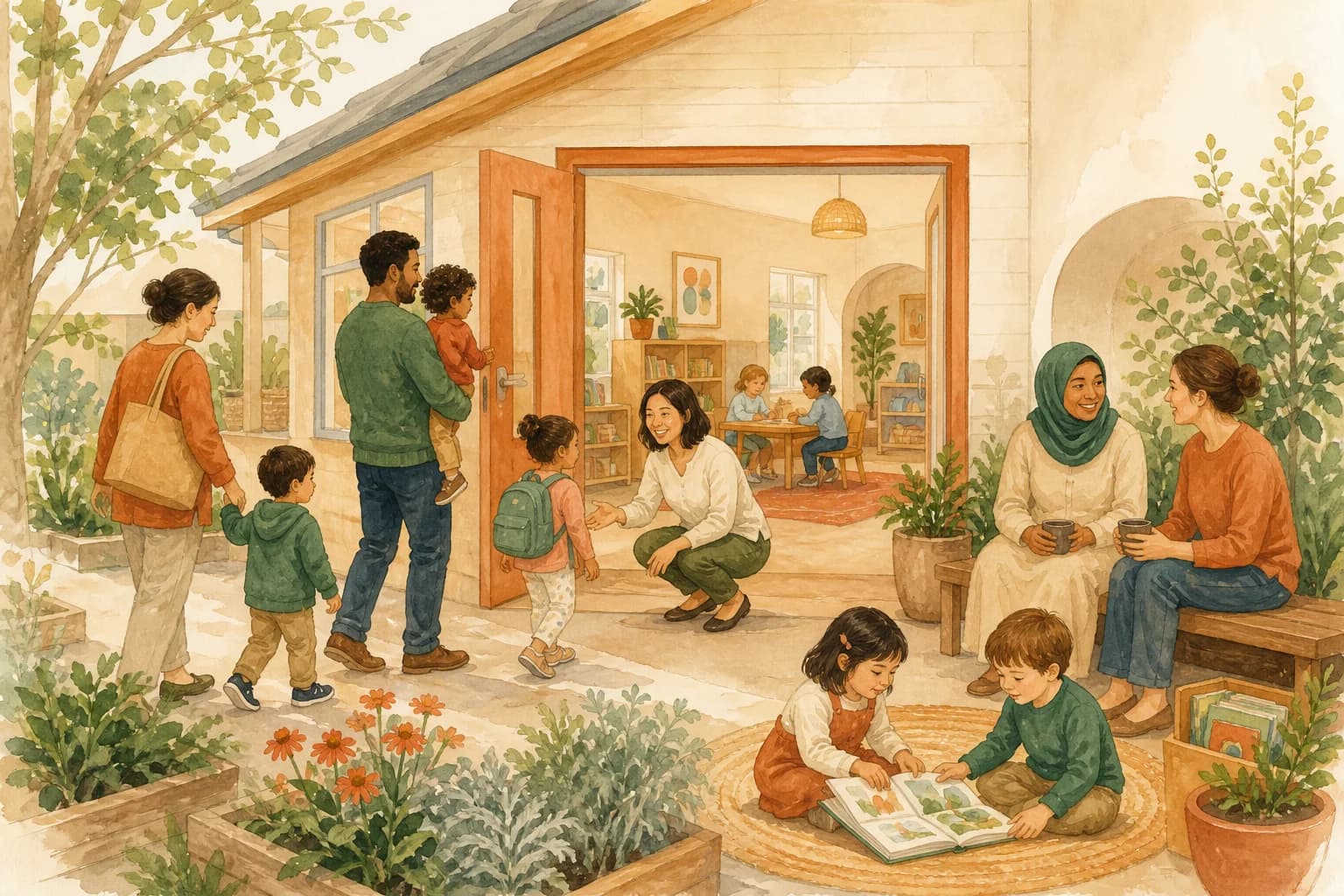
What is faith-based childcare in New Zealand?
Faith-based childcare is an early learning service with a religious connection, such as a church, mosque, synagogue, school or community organisation. A licensed service must still meet the same Ministry of Education standards as any other ECE provider and use the national Te Whāriki curriculum framework.
What faith-based childcare can look like
The label can mean different things. Some centres are owned by a religious organisation. Others rent space from a church or include a faith tradition in their daily rhythm. You may see a short prayer, grace before food, stories drawn from a faith tradition, music, seasonal celebrations or an emphasis on values such as care, service and hospitality. The practical question is not whether a centre uses the label. It is what children actually experience each day.
In Aotearoa, faith-connected early learning settings may be Christian, including Catholic, Anglican, Baptist or Adventist communities. There are also services and playgroups connected with Muslim, Jewish, Hindu, Sikh and other communities. Availability varies sharply by suburb and by age group, so search locally and ask the service directly about its affiliation rather than relying on a directory label.
Video
The same ECE standards still apply
A religious affiliation does not create a separate set of childcare rules. The Ministry of Education says licensed services are regulated under the Education and Training Act 2020 and the Education (Early Childhood Services) Regulations 2008. Licensing covers curriculum, health and safety, premises, governance, management and child protection. Ask to see the current licence and check the service's most recent Education Review Office information as part of any decision.
Every licensed service must work within Te Whāriki, New Zealand's bicultural early childhood curriculum. That means learning should recognise the special place of Māori as tangata whenua, respect children and whānau, and help children understand other cultures. A faith tradition can be part of a centre's local curriculum. It does not replace Te Whāriki or give a service permission to ignore a child's identity, home language or family values.
A useful distinction
What to look for on a visit
The visit matters more than the brochure. Notice how kaiako greet children, whether children appear settled, and how the room reflects the families who use it. Ask where religious content appears in the week. Is it an optional moment, woven through stories and songs, or part of a more structured programme? None of those answers is automatically right or wrong. You need an answer that fits your family.
- How is your faith tradition present in a normal day?
- Do children need to take part in prayer, worship, food practices or religious celebrations?
- Do families need to belong to the faith community, and are there enrolment priorities or waitlist rules?
- How do you include children from other faiths, no faith, and different family structures?
- How do you weave Te Whāriki, te reo Māori and local tikanga into the programme?
- What happens if a child or parent is uncomfortable with an activity?
- Can I read your policies on enrolment, guidance, inclusion, complaints and child protection?
Food, celebrations and family choices
Food is often where values become very practical. A centre may provide halal, vegetarian, kosher-style or other faith-informed meals, or it may ask families to pack food that meets particular guidelines. Ask about allergies and medical diets as well as religious requirements. The important thing is a clear written process, especially around shared food, birthday celebrations and cultural events.
Celebrations can be a lovely way for tamariki to learn about one another, but they should not become a test of belonging. Ask how the centre handles Christmas, Easter, Ramadan, Diwali, Hanukkah, Matariki and other occasions relevant to its community. A thoughtful answer will explain what children do, why they do it, and how families can raise concerns or opt out where appropriate.
Does your child need to share the faith?
There is no universal answer. Some services welcome any family and simply make their affiliation visible. Others may have a stated character, a community connection or enrolment priorities. Do not assume either openness or exclusion. Ask before you put your name on a waitlist, then ask the same question again when a place is offered so the arrangement is clear in writing.
You are looking for respectful fit, not a perfect label. A family that shares the faith may want a centre where traditions are familiar. A family from another background may value the same community while wanting clear boundaries around participation. In both cases, your child needs warm relationships, responsive teaching and a programme that treats their identity with care.
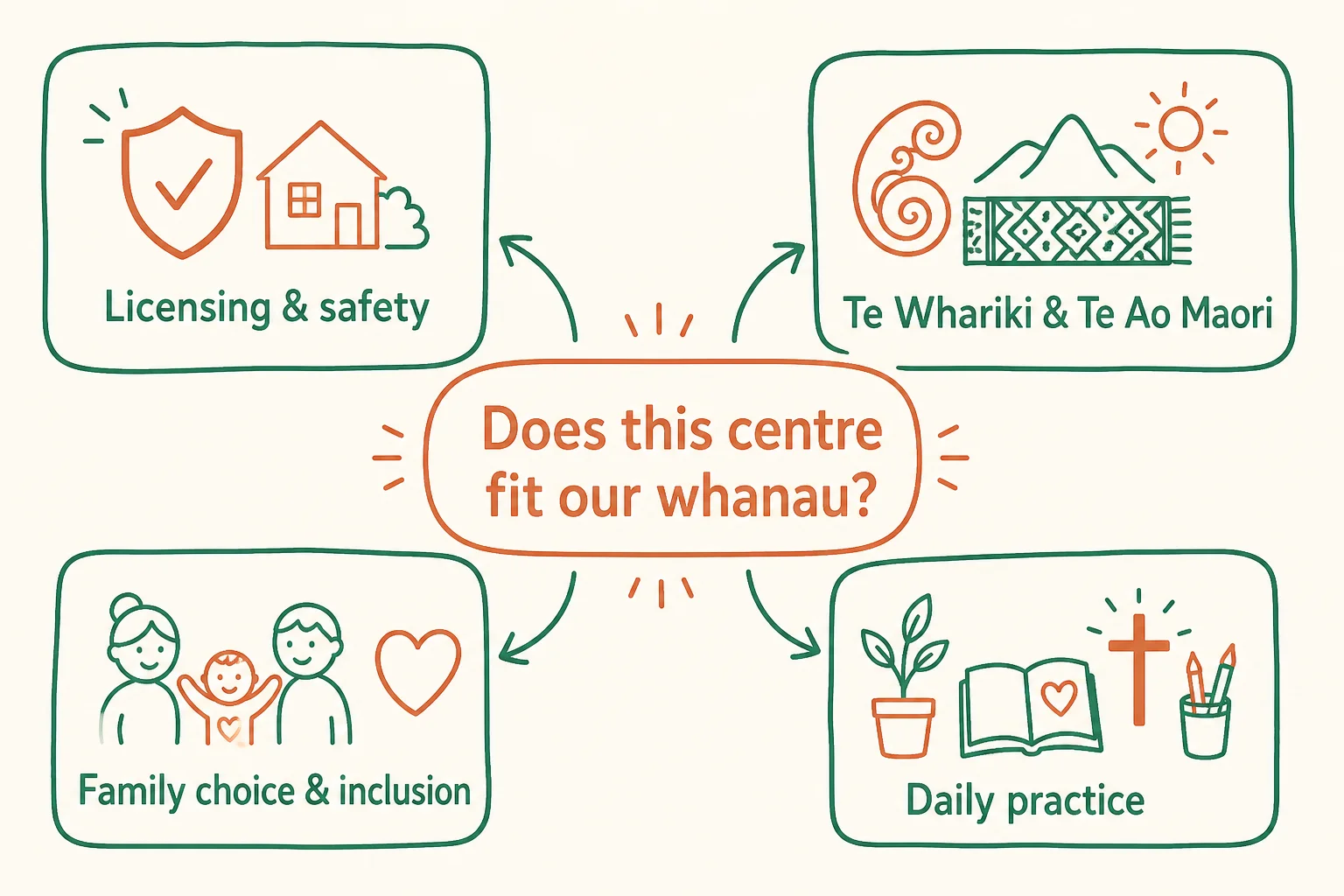
How to compare a faith-based centre fairly
| Check | Why it matters | What a clear answer sounds like |
|---|---|---|
| Licence and quality information | Faith affiliation does not replace ECE oversight | Here is our licence, policies and the information we use for quality review. |
| Daily programme | Families need to know what children take part in | Prayer and faith stories happen at these times, and this is how we discuss participation. |
| Inclusion | Children should feel safe and respected | We welcome questions and explain how we support families with different beliefs and practices. |
| Whānau voice | Parents are part of a child's learning | We ask about your aspirations and review them through learning stories and conversations. |
Compare the centre against the same basics you would use anywhere else: adult responsiveness, continuity of kaiako, safe routines, outdoor play, communication, fees and the journey from home. The Parent Circle's centre search can help you narrow down local options, but a visit and a proper conversation should decide the final shortlist. If you are comparing two services, put the answers side by side in Compare Centres while the details are fresh.
Faith-based childcare in NZ: common questions
Are faith-based childcare centres licensed in New Zealand?
If a service is licensed, it must meet Ministry of Education requirements for education and care, including curriculum, health and safety, premises, governance and child protection. Ask the centre to explain its licence and policies.
Do faith-based centres have to follow Te Whariki?
Yes. Licensed early learning services and certificated playgroups must follow the national Te Whariki curriculum framework. A faith tradition can be part of local practice, but it does not replace the curriculum framework.
Do parents have to share the centre's faith?
It depends on the service. Some welcome all families, while others may have community connections or enrolment priorities. Ask directly about eligibility, participation and waitlist rules.
Can my child opt out of prayer or religious activities?
Policies vary. Ask what activities take place, whether participation is expected, and how the service responds if a family prefers not to take part. Get the answer in writing if it matters to your enrolment decision.
What should I ask before enrolling?
Ask how faith appears in the daily programme, how Te Whariki and Te Ao Maori are put into practice, how different beliefs are respected, what food rules apply, and how parents can raise concerns.
The best faith-based childcare setting is one where the stated values show up in ordinary moments: a child is comforted quickly, a parent can ask an awkward question, and every family is treated with dignity. Start with the complete guide to ECE philosophies, then visit local options with a clear list of questions.
Related guides
Nature-Based and Forest Kindergartens in NZ: A Parent Guide
Curious about forest kindergarten or nature-based ECE in NZ? Learn how it works, what to ask, safety checks, costs, gear and whether it fits your child.
Montessori vs Play-Based vs Reggio: Which Philosophy Is Right for Your Child?
A practical NZ parent's guide to Montessori, play-based and Reggio-inspired ECE, with temperament fit, centre questions and a plain-English comparison table.
Screen Time and Young Children: An Evidence-Based Guide for NZ Parents
A practical NZ guide to screen time for babies, toddlers and preschoolers, including what the health guidance says, how to judge quality, what to ask early learning centres, and how to build calmer routines at home.
Understanding Learning Stories: A Guide for NZ Parents
Learning stories are how kaiako document your child's learning at their ECE centre. This guide explains what they are, what good ones look like, and how to use them at home.
Find childcare near you
Search and compare providers by suburb, care type, cost, and availability.