
Resource Hub
Montessori Childcare in NZ: What to Expect and How to Choose
Published · Last updated · 7 min read
Contents
What is Montessori childcare in New Zealand?
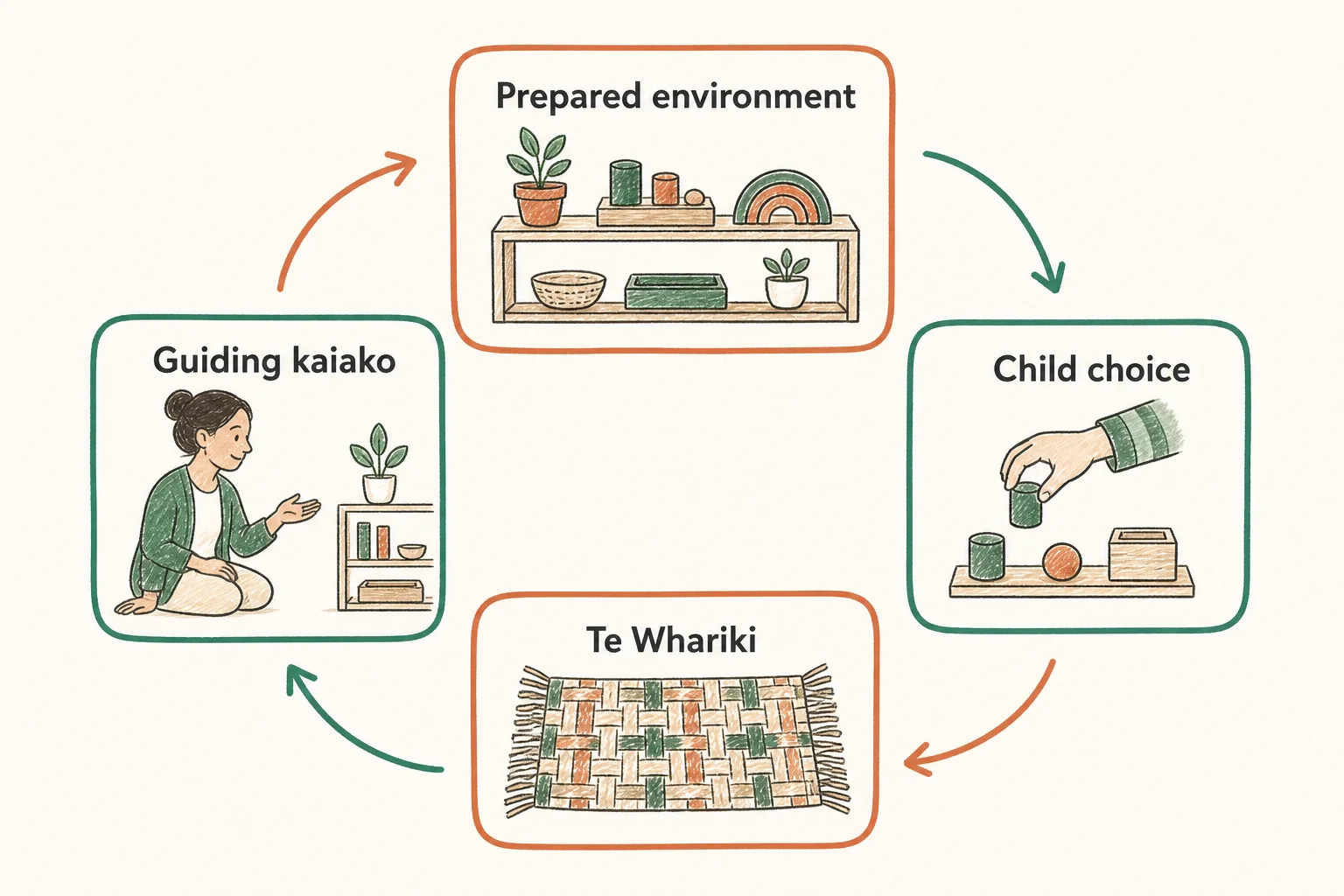
Montessori childcare is a licensed early learning service that uses a prepared, child-sized environment and self-directed activity to support independence. In New Zealand, a Montessori centre still follows Te Whariki, licensing criteria and the same safety rules as other teacher-led services.
Montessori childcare, in plain English
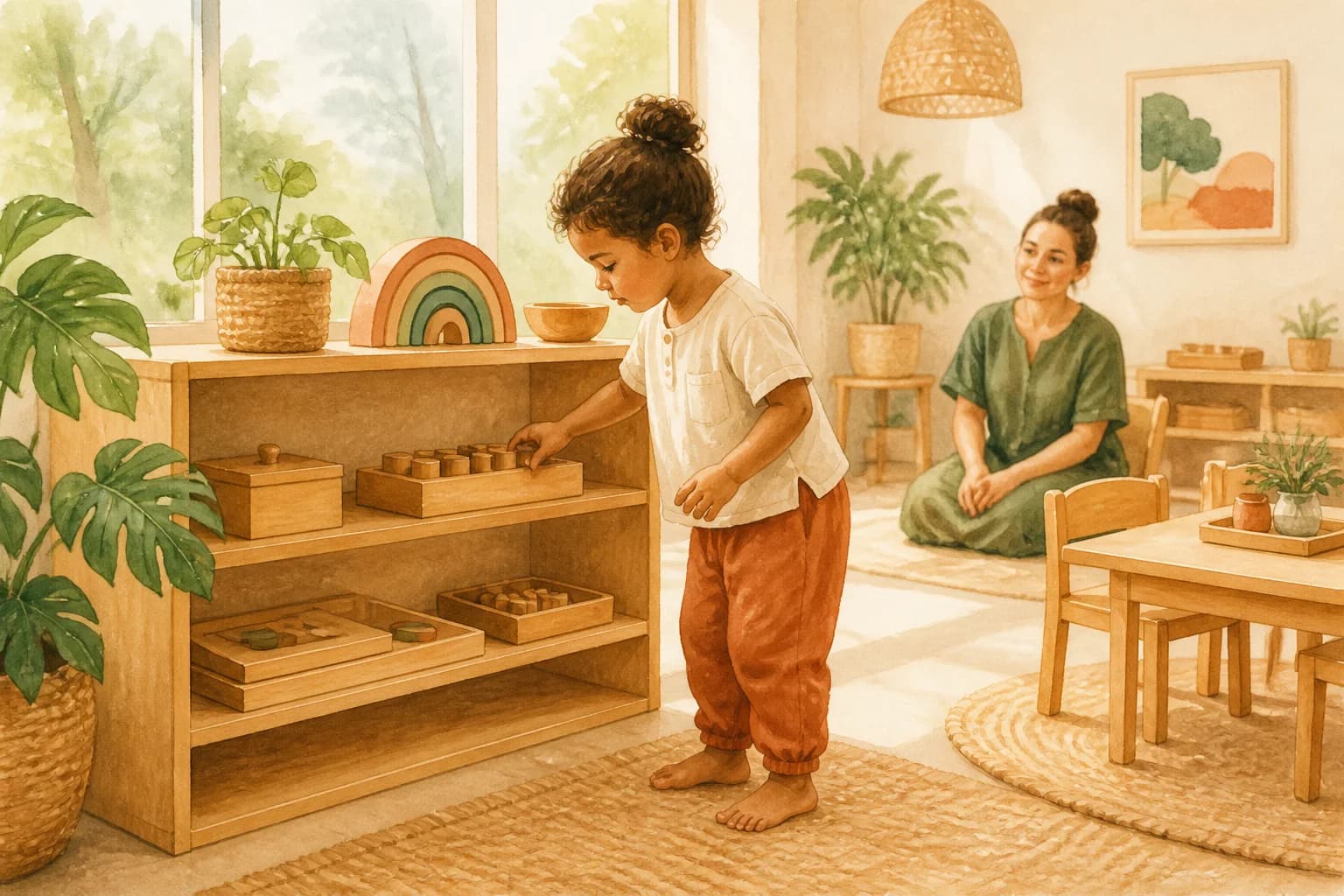
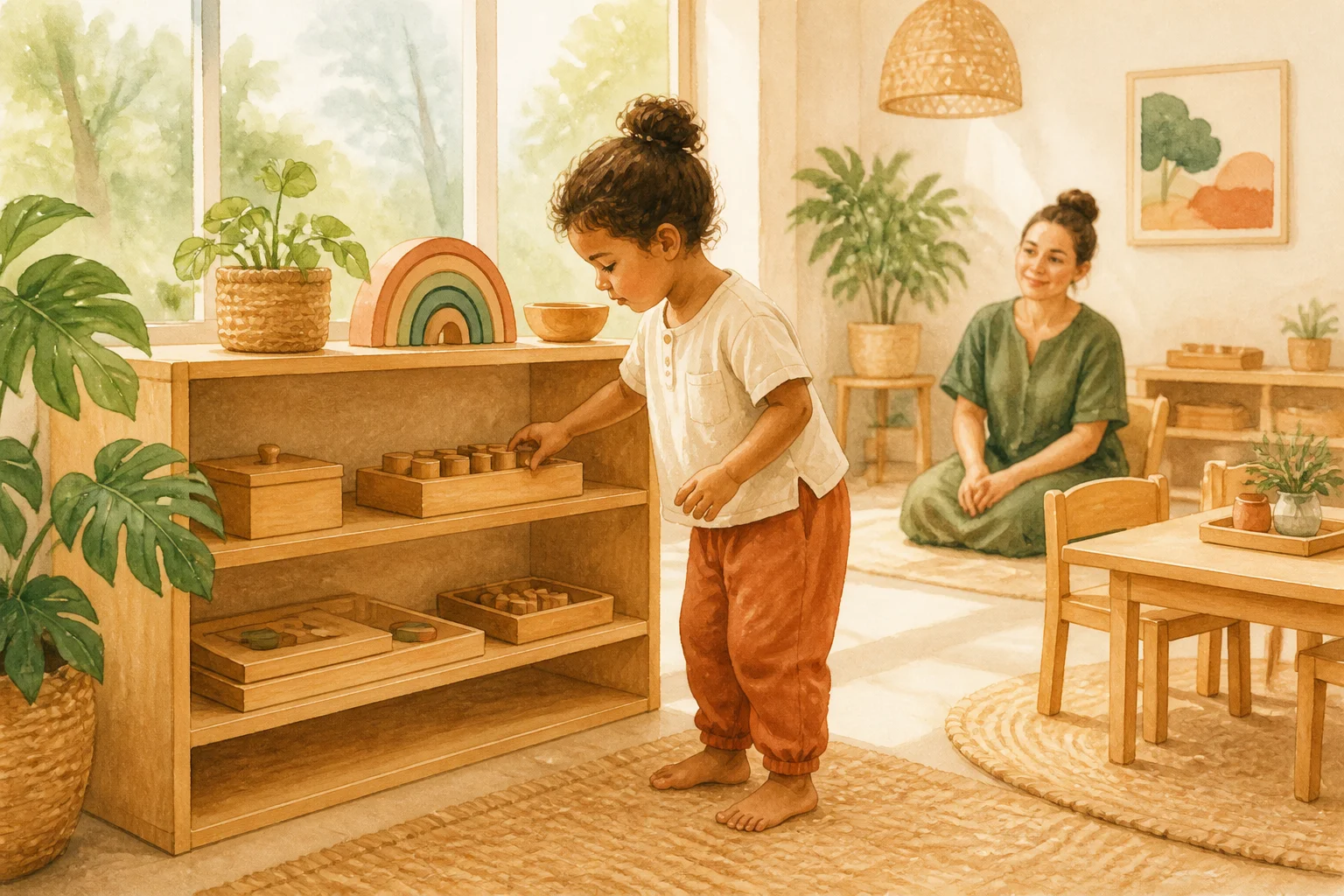
Montessori can look quieter than a typical preschool, but it is not a room where children are left to their own devices. Kaiako prepare the space, introduce materials one-to-one or in small groups, then watch closely as each child chooses purposeful work. A child might polish a mirror, match sound cylinders, wash fruit for kai, or practise pouring water before moving into early literacy or maths materials.
The aim is practical independence: 'I can do this myself.' Children have real tools sized for small hands, clear places to return them, and time to repeat an activity until it clicks. Montessori Aotearoa New Zealand says the approach is part of the wider NZ early learning sector, so a Montessori centre is licensed and funded through the Ministry of Education in the same way as other teacher-led services.
Video
What makes a Montessori environment different?
The prepared environment is the part parents notice first. Shelves are low and orderly. Materials are complete, accessible and usually displayed once rather than in a crowded toy box. The setting is designed so tamariki can choose, carry, use and put away materials with as little adult help as possible.
Montessori classrooms commonly group children across a span of ages. Younger children can observe older peers, while older children practise leadership and care for the community. The Association Montessori Internationale describes the materials as hands-on and self-correcting, which lets a child notice an error and try again without waiting for an adult to mark it wrong.
- Practical life: pouring, food preparation, cleaning, dressing and caring for plants.
- Sensorial work: materials that isolate a quality such as size, weight, colour, texture or sound.
- Language and maths: concrete materials that build toward reading, writing, counting and number relationships.
- Culture and nature: local stories, maps, science, gardening and work that connects children with their community.
What a day may look like
There is no single Montessori timetable. Each service sets its own hours, routines and age groups. Many have a long uninterrupted work period where children choose from familiar materials, receive a short presentation from a kaiako, work alone or alongside a friend, and reset the space when they finish.
That does not mean routines disappear. Meals, outdoor time, nappy changes, rest and group moments still need steady care. The difference is that the adult tries to involve children in those ordinary jobs where it is safe to do so. A two-year-old may carry their own cup to the table; a four-year-old may help set up kai or water the garden.
A useful distinction
Montessori and Te Whariki in an NZ centre
Every licensed early learning service in Aotearoa New Zealand works from Te Whariki, our early childhood curriculum. Montessori is an approach to the environment, adult role and learning materials. It does not replace the curriculum or a service's obligations to honour the bicultural foundations of Te Tiriti o Waitangi.
On a visit, ask how the centre makes Te Whariki visible in its planning and learning stories. You might hear about wellbeing, belonging, contribution, communication and exploration. The answer should be more concrete than a curriculum poster on the wall. Look for local places, te reo Maori used with care, whānau knowledge and children's interests shaping the programme.
Is 'Montessori' a guarantee of a particular standard?
No. The name Montessori is not trademarked, and Montessori Aotearoa New Zealand notes that any early learning service can use it. MANZ membership is voluntary and the association does not assess member centres for authenticity. A centre's name is a starting point for questions, not an accreditation badge.
That is why it helps to ask what the centre means by Montessori. A service may use the approach deeply across its environment, daily routines and staff development. Another may be Montessori-inspired and combine selected materials with a more conventional programme. Neither label tells you whether the place will suit your child. You need to see the practice.
| Ask about | A helpful answer sounds like |
|---|---|
| Teacher preparation | The centre can name the relevant NZ ECE qualifications and explain what Montessori training its kaiako have. |
| Mixed ages | The centre explains its actual age range and how younger and older children are supported. |
| Choice and limits | Staff describe how children choose work, how lessons are introduced and how conflicts are handled. |
| Te Whariki | Staff link daily experiences and documentation to the curriculum and to local whānau aspirations. |
| Transitions | The centre has a settling plan, a key contact and a clear way to communicate with family. |
Qualifications, licensing and ratios
A Montessori centre has the same legal responsibilities as any other licensed teacher-led ECE service. The Ministry of Education sets licensing criteria, including requirements around health, safety, premises, curriculum and adult supervision. Montessori training is separate from NZ teacher registration. MANZ says a Montessori diploma on its own is not recognised for teacher registration, while teacher-led services need at least 50 percent of regulated staff to hold a Teaching Council-recognised qualification.
For a parent, the practical question is simple: who will work with my child, and what training do they have? MANZ recommends that the lead teacher in a Montessori classroom has a Montessori qualification relevant to that age group. Ask how the service balances that specialist training with its registered ECE teacher requirements and regular professional learning.
Do not use a centre's preferred adult-to-child ratio as a substitute for the legal minimum. For example, the standard minimum ratio for children over two in many teacher-led centres is 1:10, but the applicable rules can vary with age and service type. Ask the centre for its licensed age range, legal ratio and the staffing level it normally chooses to provide.
Costs and 20 Hours ECE
Montessori is not automatically excluded from 20 Hours ECE. Eligible three, four and five-year-olds can receive the funding at participating services, subject to the same rules that apply elsewhere. Check directly with each centre whether it offers 20 Hours ECE, what hours it applies to, and what optional charges or fees may remain.
Fees vary by city, hours, age, service model and what is included. A Montessori label is not enough to predict the bill. Request the current fee sheet in writing and compare the total weekly cost, not only the advertised daily rate. Our childcare cost guide can help you frame the wider budget questions.
Could Montessori suit your child and family?
Some children enjoy choosing their own work, repeating a task and working in a calm room. Others warm up slowly, need more social prompting or simply thrive in a different style of programme. None of that is a verdict on your child. The better question is whether the adults understand your child now and can support the transition into their group.
Think about the whole family as well. Does the location work at drop-off time? Are the hours realistic? Does the centre's approach to communication match what you need? If you are comparing options, our ECE philosophies guide and Montessori, play-based and Reggio comparison put the big differences side by side.
How to find and compare Montessori centres
Start with two lists: services close enough for your real weekly routine, and services whose licensed age range fits your child. The MANZ school search is one place to identify member services. Then book visits. One tour tells you about the room; a second visit at a different time often tells you more about relationships, outdoor play and the rhythm of the day.
- Read the service profile, fee information and any available ERO information before visiting.
- Ask to see a normal part of the day rather than a staged open day.
- Watch how kaiako respond when a child needs help, disagrees with another child or loses interest.
- Ask what happens in the first weeks of enrolment and who will be your regular contact.
- Compare your notes while the visit is fresh. The best fit is usually obvious in the small details.
Frequently asked questions
Do Montessori centres in NZ follow Te Whariki?
Yes. Montessori early learning services operate within the NZ early learning sector and their curriculum must align with Te Whariki. Ask the service to show how this appears in planning, relationships and learning documentation.
Is Montessori childcare regulated differently?
No. A Montessori centre that is a licensed teacher-led ECE service follows the same Ministry of Education licensing framework as comparable services. Montessori training sits alongside, rather than replaces, NZ ECE qualification and registration requirements.
Does a Montessori name mean a centre is accredited?
No. The term Montessori is not trademarked. MANZ membership is voluntary and MANZ says it does not assess centres for authenticity. Visit, ask detailed questions and check the service's licensing information.
Can my child get 20 Hours ECE at a Montessori centre?
Eligible children may receive 20 Hours ECE at a participating Montessori service. Confirm participation, eligible hours and any remaining fees with the specific centre.
What age do children start Montessori?
Services set their own enrolment rules. MANZ says Montessori early learning can serve children from birth to six, though individual centres may have toddler or preschool entry points and specific age ranges.
Should I choose Montessori if my child likes active play?
Possibly. Visit the service and ask about outdoor time, movement, group play and how they support children with different temperaments. A label alone cannot tell you whether the everyday programme fits your child.
A good Montessori centre should be easy to question. You are choosing a place where your child will spend ordinary mornings, have big feelings, make friends and learn daily habits. Trust what you observe, then compare it with the facts the centre can clearly explain.
Related guides
Childcare During Family Transitions: A NZ Parent's Guide
A practical NZ guide to supporting your child through separation, moving, grief and other family changes at childcare.
Childcare for Twins and Multiples in New Zealand
A practical guide to finding childcare for twins and multiples, with questions on places, routines, staffing and support.
Steiner/Waldorf ECE in NZ: A Parent's Guide
A practical guide to Steiner/Waldorf early childhood education in New Zealand, including Te Whāriki, centre visits and questions for parents.
Reggio Emilia in NZ: Understanding the Reggio-Inspired Approach to ECE
A practical NZ guide to Reggio-inspired early learning, from inquiry and documentation to questions for your centre visit.
Find childcare near you
Search and compare providers by suburb, care type, cost, and availability.