
Resource Hub
Montessori vs Play-Based vs Reggio: Which Philosophy Is Right for Your Child?
Published · Last updated · 7 min read
Contents
Which ECE philosophy is best: Montessori, play-based or Reggio?
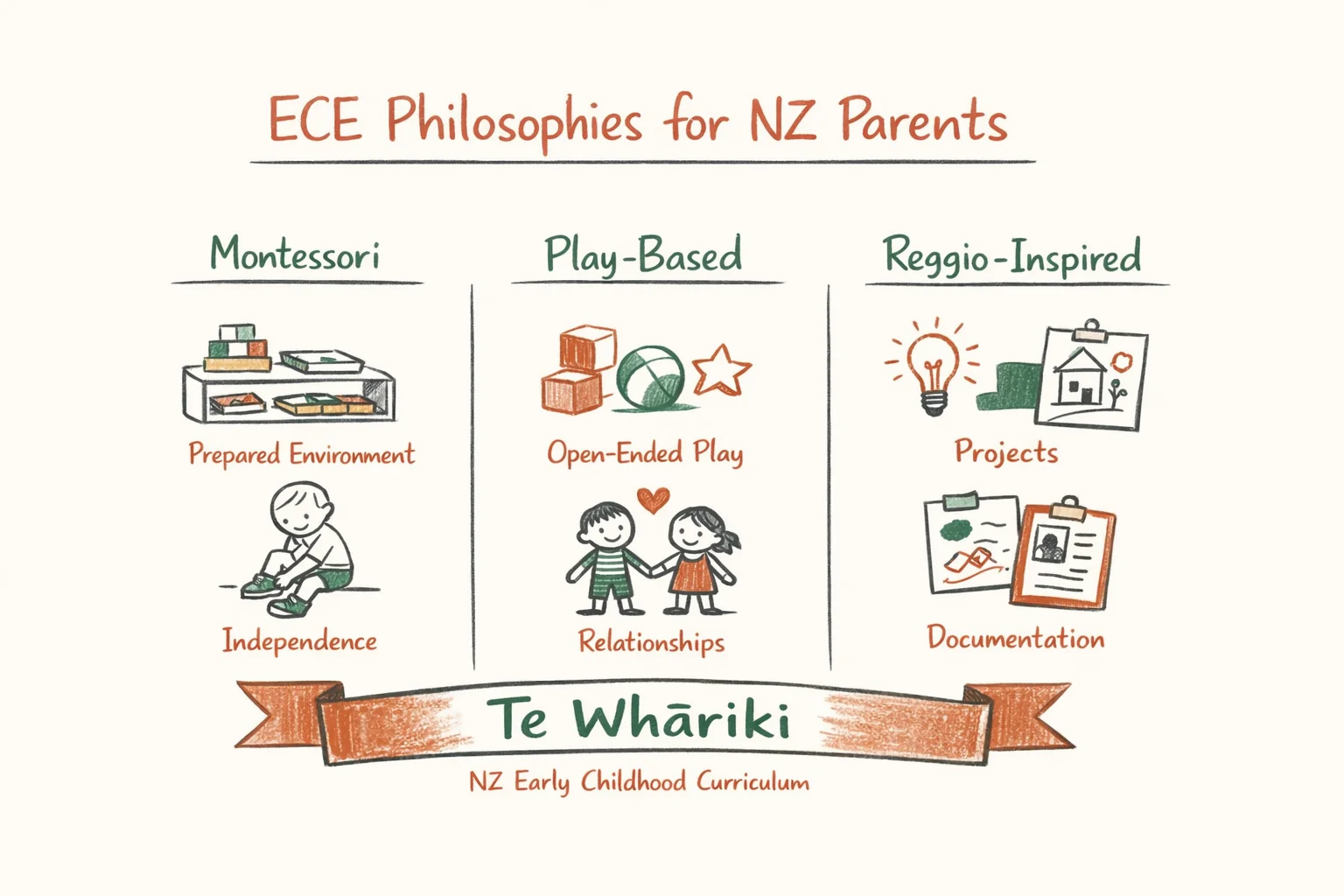
There is no single best ECE philosophy for every child. Montessori often suits children who enjoy order and independent work, play-based centres suit children who learn through open-ended social play, and Reggio-inspired centres suit children who thrive on creativity, projects and strong whānau involvement. In New Zealand, all licensed services still work within Te Whāriki, so the real question is how well the philosophy is practised day to day.
Start with the child, not the label
Parents often ask whether Montessori is better than play-based care, or whether Reggio Emilia is more creative than a regular childcare centre. The honest answer is less tidy: the philosophy matters, but the adults matter more. A thoughtful play-based centre can be far stronger than a centre using a fashionable label without much substance. For a broader NZ overview, see our guide to ECE philosophies.
In Aotearoa New Zealand, licensed early childhood services work under Te Whāriki, the national early childhood curriculum. That means Montessori, Reggio-inspired and play-based centres are not operating in separate worlds. They are different ways of arranging the same big commitments: wellbeing, belonging, contribution, communication and exploration.
The quick comparison
| Question | Montessori | Play-based | Reggio-inspired |
|---|---|---|---|
| Main idea | Children build independence through purposeful work in a prepared environment | Children learn through open-ended play, relationships and exploration | Children investigate ideas through projects, creativity and documentation |
| Kaiako role | Guide who observes, presents materials and steps back | Facilitator who extends play and supports relationships | Co-learner who listens, documents and helps children revisit ideas |
| Environment | Orderly shelves, specific materials, calm work spaces | Flexible indoor and outdoor spaces with varied resources | Beautiful, intentional spaces with art, light, loose parts and project displays |
| Structure | More structured work cycle, often mixed age | Flexible rhythm with plenty of free play | Flexible but often organised around long-running inquiries |
| Best fit | Children who like order, repetition and doing things independently | Children who learn socially, move between activities and need flexibility | Children who love making, talking, building theories and revisiting ideas |
| Watch for | Too rigid for some children if adults over-control the method | Too loose if kaiako do not intentionally extend learning | Beautiful documentation that may not match everyday practice |
A simplified comparison. Real NZ centres often blend approaches, so use this as a starting point for centre visits.
Montessori: independence, order and concentration
Montessori education is built around a prepared environment. Materials are placed where children can reach them, activities have a clear purpose, and children are encouraged to choose work, repeat it and finish it. In a good Montessori ECE room, you will usually see calm movement rather than constant adult direction.
The teacher is not meant to be the star of the room. The kaiako observes carefully, shows a child how to use a material, then gives space for practice. This can be powerful for children who enjoy order, practical tasks and the satisfaction of doing something by themselves.
- Consider Montessori if your child likes routines, sorting, pouring, puzzles, practical tasks and quiet focus.
- Ask whether kaiako have Montessori training, not just whether the centre has Montessori materials on shelves.
- Watch whether children can choose work freely, or whether adults are constantly correcting and directing them.
- Check how outdoor play, messy play, music and group relationships are protected alongside individual work.
Visit during the work cycle
Play-based: flexible learning through real life
Play-based learning is the most common language you will hear in NZ early childhood education. Done well, it is not a free-for-all. It means kaiako treat play as serious learning: building language in the sandpit, maths through block towers, social skills through pretend play, and problem-solving through messy trial and error.
This approach fits neatly with Te Whāriki because the curriculum is not a school-style list of lessons. It is a woven curriculum that follows relationships, interests, culture, language and exploration. A play-based centre should be able to explain what children are learning without turning the room into a mini classroom.
- Consider play-based care if your child is social, physical, imaginative or still finding their rhythm in groups.
- Ask kaiako how they extend play when children get stuck, repeat the same game or exclude others.
- Look for open-ended materials: blocks, clay, water, sand, dress-ups, books, loose parts and outdoor spaces.
- Be cautious if the centre uses play-based language but children seem bored, unmanaged or mostly waiting for adults.
Reggio-inspired: projects, creativity and documentation
Reggio Emilia began in Italy, but in New Zealand you will usually see centres describe themselves as Reggio-inspired rather than pure Reggio. That distinction is useful. Aotearoa has its own curriculum, bicultural commitments and community context, so good Reggio-inspired practice should feel local rather than imported.
The approach starts from a strong image of the child as capable, curious and full of ideas. Children might spend days or weeks investigating a question, building models, drawing theories, talking with kaiako and revisiting their thinking. The environment is often described as the third teacher because the room itself invites exploration.
Documentation is central. Instead of a quick photo and a generic caption, kaiako record what children said, what they tried, what theories emerged and what might happen next. For parents, this can make learning more visible. The catch is that documentation takes time, so ask how often it is done and how it feeds back into planning.
- Consider Reggio-inspired care if your child loves drawing, building, talking through ideas, group projects or imaginative problem-solving.
- Ask to see examples of project documentation and how children revisited their ideas over time.
- Look for materials that invite expression: clay, paint, wire, light tables, natural objects, blocks and dramatic play spaces.
- Check whether whānau are genuinely invited into projects, not just sent photos after the fact.
Most NZ centres are hybrids
Here is the bit that saves parents a lot of stress: many NZ centres blend philosophies. You might see Montessori-style practical life activities in the morning, play-based outdoor exploration after lunch, and Reggio-style project documentation on the wall. That is not automatically a problem. It can be excellent if the team knows what it is doing.
The problem is vague philosophy soup. If a centre claims to be Montessori, Reggio, inquiry-based, child-led, nature-focused and school-ready all at once, ask for examples. Good teams can explain their choices in plain language. Weak teams hide behind buzzwords.
Te Whariki is the common thread
How to choose for your child
Start with temperament. A child who needs predictable routines may settle beautifully in Montessori. A child who learns by moving, negotiating and pretending may need a strong play-based environment. A child who asks big questions, makes things and wants adults to take their theories seriously may come alive in a Reggio-inspired setting.
Then look at your family rhythm. Montessori may ask for patience with independence, such as letting children dress, pour and tidy at their own pace. Reggio-inspired centres may invite more whānau input into projects. Play-based centres may suit families who want flexibility, mixed experiences and plenty of outdoor time. None of this is better or worse. It is fit.
| If your child... | Look closely at... | Why |
|---|---|---|
| Gets overwhelmed by noisy, fast-moving rooms | Montessori or a calm play-based centre | Predictable routines and smaller activity zones may help settling |
| Loves making, drawing, building and explaining ideas | Reggio-inspired | Project work and documentation can feed that curiosity |
| Needs lots of movement and outdoor play | Play-based or nature-rich centres | The body is often the learning tool at this age |
| Likes doing things independently | Montessori | Practical life work can build confidence and concentration |
| Is very social and imaginative | Play-based or Reggio-inspired | Rich pretend play and group inquiry can support language and relationships |
| Struggles with transitions | Any centre with strong settling practice | Philosophy matters less than calm kaiako and predictable routines |
Use these scenarios as a prompt, not a diagnosis. Children surprise us, especially once they feel safe.
Questions to ask on a centre visit
Do not ask, "Are you child-led?" Almost every centre will say yes. Ask for examples from yesterday. The best answers are concrete: what children did, what kaiako noticed, how the team responded and what changed because of it.
- What did children investigate or work on yesterday, and how did kaiako extend it?
- How does your philosophy show up during conflict, tiredness or drop-off tears?
- How do you balance child choice with routines like kai, sleep and group times?
- Can I see a recent learning story or project record, with names removed if needed?
- How do you include Te reo Maori, tikanga Maori and whānau knowledge in the programme?
- What kinds of children tend to thrive here, and what kinds need extra support?
- How do you help children transition to school without turning ECE into school?
- What would you change about your environment if budget was no barrier?
After the visit, compare centres side by side while the details are fresh. The Parent Circle lets you compare centres, check locations, and keep practical details separate from gut feel. Philosophy is part of the decision, not the whole decision.
Red flags to watch for
- The website uses a philosophy label, but staff cannot explain what it means in daily practice.
- Children are mostly waiting, wandering or being managed rather than deeply engaged.
- Displays look beautiful, but the documentation does not include children's words or thinking.
- The centre talks about independence but shames children who need help.
- The centre talks about free play but kaiako rarely join, observe or extend the learning.
- The centre talks about creativity but children mostly complete adult-designed crafts.
Check the boring stuff too
FAQ
Is Montessori better than play-based childcare?
Not automatically. Montessori can be excellent for independence and concentration, while play-based care can be excellent for social learning, language and flexible exploration. The better choice is the centre where your child is known, safe, engaged and well supported.
Is Reggio Emilia the same as play-based learning?
No. Reggio-inspired centres value play, but they usually place more emphasis on project work, documentation, the environment as a teacher and children's many ways of expressing ideas. Many NZ centres blend Reggio ideas with play-based practice.
Do Montessori and Reggio centres still follow Te Whariki?
Licensed NZ early childhood services work within the national curriculum framework. A centre can use Montessori or Reggio-inspired practice while still planning around Te Whariki principles and strands.
Which philosophy is best for school readiness?
School readiness is not about worksheets for four-year-olds. Look for self-help skills, language, emotional regulation, curiosity, persistence and the ability to be part of a group. Any of the three approaches can support those skills when kaiako are strong.
Are Montessori centres more expensive?
Sometimes, but not always. Fees depend on location, ownership, hours, age group, staffing and whether 20 Hours ECE is offered for eligible three to five-year-olds. Always compare weekly out-of-pocket cost, not just the daily fee.
What if my child does not fit the centre philosophy?
Ask how the centre adapts. Good kaiako do not force every child into one theory. They notice the child in front of them and adjust routines, spaces and support while staying true to the centre's values.
If you are choosing now, visit at least two centres with different approaches. Take notes on what children are actually doing, how kaiako speak to them, and whether your child relaxes into the space. The right centre will not just sound good in a brochure. It will make your child feel safe enough to learn.
Compare philosophy-specific providers side by side
Use The Parent Circle to compare NZ childcare centres by location, care type, fees, ERO details and the things that matter to your whānau.
Compare CentresRelated guides
Faith-Based Childcare in NZ: What Parents Should Know
A practical guide to faith-based childcare in New Zealand, including licensing, Te Whariki, inclusion and questions to ask before enrolment.
Nature-Based and Forest Kindergartens in NZ: A Parent Guide
Curious about forest kindergarten or nature-based ECE in NZ? Learn how it works, what to ask, safety checks, costs, gear and whether it fits your child.
Screen Time and Young Children: An Evidence-Based Guide for NZ Parents
A practical NZ guide to screen time for babies, toddlers and preschoolers, including what the health guidance says, how to judge quality, what to ask early learning centres, and how to build calmer routines at home.
Understanding Learning Stories: A Guide for NZ Parents
Learning stories are how kaiako document your child's learning at their ECE centre. This guide explains what they are, what good ones look like, and how to use them at home.
Find childcare near you
Search and compare providers by suburb, care type, cost, and availability.