
Resource Hub
Childcare in Wellington: A Practical Guide for Wellington Families (2026)
Published · Last updated · 9 min read

Contents
What should Wellington parents know before they start looking for childcare?
Think in corridors, not one giant region. The Parent Circle currently tracks 408 active Wellington-region listings with licensed capacity for 18,306 children, including 4,838 under-2 places. That is enough supply to build options, but not enough to be casual about location, age group, or start date. Wellington works best when your shortlist matches how your family moves through the week.
Why Wellington needs its own childcare strategy
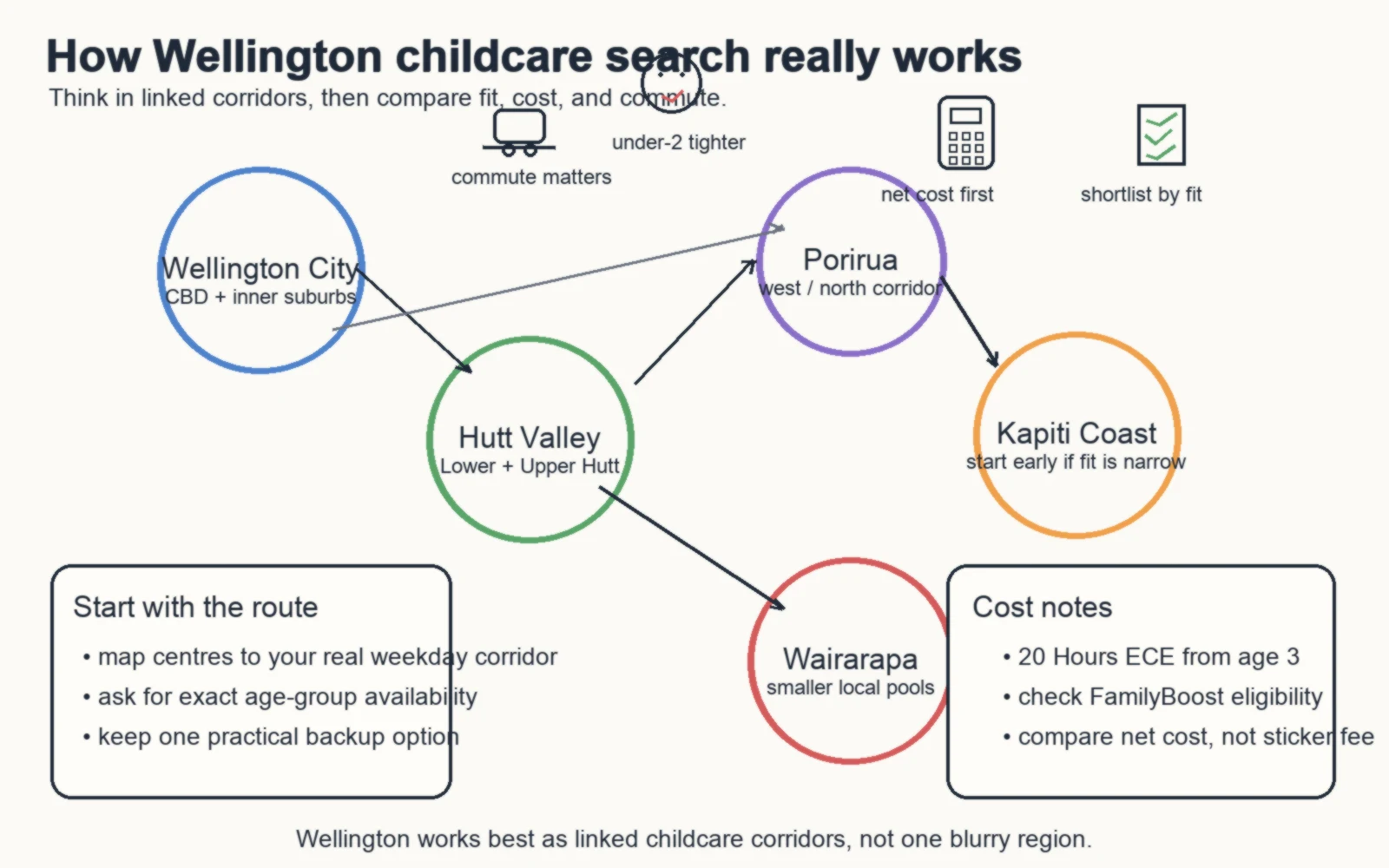
Wellington is not an Auckland-sized childcare market, but it is not small either. The mistake is treating it like one tidy local search. In practice, the region behaves like linked corridors. Wellington City, the northern suburbs, the Hutt Valley, Porirua, Kapiti Coast, and Wairarapa all have their own rhythm and supply pockets. A centre that looks fine on a map can still be a bad fit once buses, trains, parking, and pickup timing enter the picture.
That matters because Wellington families often do not live and work in the same place. Some are city based but commute north. Some live in Lower Hutt or Upper Hutt and work in the CBD or Thorndon. Some are balancing Kapiti or Wairarapa rail routines. Greater Wellington says the Metlink network connects Wellington City, Hutt Valley, Porirua, Kapiti Coast, and Wairarapa with more than 38 million journeys a year across five rail lines, nearly 100 bus routes, more than 180 school bus services, and a harbour ferry. Travel patterns are part of the childcare decision, not background noise.
This guide is built for that reality. It uses The Parent Circle's live Wellington-region listing data, current funding rules behind 20 Hours ECE, the current FamilyBoost settings, and the practical stuff parents actually trip over, like toddler waitlist pressure, route logic, and whether a centre still works when the weather turns a normal pickup into chaos.
What Wellington's childcare numbers actually tell you
The Parent Circle currently tracks 408 active listings across the Wellington region. Together they represent licensed capacity for 18,306 children, including 4,838 under-2 places. Wellington City carries the biggest share with 145 listings, followed by Lower Hutt at 96, Porirua at 50, Kapiti Coast at 38, and Upper Hutt at 36. Masterton, South Wairarapa, and Carterton add smaller but still meaningful pockets on the eastern side of the region.
Those numbers are useful, but they do not promise easy availability. Broad regional supply can hide sharp local bottlenecks. Under-2 care, exact session days, and specific start dates often tighten first. Education Counts' 2021 ECE fact sheets found Wellington was among the regions with the highest share of services reporting a waiting list for 2-year-olds, at over 60 percent of services. That is older data, not a live 2026 dashboard, but it is still a good warning not to assume the toddler market will be relaxed.
| Submarket | Active listings | What it usually means for parents |
|---|---|---|
| Wellington City | 145 | Best depth for CBD, Thorndon, inner suburb, and northern suburb routines |
| Lower Hutt City | 96 | Strong practical market for Hutt-based families and rail commuters |
| Porirua City | 50 | Solid western corridor choice, especially for local commute logic |
| Kapiti Coast District | 38 | Smaller pool, worth starting early if you need a narrow timetable fit |
| Upper Hutt City | 36 | Useful local market, but fewer backup options than the CBD or Lower Hutt |
| Wairarapa combined | 43 | Smaller local pools, so fit and timing matter more quickly |
Source: The Parent Circle Wellington-region listings snapshot, April 2026. These counts show market depth, not live vacancies.
Why this market may keep feeling tighter in the city
Wellington City and the inner north: the best choice for central work routines
If your week revolves around the CBD, Thorndon, Te Aro, Newtown, or the northern suburbs, Wellington City is the biggest and most flexible search zone in the region. The city has 145 active listings, licensed capacity for 6,155 children, and 1,737 under-2 places in the current dataset. Suburbs and local pockets like Newtown, Johnsonville, Karori, Thorndon, Khandallah, and Kaiwharawhara all show enough depth to make a real shortlist rather than a hopeful list of two centres and a prayer.
This part of the market works best when convenience beats fantasy. Parents sometimes chase the most beautiful centre, then realise they have built a daily routine around impossible parking, a bus transfer that fails in bad weather, or a pickup that collapses whenever work runs late. In Wellington, a centre that saves you one awkward leg of the commute can be worth more than a centre with slightly nicer marketing photos. If your family is city based, start with Wellington listings and filter around the corridor you actually use.
Lower Hutt and Upper Hutt: practical depth for rail-corridor families
The Hutt Valley is one of the region's most useful childcare markets because it has real depth without forcing every family into Wellington City. Lower Hutt has 96 listings, licensed capacity for 4,427 children, and 1,101 under-2 places. Upper Hutt adds another 36 listings with 1,727 licensed places and 438 under-2 places. Local pockets like Lower Hutt CBD, Wainuiomata, Naenae, Petone, Upper Hutt CBD, and Stokes Valley all show up strongly in the current data.
That depth gives Hutt families an advantage Auckland parents often do not get: local backup options that still sit on a sensible weekday route. If one centre cannot make your start date work, you may still have other realistic choices close by. This is especially helpful for families who want a train-friendly setup into Wellington City but do not want childcare itself inside the CBD. Reviewed local examples include Active Explorers Lower Hutt, BestStart Cornwall Street, BestStart Naenae, and Active Explorers Upper Hutt. Use names like these as location signals, not as a replacement for visiting and asking sharper questions.
Porirua and Kapiti Coast: workable markets if you start with local reality
Porirua sits in a sweet spot for some families. It has 50 active listings and licensed capacity for 2,566 children, enough to create choice without feeling overwhelming. Whitby, Tawa, Waitangirua, Cannons Creek, and nearby northern corridor suburbs give families a practical spread of options. If your household lives west or north of the city and does not want to drag a child across the whole region each day, this part of the market deserves early attention. Reviewed examples include Educare Adventure in Whitby.
Kapiti Coast is smaller again, with 38 listings and 1,798 licensed places. Paraparaumu, Otaki, and Waikanae give families some choice, but not the same level of backup depth you get in Wellington City or Lower Hutt. That does not make Kapiti a bad childcare market. It just means timing matters more. If you need a baby room, unusual hours, or a centre with a very specific philosophy, start early and contact more than one provider at once. Reviewed examples such as Educare Kapiti, Little Earth Montessori Kapiti, and Lollipops Paraparaumu show quality here. Just do not leave the search late.
Wairarapa: smaller local pools, stronger need for early planning
Wairarapa families sit in a different part of the equation. Masterton has 26 listings and stands out as the biggest eastern market, with smaller pools in Carterton, Greytown, Martinborough, Featherston, and the wider South Wairarapa. In the current dataset, Masterton alone has 17 active listings. That is helpful, but Wairarapa still behaves like a smaller market overall. The more specific your age group, days, and start date, the faster the pool narrows.
If you are balancing a rail commute westward or trying to keep childcare local while one parent travels, simplicity matters. A centre five minutes from home may be more valuable than a centre with a slightly better reputation forty minutes away. Wairarapa families usually benefit from asking two questions early: can this provider handle our exact weekly pattern, and what is the backup if our first choice cannot? Smaller markets punish late indecision more than larger ones do.
Costs, subsidies, and what actually changes the weekly bill
Wellington usually sits a touch below Auckland on childcare pricing, but not low enough for families to relax about cost. I would not pretend there is one clean fee table for the region, because there is not. The real price depends on age, hours, suburb, and provider. Under-2 care usually costs more because staffing ratios are tighter. Inner-city convenience or premium-feel centres can also push the number up.
The first major cost lever is 20 Hours ECE. The Ministry of Education says it covers up to six hours a day and twenty hours a week for eligible 3, 4, and 5 year olds at participating services, and those funded hours cannot be charged as fees. For Wellington families, that can change the maths dramatically, especially once a child turns three. It does not erase every cost, though. Hours beyond the cap, optional extras, and care for younger children still need real budgeting.
The second lever is FamilyBoost. Under the current settings already reflected across TPC content, eligible households under $35,000 quarterly income can claim up to 40 percent of ECE costs, capped at $1,560 a quarter. The payment tapers above that and households above $57,286 quarterly income are not eligible. The smartest comparison is not the sticker fee alone. It is the net fee after 20 Hours ECE and FamilyBoost, plus whatever time and transport friction the centre adds to your week.
This is where Wellington can fool parents. A cheaper centre is not always cheaper if it forces an awkward bus transfer, extra parking cost, or one parent to leave work early. In a corridor city, convenience has financial value. If you want a national benchmark first, read our regional cost guide. If you want to run the numbers on your own setup, use the cost estimator.
How to search Wellington without wasting weeks
My strongest advice is simple. Start with the route, then filter by age group, then compare quality. Too many parents reverse the order. They start with a broad list of well-known centres, get emotionally attached, and only later realise the logistics do not work. Wellington rewards boring realism. A centre near your station, your school run, or your actual backup caregiver can beat a more impressive centre that breaks the rest of the day.
Use search if you are building the first shortlist. Use compare when you have two or three realistic options and need to see them side by side. If you are still early in the process, read when to start looking for childcare. If you are weighing a move or comparing markets, our wider regional guide and Auckland guide show how Wellington differs from Auckland.
- Map every centre against your real weekday route before you book a second visit.
- Ask specifically about your child's exact age group and likely start date, not just general availability.
- If you need toddler care, start earlier than feels comfortable because that pressure shows up fast.
- Compare fees after 20 Hours ECE and FamilyBoost, not just before.
- Read the latest ERO report before visiting so your questions are sharper.
- Keep one practical backup option on the shortlist, not only your dream option.
Provider examples by corridor, used the right way
Parents often ask for the best centres in Wellington. I think that question points in the wrong direction. The better question is which providers sit in the part of the region that makes your week easier. In the current review-backed dataset, city examples include Active Explorers Kaiwharawhara, Barnardos Early Learning Centre Wellington Central, Co Kids Thorndon, and Kindercare Learning Centre Karori. Hutt examples include Active Explorers Lower Hutt, BestStart Cornwall Street, BestStart Naenae, and Active Explorers Upper Hutt. Northern and coastal examples include Educare Adventure in Whitby, Educare Kapiti, Little Earth Montessori Kapiti, and Lollipops Paraparaumu.
Use examples like these to think geographically. They show there is real parent feedback and supply across multiple Wellington corridors. They do not replace visits, conversations, or checking the latest review and regulatory information yourself. The goal is to build a shortlist that still works on an ordinary Wednesday.
Frequently asked questions
Is childcare in Wellington easier to find than in Auckland?
Usually, yes, but only if you search by corridor and age group. Wellington is smaller and more compact than Auckland, yet it still has 408 active listings in The Parent Circle dataset. The challenge is not just total supply. It is whether the right centre exists on the route your family actually uses, with the right age-group availability and start date.
Which parts of the Wellington region have the most childcare choice?
Wellington City has the biggest depth in the current dataset, followed by Lower Hutt, Porirua, Kapiti Coast, and Upper Hutt. That makes the city and Hutt corridor especially strong starting points for many families, while smaller markets such as Kapiti and Wairarapa reward earlier planning.
Does 20 Hours ECE help Wellington families much?
Yes. The Ministry of Education says 20 Hours ECE covers up to six hours a day and twenty hours a week for eligible 3, 4, and 5 year olds at participating services, and those funded hours cannot be charged as fees. For many families, that changes the weekly cost more than small fee differences between centres do.
Should I prioritise a centre near home or near work in Wellington?
Usually the better answer is near the route that keeps your week stable. In Wellington, that might mean near home, near the train line, near a bus hub, or near the office. A centre that looks perfect but creates a fragile commute can become the wrong choice fast.
Are under-2 places harder to secure in Wellington?
They often are. Wellington has 4,838 under-2 places in the current dataset, but historical Education Counts waitlist data also showed strong pressure for younger children in the region. If you need baby or toddler care, ask earlier than feels comfortable and contact multiple providers at once.
Wellington rewards parents who narrow early and compare smartly. Treat the region as linked daily routes, not one blurry search area, and the decision gets clearer. Start with Wellington childcare listings, then use search or compare to build a shortlist that fits your life.
Find childcare in Wellington
Search Wellington-region providers by suburb, care type, and practical fit.
Explore Wellington listingsRelated guides
Childcare in Otago: Dunedin, Queenstown, Wānaka, and the Wider Region (2026)
Looking for childcare in Otago? This practical 2026 guide breaks down Dunedin, Queenstown-Lakes, Central Otago, Clutha, and Waitaki so you can build a shortlist that actually fits your week.
Childcare in Bay of Plenty: Tauranga, Rotorua, and the Wider Region (2026)
Looking for childcare in Bay of Plenty? This practical 2026 guide breaks down Tauranga, Papamoa, Rotorua, Western Bay, and Eastern Bay so you can build a shortlist that actually fits your week.
Childcare in Waikato: Hamilton and the Greater Waikato Region (2026)
Looking for childcare in Waikato? This practical 2026 guide breaks down Hamilton, Cambridge, Te Awamutu, northern Waikato, Taupo, and smaller regional markets so you can build a shortlist that actually fits your week.
Childcare in Canterbury: Christchurch and Beyond (2026)
Looking for childcare in Canterbury? This practical 2026 guide breaks down Christchurch, Rolleston, Rangiora, Timaru, Ashburton, and smaller districts so you can build a shortlist that actually fits your week.
Find childcare near you
Search and compare providers by suburb, care type, cost, and availability.