
Resource Hub
Childcare in Bay of Plenty: Tauranga, Rotorua, and the Wider Region (2026)
Published · Last updated · 9 min read

Contents
What should Bay of Plenty parents know before they start looking for childcare?
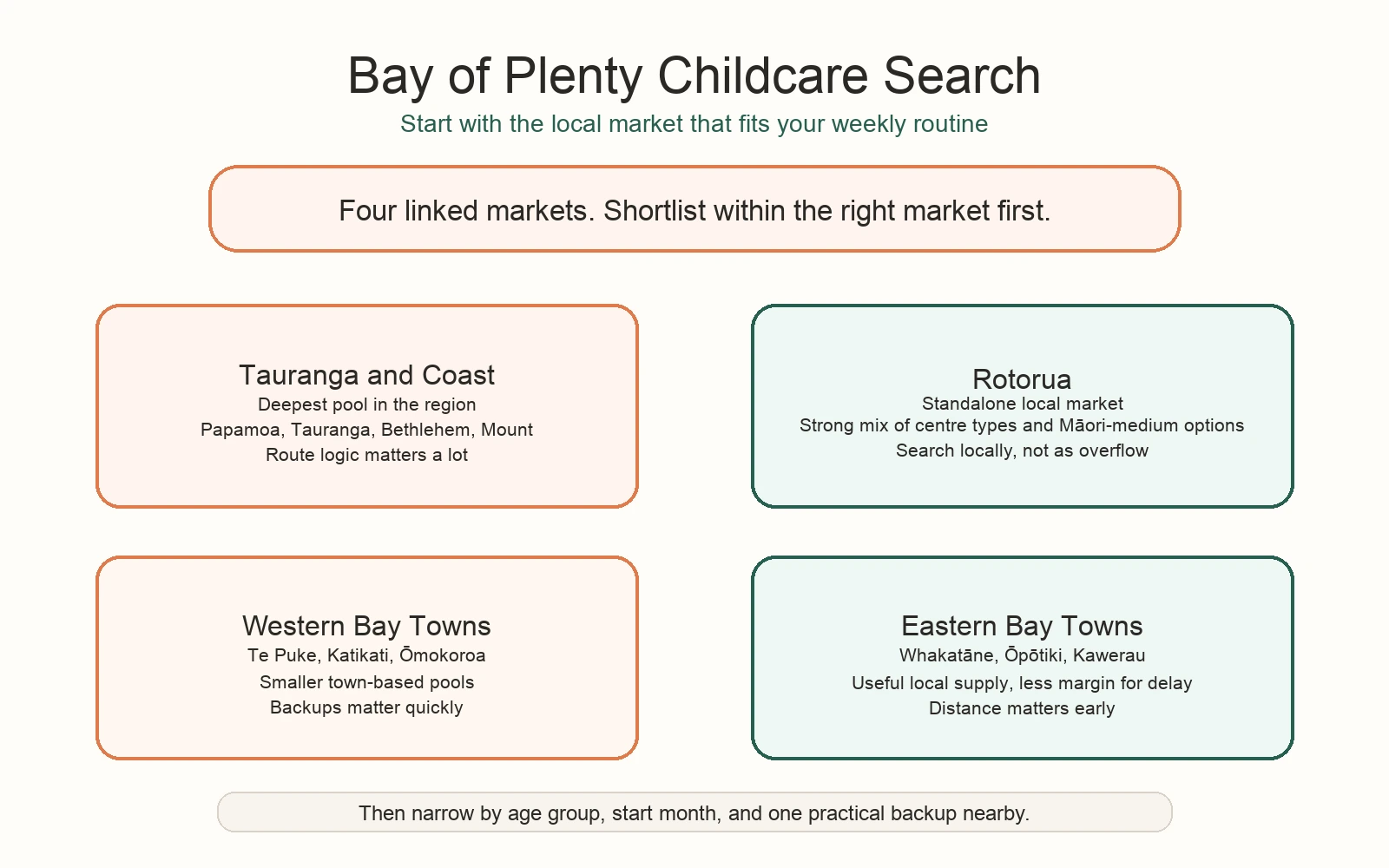
Treat Bay of Plenty as several linked childcare markets, not one giant regional search. The Parent Circle currently tracks 356 active Bay of Plenty listings with licensed capacity for 16,225 children, including 5,096 under-2 places. Tauranga and the coast give you the deepest pool, Rotorua works as its own local market, and Western Bay and Eastern Bay towns usually reward parents who search by real route, exact age group, and start month instead of browsing the whole region at once.
Why Bay of Plenty needs its own childcare strategy
Bay of Plenty gets flattened into a lifestyle label far too easily. That is not how childcare works here. A family living in Papamoa, a family based in Rotorua, and a family trying to stay local in Whakatāne are not shopping in the same market, even if all three sit inside the same regional boundary. The routes, backups, and pressure points are different.
The growth story helps explain the pressure. Tauranga City Council's Statistical Information Report 2025 puts Tauranga at 152,844 people in the 2023 Census and 161,300 by June 2024, with 11 percent growth between 2018 and 2023. The same report says Wairakei in Papamoa grew 173 percent in that period, while Pyes Pa West grew 197 percent. Further inland, Rotorua Lakes Council says district households are projected to grow 23 percent to 37,000 by 2054. More homes and more young families do not automatically mean easier childcare searches. Usually it means you need a better one.
What Bay of Plenty's childcare numbers actually tell you
The Parent Circle currently tracks 356 active listings across Bay of Plenty. Together they represent licensed capacity for 16,225 children, including 5,096 under-2 places. Tauranga City carries the biggest share with 152 listings. Rotorua District follows with 84, then Whakatāne District with 52 and Western Bay of Plenty District with 43. That sounds healthy until you remember the region is spread across very different towns, coastlines, and commute patterns.
There is meaningful variety too. The current dataset includes 186 Education and Care Services, 73 Te Kōhanga Reo, 37 Free Kindergartens, 25 Playcentres, and 23 Homebased Networks, plus a smaller number of Reo Rua services, Puna Reo, and hospital-based care. So the real question is not only whether you can find a place. It is what kind of place fits your child, your whānau, and your week.
| District | Active listings | Licensed capacity | Under-2 capacity | What it usually means for parents |
|---|---|---|---|---|
| Tauranga City | 152 | 8,019 | 2,707 | Best depth for suburb choice, coastal routes, and backup options, but growth corridors can still feel tight |
| Rotorua District | 84 | 3,624 | 1,021 | Solid standalone market with its own local logic and stronger Māori-medium presence |
| Whakatāne District | 52 | 2,102 | 750 | Useful Eastern Bay anchor market, but options narrow faster once you shortlist by age and days |
| Western Bay of Plenty District | 43 | 1,592 | 388 | Town-based searching around places like Te Puke, Katikati, and Ōmokoroa works better than broad regional browsing |
| Ōpōtiki District | 15 | 520 | 136 | Smaller pool, so timing and backup planning matter quickly |
| Kawerau District | 10 | 368 | 94 | Local supply exists, but there is not much room for late indecision |
Source: The Parent Circle Bay of Plenty listings snapshot, April 2026. These counts show market depth, not live vacancies.
One important gap in the data
Tauranga, Mount Maunganui, and Papamoa are the anchor market
Tauranga City is the engine room of the region's childcare market. The current dataset shows 152 active listings, licensed capacity for 8,019 children, and 2,707 under-2 places. Papamoa alone has 28 listings. Tauranga has 17, Bethlehem 11, Welcome Bay 11, Mt Maunganui 9, Mount Maunganui 8, and Tauriko 6. If you want the broadest shortlist and the best chance of keeping a backup option alive, this is where the numbers work hardest for you.
That does not make Tauranga easy. The Tauranga report says 73 percent of workers commute by private or company vehicle, which is exactly why route logic matters here. A centre that looks fine on a map can be a headache once school drop-off, bridge traffic, or a late meeting lands on top of it. The fast-growth suburbs prove the point. Wairakei in Papamoa and Pyes Pa West are growing hard, and the SmartGrowth Development Trends Report 2025 says Wairakei accounted for 30 percent of Tauranga residential development in 2025. Reviewed examples such as BestStart Palm Springs, New Shoots Childrens Centre (Papamoa), Ako Early Learning, New Shoots Children's Centre - Tauranga, and The Village Preschool & Childcare Centre are best used as location signals, not automatic recommendations.
Rotorua is a separate market, not an overflow option
Rotorua District deserves to be searched on its own terms. The Parent Circle currently tracks 84 active listings there, with licensed capacity for 3,624 children and 1,021 under-2 places. Rotorua Central has 16 listings, Rotorua suburb has 11, and Owhata has 9. This is enough depth to build a proper shortlist, but it is still a smaller market than Tauranga once you narrow by age group, hours, and philosophy.
Rotorua also has a distinct cultural profile. The current district mix includes 17 Te Kōhanga Reo, 3 Puna Reo, 1 Reo Rua service, and a hospital-based provider alongside mainstream centres, kindergartens, and Playcentres. That gives families seeking stronger te reo Māori pathways more genuine options than a generic daycare search suggests. There is some practical breathing room in the district too. Rotorua Lakes Council says housing and business development capacity has moved from deficit to surplus, with more than $560 million in planned water, wastewater, stormwater, and transport investment across the 2024 to 2034 long-term plan. Reviewed examples such as BestStart Herewini Street, Little Darlings Childcare Centre, Eastern Suburbs Pre-School Inc, BestStart Pukuatua, and Te Pākārito show the market is not one-note.
Western Bay towns reward parents who search locally first
If you live around Te Puke, Katikati, or Ōmokoroa, the smartest search is usually local before wider. Western Bay of Plenty District has 43 active listings with licensed capacity for 1,592 children and 388 under-2 places. Te Puke has 14 listings, Katikati 7, and Omokoroa 5 in the current suburb snapshot. Those are usable town markets, but not huge ones. Once you narrow by age group and exact days, the shortlist shrinks faster than it does in Tauranga.
The growth pipeline says these towns matter. SmartGrowth reports 70 new dwellings consented in Te Puke in 2025 and 122 in Ōmokoroa, with a new childcare centre included in Western Bay commercial consents. That is encouraging, but it does not mean you should wait until the last minute. Families here usually do better when they contact several providers at once and keep one practical backup in the same town or corridor. Reviewed examples include Ngā Reo e Rua, Learning Adventures Te Puke, Minnows Kindergarten, Omokoroa Pre School, Busy Bees Katikati, and Katikati Free Kindergarten.
Eastern Bay has real supply, but less margin for delay
Eastern Bay is not empty. It is just less forgiving. Whakatāne District carries 52 active listings, licensed capacity for 2,102 children, and 750 under-2 places. Ōpōtiki adds 15 listings and Kawerau another 10. Whakatāne suburb alone has 19 listings, while Opotiki has 12 and Kawerau 10. That gives many families real local choice, but fewer fallback options once they cut the list down to the days, location, and style they actually need.
There is also strong Māori-medium presence here. Whakatāne District includes 22 Te Kōhanga Reo and Ōpōtiki District includes 10 in the current dataset. That matters for whānau seeking language and cultural alignment, and it also means a standard chain-centre search will miss part of the market. Reviewed examples such as The Tree House, Bizzy Buddyz Ltd, Central Kids Kindergartens - Garaway, Te Kōhanga Reo o Apanui ki Whakatāne, Te Kōhanga Reo o Nukutere, and Opotiki Community Childcare Centre show how mixed the local offer is. Use that mix to search by fit, not by assumptions.
Bay of Plenty gives families more than one care style
One strength of this region is range. There is plenty of standard long-day centre care, but Bay of Plenty also has a strong Te Kōhanga Reo footprint, a decent kindergarten layer, active Playcentres, home-based networks, and a smaller number of bilingual or specialist settings. That matters because not every family is solving the same problem. Some need long hours near work. Some want a community-based option. Some care deeply about cultural immersion or smaller environments.
The 73 Te Kōhanga Reo listings alone are a strong reminder to search with intent. If you only browse generic daycare results, you can miss a big part of what this region offers. The same goes for kindergartens, Playcentres, and home-based care. Decide what kind of care you want before you obsess over suburb names, otherwise the search gets noisy fast.
Costs, funding, and the real weekly bill
There is no trustworthy Bay of Plenty-wide official fee table that parents can use as a clean benchmark. That is annoying, but normal. The real bill still depends on your child's age, booked hours, provider type, and whether the service charges for extras. A useful national guide from OECE says home-based education can sit around NZ$5 to NZ$12 or more an hour, some kindergartens may charge about NZ$3 an hour for hours above 20 Hours ECE, and other centres often land around NZ$5 to NZ$8 an hour for children not receiving funded hours. Under-2 care usually costs more because the minimum staffing ratio is tighter.
Two national supports matter here. Eligible children can receive up to 20 funded hours a week through 20 Hours ECE. Eligible households may also reduce the bill through FamilyBoost and, in some cases, the WINZ Childcare Subsidy. The practical comparison is never just the sticker fee. It is the net weekly cost after funding, plus how much time, fuel, and stress the centre adds to your life.
How to search Bay of Plenty without wasting weeks
My strongest advice is simple: start with the route, then narrow by age group, then compare provider style. Parents often reverse that order. They fall for a centre name, an Instagram page, or a polished tour, then realise the location, room availability, or daily routine does not actually fit their week. Bay of Plenty punishes that mistake faster than some regions because the useful search radius can change sharply between Tauranga traffic, Rotorua runs, and smaller town options.
If you are starting wide, browse Bay of Plenty listings or use search to build the first shortlist. Once you have two or three serious options, compare becomes useful. If you are still early in the process, our guide on when to start looking for childcare can help you avoid the usual timing mistake.
- Search inside the corridor or town that fits your real weekday routine, not the whole region at once.
- Ask about your child's exact age group and likely start month, especially if you need under-2 care.
- If you live in a smaller market such as Te Puke, Katikati, Ōpōtiki, or Kawerau, contact several providers at once instead of waiting on one reply.
- Compare net fees after 20 Hours ECE, FamilyBoost, or WINZ support, instead of staring at the pre-funding number alone.
- Read the latest provider information or ERO material before you tour so your questions are sharper.
- Keep one practical backup option on the shortlist, not only the centre that looked nicest online.
How to use provider examples by corridor
Parents often ask for the best centres in Bay of Plenty. I think that question is too blunt to be useful. The better question is which providers sit in the part of the region that makes your week easier. In Tauranga and the coast, names like BestStart Palm Springs, Ako Early Learning, New Shoots Children's Centre - Tauranga, and The Blue Cottage show where the bigger coastal search zones sit. In Rotorua, BestStart Herewini Street, Little Darlings Childcare Centre, and Eastern Suburbs Pre-School Inc give you a feel for local spread. In Western Bay, Minnows Kindergarten, Ngā Reo e Rua, and Busy Bees Katikati are useful location signals. In Eastern Bay, The Tree House and Opotiki Community Childcare Centre tell you where local supply anchors are.
Use examples like these to think geographically. They do not replace visits, tougher questions, or checking whether the centre still works on an ordinary Tuesday. A shorter drive, a calmer drop-off, and a better fit for your actual hours often beat a more impressive-sounding option on paper.
Frequently asked questions
Should I search all of Bay of Plenty at once?
Usually no. Bay of Plenty works better as several linked childcare markets: Tauranga and the coast, Rotorua, Western Bay towns, and Eastern Bay towns. That keeps your shortlist realistic and saves time.
Is Tauranga childcare easier to find because there are more centres?
Sometimes, but not automatically. Tauranga has the deepest pool in the region, yet fast-growth suburbs and route-based searches can still feel tight. More choice helps most when you search by your real corridor instead of browsing everything.
Does Rotorua have good options beyond standard daycare centres?
Yes. The current Rotorua District dataset includes Te Kōhanga Reo, Puna Reo, kindergartens, Playcentres, and mainstream Education and Care Services. It is worth deciding what kind of care you want before you shortlist by suburb alone.
Does 20 Hours ECE make Bay of Plenty childcare free once my child turns three?
Not automatically. Eligible children can receive up to 20 funded hours a week at participating services, but the final bill still depends on booked hours, provider policies, and any optional charges. Check the funding rules and then compare the real weekly cost.
What is the smartest way to compare Bay of Plenty childcare options?
Compare by route, age-group availability, and total weekly friction first, then by fees and philosophy. Use [compare](/compare) for side-by-side notes and the [cost estimator](/cost-estimator) when the price difference between two centres looks close.
Bay of Plenty gives families real choice, but only if you search the way the region actually works. Think in corridors and towns, not one blurry regional label. Start earlier in the smaller markets, take under-2 availability seriously, and compare convenience with cost instead of treating them as separate decisions. If two centres look similar, choose the one that makes your Tuesday easier. From there, you can narrow the shortlist in Bay of Plenty childcare listings.
Explore Bay of Plenty childcare options
Browse Bay of Plenty providers by town and suburb, compare realistic options, and build a shortlist that fits your actual route.
Explore Bay of Plenty listingsRelated guides
Rural Childcare in NZ: Options for Families Outside Major Cities
Rural childcare in NZ takes more planning, but there are workable options: small centres, Playcentre, home-based care, kōhanga reo, and local whānau networks.
Childcare in Otago: Dunedin, Queenstown, Wānaka, and the Wider Region (2026)
Looking for childcare in Otago? This practical 2026 guide breaks down Dunedin, Queenstown-Lakes, Central Otago, Clutha, and Waitaki so you can build a shortlist that actually fits your week.
Childcare in Waikato: Hamilton and the Greater Waikato Region (2026)
Looking for childcare in Waikato? This practical 2026 guide breaks down Hamilton, Cambridge, Te Awamutu, northern Waikato, Taupo, and smaller regional markets so you can build a shortlist that actually fits your week.
Childcare in Canterbury: Christchurch and Beyond (2026)
Looking for childcare in Canterbury? This practical 2026 guide breaks down Christchurch, Rolleston, Rangiora, Timaru, Ashburton, and smaller districts so you can build a shortlist that actually fits your week.
Find childcare near you
Search and compare providers by suburb, care type, cost, and availability.