
Resource Hub
When Should You Start Looking for Childcare? A Timeline for NZ Parents
Published · Last updated · 8 min read

Contents
When should I start looking for childcare in NZ?
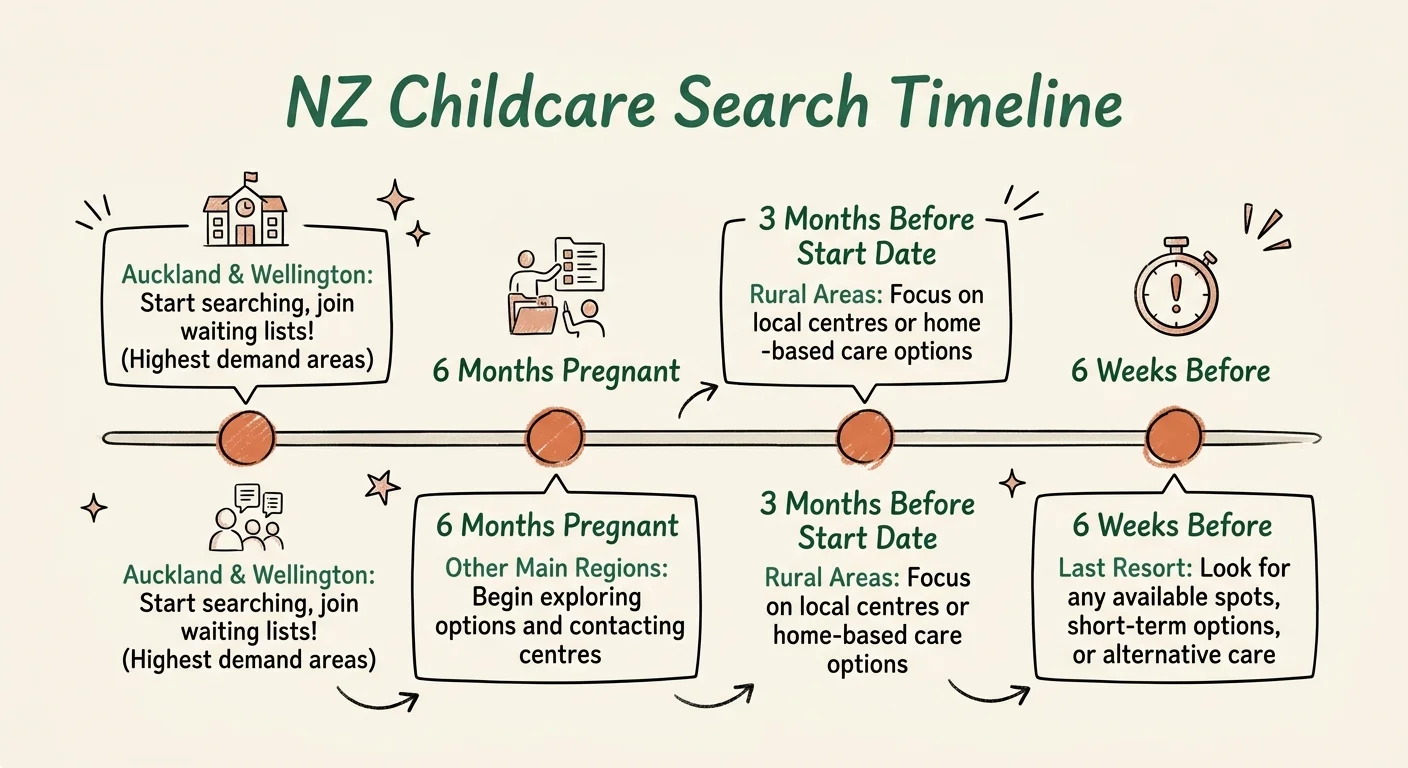
Start researching during your second trimester if you need infant care (under-2 places). For urban areas like Auckland and Wellington, waitlists of 6–12 months are common — some run longer. If your child is already here and you need over-3 care, 3–6 months of lead time is usually enough in most regions. The earlier you start, the more options you'll have.
The short answer: earlier than you think
Most NZ parents underestimate how far ahead they need to plan for childcare. If you're pregnant and thinking "I'll sort that out after the baby arrives" — you're already behind in some parts of the country.
The reason is simple maths. Under-2 places are scarce because centres need one teacher for every five infants (compared to 1:10 for over-3s). Fewer places, more demand. Not all centres even accept children under two. And the ones that do often have waitlists that predate your due date.
Over-3 care is generally easier to find. Once your child hits three, they qualify for 20 Hours ECE — government-funded hours that most centres and kindergartens offer. That opens up far more options, including sessional kindergartens that run at little or no out-of-pocket cost.
Your pregnancy timeline: what to do each trimester
First trimester (weeks 1–12): think, don't act
You've got enough going on. But if you already know you'll need infant care for your return to work, start thinking about the type of care you want. Centre-based? Home-based through a network like PORSE or Barnardos? A nanny or nanny share? Each has different timelines and availability patterns.
- Talk to friends and colleagues with young kids. They'll tell you which centres have long waitlists, which are worth the wait, and which to avoid. Word of mouth beats Google for this.
- Roughly map your return-to-work date. NZ paid parental leave runs up to 26 weeks. If you plan to use it all and your baby is due in June, you're looking at a December start — which is tricky because most centres close briefly over Christmas/New Year.
- Browse providers in your area on The Parent Circle to get a sense of what's available and how they compare.
Second trimester (weeks 13–26): start your shortlist
This is when you should get serious, especially if you're in Auckland, Wellington, or any urban area where under-2 places are tight.
- Get on waitlists. Don't wait for visits first. Most centres accept waitlist registrations before you've toured the facility. Some charge a fee ($20–$100), some don't. Check if the fee is refundable if no place materialises by your target date.
- Register at 3–5 centres. This isn't about being flaky — it's about hedging. Waitlist spots aren't binding commitments. Parents in Wellington regularly report 12–18 month waits, so registering at 20 weeks pregnant for care starting at 6 months old means you're already cutting it fine.
- Book centre visits. Once you're on the waitlist, schedule tours. You're evaluating the centre, not committing. Look at teacher interactions with children, cleanliness, outdoor spaces, and the general vibe. Our guide to choosing childcare covers what to look for in detail.
- Ask about under-2 capacity. Some centres have only 5–10 under-2 places. Others have none. Confirm the age range they accept and how many spots turn over each year.
Waitlist fees
Third trimester (weeks 27–40): confirm and prepare
By now you should have at least 2–3 centres on your list. If you've been offered a place, you'll need to complete enrolment paperwork — which usually includes your child's immunisation records, emergency contact details, any allergy or medical information, and authorised pick-up people.
- Confirm your preferred centre. Let them know your expected start date and any changes to your work plans.
- Ask about settling-in. Most centres run orientation visits — a few short sessions where you stay with your child, then gradually leave for longer periods. This typically takes 1–2 weeks. Factor it into your return-to-work timeline.
- Have a Plan B. If your top centre hasn't come through, look at home-based care as a bridge. Licensed home-based networks can often match you faster than centres, and some families find they prefer the smaller, more personal environment for a young baby.
Regional differences: where waitlists bite hardest
Childcare availability varies wildly across NZ. The national average occupancy rate is around 77%, which sounds like there's plenty of room — but that masks extreme demand in cities and surplus capacity in some smaller towns.
| Region | Under-2 waitlist (typical) | Over-3 waitlist (typical) | Notes |
|---|---|---|---|
| Auckland (central/inner suburbs) | 6–12+ months | 1–3 months | Highest demand nationwide. Some centres have year-long waits for infant places. |
| Wellington | 6–18 months | 2–4 months | Parents report waitlists up to 18–24 months in popular suburbs. Start early. |
| Christchurch | 3–6 months | 1–2 months | Improved since post-earthquake rebuilding added capacity. |
| Hamilton / Tauranga | 3–6 months | 1–3 months | Growing demand as population increases. Inner suburbs tighter than outer. |
| Regional NZ (Gisborne, Hawke's Bay, etc.) | 0–3 months | Often immediate | Many centres have vacancies. More options, less competition. |
These timelines are rough guides based on parent reports and sector data — your experience will depend on the specific suburb and centre. The pattern is clear though: the bigger the city, the earlier you need to start.
Platform insight
Age-specific timelines
Infant care (under 2)
This is the hardest age group to place. The 1:5 staff-to-child ratio requirement makes under-2 places expensive to run, so centres have fewer of them. Some centres don't accept infants at all. If you need care before your child turns two, start looking during pregnancy — ideally by the second trimester.
Weekly costs for infant care in a centre typically range from $300–$500+ in urban areas. Home-based care is often easier to find for this age group and can be more affordable, especially for fewer days per week.
Toddler care (2–3 years)
Slightly easier than infant places, but there's a catch. Centres make less money on 2-year-olds than 3-year-olds because only over-3s attract the higher 20 Hours ECE funding rate. Some centres quietly prioritise over-3 enrolments for financial reasons. If your child is approaching two, aim to have a confirmed place 3–6 months ahead.
Preschool (3+ years)
Once your child turns three, 20 Hours ECE makes a huge difference. It covers up to 6 hours per day and 20 hours per week at any licensed provider — and you can apply just before they turn three if they're already enrolled. Kindergartens, which run sessional hours and are often fully funded through 20 Hours ECE, become an option.
At this age, 3–6 months of lead time is usually enough in most regions. Kindergartens in popular areas (like Auckland Grammar zone or Island Bay in Wellington) may have longer waits — check directly.
Key dates NZ parents should know
- 20 Hours ECE eligibility: From your child's 3rd birthday. You can apply just before they turn 3 if they're already attending a licensed service.
- Paid parental leave: Up to 26 weeks. Your return-to-work date sets the earliest you'll need care.
- School terms 2026: Term 1 starts between 26 January and 9 February (varies by school). Term 2: 20 April. Term 3: 20 July. Term 4: 12 October. Kindergartens follow school terms, so enrolment often aligns with these dates.
- January crunch: Many centres close for 1–2 weeks over Christmas/New Year. If your parental leave ends in January, you may need a short-term bridging solution.
- Mid-year starts: Centres have rolling enrolment, so you don't have to wait for a new term. Kindergartens vary — some accept mid-term, others prefer term starts.
What if you're already behind?
If your return to work is looming and you don't have a place sorted, don't panic. There are quicker options:
- Home-based care. Licensed networks (PORSE, Barnardos, Jade Home Based Learning, and others) can often match you with an educator within weeks. The care happens in the educator's home with a small group of children (up to 4). It's a good fit for babies and toddlers who benefit from a calm, home-like environment.
- Try centres slightly further out. If your nearest suburb is full, look one or two suburbs over. A 15-minute drive can open up completely different availability. Use The Parent Circle's search to expand your radius.
- Playcentre is parent-led and free to attend. It won't cover your work hours (you have to be there), but it gives your child social time while you wait for a centre place.
- Ask about casual or emergency spots. Some centres keep a small number of casual-use places. They're not a long-term solution, but they can bridge a gap.
- Negotiate with your employer. Since 2024, every NZ employee can request flexible working arrangements from day one. A phased return — starting with 2–3 days — buys you time while you wait for full-time care.
Your childcare search checklist
- Decide what type of care you want (centre, home-based, kindergarten, nanny)
- Search your area on The Parent Circle and make a longlist of 5–8 providers
- Register on waitlists at your top 3–5 choices (pay the fee if required)
- Book and attend centre visits — read our 30 questions to ask before you go
- Compare your shortlist using The Parent Circle's comparison tool
- Accept an offer and complete enrolment paperwork
- Schedule settling-in visits (1–2 weeks before your official start date)
- Apply for 20 Hours ECE (if your child is 3+) and any applicable WINZ subsidies or FamilyBoost
Frequently asked questions
Can I put my child on a waitlist before they're born?
Yes, and you should if you're in an urban area. Most centres accept waitlist registrations during pregnancy. Some charge a small fee ($20–$100). The earlier you register, the higher your position on the list.
How much does it cost to go on a waitlist?
Waitlist fees range from free to $100+. A fee of $20 is reasonable for admin costs. Higher fees are essentially revenue for the centre. Always ask whether the fee is refundable if a place isn't offered by your target date.
Is home-based care a good option while waiting for a centre place?
Absolutely. Licensed home-based care through networks like PORSE or Barnardos is fully government-funded (same subsidies as centres), has smaller ratios (1 educator to 4 children), and can often be arranged faster than centre placements. Many families start with home-based care and transition to a centre later.
When does 20 Hours ECE start exactly?
From your child's 3rd birthday. If your child is already enrolled at a licensed provider, you can apply just before they turn three and the funding kicks in immediately. It covers up to 6 hours per day, 20 hours per week.
What documents do I need to enrol my child?
Most centres require your child's birth certificate, immunisation records (from your Well Child Tamariki Ora book), emergency contact details, any allergy or medical information, and details of authorised pick-up people. You'll also sign an enrolment agreement covering fees, hours, and the centre's policies.
The single biggest mistake parents make with childcare is assuming there'll be a spot when they need one. In cities, there often isn't — at least not for the age group, days, and location you want. Starting your search early doesn't mean locking in a decision early. It means having options. For more on evaluating centres once you've found them, read our complete guide to choosing childcare in NZ, or use The Parent Circle's search to see what's available near you right now.
Start your childcare search today
Search 4,394+ licensed ECE providers across New Zealand. Filter by location, age group, and care type to find providers accepting enrolments near you.
Find Childcare Near YouRelated guides
Find childcare near you
Search and compare providers by suburb, care type, cost, and availability.