
Resource Hub
Childcare in Otago: Dunedin, Queenstown, Wānaka, and the Wider Region (2026)
Published · Last updated · 8 min read

Contents
What should Otago parents know before they start looking for childcare?
Treat Otago as several linked childcare markets, not one regional search. The Parent Circle currently tracks 178 active Otago listings with licensed capacity for 8,377 children, including 2,448 under-2 places. Dunedin gives you the deepest pool, Queenstown and Wānaka carry the sharpest growth pressure, and smaller markets such as Oamaru, Balclutha, Cromwell, and Alexandra reward parents who search early and stay practical about route and backup options.
Why Otago needs its own childcare strategy
Otago gets described as one place far too often. That is fine for postcards. It is useless for childcare. A family living in Mosgiel, a family juggling Queenstown rent and resort-town traffic, and a family trying to stay local in Oamaru are not shopping in the same market, even if they all sit inside the same regional boundary.
The wider numbers explain why the region feels uneven. Stats NZ puts Otago at 253,900 people at 30 June 2025, with 61,236 families in the 2023 Census. Inside that, Dunedin City has 132,800 people and 31,410 families, while Queenstown-Lakes District has 53,800 people, 12,114 families, and a median weekly rent of NZ$600. Those are very different family realities before you even start comparing centres.
What Otago's childcare numbers actually tell you
The Parent Circle currently tracks 178 active listings across Otago. Together they represent licensed capacity for 8,377 children, including 2,448 under-2 places. Dunedin City carries more than half of the region's listings with 91. Queenstown-Lakes follows with 36, then Central Otago with 20, Clutha with 17, and Waitaki with 14. That sounds workable until you remember those places are spread across university suburbs, resort towns, commuter corridors, and smaller rural centres.
There is useful variety too. The current dataset includes 98 Education and Care Services, 43 Free Kindergartens, 22 Playcentres, 9 Homebased Networks, 3 Te Kōhanga Reo, 2 Casual Education and Care services, and 1 hospital-based provider. So the real decision is not only whether you can find a place. It is which kind of place fits your child, your whānau, and the shape of your week.
| District | Active listings | Licensed capacity | Under-2 capacity | What it usually means for parents |
|---|---|---|---|---|
| Dunedin City | 91 | 4,295 | 1,241 | Best depth for suburb choice, longer shortlists, and realistic backup options |
| Queenstown-Lakes District | 36 | 1,987 | 632 | Strong demand pressure, higher living costs, and sharp route differences between Queenstown, Frankton, Arrowtown, and Wānaka |
| Central Otago District | 20 | 895 | 326 | Useful town-based supply around Cromwell and Alexandra, but not much room for late indecision |
| Clutha District | 17 | 664 | 142 | Local choice exists around Balclutha and Milton, though shortlists narrow fast once you filter by age and days |
| Waitaki District | 14 | 536 | 107 | Oamaru anchors the market, but smaller pool means timing matters quickly |
Source: The Parent Circle Otago listings snapshot, April 2026. These counts show market depth, not live vacancies.
One important gap in the data
Dunedin is the anchor market, but the route still matters
Dunedin is where the regional numbers work hardest for parents. The current dataset shows 91 active listings, licensed capacity for 4,295 children, and 1,241 under-2 places. Dunedin suburb has 14 listings, Dunedin Central has 8, Mosgiel has 9, St Clair has 5, and South Dunedin has 4. That gives families more room to build a shortlist than most other Otago markets.
Depth does not make the city simple. Dunedin has its own corridor logic. A centre near the hospital or university can suit one family perfectly and be annoying for another once school pickup, hill suburbs, or a Mosgiel commute gets involved. Reviewed examples such as Otago Childcare Centre Inc, York Place Preschool & Nursery, Pioneers Elm Row, Bear Park - St Clair, St Clair Kindergarten, and BestStart Mosgiel are best used as location signals, not as automatic recommendations.
Queenstown-Lakes feels the most pressure, especially once rent and growth join the conversation
Queenstown-Lakes is the part of Otago where growth pressure is hardest to ignore. The Parent Circle currently tracks 36 active listings there, with licensed capacity for 1,987 children and 632 under-2 places. Wānaka has 12 listings in the current suburb snapshot, Queenstown has 11, Frankton-Queenstown has 4, and Arrowtown has 3. That is not a tiny market, but it is a smaller one than many relocating families expect.
The official growth story is blunt. Queenstown Lakes District Council's 2025 demand projections start with a resident population of 54,440 in 2025 and project 98,345 by 2055 under the recommended scenario, an 80 percent increase. The same report says the district's average-day population rises from 81,660 to 147,518 over that period. Add a median weekly rent of NZ$600 from Stats NZ and you get the practical Otago problem in one sentence: convenience and backup options matter more when life is already expensive.
This is why parents in Queenstown, Frankton, Jacks Point, Arrowtown, and Wānaka should search by actual route, not mountain-town vibes. Reviewed examples such as ACG Queenstown Henry Street, BestStart Hanleys Farm, Queenstown Preschool and Nursery, Kidsfirst Kindergartens Frankton, Wakatipu Playcentre, Aspiring Beginnings Early Learning Centre, and Wanaka Pre-School Early Childhood Centre show there is real supply, but not much slack if you leave the search late.
Central Otago, Clutha, and Waitaki reward parents who start earlier
Central Otago District has 20 active listings with licensed capacity for 895 children and 326 under-2 places. Cromwell has 8 listings and Alexandra has 7 in the current suburb snapshot. That is enough to compare properly, but only if you start early and keep expectations realistic. Central Otago District Council says the district is among the fastest-growing in the country and that growth is adding pressure to housing, education, healthcare, and infrastructure. The same council says people are already looking toward smaller communities such as Roxburgh and Omakau as Cromwell and Alexandra become larger or pricier.
Clutha and Waitaki are smaller again, which changes the search rhythm. Clutha District has 17 listings with licensed capacity for 664 children, while Waitaki has 14 listings with capacity for 536. Balclutha has 7 listings and Oamaru has 10. Waitaki District Council says the district continues to experience modest growth in permanent and visitor population and economic activity, which is increasing demand on infrastructure. In plain English, local supply exists, but there is less margin for hesitation.
Reviewed examples such as BestStart Alexandra, Kopuwai Early Learning Centre, BestStart Wooing Tree, Willows Early Learning Centre, BestStart Balclutha, Balclutha Kindergarten, Barnardos Early Learning Centre Oamaru, and Montessori Oamaru by Busy Bees are useful because they show where the local market actually sits. Use them to think geographically. Then ask harder questions about age-group availability, booked days, and what happens if your work hours change.
Otago gives families more than one care style
One strength of Otago is range. There is plenty of standard long-day centre care, but the region also has a strong kindergarten layer, active Playcentres, home-based networks, a small Te Kōhanga Reo presence, and even a hospital-based service in the current dataset. That matters because not every family is solving the same problem. Some need long hours near work. Some want a community-based option. Some care deeply about smaller environments or parent involvement.
The practical mistake is searching only by suburb and ignoring care type. A family in Dunedin might prefer a kindergarten or Playcentre once they compare philosophy and hours. A Queenstown family may need the flexibility of long-day care close to work. A Central Otago family may decide the best answer is the service that can actually carry the week without extra driving drama.
Costs, support, and the real weekly bill
There is no trustworthy Otago-wide official fee table that parents can plan from. That is annoying, but normal. The real bill still depends on your child's age, booked hours, provider type, and whether the service charges for extras such as meals. Otago also has a housing-cost split inside it. Queenstown-Lakes families are already working around much higher rent than most of the region, so convenience costs and backup days can hurt faster there.
A useful national benchmark from OECE says home-based education can sit around NZ$5 to NZ$12 or more an hour, some kindergartens may charge about NZ$3 an hour for hours above 20 Hours ECE, and other centres often land around NZ$5 to NZ$8 an hour for children not receiving funded hours. Under-2 care usually costs more because staffing ratios are tighter. So the smart comparison is never just the advertised fee.
Two national supports matter here. Eligible children can receive up to 20 funded hours a week through 20 Hours ECE. Eligible households may also reduce the bill through FamilyBoost and, in some cases, the WINZ Childcare Subsidy. The useful number is your net weekly cost after funding, plus how much time, fuel, and stress the centre adds to the week.
How to search Otago without wasting weeks
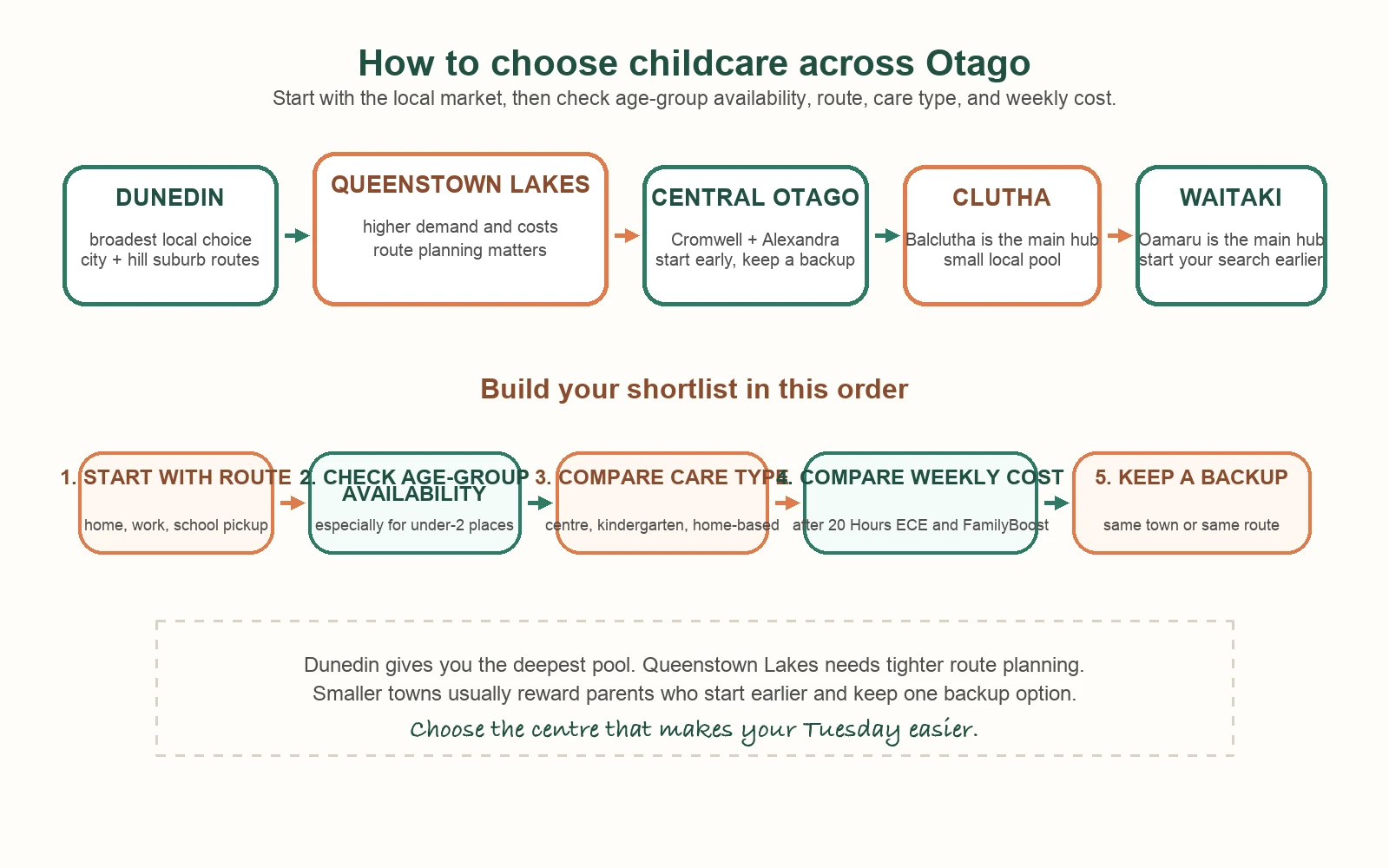
My strongest advice is simple: start with the route, then narrow by age group, then compare provider style. Parents often reverse that order. They fall for a centre name, a polished tour, or a pretty location, then realise the room availability, booked days, or drive does not actually fit ordinary life. Otago punishes that mistake faster than some regions because the local market can change sharply between Dunedin, Queenstown-Lakes, and the smaller towns.
If you are starting wide, browse Otago listings or use search to build the first shortlist. Once you have two or three serious options, compare becomes useful. If you are still early in the process, our guide on when to start looking for childcare can help you avoid the usual timing mistake.
- Search inside the town or corridor that fits your real weekday routine, not the whole region at once.
- Ask about your child's exact age group and likely start month, especially if you need under-2 care.
- If you live in a smaller market such as Oamaru, Balclutha, Cromwell, Alexandra, or Arrowtown, contact several providers at once instead of waiting on one reply.
- Compare net fees after 20 Hours ECE, FamilyBoost, or WINZ support, instead of staring at the pre-funding number alone.
- Read the latest ERO report or provider information before you tour so your questions are sharper.
- Keep one practical backup option on the shortlist, not only the centre that looked nicest online.
How to use provider examples by corridor
Parents often ask for the best centres in Otago. I think that question is too blunt to help much. The better question is which providers sit in the part of the region that makes your week easier. In Dunedin, names like York Place Preschool & Nursery, Otago Childcare Centre Inc, and Bear Park - St Clair show where the deeper city search sits. In Queenstown-Lakes, BestStart Hanleys Farm, Kidsfirst Kindergartens Frankton, and Wanaka Pre-School Early Childhood Centre help map the real growth corridors.
In the smaller town markets, BestStart Alexandra, Willows Early Learning Centre, BestStart Balclutha, and Barnardos Early Learning Centre Oamaru are useful location signals. Use examples like these to think geographically. They do not replace visits, tougher questions, or checking whether the centre still works on an ordinary Tuesday.
Frequently asked questions
Should I search all of Otago at once?
Usually no. Otago works better as several linked childcare markets: Dunedin, Queenstown-Lakes, Central Otago, Clutha, and Waitaki. That keeps your shortlist realistic and saves time.
Is Dunedin childcare easier to find because there are more centres?
Often, yes, because Dunedin has the deepest pool in the region. The Parent Circle currently tracks 91 active Dunedin City listings. But under-2 care and route-based searches can still feel tight if you need a very specific part of the city.
Why does Queenstown-Lakes feel harder even though there are still quite a few providers?
Because the market is smaller, the district is growing fast, rent is high, and the route between home, work, and backup care matters a lot. A decent number of listings helps, but it does not create much slack if your shortlist is narrow.
Does 20 Hours ECE make Otago childcare free once my child turns three?
Not automatically. Eligible children can receive up to 20 funded hours a week at participating services, but the final bill still depends on booked hours, provider policies, and any optional charges. Check the funding rules, then compare the real weekly cost.
What is the smartest way to compare Otago childcare options?
Compare by route, age-group availability, and total weekly friction first, then by fees and philosophy. Use [compare](/compare) for side-by-side notes and the [cost estimator](/cost-estimator) when the price difference between two centres looks close.
Otago gives families real choice, but only if you search the way the region actually works. Think in routes and local markets, not one blurry region. Start earlier in the smaller towns, take under-2 availability seriously, and compare convenience with cost instead of treating them as separate decisions. If two centres look similar, choose the one that makes your Tuesday easier. From there, you can narrow the shortlist in Otago childcare listings.
Explore Otago childcare options
Browse Otago providers by town and suburb, compare realistic options, and build a shortlist that fits your actual route.
Explore Otago listingsRelated guides
Rural Childcare in NZ: Options for Families Outside Major Cities
Rural childcare in NZ takes more planning, but there are workable options: small centres, Playcentre, home-based care, kōhanga reo, and local whānau networks.
Childcare in Bay of Plenty: Tauranga, Rotorua, and the Wider Region (2026)
Looking for childcare in Bay of Plenty? This practical 2026 guide breaks down Tauranga, Papamoa, Rotorua, Western Bay, and Eastern Bay so you can build a shortlist that actually fits your week.
Childcare in Waikato: Hamilton and the Greater Waikato Region (2026)
Looking for childcare in Waikato? This practical 2026 guide breaks down Hamilton, Cambridge, Te Awamutu, northern Waikato, Taupo, and smaller regional markets so you can build a shortlist that actually fits your week.
Childcare in Canterbury: Christchurch and Beyond (2026)
Looking for childcare in Canterbury? This practical 2026 guide breaks down Christchurch, Rolleston, Rangiora, Timaru, Ashburton, and smaller districts so you can build a shortlist that actually fits your week.
Find childcare near you
Search and compare providers by suburb, care type, cost, and availability.