
Resource Hub
Childcare Costs by Region: Where Is Childcare Most (and Least) Expensive in NZ?
Published · Last updated · 9 min read

Contents
Which parts of NZ have the highest childcare costs?
In our provider fee dataset, **Queenstown-Lakes is the most expensive area**, with Auckland close behind. Wellington also sits near the top, while places like **Nelson/Tasman are among the cheapest**. Most regions cluster within roughly a 20–25% band of Auckland, but the difference is big enough to change your weekly budget — especially if you’re paying for 30–50 hours of care.
Childcare costs in NZ aren’t ‘one national price’
If you’ve ever compared a daycare quote in Auckland with one in Nelson, you already know this: childcare in New Zealand is a postcode problem. Two families can buy the same hours of care, for kids the same age, and end up with very different invoices.
This article is about regional differences — where childcare tends to run hot, where it tends to be gentler, and why. If you want the full national picture first (care types, ages, subsidy stacking, and what ‘typical’ fees look like in 2026), start with our full childcare cost guide.
A quick note on what we mean by ‘region’
National overview: why childcare feels expensive everywhere
Even the ‘cheapest’ region often doesn’t feel cheap — because ECE is labour-intensive, tightly regulated, and increasingly shaped by the same pressures as the wider economy (wages, rent, insurance, utilities).
The two biggest cost drivers that show up in almost every family’s bill are:
1) Hours (30 hours vs 45 hours is the difference between ‘manageable’ and ‘gulp’).
2) Age (under-2 care is usually pricier because minimum staffing ratios are tighter — see the regulated ratios in Schedule 2 of the Education (Early Childhood Services) Regulations 2008).
Then the regional layer sits on top of that. If your centre’s biggest costs are staff and premises, it makes sense that fees move with local labour markets and local property markets.
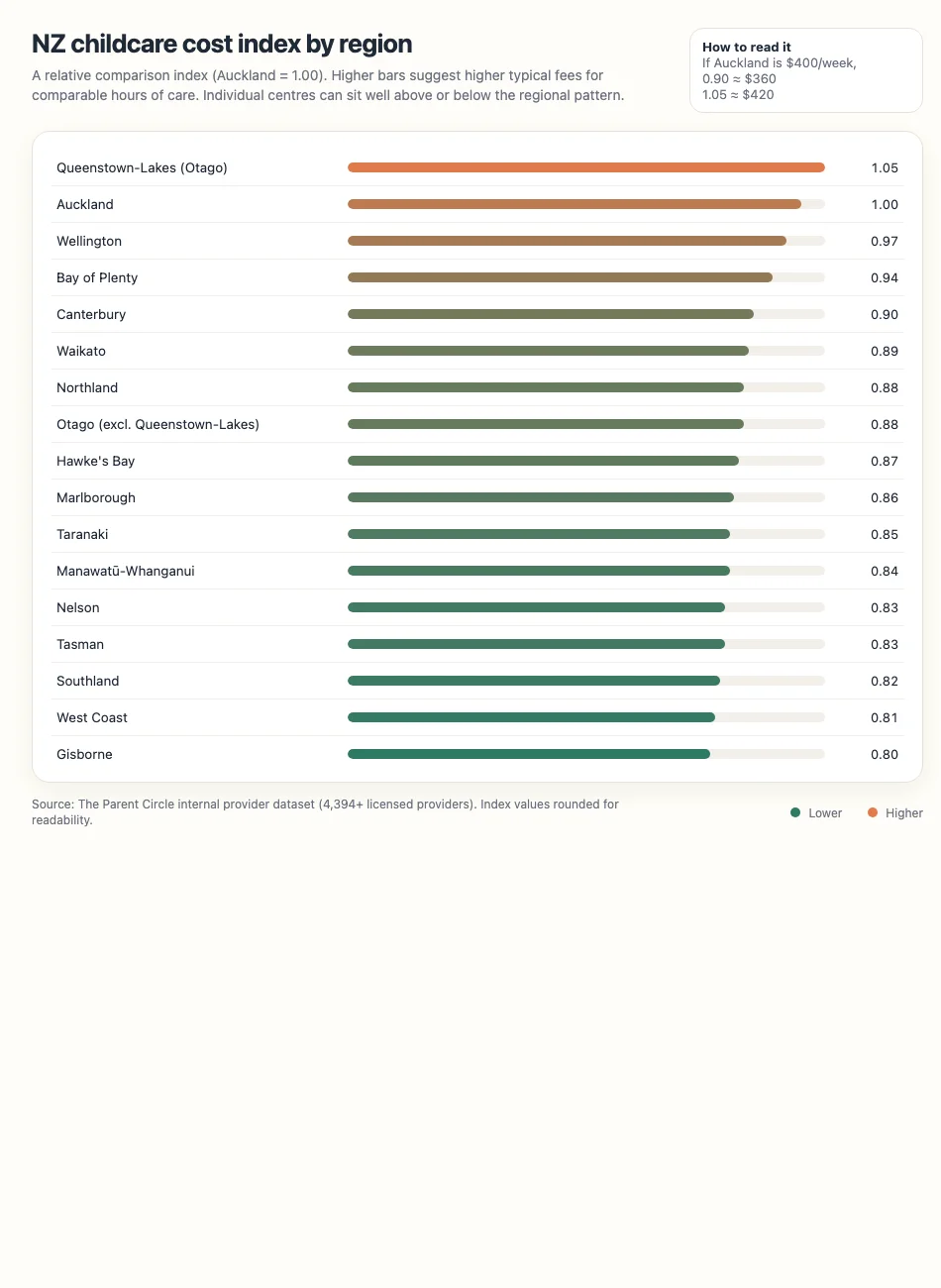
Regional childcare cost comparison (Auckland = 1.00)
Here’s the core comparison table. Think of it as a cost index: Auckland is the baseline at 1.00, and other regions are shown as a multiplier against that.
It’s most useful when you’re moving regions, comparing job offers, or trying to sanity-check a quote. For your exact numbers (your hours, your child’s age, and your subsidies), jump to the cost estimator.
| Region / area | Cost index | Plain-English read |
|---|---|---|
| Queenstown-Lakes (Otago) | 1.05 | Highest |
| Auckland | 1.00 | Baseline |
| Wellington | 0.97 | Very high |
| Bay of Plenty | 0.94 | High |
| Canterbury | 0.90 | High |
| Waikato | 0.89 | Mid |
| Northland | 0.88 | Mid |
| Otago (excl. Queenstown-Lakes) | 0.88 | Mid |
| Hawke's Bay | 0.87 | Mid |
| Marlborough | 0.86 | Lower |
| Taranaki | 0.85 | Lower |
| Manawatū-Whanganui | 0.84 | Lower |
| Nelson | 0.83 | Among the lowest |
| Tasman | 0.83 | Among the lowest |
| Southland | 0.82 | Low |
| West Coast | 0.81 | Low |
| Gisborne | 0.80 | Low |
Cost index is a relative comparison (Auckland = 1.00). Use it as a multiplier: if an Auckland quote is $400/week for your scenario, a 0.90 region is roughly $360/week for the same pattern of care.
How to use the table without overthinking it
Where is childcare most (and least) expensive?
Two things can be true at once: most regions sit in a fairly tight band, and the difference still hurts if you’re paying full-time fees. A 10% swing on a big weekly bill is real money.
If you only read one part of this article, read this: the biggest ‘pain’ tends to sit in tourism + high-rent pockets (Queenstown-Lakes), then the big metros (Auckland/Wellington). The gentler end tends to be smaller regions where premises and labour costs are lower (Nelson/Tasman are good examples).
Most expensive (relative to Auckland)
- Queenstown-Lakes (highest): property + workforce dynamics are different there.
- Auckland (baseline): big-city rents and strong demand keep prices firm.
- Wellington (very high): similar big-city pressure, but not always quite Auckland-level.
Among the cheapest
- Nelson and Tasman: consistently lower relative fee levels.
- West Coast / Southland / Gisborne: often lower sticker prices, but watch for ‘childcare desert’ issues (fewer options, longer travel).
Example only: what the index does to a weekly bill
A practical way to compare quotes (without getting lost)
- Compare weekly total for the same hours (not ‘per day’ unless the days are identical).
- Ask what’s included: meals, nappies, outings, sunscreen, and any ‘optional’ charges.
- Check the under-2 settings (staffing/room structure) — it can change price more than the region does.
- Ask about absence policy (fees during sickness/holidays) and whether you pay to hold your place.
- Then sanity-check against this regional index, and run your scenario in the cost estimator.
Why childcare costs vary by region
Most parents assume fees are basically ‘whatever the centre feels like charging’. In reality, the big drivers are boring — and that’s useful, because boring drivers are predictable.
Here are the regional factors that show up again and again:
1) Premises: rent, land, and compliance costs
Centres don’t just need a building; they need one that meets ECE licensing requirements (indoor/outdoor space, fencing, bathrooms, kitchen, sleep areas, safe access). In high-rent markets, the premises line alone can push fees up — even if staff wages are similar.
This is why pockets like Queenstown-Lakes can run hotter than their ‘region average’. Property costs there don’t behave like the rest of Otago.
2) Staff: wages, shortages, and the under-2 ratio
ECE is people-heavy. If you have more teachers per child, you need more wages per hour of care — and under-2 rooms are the clearest example.
In centre-based care, the regulated minimum ratios include 1 adult to 5 children under 2 (Schedule 2 of the ECE Regulations). For children aged 2 and over, the minimum staffing steps work out to about 1:10 at typical group sizes.
Regions with tight labour markets (big cities, tourism hubs) often have to pay more to hire and keep kaiako, which flows into fees.
3) Demand pressure: waitlists and ‘full capacity’ pricing
When most services in an area are running full, you don’t get the ‘new customer discount’ effect. You get the opposite: centres can hold their price because they’ll fill places anyway.
If you’re in a high-demand suburb and you’re relying on a specific start date, read our guide to childcare waitlists in NZ — the strategy can be different by region.
4) Local mix of care types
Some regions have a strong kindergarten footprint. Others skew heavily to full-day private centres, or have more home-based educators. Because the fee models differ, the average fee in a region can shift simply because the region’s care mix is different.
Region-by-region notes (quick guide)
Numbers are helpful, but parents usually notice patterns. Here’s a quick ‘what to expect’ guide by region. Use it as a starting point, then filter and compare real services in search.
| Region / area | What parents often notice | If you’re trying to save money |
|---|---|---|
| Queenstown-Lakes | High fees + tight availability; tourism hub dynamics. | Add home-based and flexible days to your shortlist; ring early. |
| Auckland | Huge suburb-to-suburb spread; waitlists common in growth areas. | Compare ‘extras’ (food/charges), and consider kindy + wraparound if it fits. |
| Wellington | Similar to Auckland but sometimes slightly lower; limited parking/travel time can add stress. | Prioritise a centre near work/home to cut the hidden cost of commute. |
| Canterbury | Generally lower than Auckland/Wellington; Christchurch varies by suburb. | Ask about 20 Hours ECE + optional charges; some centres price these very differently. |
| Bay of Plenty | Tauranga/Western BOP can feel ‘city-priced’. | If you’re commuting, look one suburb out — the difference can be bigger than the region index. |
| Waikato | Hamilton anchors pricing; smaller towns can be cheaper but with fewer options. | Get on lists early in small towns; choice is often the limiting factor. |
| Northland | Lower sticker prices, but fewer providers outside Whangārei. | Check travel distance and opening hours (they can be shorter). |
| Otago (excl. QL) | Dunedin sits mid-range; Queenstown is the outlier. | If you’re in Dunedin, compare centres vs kindy-style options for 3–5s. |
| Hawke's Bay | Often mid-range; demand spikes around key employers and school zones. | Ask about part-time patterns and whether you pay to hold extra days. |
| Taranaki | Often lower fees, but limited choice in some areas. | Shortlist more than one option so you’re not forced into the first vacancy. |
| Manawatū-Whanganui | Palmy vs smaller centres can differ; availability varies. | Home-based can be good value for under-2s if you find a stable educator. |
| Nelson | Consistently among the lowest in our comparisons. | If you need full-time, focus on quality/fit — price is often less extreme here. |
| Tasman | Low fees but can be spread out geographically. | Map your driving route before committing; 10 minutes matters at pick-up time. |
| Marlborough | Lower to mid; service mix matters. | Compare sessional vs all-day options if your work hours allow it. |
| Southland | Lower fees; options can be limited outside Invercargill. | Start early and ask about under-2 availability (it can be the bottleneck). |
| West Coast | Often low fees but long distances and fewer services. | Plan for backup care — sickness + travel can knock work around. |
| Gisborne | Often lower fees; availability can be the bigger issue. | Ring centres early and consider flexible part-week arrangements. |
This is a practical guide, not a guarantee. Individual services can sit well above or below the regional pattern.
Affordability: ‘cheaper’ regions can still feel harder
A useful way to think about childcare is not just dollars — it’s percentage of household income.
A $40/week difference doesn’t sound dramatic until you realise that many families are paying $300–$500/week out of pocket during the under-2 years. That’s why a region that’s 10% cheaper on paper can mean the difference between ‘we’re fine’ and ‘we’re cancelling swimming lessons’.
The hidden regional cost: travel time
How subsidies interact with regional prices
Subsidies don’t erase regional differences, but they do change how much the differences matter — especially for families right on the edge of eligibility thresholds.
Three supports matter most in 2026:
- 20 Hours ECE (for most 3–5 year olds): reduces the bill for a capped number of hours, but doesn’t help much if you need 40–50 hours a week.
- WINZ Childcare Subsidy: income-tested help that pays up to a maximum hourly amount. The cap is the same nationwide, so it tends to stretch further in lower-fee regions.
- FamilyBoost (IRD): a quarterly tax credit that refunds a percentage of eligible fees (subject to caps and income thresholds).
WINZ Childcare Subsidy: the cap matters more in high-fee regions
WINZ publishes the current rate tables, including income thresholds and maximum hourly assistance by age. Because the subsidy is capped, the same maximum rate covers a smaller share of the total bill in Auckland or Queenstown than it does in, say, Nelson.
If you want the detail (what counts as ‘household income’, what documents you need, and how it works for different hours), see our step-by-step guide: WINZ Childcare Subsidy NZ.
Official rate table: https://www.workandincome.govt.nz/map/deskfile/extra-help-information/childcare-assistance-tables/childcare-subsidy-current.html
FamilyBoost: why it can move the needle even if you don’t get WINZ
FamilyBoost is administered through Inland Revenue and is claimed quarterly. For quarters starting 1 July 2025, IRD describes FamilyBoost as 40% of eligible childcare costs, up to $1,560 per quarter, with an income test based on quarterly household income.
If you’re in a higher-fee region and you’re paying a lot out of pocket, that cap becomes a real line item in your budget.
Official details: https://www.ird.govt.nz/familyboost/can-you-get-familyboost/how-much-familyboost-are-you-eligible-for
The childcare desert problem (and why it’s not just a rural thing)
‘Childcare desert’ is a blunt term, but it describes something lots of NZ parents recognise: you can afford care in theory, but you can’t access it in practice.
It shows up in a few ways:
- Rapid-growth suburbs where the number of young families rose faster than the number of licensed places.
- Regions with long travel distances between towns (even if fees are lower).
- Areas where the only vacancies are in hours that don’t match typical work patterns (e.g., three half-days).
If you’re stuck with availability
Regional ‘best value’ recommendations (by care type)
Value isn’t just the cheapest invoice. It’s the best fit for your hours, your child’s age, and what you get for the money (qualified staff, stable teams, outdoor space, food included, etc.).
These are the patterns we see most often:
- If you need full-time (40–50 hours/week): compare fee + food charges + late pickup fees — the ‘extras’ are where high-cost regions can bite.
- If your child is 3–5: prioritise services that apply 20 Hours ECE cleanly (and ask how they handle optional charges).
- If you’re in a high-cost pocket (Auckland, Wellington, Queenstown): put home-based on the shortlist — it can be the ‘least bad’ price for under-2s in some suburbs.
- If your region has a strong kindergarten network: use it. Even if you still need wraparound care, it can reduce the number of paid hours.
- If your region is low-cost but low-availability: start earlier than you think. Limited supply is its own cost.
FAQ
Is Auckland always the most expensive place for childcare?
Auckland is consistently near the top, but it’s not always #1. In our comparisons, Queenstown-Lakes often edges it out. Within Auckland, fees also vary a lot by suburb and by whether a centre offers under-2 rooms, meals, and extended hours.
Why is Queenstown-Lakes so expensive?
It behaves like a separate market: high property costs, a seasonal workforce, and strong demand pressure. Even small shifts in staffing and premises costs show up quickly in fees.
Do subsidies change by region?
The rules are national, not regional — but the *impact* differs. A capped subsidy (like WINZ) can cover a bigger share of a lower-fee region’s bill than a high-fee region’s bill.
Can I get WINZ Childcare Subsidy and FamilyBoost?
Often, yes. WINZ support reduces what you pay to the provider, and FamilyBoost is a tax credit on eligible childcare costs (subject to caps and income thresholds). You can’t claim two supports for the same dollar, but they can stack in practice depending on your situation.
How do I estimate childcare costs for my region?
Use a two-step approach: (1) start with the regional cost index for a rough multiplier, then (2) plug your hours, child age, and subsidies into our /cost-estimator to get a weekly estimate.
Is childcare cheaper in regions with lower cost of living?
Often, yes — but it’s not a perfect match. Some low-cost regions have fewer services, longer travel distances, or limited vacancy. That can make childcare feel harder even if the sticker price is lower.
Regional averages are useful, but your real-world bill comes down to one question: how many paid hours are left after subsidies. If you’re planning a move, negotiating a job package, or just trying to pick a centre that won’t blow up your budget, start with the tools that let you model it properly.
Next steps:
- Run your numbers in the cost estimator
- Search providers by region (and ring early if you’re in a tight market)
- If you want the full national context, go back to the full childcare cost guide
Calculate your childcare costs for any NZ region
Use our cost estimator to model weekly costs by region, your child’s age, hours needed, and which subsidies you might be able to stack.
Use the cost estimatorFind childcare near you
Search and compare providers by suburb, care type, cost, and availability.