
Resource Hub
Childcare in Waikato: Hamilton and the Greater Waikato Region (2026)
Published · Last updated · 9 min read

Contents
What should Waikato parents know before they start looking for childcare?
Treat Waikato as several linked childcare markets, not one giant Hamilton search. The Parent Circle currently tracks 489 active Waikato listings with licensed capacity for 23,234 children, including 6,759 under-2 places. Hamilton gives you the deepest pool, but Cambridge, Te Awamutu, Taupo, Tokoroa, Thames, Pokeno, and Ngaruawahia all behave differently once you factor in age group, commute, and start date.
Why Waikato needs its own childcare strategy
Waikato sits in an awkward but useful middle ground. It is bigger and more varied than many parents expect, yet it still gets flattened into 'Hamilton and nearby' in casual advice. That misses the real shape of the region. A family living in Rototuna, a family commuting from Pokeno, and a family trying to keep life local in Taupo are not shopping in the same childcare market, even if they all live in Waikato.
Population growth helps explain why this region feels busier. Stats NZ and Waikato regional reporting put the region at about 532,100 people in 2025, with annual growth around 1.0 percent. Waikato Regional Council's trend reporting says the region is on track to overtake Wellington by 2033. Hamilton City Council's 2024 economic reporting says the city kept growing in population and housing, while Waikato District Council describes the district as the heart of the Golden Triangle between Auckland, Hamilton, and Tauranga. Put simply, more families are arriving and more housing is spreading through the region, so childcare demand is unlikely to ease soon in the main growth corridors.
What Waikato's childcare numbers actually tell you
The Parent Circle currently tracks 489 active listings across Waikato. Together they represent licensed capacity for 23,234 children, including 6,759 under-2 places. Hamilton City carries the biggest share with 182 listings. After that, the market spreads across Waikato District, Waipa, Taupo, Matamata-Piako, South Waikato, Thames-Coromandel, and several smaller districts. What matters is how unevenly that supply is spread across the region.
There is useful variety too. The current dataset includes 276 Education and Care Services, 65 Free Kindergartens, 60 Te Kohanga Reo, 56 Playcentres, and 18 Homebased Networks. So the decision is not only about finding a vacant room. It is also about deciding what sort of care setup fits your week, your child's age, and your whānau's values.
| District | Active listings | Licensed capacity | Under-2 capacity | What it usually means for parents |
|---|---|---|---|---|
| Hamilton City | 182 | 10,361 | 3,520 | Best depth for suburb choice, long-day routines, and backup options |
| Waikato District | 81 | 3,763 | 952 | Important for Golden Triangle commuters and fast-growing northern towns |
| Waipa District | 51 | 2,568 | 659 | Strong town-based choice around Cambridge and Te Awamutu |
| Taupo District | 36 | 1,355 | 272 | Useful local market, but smaller once you narrow by age group and hours |
| Matamata-Piako District | 31 | 1,411 | 398 | Solid town supply around Morrinsville and Matamata |
| South Waikato District | 30 | 1,126 | 245 | Local choice exists, but fewer backup options once you shortlist |
| Thames-Coromandel District | 27 | 914 | 219 | Works best when you search locally and start early |
| Hauraki District | 22 | 809 | 214 | Smaller pool, so practical fit matters fast |
Source: The Parent Circle Waikato listings snapshot, April 2026. These counts show market depth, not live vacancies.
One important gap in the data
Hamilton is the anchor market, but not the whole answer
Hamilton has the widest range of options in the region. It has 182 listings, licensed capacity for 10,361 children, and 3,520 under-2 places in the current dataset. Hamilton Central alone has 38 listings. Chartwell has 22, Hamilton East 13, Frankton 12, and Te Rapa 12. For many city families, that makes it easier to build a backup shortlist instead of pinning everything on one centre.
That does not mean Hamilton is easy if you search lazily. The city has its own corridor logic. Rototuna and Flagstaff work differently from Hamilton Central. Te Rapa, Frankton, Hillcrest, Claudelands, and Melville each suit different school runs and work routes. Reviewed examples in the current dataset include Brightlands Childcare Centre Vickery Street, Learn A Lot Childcare, Midcity Childcare, Peachgrove Road Educare, and House of Wonder Chartwell. Use names like these as location signals, not as automatic recommendations.
Cambridge, Te Awamutu, and the town-based Waipa search
Waipa District adds 51 listings, while neighbouring Matamata-Piako adds another 31. For families outside Hamilton, these are usable local markets rather than overflow territory. Te Awamutu has 18 listings in the current suburb snapshot. Cambridge has 15. Matamata has 11, and Morrinsville has 12. That is enough choice to compare properly, but delays can narrow options quickly.
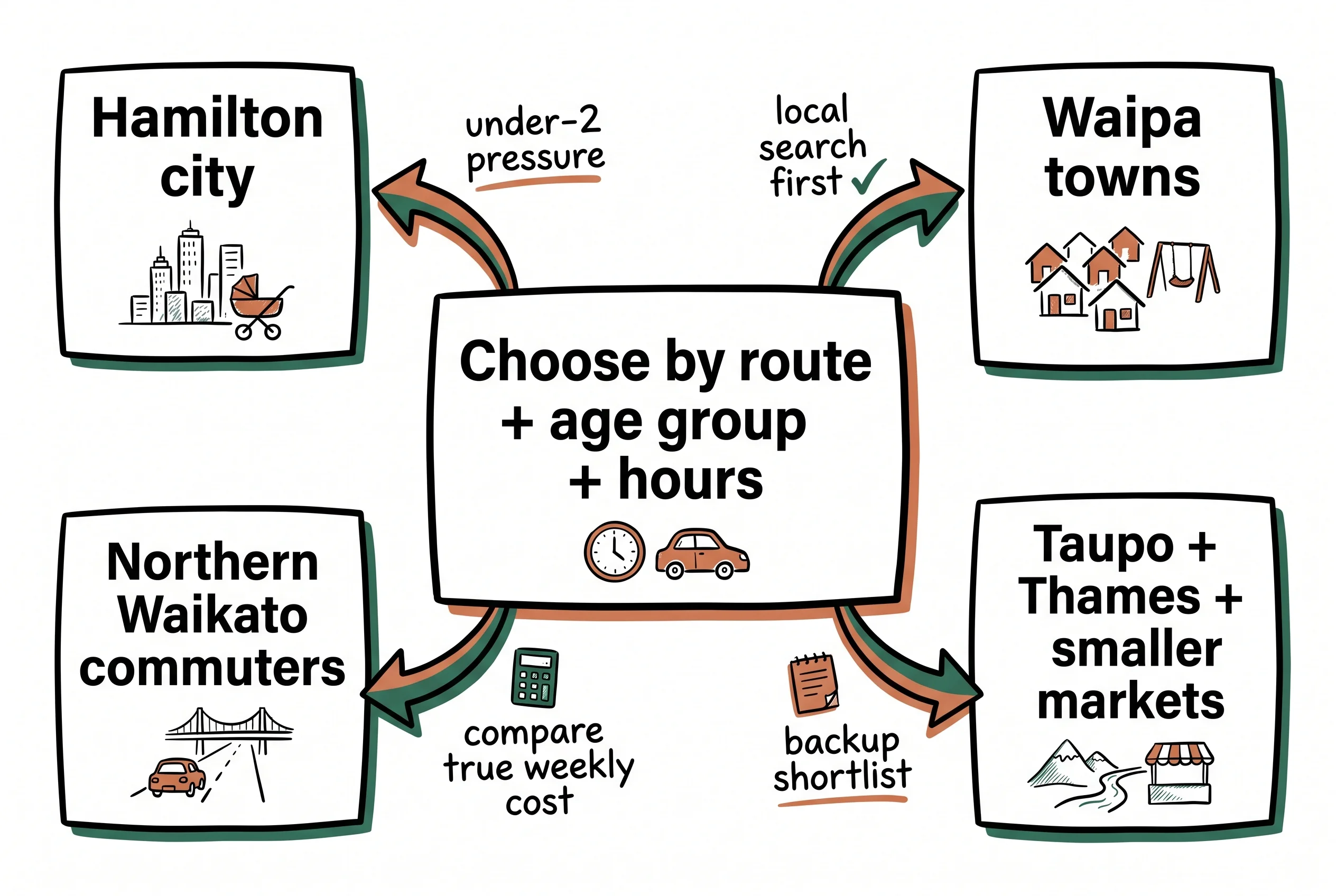
Families in this part of the region usually do better when they search locally first and only stretch toward Hamilton if they need to. That keeps drop-off, school pickups, and backup care more realistic. Reviewed examples include BestStart Te Awamutu, Central Kids Rewi Street, Busy Bees Cambridge, Educare Tree Town, Central Kids Mill Crescent in Matamata, and Central Kids Morrinsville. This part of Waikato often rewards parents who choose a centre that fits the whole week, not just one that looks best on tour day.
Northern Waikato and the Golden Triangle effect
Waikato District behaves differently from Hamilton and the smaller town markets. The district has 81 listings, licensed capacity for 3,763 children, and 952 under-2 places. Waikato District Council says the district sits in the Golden Triangle bounded by Auckland, Hamilton, and Tauranga, and that about half of New Zealand's population lives within a couple of hours' drive. If you live in places like Pokeno, Tuakau, Te Kauwhata, Huntly, Ngaruawahia, or Te Kowhai, childcare decisions often get tangled up with wider housing and commute choices.
This is where parents can get trapped by map thinking. A centre may look close in kilometres but still be wrong for your real weekday route. Northern Waikato families should search around the direction their week actually moves, whether that is Hamilton-facing, Auckland-facing, or fully local. Reviewed examples include Pokeno Explorers, Pokeno Child Care Centre, Active Discoverers Educare in Ngaruawahia, Educare Two Rivers, Te Kauwhata Childcare & Learning Centre, and Country Gate Early Learning.
Taupo, Thames-Coromandel, Tokoroa, and the wider region
The rest of Waikato deserves its own respect. Taupo District has 36 listings and Taupo suburb alone has 18. Thames-Coromandel has 27 listings. South Waikato has 30, with Tokoroa and Putaruru doing a lot of the work. Hauraki has 22. These are not tiny numbers, but they are not huge markets either. Once you narrow by age group, philosophy, and exact days, the shortlist gets smaller much faster than it does in Hamilton.
Parents here usually need to start earlier and contact several providers at once because options narrow fast. In Taupo, reviewed examples include BestStart Abacus, BestStart Richmond Kindy, Four Seasons Rudolf Steiner Kindergarten, and Taupo Kids Community. In Thames-Coromandel, examples include Central Kids Thames, Pukekos Educare Thames, and Central Kids Mercury Bay. In South Waikato, names such as Central Kids Balmoral, Central Kids Glenshea, and Busy Bees Putaruru show there is local supply, but not much room for late indecision.
Waikato gives families more than one care style
One strength of the Waikato market is its range of care types. There is plenty of standard long-day centre care, but the region also has a strong kindergarten footprint, a meaningful Te Kohanga Reo presence, active Playcentres, and some home-based options. That matters because not every family is solving the same problem. Some need long hours close to work. Some want a smaller setting. Some care deeply about cultural immersion or parent involvement.
The current dataset shows 60 Te Kohanga Reo listings across Waikato, which gives many Māori whānau, and families seeking stronger te reo Māori pathways, a meaningful set of options. There is also enough variation in kindergartens, Playcentres, and specialist approaches that it is worth being specific about what you want instead of searching only by suburb.
Costs, subsidies, and the real weekly bill
There is no single official Waikato fee table that tells the whole truth. The real number still depends on your child's age, booked hours, provider type, and whether the service charges for extras such as meals. Waikato often feels easier than Auckland, but sometimes that is because the route is simpler, not because the fees are magically low. Under-2 care still usually costs more because staffing ratios are tighter.
Two national supports matter here. 20 Hours ECE covers up to 6 hours a day and 20 hours a week for eligible 3, 4, and 5 year olds at participating services. FamilyBoost can also reduce the bill for eligible households by refunding part of their childcare spend. The useful comparison is not just the sticker fee. It is the net weekly cost after funding, plus how much time and fuel the centre adds to your life.
That last part gets ignored too often. A centre that is a little cheaper can still cost more overall if it sits on the wrong side of Hamilton traffic or sends you on a bad detour between Cambridge and work. For a broader benchmark, see our guide to childcare costs by region and the cost estimator.
How to search Waikato without wasting weeks
My strongest advice is simple: start with the route, then narrow by age group, then compare provider style. Parents often reverse that order. They fall for a centre name or a polished visit, then realise the location, session pattern, or infant-room availability does not actually fit their week. Waikato rewards practical realism more than broad browsing.
If you are starting wide, browse Waikato listings or use search to build the first shortlist. Once you have two or three serious options, compare is useful. If you are still early in the process, our guide on when to start looking for childcare can help you time the search.
- Search around the route you actually travel, not just the suburb name you prefer.
- Ask about your child's exact age group and likely start month, especially if you need under-2 care.
- If you live in a smaller Waikato market, contact several providers at once instead of waiting on one reply.
- Compare net fees after 20 Hours ECE or FamilyBoost, not just before.
- Read the latest ERO report or provider information before you tour so your questions are sharper.
- Keep one practical backup option on the shortlist, not only the centre that looks nicest online.
How to use provider examples by corridor
Parents often ask for the best centres in Waikato. I think that question is a little too blunt. The better question is which providers sit in the part of the region that makes your week easier. In Hamilton, names like Brightlands Childcare Centre Vickery Street, Learn A Lot Childcare, and Midcity Childcare show the city has a wider choice of providers. In Waipa, Busy Bees Cambridge, BestStart Te Awamutu, and Central Kids Rewi Street show solid town-based options. In northern Waikato, Pokeno Explorers, Active Discoverers Educare, and Te Kauwhata Childcare & Learning Centre are useful location signals.
Further south and east, BestStart Abacus and Four Seasons Rudolf Steiner Kindergarten show Taupo's range, while Central Kids Thames and Pukekos Educare Thames show there is meaningful supply in Thames-Coromandel too. Use examples like these to think geographically. They do not replace visits, tougher questions, or checking whether the centre still works on an ordinary Tuesday.
Frequently asked questions
Is childcare easier to find in Hamilton than in Auckland?
Usually, yes, because Hamilton is smaller and the local market is easier to search well. The Parent Circle currently tracks 182 Hamilton City listings, which gives many families genuine backup options. But under-2 care and narrow route-based searches can still feel tight.
Should I search Hamilton centres if I live in Cambridge, Te Awamutu, or Ngaruawahia?
Only if that route genuinely fits your week. Many Waikato families do better by searching locally first, then adding one wider backup corridor. A bigger market is not automatically a better market if it breaks your drop-off and pickup routine.
Does Waikato have good options beyond standard daycare centres?
Yes. The current Waikato dataset includes Free Kindergartens, Te Kohanga Reo, Playcentres, Homebased Networks, and some specialist approaches alongside mainstream Education and Care Services. It is worth deciding what type of care you want before you shortlist by suburb alone.
Does 20 Hours ECE make Waikato childcare free once my child turns three?
Not automatically. Eligible children can receive up to 20 funded hours a week at participating services, but the final bill still depends on booked hours, provider policies, and any optional charges. Read the official 20 Hours ECE rules before comparing fees.
What is the smartest way to compare Waikato childcare options?
Compare by route, age-group availability, and total weekly friction first, then by fees and philosophy. Use [compare](/compare) for side-by-side notes and the [cost estimator](/cost-estimator) when the price difference between two centres looks close.
Waikato gives families real choice, but only if you search the way the region actually works. Think in towns and corridors, not one blurry region. Start earlier in the smaller markets, take under-2 availability seriously, and compare convenience with cost instead of treating them as separate decisions. If two centres look similar, choose the one that makes your Tuesday easier, not the one that sounded best on the tour. From there, you can narrow the shortlist in Waikato childcare listings.
Explore Waikato childcare options
Browse Waikato providers by town and suburb, compare realistic options, and build a shortlist that fits your actual route.
Explore Waikato listingsRelated guides
Rural Childcare in NZ: Options for Families Outside Major Cities
Rural childcare in NZ takes more planning, but there are workable options: small centres, Playcentre, home-based care, kōhanga reo, and local whānau networks.
Childcare in Otago: Dunedin, Queenstown, Wānaka, and the Wider Region (2026)
Looking for childcare in Otago? This practical 2026 guide breaks down Dunedin, Queenstown-Lakes, Central Otago, Clutha, and Waitaki so you can build a shortlist that actually fits your week.
Childcare in Bay of Plenty: Tauranga, Rotorua, and the Wider Region (2026)
Looking for childcare in Bay of Plenty? This practical 2026 guide breaks down Tauranga, Papamoa, Rotorua, Western Bay, and Eastern Bay so you can build a shortlist that actually fits your week.
Childcare in Canterbury: Christchurch and Beyond (2026)
Looking for childcare in Canterbury? This practical 2026 guide breaks down Christchurch, Rolleston, Rangiora, Timaru, Ashburton, and smaller districts so you can build a shortlist that actually fits your week.
Find childcare near you
Search and compare providers by suburb, care type, cost, and availability.