
Resource Hub
Childcare in Auckland: The Complete Guide for Auckland Parents (2026)
Published · Last updated · 10 min read

Contents
What should Auckland parents know before starting the childcare search?
Start with your route, not with a random list of centres. The Parent Circle currently lists 1,183 active Auckland providers with combined licensed capacity of 66,115 and under-2 capacity of 20,211, so there is real choice here. But Auckland is not one neat market. It is a patchwork of suburb-level markets, traffic patterns, and age-group bottlenecks. A centre that looks promising on a map can still be a terrible fit for your actual week.
Why Auckland needs its own childcare playbook
Auckland has the biggest childcare market in the country, but that does not mean the search feels easy. Bigger markets come with more choice, more suburb variation, and more ways to waste time. Parents often start too wide, visit centres that were never going to work logistically, then realise the real issue was not quality alone. It was whether drop-off and pickup still made sense on a normal Tuesday.
This guide is built for that reality. It pulls in The Parent Circle's Auckland listing data, the practical funding rules behind 20 Hours ECE, current FamilyBoost settings, and the boring but important stuff parents actually deal with, like peak-hour traffic, under-2 pressure, and the difference between a big region and a usable shortlist.
If you want the short version, here it is. Auckland gives you more options than anywhere else, but it punishes vague searching. Families who narrow early by suburb or corridor usually do better than families who treat all of Auckland as one pool.
What Auckland's childcare numbers actually tell you
The Parent Circle currently tracks 1,183 active Auckland listings. Together they represent licensed capacity for 66,115 children, including 20,211 under-2 places. Those are big numbers, and they matter. They tell you Auckland has depth across care types and neighbourhoods. But they do not guarantee an easy search for your family in your part of the city. A market can be deep overall and still feel tight on one route, one age group, or one start date.
The densest parts of the current dataset sit in Henderson-Massey, Otara-Papatoetoe, Mangere-Otahuhu, Howick, Manurewa, Albert-Eden, Maungakiekie-Tamaki, Upper Harbour, Kaipatiki, and Orakei. At suburb level, Manurewa, Henderson, Mangere, Otara, and Papatoetoe lead the current listing count. That does not mean those suburbs are automatically "best". It means parents searching there have more raw supply to work with than parents in thinner pockets. Supply helps, but only if it lines up with your route and your child's age.
| Area | Active listings | What it suggests |
|---|---|---|
| Henderson-Massey | 115 | Strong western supply and plenty of route-based options |
| Otara-Papatoetoe | 110 | Large South Auckland market with real depth |
| Mangere-Otahuhu | 100 | Good volume near airport and southern corridors |
| Howick | 91 | Solid eastern market, especially for family suburbs |
| Manurewa | 86 | High local supply, worth checking early for under-2 care |
| Albert-Eden | 82 | Useful for central-west commuters and inner-suburb families |
| Upper Harbour | 74 | A practical North Shore growth corridor |
| Kaipatiki | 69 | North Shore depth without CBD-level travel pressure |
| Orakei | 63 | Strong eastern-central pocket, often with premium-fee spillover |
Source: The Parent Circle Auckland listings snapshot, April 2026. These counts show market depth, not live availability.
A useful stat, with one catch
What childcare costs in Auckland, and what actually reduces the bill
For many Auckland families, full-time centre-based care lands somewhere around $250 to $450 a week before subsidies and funding. That is a market range, not a government-set fee table, and the spread is real. Under-2 care usually costs more because staffing ratios are tighter. Premium suburbs, longer hours, and extra services can push the number north quickly.
The first major cost lever is 20 Hours ECE. The Ministry of Education says it covers up to 6 hours a day and 20 hours a week for eligible 3, 4, and 5 year olds at participating services, and parents cannot be charged fees for those funded hours. That matters a lot in Auckland. It can turn a painful weekly fee into something manageable. It does not solve every cost, though. Hours beyond the funded cap, optional extras, and under-3 care still need proper budgeting.
The second lever is FamilyBoost. For quarters ending after 1 July 2025, households under $35,000 quarterly income can claim up to 40% of ECE costs, capped at $1,560 a quarter. Above that, the payment tapers, and households above $57,286 quarterly income are not eligible. For Auckland families paying big weekly fees, that is not a small detail. It can change the real cost gap between two centres, especially once you compare net cost rather than sticker price.
One mistake I see a lot is comparing fees without comparing travel. A cheaper centre can become more expensive if it adds thirty extra minutes of driving a day, messes with pickup backup, or forces one parent to leave work early. Auckland is harsh on theoretical bargains. The right comparison is total weekly friction: fees, funded hours, traffic, time, and whether the setup still works when the day goes sideways. If you want a broader benchmark, pair this with our guide to childcare costs by region and the cost estimator.
Where Auckland seems strongest for raw availability
In the current dataset, Manurewa leads with 54 listings, followed by Henderson with 52. Mangere and Otara each sit on 41, Papatoetoe on 39, and Mangere East on 31. Glen Eden, Glenfield, and Remuera each have 22. Albany and Howick each have 19, with Massey, Flat Bush, and Pakuranga close behind. That gives you a rough map of where Auckland's childcare supply is thickest right now.
Use that map carefully. More listings usually means more room to compare, not guaranteed quick enrolment. Under-2 places, specific session times, and philosophy-driven centres can still be tight. Think of high-count suburbs as better hunting grounds, not guaranteed wins.
North Shore: strong depth if your week lives north of the bridge
The North Shore works best when your family's life is already on that side of the harbour. Kaipatiki and Upper Harbour both show solid listing depth, and suburbs like Glenfield and Albany have enough volume to make a proper shortlist instead of a desperation shortlist. That is the good news. The less fun truth is that a centre that looks fine on paper can become nonsense if one parent is crossing the bridge twice a day.
If you live and work north, this can be one of Auckland's easier childcare markets to navigate. Example providers in the current review-backed dataset include Active Explorers Glenfield Kea and Active Explorers Glenfield Rimu in Glenfield. I would use examples like these as proof that there is real supply and parent feedback in the area, not as a shortcut around doing your own visits, questions, and ERO checks.
Central Auckland and CBD-adjacent routes: convenience can beat beauty
Central Auckland parents usually face a classic trade-off. Do you want the nicest-looking centre, or the one that will not wreck pickup on a day with motorway delays and a late meeting? Inner areas like Albert-Eden and Orakei give decent supply, and suburbs such as Remuera show meaningful depth. If you work in the CBD, Greenlane, Newmarket, or Penrose, route logic should drive the shortlist early.
Remuera and Ellerslie already show up in the reviewed provider examples, including ACG Remuera Early Learning School, Active Explorers Central Park, and Active Explorers Ellerslie. These are useful signals for centre clusters around central-eastern work routes. They are not rankings. They are proof that if you narrow by the way you actually travel, the search gets smarter very quickly.
West Auckland: deep supply, better odds of a workable shortlist
West Auckland looks good in the current data. Henderson-Massey leads the city with 115 listings, Henderson alone has 52, and Glen Eden has 22. That matters because western families often need choice that stays inside a practical daily radius. A centre ten kilometres away is not helpful if it drags you across the wrong traffic flow every morning.
This is one of the places where a larger local market gives you breathing room. If your first choice says no, you still have alternatives nearby. Active Explorers Blockhouse Bay is one reviewed example on the western side. I would still filter hard by age group and pickup hours, but West Auckland is one of the better areas to compare without feeling boxed in immediately.
South Auckland: big local market, strong variety, start early for under-2 care
South Auckland has real scale. Otara-Papatoetoe holds 110 listings, Mangere-Otahuhu 100, and Manurewa 86. At suburb level, Manurewa, Mangere, Otara, Papatoetoe, Mangere East, and Otahuhu all show strong supply. That is not a small thing. Families in the south often have better local comparison potential than outsiders assume.
The warning label is age and timing. Large southern supply does not mean easy late-stage enrolment for babies and toddlers. If you need under-2 care, ask earlier than feels reasonable and ask multiple centres at once. For airport-corridor families, Active Explorers Airport is one reviewed example worth knowing about. But again, examples help you map the market. They do not replace visits, parent questions, or a look at ERO review reports.
East Auckland: family-suburb strength, sometimes with a premium feel
East Auckland has a useful mix of family suburbs and established provider pockets. Howick shows 19 listings in the current suburb snapshot, while Flat Bush and Pakuranga each sit on 18. At territorial level, Howick is one of the stronger parts of the Auckland market. That usually means a better chance of building a shortlist that stays close to school runs, local work routes, and after-work pickups.
You can also feel the fee gradient here. Parts of East Auckland and nearby central-eastern suburbs can push into more expensive territory, especially if you are comparing premium-feel centres or longer hours. Active Explorers Highbrook gives one example tied to the wider eastern business corridor. Treat that as one reference point, then compare suburb by suburb rather than assuming the whole east behaves the same way.
Waitlists, visits, and how to search like you actually live in Auckland
Do not wait until the last minute because Auckland looks rich in supply. The city may have depth overall, but your exact corridor might not. That is especially true if you need a centre near the CBD, near the airport, or close to one of the growth corridors where many families are searching at once.
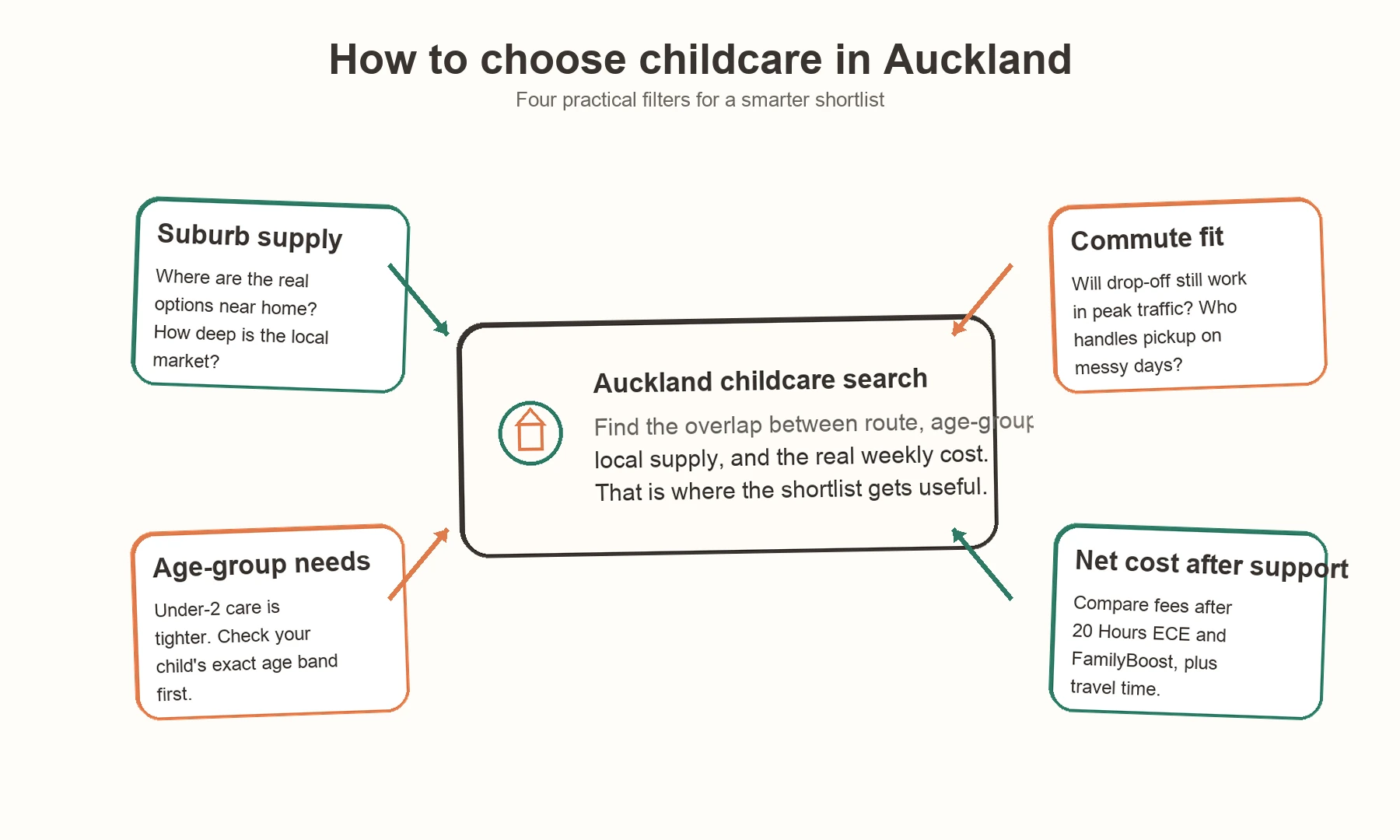
My rule would be simple. Start wide for one afternoon, then narrow fast. Search by suburb and route in Auckland's hub page or go straight to search. If you are comparing two workable options, use compare. If you are still in the early stage, our guide on when to start looking for childcare is worth reading before you book visits.
- Map the centre against your real weekday route before you fall in love with it.
- Ask specifically about your child's age group, not just general availability.
- Read the latest ERO report before you visit so your questions are sharper.
- Check what the fee looks like after 20 Hours ECE or FamilyBoost, not just before.
- Ask what happens if you need to swap days, change hours, or start later than planned.
Provider examples by area, used the right way
Parents often ask for the "best" Auckland centres. I do not love that question because one answer never fits every route, budget, age group, and philosophy. Provider examples are more useful as location signals. In the current dataset, examples with at least three approved reviews include ACG Remuera Early Learning School in Remuera, Active Explorers Airport near the southern airport corridor, Active Explorers Blockhouse Bay in the west, Active Explorers Central Park and Active Explorers Ellerslie around central-eastern commuter routes, Active Explorers Glenfield Kea and Active Explorers Glenfield Rimu on the North Shore, Active Explorers Highbrook in the eastern business corridor, and Adventureland Early Learning Centre in Ellerslie.
Use that list to think geographically, not emotionally. Read the ERO report. Ask about teacher stability, transition routines, and how the day actually runs. Auckland has enough choice that you do not need to settle for a centre that looks lovely but breaks your week.
Frequently asked questions
How much does childcare cost in Auckland?
For many families, full-time centre-based care in Auckland lands around $250 to $450 a week before subsidies and funding, with under-2 care often sitting higher because staffing ratios are tighter. Exact fees vary a lot by suburb, hours, and provider.
Does 20 Hours ECE reduce Auckland childcare fees?
Yes, for eligible 3, 4, and 5 year olds at participating services. The Ministry of Education says 20 Hours ECE covers up to 6 hours a day and 20 hours a week, and services cannot charge fees for those funded hours. It helps, but it does not cover hours beyond the cap or every optional extra.
Is childcare easier to find in Auckland because there are so many centres?
Not automatically. Auckland has the biggest market, but it behaves like many smaller local markets stitched together. A suburb can look well supplied on paper and still feel tight if you need under-2 care, a specific route, or a start date soon.
What should I check before joining a waitlist?
Check whether the centre works for your real weekday route, your child's age group, your likely start date, and your budget after 20 Hours ECE or FamilyBoost. Also read the ERO report and ask what happens if you need to change days.
Should I choose childcare near home or near work in Auckland?
That depends on your family's route and pickup backup plan. For many Auckland families, the best answer is not near home or near work in the abstract. It is the centre that still works when traffic is ugly and one parent is running late.
The best Auckland centre is the one that still works in traffic
Auckland can make parents over-optimistic at the start. The market looks huge, so the answer should feel easy. Then real life enters the room: bridge traffic, airport runs, split commutes, under-2 limits. A centre that looked fine on Saturday can look ridiculous on Wednesday.
The smarter approach is less romantic and more useful. Start with the life you already live. Filter hard by route, age group, and net cost. Use Auckland's region page to narrow, search to scan, and compare when you have two or three serious options. If you want the bigger national picture first, our region-by-region guide is the natural next read.
Explore childcare in Auckland
Search Auckland providers by suburb, compare realistic options, and build a shortlist that fits your family's actual route.
Search Auckland nowRelated guides
Childcare in Otago: Dunedin, Queenstown, Wānaka, and the Wider Region (2026)
Looking for childcare in Otago? This practical 2026 guide breaks down Dunedin, Queenstown-Lakes, Central Otago, Clutha, and Waitaki so you can build a shortlist that actually fits your week.
Childcare in Bay of Plenty: Tauranga, Rotorua, and the Wider Region (2026)
Looking for childcare in Bay of Plenty? This practical 2026 guide breaks down Tauranga, Papamoa, Rotorua, Western Bay, and Eastern Bay so you can build a shortlist that actually fits your week.
Childcare in Waikato: Hamilton and the Greater Waikato Region (2026)
Looking for childcare in Waikato? This practical 2026 guide breaks down Hamilton, Cambridge, Te Awamutu, northern Waikato, Taupo, and smaller regional markets so you can build a shortlist that actually fits your week.
Childcare in Canterbury: Christchurch and Beyond (2026)
Looking for childcare in Canterbury? This practical 2026 guide breaks down Christchurch, Rolleston, Rangiora, Timaru, Ashburton, and smaller districts so you can build a shortlist that actually fits your week.
Find childcare near you
Search and compare providers by suburb, care type, cost, and availability.