
Resource Hub
Te Whāriki Explained: Understanding NZ's Early Childhood Curriculum
Published · Last updated · 7 min read

Contents
What is Te Whāriki in simple terms?
Te Whāriki is New Zealand's national early childhood curriculum for children from birth to six. It is play-based, bicultural, and broad by design, which means centres use a shared framework rather than one rigid script. A good early learning service should be able to show how that framework is woven into your child's real day through relationships, play, communication, belonging, wellbeing, contribution, and exploration.
What is Te Whāriki?
If your child attends daycare, kindergarten, preschool, or another early learning service in Aotearoa New Zealand, Te Whāriki sits behind a lot of what happens there. Many parents hear the term, nod politely, and still have no idea what it actually means. Fair enough. Curriculum language can get abstract very quickly.
In plain language, Te Whāriki is New Zealand's national early childhood curriculum for ages 0 to 6. It first launched in 1996 and was refreshed in 2017. It gives services a shared framework built around principles, strands, goals, and learning outcomes, but it does not tell every centre to run the same day in the same way. That flexibility is the point.
Ministry of Education guidance describes Te Whāriki as play-based and says tamariki learn across science, maths, literacy, social, emotional, and cultural areas through play and planned learning experiences. It is also bicultural. Te reo Māori, tikanga, and Māori perspectives are not meant to sit on the edge of the programme. They belong in the middle of it.
A quick note on Te Kōhanga Reo
Why it is called a woven mat
The word whāriki means woven mat. That metaphor matters because Te Whāriki is not built on the idea that children develop in neat little boxes. A young child making a hut from cushions may be solving problems, negotiating with friends, building language, testing physical skills, and growing in confidence all at once.
The woven mat image also speaks to partnership. Kaiako and whānau weave together the different parts of a child's world: home, culture, language, relationships, identity, local history, community, interests, and aspirations. Learning is not something a centre does to a child and then reports back on later. At its best, it is built with families, not around them.
Different does not mean off track
The four principles in plain language
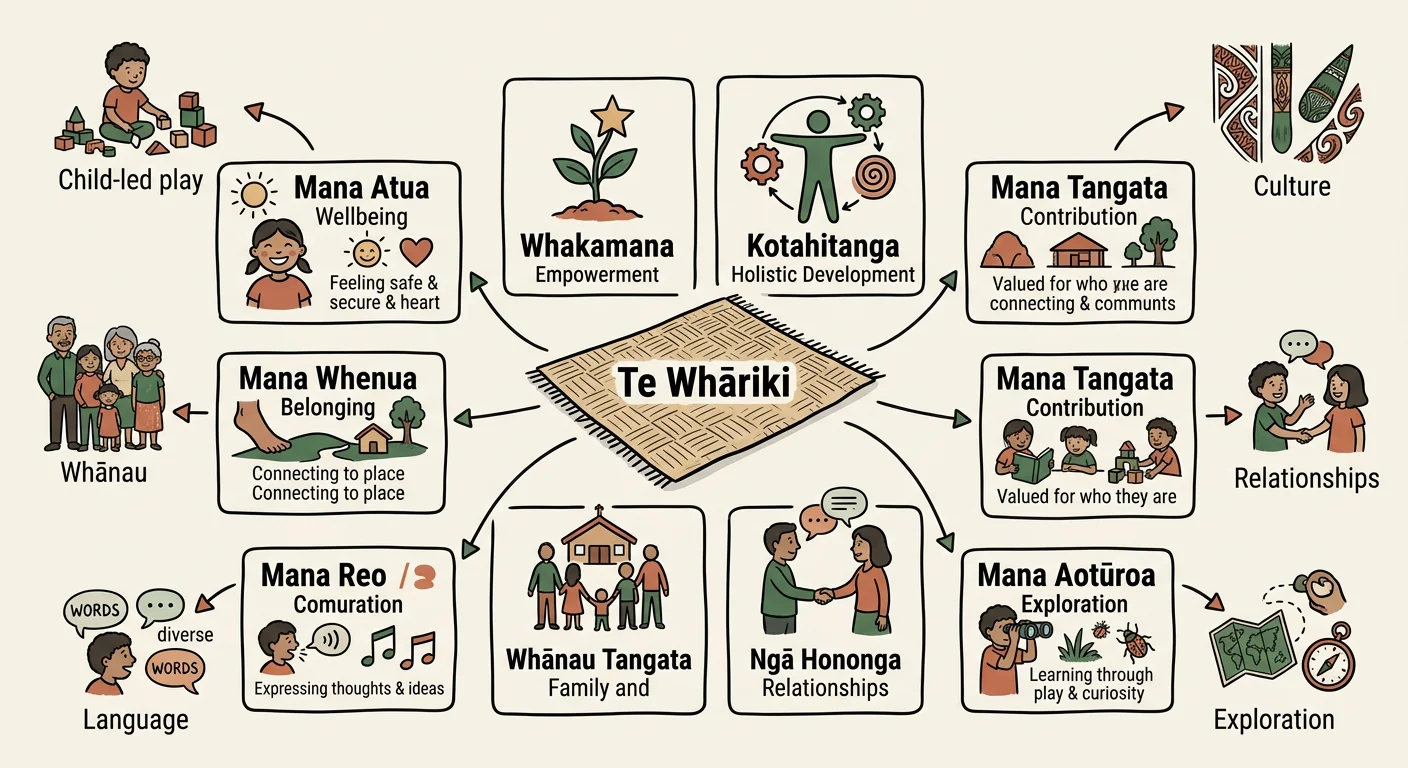
Te Whāriki is organised around four principles. These are not decorative words for a wall display. They should shape the way a service thinks, plans, and responds every day.
- Whakamana / Empowerment: children should feel able to make choices, try things, and grow in confidence as learners.
- Kotahitanga / Holistic Development: learning is social, emotional, physical, cognitive, cultural, and relational all at once, not separated into tidy compartments.
- Whānau Tangata / Family and Community: children's families, languages, culture, and community knowledge belong in the curriculum.
- Ngā Hononga / Relationships: children learn through warm, responsive, reciprocal relationships with people, places, and things.
For parents, these principles are useful because they make it easier to see past marketing language. A service might say it supports independence, but if children rarely get meaningful choices, that is thin empowerment. A service might talk about school readiness, but if it ignores emotional security and play, it is missing the holistic picture.
The five strands and how they show up in a real day
The five strands are where many parents first connect the curriculum to everyday practice. Learning stories often refer to them, and once you know what they mean, centre updates become much easier to read.
| Strand | Plain-English meaning | What you might actually notice |
|---|---|---|
| Mana Atua / Wellbeing | Children feel safe, healthy, and emotionally secure | A child settles more easily, trusts kaiako, follows safety routines, and learns to ask for help when needed |
| Mana Whenua / Belonging | Children know they have a place here | Family photos are visible, routines are familiar, and children move through the environment with confidence |
| Mana Tangata / Contribution | Children are encouraged to participate and matter in the group | They help, take turns, share ideas, and see that their input has value |
| Mana Reo / Communication | Children develop many ways to express and understand meaning | You hear conversation, singing, storytelling, books, mark-making, gestures, and everyday te reo Māori |
| Mana Aotūroa / Exploration | Children learn through curiosity, play, and inquiry | They investigate bugs, mix water and sand, test balance, build, count, compare, and ask questions |
The five strands of Te Whāriki
These strands overlap constantly. A child joining a pretend supermarket game may be communicating, contributing, exploring, and strengthening a sense of belonging at the same time. That is one reason Te Whāriki can feel less tidy than a more prescriptive curriculum. Early learning is rarely linear.
What a local curriculum means
Ministry guidance says each early learning service develops its own local curriculum. That means the national framework is shaped around the place you live, the history of the land and people, and the children and families who attend. Language, culture, identity, aspirations, interests, and passions are meant to matter.
So one centre may lean into local moana stories, beach walks, and marine life because that is the community it serves. Another may build a strong language-rich programme around the home languages of enrolled families. Another may reflect a kaupapa Māori or Pasifika context in much more visible ways. That is not drift. That is Te Whāriki doing what it is supposed to do.
The parent test
Learning stories and how progress is shared
Parents sometimes worry that a broad, play-based curriculum means progress is hard to see. In practice, many services document children's learning through learning stories, photos, artwork, videos, and written observations. These may be shared through an app, a paper scrapbook, or displays around the service.
A learning story is usually a short narrative about a meaningful moment. It might describe how your child persisted with a puzzle, joined a group game, solved a disagreement, told a story, or explored something outdoors. The better versions do more than say, "Look what we did today." They explain what was noticed, how it links to learning, and what kaiako may support next.
This style of assessment is less formal than benchmark-driven systems, but it should not feel random. Over time, you should be able to see patterns. Is your child growing in confidence? Are they using richer language? Are they showing more belonging? Are kaiako noticing the child's strengths and interests, not just their compliance? If every update is just a photo with a cute caption, that is not telling you much.
How Te Whāriki differs from more prescriptive overseas curricula
Parents who have lived in the UK or Australia often notice that Te Whāriki sounds different from England's EYFS or Australia's EYLF and NQF. That is because it is intentionally broad and less prescriptive. It gives a framework, not a national checklist that every child must be marched through in the same way.
That flexibility can be a strength. It allows services to respond to culture, place, community, and the individual child. It also means strong practice depends heavily on thoughtful kaiako who can explain what they are noticing and why. Freedom is useful when it is used well. It is not very useful when it hides weak thinking behind vague language.
What parents can look for in a centre
You do not need an education degree to spot whether Te Whāriki is alive in practice. You are looking for signs that the curriculum is shaping relationships, routines, and learning, not just sitting in a handbook.
- Children are leading or co-leading play rather than being managed through a rigid script.
- Bicultural practice is visible through language, waiata, stories, tikanga, and respectful everyday use of te reo Māori.
- Kaiako know your child well and can talk specifically about strengths, interests, and current learning.
- Learning stories or observations connect moments to the strands and show where learning may go next.
- The environment feels calm, responsive, and suited to exploration.
- Whānau partnership is genuine, not just a form filled in at enrolment and forgotten.
Five good questions to ask kaiako
A few direct questions can tell you far more than a polished tour. If you are enrolling, doing a visit, or trying to understand your current service better, start here.
- How do you observe and document my child's strengths and interests?
- Which strands are showing up for my child at the moment?
- How do you weave in te reo Māori and our family's culture?
- How does whānau input shape planning or next steps?
- How do you balance child-led play with early literacy and maths foundations?
Listen for specificity. Good answers usually include real examples, not just polished phrases. If a kaiako can explain one recent learning story in plain language, connect it to the child's interests, and describe what the team might do next, that is a strong sign they understand the curriculum rather than just its vocabulary.
Frequently asked questions
What is Te Whāriki in simple terms?
It is New Zealand's national early childhood curriculum for children from birth to six. It guides how early learning services support children's development through play, relationships, culture, communication, belonging, wellbeing, contribution, and exploration.
Is Te Whāriki play-based?
Yes. Te Whāriki is play-based. Children learn through active exploration, relationships, and planned learning experiences rather than mainly through formal lessons or worksheets.
What are the four principles of Te Whāriki?
The four principles are Whakamana or Empowerment, Kotahitanga or Holistic Development, Whānau Tangata or Family and Community, and Ngā Hononga or Relationships.
What are the five strands of Te Whāriki?
The five strands are Mana Atua or Wellbeing, Mana Whenua or Belonging, Mana Tangata or Contribution, Mana Reo or Communication, and Mana Aotūroa or Exploration.
How do centres usually share progress with parents?
Many services share progress through learning stories, photos, artwork, videos, and written observations, often through an app, a paper portfolio, or displays at the service.
You do not need to become a curriculum expert overnight. You just need enough understanding to notice whether a centre is doing the real work of weaving learning well. When Te Whāriki is alive in practice, children are respected, relationships matter, play has purpose, culture is visible, and whānau are part of the picture. That is a far better sign of quality than a room full of worksheets ever will be.
Find centres that follow Te Whāriki
Search The Parent Circle to compare early learning services across New Zealand.
Search centresRelated guides
Childcare During Family Transitions: A NZ Parent's Guide
A practical NZ guide to supporting your child through separation, moving, grief and other family changes at childcare.
Understanding Te Whāriki: How NZ's National Curriculum Shapes Every ECE Centre
A parent's guide to Te Whāriki, New Zealand's early childhood curriculum, and how its principles and strands shape daily learning at ECE.
Screen Time and Young Children: An Evidence-Based Guide for NZ Parents
A practical NZ guide to screen time for babies, toddlers and preschoolers, including what the health guidance says, how to judge quality, what to ask early learning centres, and how to build calmer routines at home.
Understanding Learning Stories: A Guide for NZ Parents
Learning stories are how kaiako document your child's learning at their ECE centre. This guide explains what they are, what good ones look like, and how to use them at home.
Find childcare near you
Search and compare providers by suburb, care type, cost, and availability.