
Resource Hub
Socialisation in Childcare: How ECE Builds Your Child's Social Skills
Published · Last updated · 7 min read

Does childcare help with socialisation in NZ?
Yes. Quality ECE gives children regular, structured contact with peers at the exact ages when social skills develop fastest. Children in group ECE settings learn to share, take turns, and form friendships earlier than those in home-only care. The benefits are strongest from 12 months onward, when children actively start seeking out peers.
Why socialisation in the early years actually matters
The ability to get along with other people is one of the most useful things a child learns in their first five years. It shapes how they handle conflict, how they make and keep friends, and how they cope with unfamiliar situations. None of it is automatic.
Research from the New Zealand Council for Educational Research (NZCER) shows that children who develop strong social-emotional foundations before school entry tend to settle into year one more easily and show better peer competence throughout primary school. That foundation is built through daily, repeated practice with other children.
This is where quality ECE has a genuine edge over home-only care. You can teach a toddler patience at home, but the real test is a shared sandpit with three other toddlers who all want the same bucket.
Video
Social development milestones: what to expect at each age
Social development does not happen in a straight line, but there are predictable patterns. Plunket and the Ministry of Education track these milestones as part of the well-child programme.
| Age | What you typically see |
|---|---|
| 0-12 months | Eye contact, smiles, mirroring expressions. Stranger wariness from around 6-9 months is normal. |
| 12-24 months | Interest in other children increases. Lots of watching and copying. Biting and tantrums common as language is still developing. |
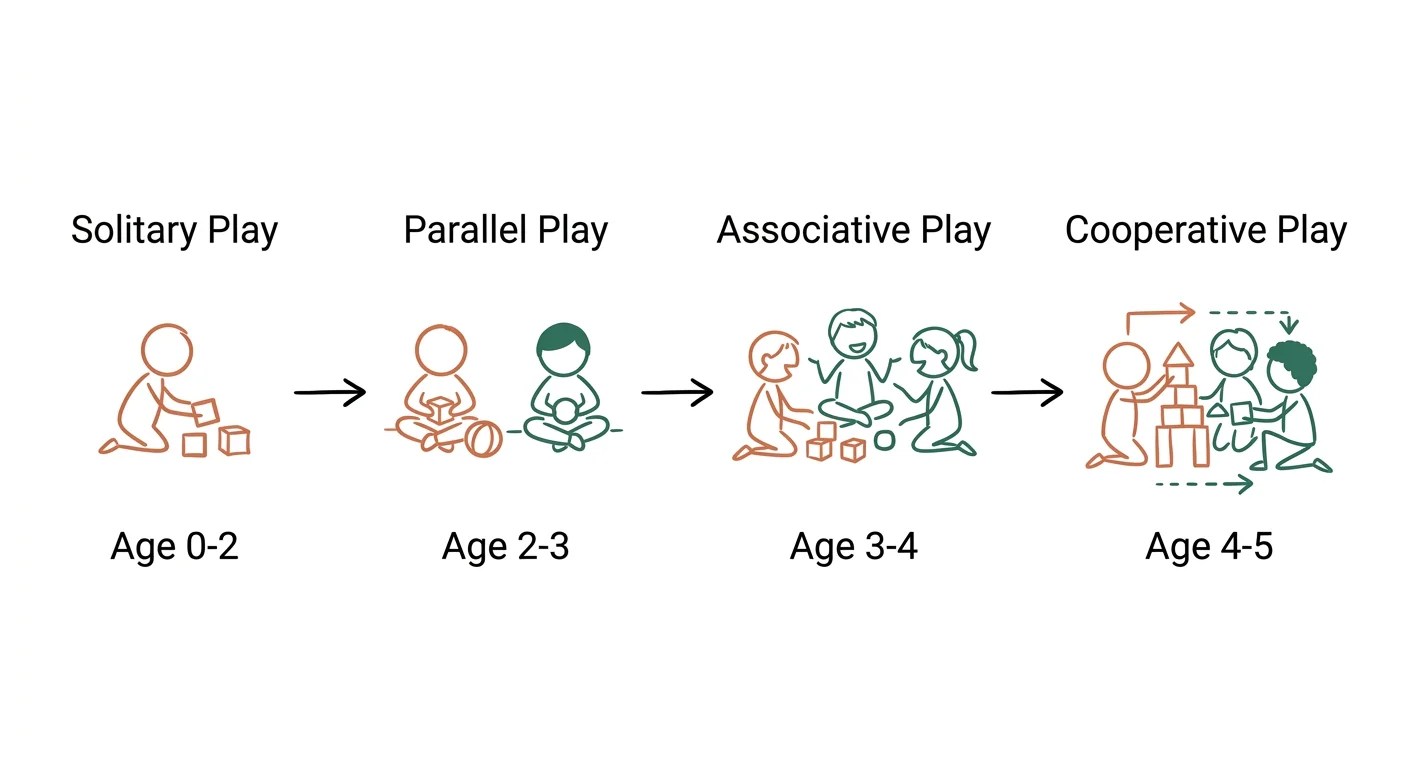
| 2-3 years | Parallel play (playing alongside, not yet with, other children). Beginning to understand others have feelings. Turn-taking starts to click. |
| 3-5 years | Cooperative play emerges. Friendships form. Children negotiate roles in pretend play, problem-solve together, and start to care about fairness. |
These are ranges, not deadlines
How NZ ECE settings build social skills through Te Whariki
Te Whariki, New Zealand's national ECE curriculum, treats social learning as central, not supplementary. Five strands run through every licensed ECE setting: Belonging (Mana Whenua), Well-being (Mana Atua), Contribution (Mana Tangata), Communication (Mana Reo), and Exploration (Mana Aoturoa).
The Contribution strand is particularly relevant here. It covers children learning to take part in group activities, understand their place in a group, and respect the contributions of others. Kaiako (teachers) actively plan for these experiences, not just let them happen.
- Peer play blocks give children uninterrupted time to negotiate, fall out, and work things out without constant adult intervention
- Group kai (mealtimes) teach conversation, waiting, and sharing in a low-stakes setting
- Cooperative projects like building, gardening, and collaborative art require children to listen and adjust to each other
- Cultural activities connect children to their own identity while building respect for others' backgrounds
- Stories and puppets help children rehearse social scenarios before they face them in real life
Home care vs group ECE: what the difference actually looks like
This comes up a lot, and the honest answer is: group ECE provides social experiences that are genuinely hard to replicate at home. That is not a criticism of parents who care for their children at home. It is just a fact about what group settings offer.
| Social opportunity | Home/nanny care | Group ECE |
|---|---|---|
| Daily peer contact | Limited, requires active planning (playdates, playgroups) | Built in every session |
| Conflict resolution practice | Mostly with siblings or adults | Multiple daily situations with different children |
| Diversity of social styles | Low unless playgroups are frequent | Children encounter shy, bold, aggressive, and withdrawn peers |
| Kaiako guidance | Relies on caregiver skill | Qualified teachers trained in social-emotional development |
| Attachment security | Often stronger (consistent caregiver) | Can also be strong with a key person model |
A home-based or nanny arrangement with regular playgroup attendance can close some of this gap. But it takes deliberate effort. Group ECE delivers peer socialisation by default.
What age should children start ECE for socialisation benefits?
Many parents ask this, expecting a specific answer. There is not one, because children are different. But the research points to 12-24 months as a period when interest in other children accelerates. Before that, babies are interested in adults far more than peers.
In practice, many NZ families start their child in ECE between 6-12 months due to parental leave ending (paid parental leave is currently up to 26 weeks). ERO data suggests quality ECE from this age, when transition is handled well, produces positive social outcomes. The quality of the centre and the settling process matter more than the exact age.
Starting later is not automatically better
Signs your child is socialising well (and when to be concerned)
Kaiako will often give you feedback at pickup, but it helps to know what to look for yourself. Use the self-check below, or ask these questions directly at your child's next parent-teacher conversation.
Common concerns: shyness, aggression, and not fitting in
Shyness
Shyness peaks around 12-24 months and again around school entry. It is not a problem to fix. Shy children often observe carefully before joining in, and this can be a strength. Forcing a shy child into the centre of group activities tends to backfire. Better to let them warm up at the edges and join when ready, with the kaiako's support.
Biting and physical aggression
Biting is common between 1-2 years. It is usually not about aggression; it is about frustration and limited language. As vocabulary grows, biting tends to drop off. By age 3, most children have other ways to express frustration. If biting or hitting persists past 3, talk to the centre about what triggers it and what strategies they are using.
Separation anxiety
Separation anxiety is not a socialisation problem. It is a sign of secure attachment. The settling-in process at a good ECE centre handles this gradually: short visits first, then longer stays, with a consistent key person assigned to your child. Most children settle within 2-4 weeks. Ongoing distress after 6 weeks is worth discussing with the centre and your GP.
What good kaiako do to support social development
Under NZ licensing criteria, at least 50% of teachers at a licensed ECE centre must hold a relevant degree-level qualification. Social-emotional guidance is a core part of teacher training. Here is what skilled kaiako actually do.
- Narrate social moments out loud: "Aroha is crying because she wanted that truck. What could we do?"
- Step back before stepping in during minor conflicts, giving children a chance to negotiate
- Scaffold friendships by suggesting playmates and teaching children specific phrases to use: "Can I play too?"
- Track progress through learning stories and share observations with whanau at pickup
- Plan intentionally rather than just supervising, structuring activities that require cooperation
When you are assessing a centre, ask how teachers support children who struggle socially. A centre that talks about specific strategies is a better sign than one that says things will sort themselves out.
How to support social development at home
ECE does not carry the whole load. What happens at home between sessions matters too.
- Arrange regular playdates with one or two children from the ECE centre. One child at a time works better than big groups for under-3s.
- Read books with social themes and talk about what characters are feeling. Ask "what do you think she should do?"
- Name emotions out loud during the day: "You look frustrated. That is a hard puzzle." Children need vocabulary before they can use it socially.
- Play cooperative games together at home. Simple ones where you take turns or build something together are more useful than competitive games at this age.
- Debrief ECE days without interrogating. "Who did you play with today?" gets more than "Did you have a good day?"
The 20/20/20 rule
Finding an ECE centre that prioritises social development
Not all ECE centres give equal attention to social-emotional learning. When you visit, look for: kaiako who are down at child level and engaged in conversations (not standing at the edges); outdoor spaces that encourage group play; visible learning stories that reference social skills, not just academic milestones; and a settling-in process that takes the child's pace rather than a fixed schedule.
The Parent Circle lists more than 4,394 licensed ECE providers across New Zealand, with ERO report links and parent reviews. You can filter by suburb, care type, and available spaces to shortlist centres worth visiting.
Common questions from NZ parents
My child is very shy. Will forcing them into childcare make things worse?
Not if the transition is handled well. A quality ECE centre with a gradual settling process and a consistent key person gives shy children time to observe before joining. Many shy children actually flourish in ECE once settled, because they get daily low-stakes practice with peers. Talk to the centre about their settling approach before enrolling.
My 2-year-old bites other children at childcare. What should I do?
Biting is common at this age and usually reflects frustration rather than aggression. Talk to your child's kaiako about what seems to trigger it and what they are doing to respond. Most centres track incidents and work on prevention. Ask what language strategies they are teaching your child to use instead.
My child has been at childcare for two months and still doesn't have any friends. Should I be worried?
Reciprocal friendships typically emerge from age 3 onward. Before that, children play alongside each other more than with each other. Check in with the kaiako rather than drawing conclusions from home reports alone. If your child is 3+ and consistently plays alone by choice, it is worth raising with the centre and your GP.
Is there any research specifically on NZ children and ECE socialisation outcomes?
Yes. The New Zealand Council for Educational Research (NZCER) has documented links between quality ECE attendance and stronger social-emotional development at school entry. ERO reviews also assess how well individual centres implement Te Whariki's Contribution strand. You can read your centre's ERO report at ero.govt.nz.
My child is in home-based care. Are they missing out on socialisation?
Home-based care with a quality educator and regular playgroup attendance can support social development well. The gap widens if there is no peer contact outside the home. Talk to your home-based coordinator about what peer-contact opportunities are built into the programme.
For more on what NZ ECE settings actually teach, read our guide to Te Whariki explained and our overview of play-based learning in NZ ECE. If you are still searching for the right centre, our guide to school readiness covers what to look for as your child approaches 5.
Find ECE centres near you
Compare 4,394+ licensed providers across New Zealand, with ERO reports and parent reviews
Search NowRelated guides
Childcare During Family Transitions: A NZ Parent's Guide
A practical NZ guide to supporting your child through separation, moving, grief and other family changes at childcare.
Understanding Te Whāriki: How NZ's National Curriculum Shapes Every ECE Centre
A parent's guide to Te Whāriki, New Zealand's early childhood curriculum, and how its principles and strands shape daily learning at ECE.
Faith-Based Childcare in NZ: What Parents Should Know
A practical guide to faith-based childcare in New Zealand, including licensing, Te Whariki, inclusion and questions to ask before enrolment.
Nature-Based and Forest Kindergartens in NZ: A Parent Guide
Curious about forest kindergarten or nature-based ECE in NZ? Learn how it works, what to ask, safety checks, costs, gear and whether it fits your child.
Find childcare near you
Search and compare providers by suburb, care type, cost, and availability.