
Resource Hub
Understanding Learning Stories: A Guide for NZ Parents
Published · Last updated · 9 min read

What are learning stories in NZ childcare?
Learning stories are short narrative records written by kaiako (teachers) that capture significant moments in your child's learning at their ECE centre. They focus on your child's strengths and dispositions, things like curiosity, persistence, and communication, rather than ticking off developmental milestones. Every licensed ECE centre in New Zealand uses some form of learning story assessment, as required under the Education (Early Childhood Services) Regulations 2008.
Learning Stories: What NZ Parents Need to Know
If you have ever flicked through your child's portfolio at their centre and found a handwritten (or printed) story about the time they built a block tower or helped a friend, you have read a learning story. They are the primary assessment tool used in New Zealand ECE, and they are genuinely different from what most parents grew up with.
Unlike report cards or developmental checklists, learning stories do not score or rank your child. They document moments of real learning, in the kaiako's own words, often with photos, and connect those moments to the skills and dispositions that matter most for lifelong learning. Understanding them helps you get far more out of your child's centre relationship.
Video
Where Learning Stories Come From
Learning stories were developed in New Zealand by Professor Margaret Carr at the University of Waikato, alongside Wendy Lee. They emerged directly from the development of Te Whāriki, NZ's early childhood curriculum (first published by the Ministry of Education in 1996 and updated in 2017). The goal was an assessment method that matched what Te Whāriki actually values: children as confident, competent learners in relationship with people and places.
Traditional developmental checklists tend to ask 'can this child do X yet?' Learning stories ask a different question: 'What is this child genuinely engaged in, and what does that tell us about how they learn?' That shift matters. It means your child's portfolio is a picture of their strengths, not a list of gaps.
The approach is supported by Kei Tua o te Pae, the MOE's assessment exemplar series published between 2004 and 2009, which gives kaiako real examples of strong learning stories across different ages and contexts. The Education Review Office (ERO) has endorsed learning stories in its reviews since 2007, cementing them as the standard practice across NZ ECE.
The Five Learning Dispositions
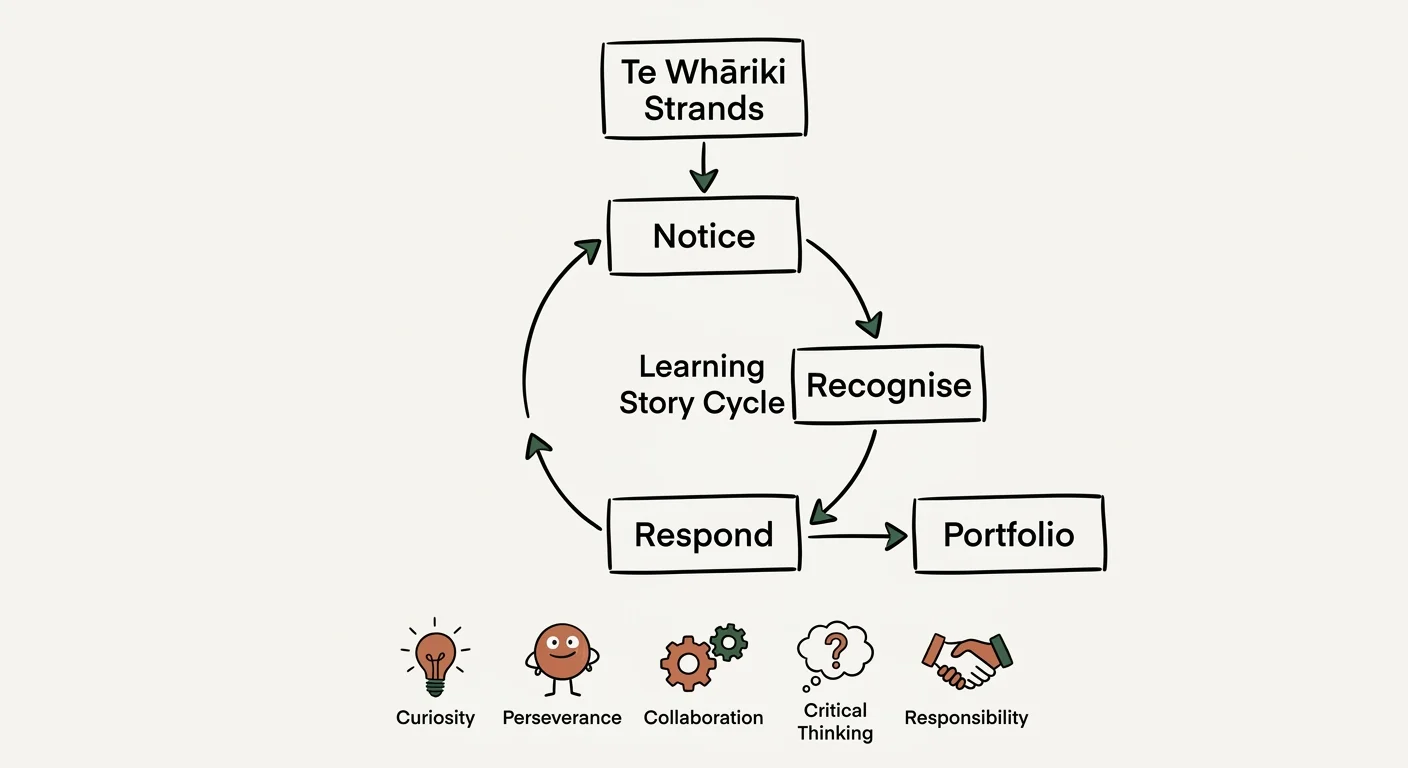
Learning stories are built around five key learning dispositions identified by Margaret Carr as the foundations of being a learner. These are not skills in the traditional sense, they are the orientations that enable children to use skills effectively throughout life.
- Taking an interest: showing curiosity and involvement with people, places, and ideas. A child who runs to look at a bug on the path is exercising this disposition.
- Being involved: sustaining focus and engagement. Not just starting an activity, but sticking with it long enough to go deep.
- Persisting with difficulty: keeping at something when it is hard. Trying again after a block tower falls. Asking for help rather than giving up.
- Communicating: expressing ideas, listening to others, contributing to shared meaning. This includes language, gesture, drawing, and play.
- Taking responsibility: contributing to the community of the centre: looking after shared resources, helping a peer, following the routines.
When a kaiako writes a learning story, they are looking for evidence of one or more of these dispositions in action. The story names the disposition explicitly, so when you read it, you can see not just what your child did, but what kind of learner it shows them to be.
How Kaiako Write Learning Stories
There is no single required format, centres adapt to their community and philosophy. But good learning stories follow a consistent structure drawn from the Ministry of Education's guidance.
Notice, Recognise, Respond
Kaiako use a three-step process: notice a significant moment (often a photo triggers this), recognise what learning disposition or Te Whāriki strand it connects to, then respond by planning what to offer next. The written story is the record of all three steps.
What a Learning Story Typically Includes
- The observation: a paragraph describing what the child did, in their own context. Often written directly to the child: 'Today, Mia, I watched you...'
- Photos or evidence: a photo, a drawing the child made, or a quote from the child's own words.
- The analysis: what disposition or learning strand the kaiako sees in the moment. 'This shows you persisting with difficulty...'
- The link to Te Whāriki: which strand or goal this connects to (Mana Atua/wellbeing, Mana Whenua/belonging, Mana Reo/communication, Mana Aotūroa/exploration, Mana Tangata/contribution).
- What comes next: what the kaiako plans to offer to extend the learning.
A note on length
Why Learning Stories Matter for Your Child
The evidence base for learning stories is strong. When done well, they do several things that checklist assessment cannot.
- They build identity as a learner. Children who hear their stories read aloud come to see themselves as curious, capable, and competent. This self-image is foundational for school readiness.
- They capture the whole child. Strengths in social play, creative problem-solving, and empathy show up in stories, they are invisible in milestone checklists.
- They create a learning conversation. A portfolio of stories becomes a shared narrative between kaiako, child, and whānau. That three-way relationship is one of the strongest predictors of positive ECE outcomes.
- They inform planning. Kaiako use stories to plan what to offer next, extending interests, meeting the child where they are. This makes learning genuinely responsive.
- They support transitions. A portfolio handed to a school teacher gives that teacher real context about who your child is and how they learn.
How to Read Your Child's Learning Stories
When you receive a learning story, whether in a physical portfolio at the centre or via an app notification, there is more to take in than the cute photo. Here is what to look for.
| What you see in the story | What it tells you |
|---|---|
| The disposition named (e.g., 'persisting') | Which of the five learning dispositions your child demonstrated |
| The Te Whāriki strand referenced | Which area of the curriculum this learning connects to |
| The 'what comes next' section | What the kaiako plans to offer, you can reinforce this at home |
| Your child's own words quoted | How your child described their own learning, worth asking about at pickup |
| Repeated themes across stories | Your child's current deep interests and strongest dispositions |
Many parents make the mistake of reading stories passively and filing them away. The stories are an invitation. If you see your child is deeply engaged in water play, and the kaiako writes about their curiosity around cause and effect, you can set up similar experiments at home.
Engaging with the Portfolio: Practical Steps
- Add your own observations. Most portfolios have a whānau section, fill it in. Kaiako value knowing what your child does at home. It enriches the learning story and helps them connect centre and home learning.
- Read stories with your child. Even toddlers respond to hearing about their own moments. Point to the photos and ask 'What were you doing here?' Revisiting stories builds narrative identity.
- Ask questions at pick-up. 'I saw the story about the water table, what was she figuring out?' opens a real conversation rather than just 'How was their day?'
- Request a learning meeting. Most centres offer parent-teacher meetings where you look at the portfolio together. These are worth taking up.
- Look for patterns across three to five stories. One story is a moment. A pattern across multiple stories shows you your child's genuine interests and current learning edge.
Digital vs Physical Portfolios in NZ
Most NZ centres now use digital portfolio platforms. The three most common are Storypark, Educa, and Seesaw. Each lets kaiako post stories with photos in real time, and lets families add comments and observations from home.
- Storypark: NZ-built, widely used, strong whānau engagement features. Stories can be shared with extended family (grandparents, for example).
- Educa: Also widely adopted in NZ centres; good planning integration for kaiako.
- Seesaw: More common in school settings but used by some ECE services; strong multimedia support.
Digital platforms do not change what makes a good learning story, they change how quickly you receive it and how easily you can respond. Some families prefer the physical portfolio for its permanence; many centres now produce an end-of-year printed book from digital content as a keepsake.
No MOE mandate on format
What Makes a Strong Learning Story (And What Doesn't)
Not all learning stories are created equal. The Education Review Office has noted that the quality of narrative assessment varies widely across NZ centres. Here is what separates a genuinely useful story from a weak one.
| Strong learning story | Weak learning story |
|---|---|
| Describes a specific moment ('Tama spent 20 minutes...') | Vague and generic ('Tama enjoyed playing today') |
| Names the disposition and explains why ('This shows persisting...') | Lists activities without analysis ('Tama built blocks and painted') |
| Links to a Te Whāriki strand | No curriculum connection mentioned |
| Includes what comes next / next steps | Ends with the observation, no planning response |
| Includes child's voice or whānau perspective | Written entirely from kaiako perspective only |
| Written directly to the child in warm, specific language | Written in third person, could describe any child |
If most of your child's stories look like the right column, it is worth raising with the centre manager. Learning stories are required documentation, they should be informing practice, not just filling a portfolio.
NZ Regulations Around ECE Assessment
The Education (Early Childhood Services) Regulations 2008 require all licensed ECE services to have their practice informed by assessment, planning, and evaluation. Specifically, Licensing Criteria GMA6 requires that services demonstrate their understanding of children's learning, interests, and whānau contexts.
There is no regulation requiring a specific number of learning stories per term or per child, that is set by each centre's policy. However, ERO reviews assess whether the centre's assessment genuinely informs planning and engages whānau. Centres where portfolios are thin or formulaic will be noted.
Ask your centre: How many stories per term?
Extending Learning at Home
Learning stories are most powerful when they create a link between centre and home. Te Whāriki explicitly calls for this: learning is richest when it is consistent across contexts. Here are practical ways to use what you learn from stories.
- Identify the current interest. If three stories in a row mention fascination with water, set up a sensory tray at home. Match the environment to the interest.
- Strengthen the disposition named. If a story highlights persisting with difficulty, look for moments at home to name that: 'I see you're working hard on that puzzle, that's persisting.'
- Use the kaiako's language. When both home and centre use the same words for dispositions, it builds a coherent identity across contexts.
- Bring home observations back. Did your child spend an hour digging in the garden? Write or tell the kaiako. That observation might become the seed of the next story.
- Talk about the portfolio as a family. Looking at stories together at home, with grandparents, siblings, builds your child's narrative identity. 'This is the kind of learner you are.'
Common Questions from NZ Parents
How often should my child get a new learning story?
Most NZ centres aim for at least one learning story per child per fortnight, though there is no legal minimum. Ask your centre what their policy is. Younger children (under 2) often receive more frequent stories because development moves faster. If the portfolio goes more than a month without an update, ask the room leader.
Can I ask for more learning stories?
Yes, absolutely. You can ask your child's kaiako to focus on particular interests or areas of learning you have noticed at home. Many centres welcome whānau-initiated observations, you can write your own short story and add it to the portfolio.
What is the difference between a learning story and a developmental checklist?
Developmental checklists track whether a child has reached a specific milestone by a certain age. Learning stories capture how a child is approaching learning, their dispositions and engagement, without reference to age norms. NZ ECE uses stories rather than checklists because Te Whāriki is not milestone-based. If your child's kaiako uses checklists as the primary assessment, that is unusual in a licensed NZ ECE setting.
What do I do if I disagree with how a learning story describes my child?
Talk to the kaiako or room leader. Learning stories are collaborative, your perspective as the parent is genuinely part of the picture. You can add a whānau response in the portfolio, or ask for a meeting to discuss your observations. Disagreement is not a problem; it is useful information for the centre.
Will my child's learning stories follow them to school?
This depends on your school and centre. Many NZ primary schools request or welcome a portfolio summary at enrolment. It is worth asking your year 0/1 teacher whether they would like to see the portfolio, many appreciate the context it provides.
Learning stories are one of the most distinctive features of NZ's early childhood approach, and one of its genuine strengths. They give you a window into who your child is as a learner, not just what they can and cannot do yet. Understanding how to read them, respond to them, and use them at home makes the investment your child's centre is making far more valuable. For more on what to look for in quality ECE, see our guides on Te Whāriki explained and what child development in ECE looks like.
Related guides
Understanding Te Whāriki: How NZ's National Curriculum Shapes Every ECE Centre
A parent's guide to Te Whāriki, New Zealand's early childhood curriculum, and how its principles and strands shape daily learning at ECE.
Faith-Based Childcare in NZ: What Parents Should Know
A practical guide to faith-based childcare in New Zealand, including licensing, Te Whariki, inclusion and questions to ask before enrolment.
ECE Philosophies Explained: Montessori, Reggio Emilia, Steiner, and More in NZ
A practical NZ guide to Montessori, Reggio-inspired, Steiner, play-based, nature-based, RIE, and faith-based early learning.
Nature-Based and Forest Kindergartens in NZ: A Parent Guide
Curious about forest kindergarten or nature-based ECE in NZ? Learn how it works, what to ask, safety checks, costs, gear and whether it fits your child.
Find childcare near you
Search and compare providers by suburb, care type, cost, and availability.