
Resource Hub
Preparing Your Child for School in New Zealand: A Parent's Complete Guide
Published · Last updated · 10 min read

How do I prepare my child for school in New Zealand?
Children can start school any weekday after turning 5 in New Zealand. The best preparation combines quality time in ECE (which uses Te Whariki to build the exact skills schools need), simple home routines like reading daily and practising independence, and visiting the school before the first day. There is no formal readiness test. Teachers and parents assess readiness together.
School Readiness in New Zealand: What It Actually Means
Every parent counts down to that first school day with a mix of pride and nerves. But 'readiness' in New Zealand looks different from what many parents expect. There is no checklist of academic skills your child must master. No entrance test. No minimum reading level.
The Ministry of Education describes a ready child as one who is curious, resilient, and able to connect with others, not one who can already write their name or count to 20. This framing comes directly from Te Whariki, New Zealand's national early childhood curriculum, which treats school readiness as a natural outcome of quality play-based learning rather than a separate goal to chase.
For parents, this is actually good news. It means the most effective preparation is the kind that feels natural: reading together on the couch, letting your child get dressed without help, organising playdates with other kids, and choosing a good ECE centre. The heavy lifting happens through everyday life.
Video
When Can Children Start School in NZ?
New Zealand has one of the youngest school starting ages in the world. Your child can start school on any weekday after their 5th birthday, with no fixed term dates or intake windows. Each school manages its own enrolment, so you will typically contact the school a few months before your child turns 5 to get the process started.
No Penalty for Waiting
Most tamariki in New Zealand start ECE around age 2 or 3 and attend until they turn 5. By the time they transition to school, they have typically spent two to three years in a quality early learning environment. Research consistently shows this is one of the strongest predictors of success in Year 1 and beyond.
How Te Whariki Builds School-Ready Kids
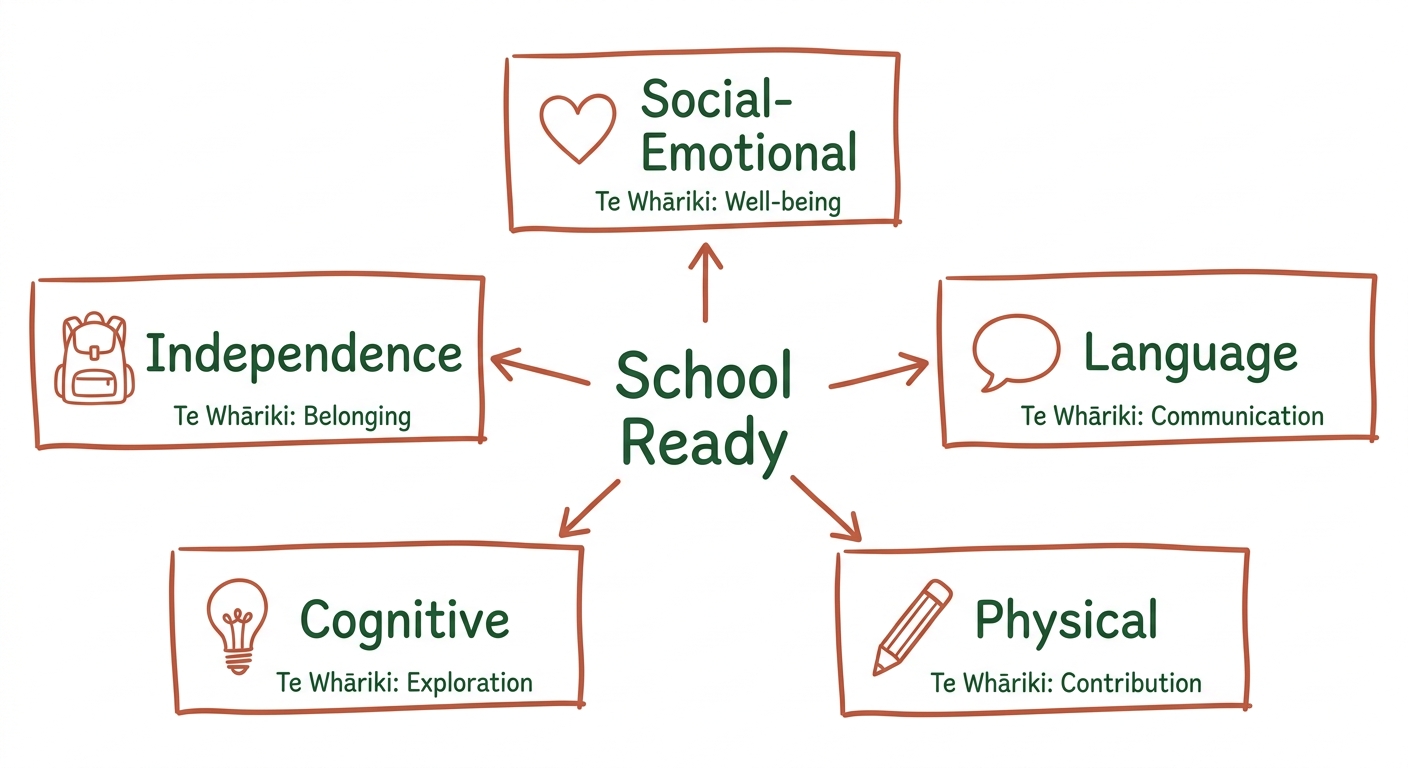
Te Whariki (meaning 'woven mat' in te reo Maori) is the curriculum framework that guides all licensed ECE centres in New Zealand. Rather than preparing children for school through drills or worksheets, it weaves together five learning strands that build the exact dispositions primary schools are looking for.
| Te Whariki Strand | What It Builds | How It Helps at School |
|---|---|---|
| Mana Atua (Wellbeing) | Emotional regulation, resilience, self-care | Manages the emotional demands of a new environment |
| Mana Whenua (Belonging) | Sense of place, routines, feeling safe | Settles into classroom culture quickly |
| Mana Tangata (Contribution) | Cooperating, sharing, following group norms | Works with peers and follows teacher instructions |
| Mana Reo (Communication) | Language, te reo Maori, expressing ideas | Communicates needs, participates in discussions |
| Mana Aotuuroa (Exploration) | Curiosity, problem-solving, persistence | Engages with new learning without giving up |
When kaiako (teachers) write learning stories about your child, they are documenting progress across these five strands. A story about your child figuring out how to build a tower that keeps falling is not just a cute anecdote. It is evidence of problem-solving, persistence, and curiosity. That is the kind of learning Te Whariki is designed to grow.
Key Skills for School Readiness (What NZ Schools Actually Need)
New Zealand primary schools do not require children to arrive reading or writing. What teachers consistently say they need is a child who can function within a group, communicate their needs, and give new things a try. Here is what readiness actually looks like across the key domains.
Social and Emotional Readiness
- Can play alongside and with other children without constant adult support
- Manages basic emotions and can recover from upsets without a full meltdown
- Understands taking turns and sharing (most of the time)
- Can separate from parents without extended distress
- Shows empathy and notices when others are sad or hurt
- Can follow a simple two-step instruction ('put your bag away and sit on the mat')
This is the area that matters most to Year 1 teachers. A child who cannot manage the social dynamics of a classroom will struggle regardless of their academic readiness. Quality ECE is the single best place to build these skills, because it provides structured group experiences in a safe, play-based environment.
Language and Communication
- Can communicate basic needs clearly (hungry, tired, needing the bathroom)
- Uses sentences, not just single words, to express ideas
- Follows and enjoys stories when read aloud
- Shows interest in books, print, and written language
- Can hold a short conversation with an adult they do not know well
- Knows some basic te reo Maori words and greetings (helps with NZ classroom culture)
Physical Readiness
- Fine motor: Can hold a pencil or crayon, use scissors safely, do up buttons or a simple zip
- Gross motor: Can run, jump, balance, climb, and catch a large ball
- Self-care: Can manage toileting independently, wash hands, eat without help, put on shoes (even if velcro or slip-on)
- Can carry their own bag and manage their lunchbox
Fine Motor Skills Take Time
Cognitive and Learning Readiness
- Can concentrate on a task for 10-15 minutes
- Shows curiosity and asks 'why' and 'how' questions
- Can count objects to 10 (not just recite numbers, but actually count)
- Recognises some letters, especially those in their own name
- Can recall and retell a simple story in sequence
- Tries new activities even when they are hard
Note what is not on this list: reading, writing sentences, or knowing all the alphabet letters. New Zealand's reading and writing instruction begins formally in Year 1. A child who arrives curious and willing to try is in the best possible starting position.
What ECE Centres Do to Prepare Your Child
Good ECE centres treat the transition to school as a significant process, not just an exit date. From around age 4, most centres shift their programme to include more structured group activities, school-like routines, and deliberate transition support.
- School visits: Most centres organise visits to local primary schools in the year before school. Children see the classroom, meet the teacher, find the toilets and the lunch area, and start to feel at home before day one.
- Learning portfolios: Your child's portfolio contains learning stories documenting their growth across Te Whariki strands. Centres often share a summary with the receiving school.
- Transition meetings: Kaiako will often meet with you and sometimes with the Year 1 teacher to discuss your child's strengths, interests, and anything they need extra support with.
- Independence focus: In the pre-school year, centres deliberately encourage tamariki to manage more things for themselves: packing bags, serving their own food, and leading activities.
- Goodbye rituals: A proper farewell from the centre community helps children feel celebrated and ready for the next step.
If your centre is not offering school visits or a transition conversation by the time your child is 4.5, ask about it. This is standard practice across New Zealand, and it makes a real difference to first-day confidence.
What You Can Do at Home to Prepare Your Child
You do not need expensive workbooks or tutoring sessions. The activities that build school readiness are the same ones that make childhood good. Here is where to focus your energy.
Read Together Every Day
Daily reading is the single highest-impact thing you can do. It builds vocabulary, listening comprehension, and an understanding of how books work (left to right, pages turn, words connect to pictures). Aim for 15 to 20 minutes a day. It does not need to be bedtime, and it can be the same book four days running if your child asks for it again.
In the NZ context, mixing in te reo Maori picture books adds real value. Titles like Haere Mai, E Koro or books in the Tukutuku series give tamariki familiarity with te reo before they encounter it in the classroom. Your local library will have a good selection.
Build Independence Skills
One of the most common struggles for new school entrants is not academic. It is managing their own things. A child who can pack their own bag, do up their shoes, manage their lunchbox, and get to the toilet without asking an adult is freed up to actually focus on learning.
- Practise getting dressed and undressed independently every morning
- Let them make their own lunch choices and pack their own bag
- Teach them to blow their nose, wash their hands, and do up their zip
- Give them small responsibilities at home (feeding a pet, setting the table, tidying their room)
- Let them problem-solve before jumping in to help. Frustration tolerance is a skill
Social Play and Group Experiences
If your child is in ECE, they are already getting daily group experience. But time outside ECE matters too. Playdates, sports teams, library groups, and family gatherings all build the social muscles schools rely on. The goal is not a perfectly sociable child. It is a child who has practiced navigating conflict, sharing space, and recovering from disappointment.
Fine Motor Activities
- Playdough: Rolling, cutting, and squishing builds hand strength
- Puzzles and Lego: Develop precision and spatial thinking
- Drawing and colouring: Not for the product, for the pencil control
- Threading beads or pasta: Develops pincer grip for writing
- Tearing and cutting paper: Safe scissor practice builds cutting skills
- Peeling fruit, opening packages: Real-life fine motor challenges
Visit the School Before Day One
Most NZ primary schools welcome visits before enrolment and often organise 'starting school' mornings where new entrants come in with their parents, meet the teacher, and explore the classroom. Ask the school what they offer. A familiar face and a known route to the bathroom removes two major sources of first-day anxiety.
Signs Your Child Might Need More Time
Nervous is normal. Most children have some first-day wobbles, and that is healthy. But there are signs that a child might genuinely benefit from a few more months in ECE rather than starting right on their 5th birthday.
| Normal Nervousness | Signs Worth Discussing with Your ECE Centre |
|---|---|
| Mild clinginess at drop-off that fades within minutes | Extreme separation anxiety that does not settle after weeks |
| Excitement mixed with worry about the new environment | Persistent aggression toward other children in group settings |
| Some reluctance to leave a beloved ECE centre | Significant delays in self-care, still needing help with toileting at 5 |
| First-week sleep disruption | Regression (bedwetting, thumb-sucking) that appears out of nowhere |
| Wanting reassurance about school | Very limited speech or communication for their age |
If you are concerned, talk to your child's kaiako first. They observe tamariki in group settings every day and have a good sense of where your child sits compared to their peers. Your GP or Plunket nurse can also refer you to a speech-language therapist, occupational therapist, or developmental paediatrician if there are specific areas of concern.
Delaying Is a Decision, Not a Failure
If Your Child Starts School and Struggles
Even well-prepared children sometimes hit a wall in the first weeks. New Zealand primary schools have a range of support structures specifically for this:
- Learning Support Coordinators: Every NZ primary school has one. They coordinate support services and can connect your child with extra help quickly.
- Resource Teachers: Learning and Behaviour (RTLB): Specialist teachers who work with children experiencing learning or behaviour difficulties. Your school can make a referral.
- Reading Recovery: A one-to-one literacy programme for children who need extra reading support in Year 1.
- Speech-Language Therapy: Referrals through your GP or the school's Learning Support Coordinator if language is a concern.
- Year 1 play-based classrooms: Many NZ schools recognise that new entrants need a gradual transition and keep Year 0/1 programmes intentionally play-based for the first term.
The most important thing is to raise concerns early. Year 1 teachers are trained to notice when a child is struggling, but they see 25 to 30 children every day. If something does not feel right, ask for a meeting in week two or three. Do not wait for the first formal parent-teacher conference.
Why Quality ECE Is Your Best Investment
Research consistently shows that children who attend quality ECE arrive at school with stronger literacy, numeracy, and social skills than those who did not. The Ministry of Education funds 20 Hours ECE for children aged 3 to 5 specifically because the evidence for ECE's impact on school readiness is so strong.
ERO reports have found that ECE centres with strong Te Whariki implementation particularly benefit tamariki Maori and Pasifika, reducing readiness gaps that can otherwise widen in primary school. Choosing a centre with qualified kaiako, a rich curriculum, and good transition practices is one of the most concrete things you can do for your child's school future.
On The Parent Circle, you can compare over 4,394 licensed ECE providers across New Zealand, read ERO review summaries, and check teacher qualification rates, all in one place. If you are looking for a centre that takes the transition to school seriously, that is a good place to start.
Frequently Asked Questions
What age do children start school in New Zealand?
Children can start school on any weekday after their 5th birthday. Enrolment by age 6 is compulsory, but you can choose to delay if your child needs more time. Most children start close to their 5th birthday, but there is no single intake date as in many other countries.
Does my child need to know how to read before starting school?
No. New Zealand Year 1 teachers begin formal reading and writing instruction at school. A child who arrives with strong oral language, an interest in books, and some letter awareness is well positioned. Pre-reading is not expected or required.
What if my child is nervous about starting school?
Some nervousness is completely normal and usually fades within the first two to three weeks. Visit the school beforehand, meet the teacher, and keep your goodbye short and confident. If anxiety is severe or persistent for more than a month, talk to your child's ECE centre or GP.
Should I teach my child to read before they start school?
There is no need to rush academic instruction. The most valuable things you can do are read aloud together daily, talk with your child about books, and build a love of stories. Formal phonics and reading instruction is what school is for.
Can I delay my child's school start in NZ?
Yes. The only legal requirement is enrolment by age 6. Many parents choose to start their child at 5 years and 3 to 6 months rather than on the birthday, particularly if the child is born in the first half of the year. Talk to your ECE centre and the school for guidance specific to your child.
What support is available if my child struggles in Year 1?
Every NZ primary school has a Learning Support Coordinator who can connect your child with extra help. Resource Teachers: Learning and Behaviour (RTLB) provide specialist support for learning and behaviour difficulties. Reading Recovery offers one-to-one literacy support for children who need it in Year 1. Raise concerns early. Do not wait.
Starting school is a big milestone, but the preparation does not need to be complicated. Quality time in ECE, daily reading, a bit of independence practice, and a visit to the school will do far more than any workbook. For more on choosing the right ECE centre for your child's last year before school, see our guide to choosing childcare in NZ and our breakdown of what Te Whariki actually means for your child.
Find the Right ECE Centre for Your Child
Compare 4,394+ licensed providers across New Zealand. Read ERO summaries, check teacher ratios, and find your shortlist.
Search CentresRelated guides
Faith-Based Childcare in NZ: What Parents Should Know
A practical guide to faith-based childcare in New Zealand, including licensing, Te Whariki, inclusion and questions to ask before enrolment.
Nature-Based and Forest Kindergartens in NZ: A Parent Guide
Curious about forest kindergarten or nature-based ECE in NZ? Learn how it works, what to ask, safety checks, costs, gear and whether it fits your child.
Montessori vs Play-Based vs Reggio: Which Philosophy Is Right for Your Child?
A practical NZ parent's guide to Montessori, play-based and Reggio-inspired ECE, with temperament fit, centre questions and a plain-English comparison table.
Screen Time and Young Children: An Evidence-Based Guide for NZ Parents
A practical NZ guide to screen time for babies, toddlers and preschoolers, including what the health guidance says, how to judge quality, what to ask early learning centres, and how to build calmer routines at home.
Find childcare near you
Search and compare providers by suburb, care type, cost, and availability.