
Resource Hub
Child Development and ECE: What NZ Parents Need to Know
Published · Last updated · 14 min read

Contents
How does early childhood education support child development in NZ?
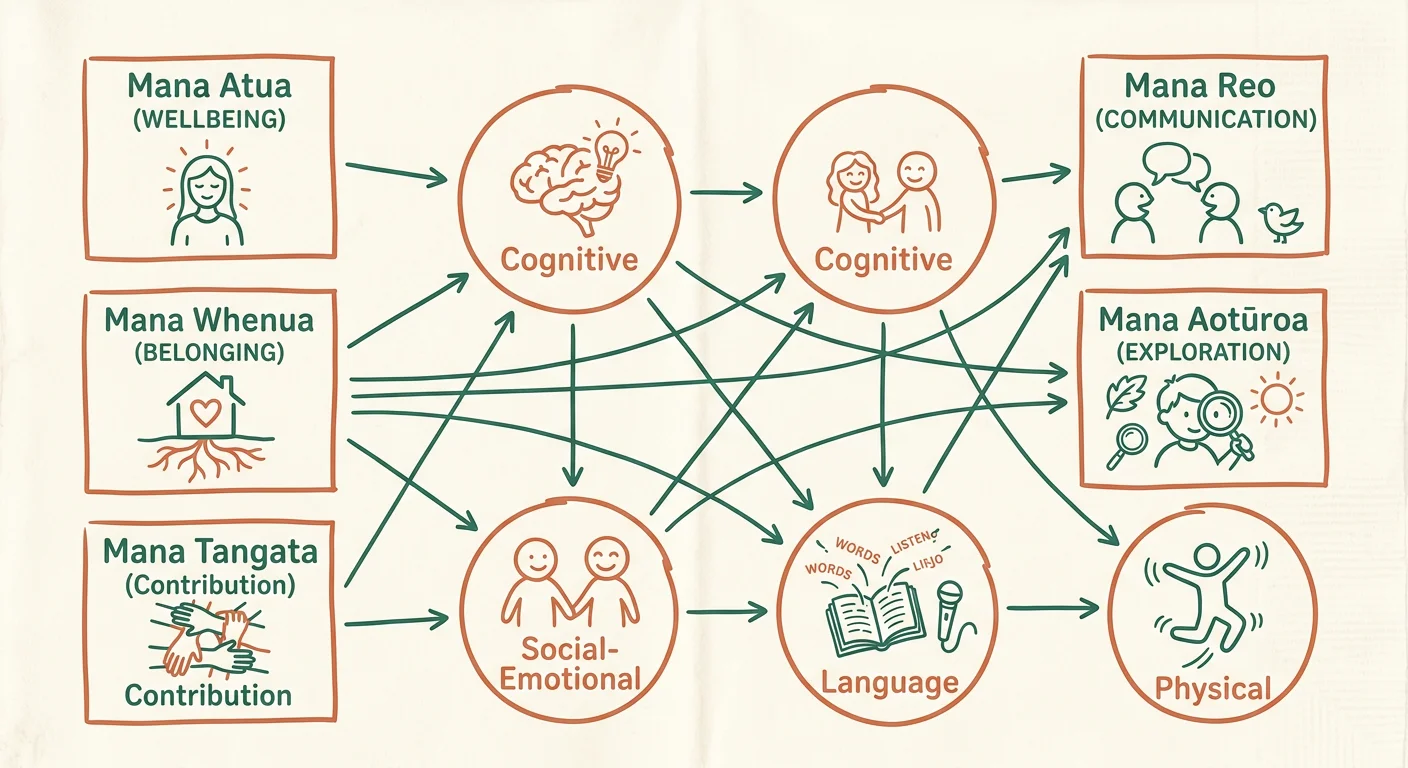
Quality ECE in NZ addresses four development domains: cognitive, social-emotional, language, and physical. Te Whariki, NZ's national ECE curriculum, is built around five strands that give children a foundation for learning across their whole lives. Children who attend quality ECE before age 5 show stronger literacy, numeracy, and social skills when they start school.
Why early childhood education shapes development
The years from birth to five are when the brain develops faster than at any other point in a person's life. By age three, a child's brain has formed around 1,000 trillion synaptic connections. The experiences a child has during these years, including the quality of their ECE environment, shape the neural pathways that underpin learning, behaviour, and health for decades.
In New Zealand, over 95% of children attend some form of early childhood education before starting school. With 4,394+ licensed ECE providers across the country, most families have genuine choice. But the research is clear: not all ECE is equal. The quality of the environment, the teacher-to-child ratios, and the curriculum approach all matter.
This guide covers what development actually looks like from birth to five, how Te Whariki shapes NZ ECE, what quality looks like across different development domains, and what you can do at home to reinforce what your child learns at their centre or home-based provider.
Developmental milestones: birth to five years
Milestones are not rigid checkboxes. They are averages drawn from large population studies. A child who walks at 16 months is not behind, and a child who walks at 10 months is not necessarily advanced in other areas. What matters is overall progress across domains over time.
NZ's B4 School Check, offered free to all four-year-olds, screens across vision, hearing, growth, and developmental milestones. If there are concerns after the check, families are referred for further assessment at no cost. The check is administered through your local health provider and is part of the WellChild/Tamariki Ora schedule.
| Age | Cognitive | Language | Social-emotional | Physical |
|---|---|---|---|---|
| 0-6 months | Responds to faces, tracks objects | Coos, reacts to sounds | Smiles socially, settles to caregivers | Holds head up, reaches for objects |
| 6-12 months | Object permanence begins, imitates actions | Babbles, responds to name | Stranger anxiety appears, plays peek-a-boo | Sits unsupported, crawls, pulls to stand |
| 1-2 years | Problem-solving, simple sorting, pretend play begins | First words (10-50 words), follows simple instructions | Parallel play, shows affection, has strong preferences | Walks independently, climbs, begins using spoon |
| 2-3 years | Understands cause-and-effect, matches shapes and colours | Two-word combinations, vocabulary explosion (200+ words) | Cooperative play starts, strong sense of self, tantrums common | Runs, kicks ball, stacks blocks |
| 3-4 years | Counts to 10, understands past and future | 3-4 word sentences, asks 'why' constantly, tells simple stories | Takes turns, understands rules, shows empathy | Pedals tricycle, uses scissors, dresses with help |
| 4-5 years | Letters, numbers 1-20, sorting by two attributes | Clear sentences, tells detailed stories, 1,500+ words | Negotiates, manages some emotions, has real friendships | Hops, skips, catches ball, draws recognisable shapes |
When to talk to your GP or Plunket nurse
The four development domains ECE supports
Development happens across four interconnected domains. A quality ECE environment addresses all four intentionally, not just the ones that are easy to observe or measure.
Cognitive development
Cognitive development covers how children think, learn, and solve problems. In quality ECE environments, this happens through exploration, play with open-ended materials, and responsive conversations with kaiako (teachers). Research from Victoria University of Wellington shows that the quality of teacher-child interaction is the strongest predictor of cognitive gains in ECE, more so than the programme type or setting.
Practical cognitive development activities in quality ECE include block building (spatial reasoning), dramatic play (abstract thinking), simple cooking projects (sequencing), and questions like 'What do you think will happen if?' that build scientific reasoning. The best centres do not use worksheets or structured academic lessons for children under five. Play is the vehicle.
Social and emotional development
Social-emotional development covers how children understand their own feelings, relate to others, and manage behaviour. It is the domain most directly affected by the quality of relationships in ECE. Stable, responsive relationships with kaiako give children a secure base from which to explore. Disruptions to those relationships, such as high staff turnover, have measurable negative effects on children's sense of security.
NZ ECE centres are legally required to assign primary caregivers to children under two. This is not just an administrative rule. Consistent caregiving at this age directly shapes attachment security and the regulation of stress hormones. The legal ratio for infants and toddlers under two is 1:5 (one trained teacher to every five children), though quality centres often maintain 1:3 or 1:4.
Language and communication
Language development in the 0-5 window is rapid and time-sensitive. Children who hear more varied vocabulary in these years consistently show stronger literacy outcomes at school, regardless of socioeconomic background. The key is interactive language: not background TV or passive exposure, but back-and-forth conversations where an adult responds to a child's attempts to communicate.
Quality ECE environments support language through frequent story reading, singing and rhyme, conversations during play and daily routines, and bilingual or multilingual environments for children from non-English speaking families. For Maori and Pacific families, ECE in te reo Maori (kohanga reo) or Pacific languages (A'oga Amata, Punanga Reo) has strong evidence for supporting both heritage language development and English acquisition. Read our detailed guide on bilingual children and ECE in NZ for more on language immersion options.
Physical development
Physical development covers both gross motor skills (running, climbing, balance) and fine motor skills (drawing, cutting, manipulating small objects). The fine motor skills developed through sand play, clay, threading beads, and mark-making in ECE directly prepare children for writing at school.
Ministry of Health guidelines recommend children aged 1-5 get at least 3 hours of movement daily. Quality ECE centres provide outdoor space for unstructured play alongside structured physical activities. NZ licensing requirements set a minimum of 5 square metres of outdoor space per child in full-day services.
Te Whariki: NZ's early childhood curriculum
Te Whariki (literally 'the woven mat') is NZ's national ECE curriculum. First published in 1996 and revised in 2017, it is recognised internationally as one of the most sophisticated early childhood frameworks in the world. Unlike many countries' ECE curricula, Te Whariki does not prescribe specific learning activities or outcomes. Instead, it describes the conditions under which children learn best.
The framework is built on a bicultural foundation. Te reo Maori and tikanga Maori are integral to the curriculum, not optional additions. The principles include whanau as central to children's learning, which means good ECE involves genuine partnership with parents, not just drop-off and pick-up.
All licensed ECE providers in NZ are required to implement Te Whariki. The Education Review Office (ERO) assesses how well providers do this during inspections. You can read any centre's ERO report online at ero.govt.nz. Reports that specifically describe responsive interactions and mention the mana of individual children are signs of strong curriculum implementation.
The five strands of Te Whariki
Te Whariki organises learning around five strands, each with a Maori name that captures its deeper meaning. Understanding these strands helps you ask better questions when visiting a centre and interpret what you see in your child's learning stories.
Mana Atua: wellbeing
Wellbeing covers physical, emotional, and spiritual health. The goal is that children experience ECE as a place where they are safe, their health is maintained, and they develop awareness of their own bodies and feelings. In practice, this means consistent sleep and rest routines, nutritious kai, physical activity, and kaiako who notice and respond to emotional needs.
When reviewing an ERO report or visiting a centre, look for specific descriptions of how staff manage transitions: arrival, departures, and room moves. These are the points where wellbeing is most at risk. High-quality centres have deliberate settling-in plans for each individual child, rather than a one-size approach.
Mana Whenua: belonging
Belonging is about children knowing that they matter, that their family and culture are respected, and that they have a place in the ECE community. This strand has direct implications for children from Maori, Pacific, and immigrant families, whose cultural identity and home language should be acknowledged in the programme, not just tolerated.
Practical questions to ask: Does the centre display images of diverse families? Are te reo Maori greetings used naturally throughout the day? Are Pacific languages welcomed? Are children's names pronounced correctly? These are not minor details. They are direct expressions of the Mana Whenua strand and affect whether a child feels genuinely welcomed.
Mana Tangata: contribution
Contribution is about each child being a fair, equitable participant in ECE. The goal is that no child is excluded from learning opportunities on the basis of ability, background, or family structure. This strand requires centres to actively include children who are quieter, children with additional needs, and children who are new to the group.
Learning stories from the centre should mention your individual child's contributions, not just group activities. If learning stories feel generic or never describe what your specific child said or did, kaiako may not be observing individual children closely enough. This is worth raising at your next parent meeting.
Mana Reo: communication
Communication covers all forms of expression: spoken language, non-verbal communication, literacy, numeracy, creative expression, and te reo Maori. This strand recognises that communication is broader than English literacy. A child who draws to express an idea, sings a waiata, or uses sign language is communicating.
Strong Mana Reo implementation means children have daily access to books, stories, songs, writing tools, and materials for drawing and construction. It also means kaiako engage in genuine conversations with children rather than mainly directive talk ('Put that down', 'Wash your hands'). The quality and frequency of back-and-forth exchanges between teacher and child is one of the strongest predictors of language development outcomes.
Mana Aotuuroa: exploration
Exploration is about curiosity, reasoning, and the development of working theories. A working theory is what a child believes about the world based on their current experience: 'Dogs bark because they want to play.' These theories are not wrong. They are the foundation of later scientific thinking. The role of kaiako is to support children in testing and refining their theories, not to replace them with correct answers.
The revised 2017 Te Whariki places explicit emphasis on learning dispositions alongside knowledge and skills. Dispositions like curiosity, perseverance, and confidence to try are named outcomes. International research consistently shows that learning dispositions predict school success better than specific academic skills acquired before age five.
Play-based learning: what the research shows
Play is the primary learning mode for children under five. This is not a philosophical preference; it reflects how the developing brain actually works. During play, children are intrinsically motivated, emotionally engaged, and repeatedly practising skills in context. This is the optimal state for learning and memory consolidation.
A University of Auckland meta-analysis of NZ ECE research found that play-based environments produced stronger long-term outcomes in self-regulation, social competence, and academic readiness compared to structured academic programmes. Children who attended play-based ECE showed fewer behavioural difficulties in the first years of primary school.
Different types of play serve different developmental functions. Solitary play (alone with objects) builds concentration. Parallel play (near other children but not interacting) is developmentally normal for children under two. Cooperative play (shared goals, negotiation) develops from around age three and requires significant social-cognitive skill to sustain. For a detailed look at how each play type contributes, read our guide to the benefits of play-based learning in NZ ECE.
What quality play-based ECE actually looks like
What to look for when assessing ECE quality
Structural indicators (ratios, qualified staff percentages, ERO rating) give you a baseline when comparing centres. But structural quality does not guarantee process quality. Process quality is what actually shapes children's development.
A well-resourced centre with good ratios can still produce poor developmental outcomes if kaiako are disengaged or if interactions are mainly instructions and directives. Here is what to observe during a visit.
- Teacher-child conversations: Are kaiako getting down to child level and having genuine back-and-forth exchanges? Or are most communications directives ('sit down', 'use your words')?
- Responsiveness to distress: When a child is upset, does a kaiako respond within seconds, or is there a 'shake it off' culture?
- Open-ended materials: Are children exploring sand, water, clay, blocks, and loose parts? Or are activities mainly colouring-in and printed worksheets?
- Learning stories: Ask to see examples. Are they specific to individual children? Do they reference Te Whariki strands? Do they identify next steps?
- Outdoor access: Can children choose to go outside throughout the day, or is outdoor time scheduled as a single block?
- Cultural responsiveness: Is te reo Maori used naturally? Are diverse families represented in books and displays?
- Staff stability: Ask how long the current teaching team has been together. High turnover is a direct risk factor for social-emotional development.
- Family partnership: Are parents invited into curriculum planning, or is communication one-directional?
School readiness: what NZ research actually shows
School readiness is widely misunderstood. Most parents assume it means academic skills: knowing the alphabet, counting to 20, writing your name. NZ research and the Te Whariki framework define it quite differently.
The Competent Children, Competent Learners study is a longitudinal project that tracked NZ children from ECE through age 20. It found that the strongest predictors of academic and social success at school were curiosity, perseverance, social skills with peers, and the ability to manage emotions and sustain attention. Academic knowledge at age five was not a significant predictor once these dispositional factors were accounted for.
| Domain | School readiness indicators | Why it matters |
|---|---|---|
| Self-management | Can manage toileting, food, and transitions independently | Frees up teacher attention for learning |
| Social skills | Can take turns, negotiate, and repair conflicts with peers | Group learning requires social competence |
| Language | Communicates needs, follows multi-step instructions, retells a story | Core reading readiness skill |
| Curiosity | Asks questions, sustains interest in a task for 10+ minutes | Predicts academic engagement long-term |
| Emotional regulation | Manages frustration without meltdown most of the time | Predicts classroom behaviour through primary school |
| Cultural identity | Has a positive sense of who they are and where they come from | Associated with resilience and wellbeing at school |
The B4 School Check, offered to all four-year-olds through WellChild/Tamariki Ora, screens across many of these areas alongside vision and hearing. If the check identifies any concerns, families are referred for further support. Early intervention through the Ministry of Education or health services is available at no cost.
NZ support services for child development
NZ has a solid network of developmental support services, many of which are free. Families do not need to wait for a formal diagnosis before accessing support. If you have concerns about your child's development, ask for a referral early rather than taking a wait-and-see approach.
- WellChild/Tamariki Ora: Free health checks from birth to school age, including developmental screening, hearing and vision checks, and referrals to specialist services. Delivered by Plunket, DHB nurses, or Tamariki Ora providers for Maori families.
- B4 School Check: Free check for all 4-year-olds covering growth, vision, hearing, oral health, and developmental milestones. Families receive results and referrals if needed.
- Ministry of Education Early Intervention: Free assessment and support for children with learning, developmental, or behavioural needs before school age. Accessible via your ECE centre, GP, or directly through the local MoE office.
- Autism NZ EarlySteps: Evidence-based early support for children identified as autistic or showing autistic traits. Referral via GP or paediatrician.
- Speech-language therapy: Available through DHBs and private providers. Public waitlists can be long, so early referral is advisable if you have concerns.
- Specialist ECE services: Some centres specialise in children with additional needs and receive additional government funding. Your local MoE office can advise on options in your region.
How to support development at home alongside ECE
ECE is not the only place development happens. Research consistently shows that what happens at home, particularly the quality of parent-child interaction, accounts for more of a child's developmental trajectory than any single ECE programme. The two environments reinforce each other.
You do not need to create structured learning activities at home. Some of the most developmentally valuable things parents do are incidental: narrating what you are cooking, asking questions during bathtime, reading before bed, letting your child help with real tasks. These experiences cannot be replaced by any ECE programme.
- Read daily: Even 10-15 minutes of shared book reading builds vocabulary, narrative skills, and a connection to literacy. Choose books slightly above your child's independent level.
- Talk about feelings: Name emotions when you see them. 'You look frustrated. That puzzle is really tricky.' This builds emotional vocabulary and self-awareness.
- Follow their lead in play: Rather than directing what your child does, ask questions: 'What are you building? What happens next?' Join their world.
- Limit screen time: Ministry of Health guidelines recommend no screen time for under-2s and less than 1 hour daily for 2-5 year-olds. Video calls with family are an exception.
- Use home language: If your family speaks a language other than English, maintaining it at home is a cognitive and cultural asset. Bilingual children develop stronger executive function.
- Connect with their ECE: Read learning stories with your child. Ask specific questions: 'Who did you play with today? What did you build?' rather than 'How was your day?'
- Let them be bored: Unstructured time at home is as important as structured activities. Boredom drives creativity. Not every moment needs to be an activity.
- Model curiosity: When you do not know something, look it up together. Showing that adults keep learning is a message that sticks.
What changed in 2025 and 2026
The Education and Training (ECE Reform) Amendment Act 2025 modernised the regulatory framework for early childhood services. The changes reduce compliance burden for well-performing centres while increasing scrutiny for those with persistent quality concerns.
Licensing criteria amendments come into effect on 20 April 2026 for all service types: centre-based, home-based, and hospital-based. The Ministry of Education has published updated guidance for providers. If you are enrolling a child in a new centre after April 2026, the centre should be operating under the revised criteria.
The OECD TALIS Starting Strong 2024 NZ reports (released late 2025) contain data on ECE teacher professional development, pay parity progress, and staff wellbeing. The data shows ongoing recruitment challenges, particularly for qualified teachers in rural and lower-decile areas. A centre with a high proportion of unqualified staff carries a quality risk worth investigating before you enrol.
Licensing changes from 20 April 2026
Questions parents ask most
What is the right age to start ECE?
There is no single right age. Most developmental benefits from quality ECE are measurable from around 18-24 months. Starting before 12 months in full-day care can be stressful for infants without highly responsive, consistent caregiving. For children over two, quality ECE generally has clear developmental benefits, particularly for language, social skills, and school readiness.
Does the type of ECE matter for development?
The setting type matters less than the quality within it. A high-quality home-based provider will produce better developmental outcomes than a low-quality centre. For Maori and Pacific families, language-immersion ECE (kohanga reo, A'oga Amata) has specific benefits for cultural identity and heritage language that other settings cannot replicate.
My child's learning stories seem generic. What should they actually look like?
Good learning stories are specific to your child. They name what your child did, quote what they said, connect it to a Te Whariki strand, and identify a next step the kaiako plans to take. A learning story that could apply to any child in the room is not a learning story. Raise this directly with the teacher at your next parent meeting.
How many hours of ECE is the right amount?
Research suggests 15-20 hours per week produces most of the developmental benefits without the fatigue effects of full-day care for young children. The 20 Hours ECE government subsidy covers this amount for eligible 3-5 year olds. More hours are often needed to support working parents, and the research on full-day care is not alarming for children over two in quality settings.
What should I do if I think my child is behind in development?
Speak to your Plunket nurse or GP first. Do not wait for the B4 School Check if you have concerns at age 2 or 3. Early intervention is significantly more effective than later support. The Ministry of Education Early Intervention team can assess and support children before school age at no cost.
Can educational apps or TV replace ECE?
No. Screen-based learning does not replicate the interactive, responsive relationships that drive development in ECE. Children learn language from people, not screens. The Ministry of Health recommends no screen time for under-2s and no more than 1 hour daily for 2-5 year olds. Apps marketed as educational have no evidence base that compares to face-to-face ECE quality.
The 0-5 years are the most development-dense period of a child's life, and the decisions parents make about ECE during this time genuinely matter. Understanding what development looks like across domains, what Te Whariki requires of providers, and what process quality looks like gives you the tools to make an informed choice. For more on how kaiako document individual learning, see our guide to understanding learning stories. Read our deep dive on socialisation in childcare to see how quality ECE builds peer skills. Use our centre search to find and compare licensed providers in your area, or browse our types of childcare guide to understand what is available in NZ.
Find quality ECE near you
Search 4,394+ licensed providers across NZ and compare quality indicators
Search CentresRelated guides
Find childcare near you
Search and compare providers by suburb, care type, cost, and availability.