
Resource Hub
How to Read an ERO Report: A Parent's Guide to Understanding ECE Reviews
Published · Last updated · 5 min read

Contents
How do I read and understand an ERO report for a childcare centre in NZ?
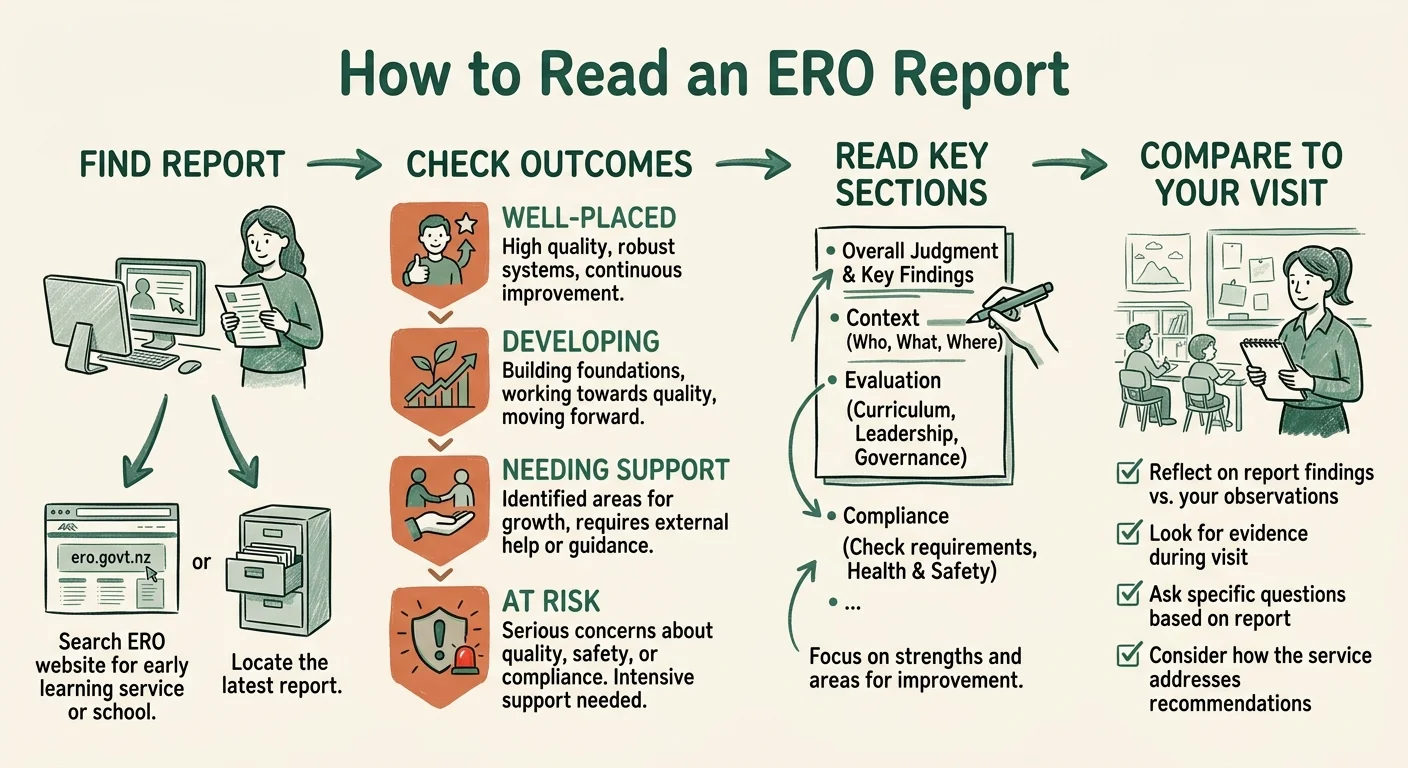
Go to ero.govt.nz and search for the centre by name. Focus on three things: the overall outcome (Very Well Placed, Well Placed, or Requires Further Development), any specific concerns about teaching quality or safety, and the date of the last review. A review older than 4 years means the cycle has stalled. ERO reports are free, public, and the single most useful independent assessment of any ECE centre in New Zealand.
What is the Education Review Office?
The Education Review Office (ERO) is a government department that independently evaluates every licensed ECE service in New Zealand. They're not the regulator — that's the Ministry of Education. ERO's job is to walk in, observe, interview staff, review documentation, and publish a public report on how well the service supports children's learning and wellbeing.
Think of MOE as the building inspector who checks the foundations. ERO is the reviewer who tells you whether it's actually a good place to live.
How often are centres reviewed?
ERO reviews ECE services on a roughly three-year cycle, though the timing depends on the previous outcome. Centres performing well may go up to four years between reviews. Those with concerns get reviewed sooner.
ERO can also conduct out-of-cycle reviews when they receive complaints, when the Ministry of Education flags risks, or when the Chief Review Officer decides a closer look is needed. Parents can request these — if you believe children's safety is at risk, ERO will listen.
Understanding ERO outcomes
ERO doesn't hand out star ratings. Instead, their reports describe what's working, what needs improvement, and what they recommend. Historically, outcomes have been described using terms like these:
| Outcome | What It Means | Next Review |
|---|---|---|
| Very Well Placed | Strong leadership, quality teaching, effective self-review. Children's learning and wellbeing are well supported. | 4 years |
| Well Placed | Meets expectations with some areas for improvement. Solid overall but not exceptional. | 3 years |
| Requires Further Development | Significant concerns about quality, safety, or management. The centre must make changes. | 1-2 years |
| Not Well Placed | Serious deficiencies. May trigger MOE licensing action alongside ERO follow-up. | 6-12 months |
ERO's approach has evolved
How to find an ERO report
- Go to ero.govt.nz
- Use the search bar to find the centre by name or location
- Click on the service to view its most recent report
- Reports are free and public — no login required
- You can also search across all ECE services in a region to compare
You can also check licensing status separately on the MOE Early Learning Services directory. Use both — ERO tells you about quality, MOE tells you about compliance.
What to focus on in an ERO report
ERO reports can be dense. Here's what to zero in on as a parent:
- Strengths section — What does the centre do well? Look for mentions of responsive teaching, strong relationships with whānau, effective use of Te Whāriki, and genuine engagement with children's interests.
- Areas for improvement — This is where the real value is. Common flags include weak self-review, inconsistent teaching quality, poor transitions between age groups, and limited professional development.
- Recommendations — ERO tells the centre exactly what to fix. If the same recommendations appear in consecutive reviews, the centre isn't listening.
- Governance and leadership — A centre can have great teachers but poor management. Look for comments about leadership capability, strategic planning, and how the centre responds to feedback.
- How the centre uses assessment — Good centres track children's learning through learning stories and portfolios. ERO comments on whether assessment actually informs teaching or is just paperwork.
What ERO reports don't tell you
ERO reports are valuable but they have blind spots. They won't tell you:
- Day-to-day reality — ERO visits are periodic, not constant. A centre can perform well during a review and coast between them.
- Exact staffing ratios — ERO doesn't publish the numbers. You need to ask the centre directly.
- Fees and costs — Financial information isn't part of ERO's scope. Use our cost estimator for that.
- Parent satisfaction — ERO talks to some parents but doesn't publish satisfaction surveys. Check parent reviews on The Parent Circle for that perspective.
- What's changed since the report — If the last review was two years ago, things may have improved or deteriorated. A report is a snapshot, not a live feed.
Licensed vs provisionally licensed vs licence-exempt
These terms come from MOE, not ERO, but they show up in ERO reports and matter for your decision:
| Status | What It Means | Should You Worry? |
|---|---|---|
| Full licence | Meets all MOE standards. Reviewed regularly by ERO. | No — this is the standard you want. |
| Provisional licence | Operating under conditions. Must fix specific issues within a timeframe (usually 12 months). | Yes — read the ERO report to understand why. Some issues are administrative; others are safety-related. |
| Licence-exempt | Not required to hold a licence (e.g., some playgroups, certain home-based arrangements). | Be cautious — no MOE oversight of qualifications, ratios, or curriculum. Not necessarily bad, but you're relying on trust. |
Red flags in ERO reports
When reading an ERO report, these phrases should make you pause:
- "Leaders must address risks to children's safety" — This is ERO's way of saying something is genuinely wrong. Take it seriously.
- "Self-review is not well established" — The centre isn't systematically checking its own quality. Problems go unnoticed.
- "Teaching is inconsistent across the service" — Some rooms may be great, others not. Your child's experience depends on which teacher they get.
- "Limited professional development" — Teachers aren't learning or growing. Stagnant practice leads to stagnant outcomes.
- Repeated recommendations from previous reviews — If ERO told them to fix something years ago and it's still unresolved, that's a management failure.
Using ERO reports alongside your own visits
ERO reports work best as one input among several. Read the report before your visit, then test what it says against what you observe. If ERO praised the outdoor environment, go see it yourself. If they flagged communication with parents, ask about their update process and see if the response matches.
For a structured approach to centre visits, see our guide to 30 questions to ask when visiting a childcare centre. And if you're weighing up two centres, our comparison tool lets you evaluate them side by side.
Frequently asked questions
Are ERO reports trustworthy?
Yes — ERO is an independent government department with no commercial ties to ECE providers. Their reports are evidence-based and publicly accountable. That said, they're periodic snapshots, not real-time monitoring. Use them as a starting point, not the final word.
What if a centre doesn't have an ERO report?
New centres may not have been reviewed yet. Licence-exempt services aren't reviewed by ERO at all. If a licensed centre has no report, it either opened very recently or something unusual has happened — worth asking about directly.
Can I request an ERO review of a specific centre?
You can raise concerns with ERO that may trigger an out-of-cycle review. Contact ERO directly through their website or phone. They take parent-initiated concerns seriously, especially where child safety is involved.
How do ERO reviews work — do they warn the centre in advance?
ERO typically provides some notice before a scheduled review, but they can and do conduct unannounced visits when responding to complaints or concerns. The scheduled reviews still provide useful data because ERO examines documentation, policies, and outcomes that can't be faked in a day.
Is an older ERO report still useful?
Somewhat. A two-year-old report gives you a baseline, but things change — staff leave, management shifts, programmes evolve. If the report is more than three years old, treat it as background context and rely more on your own visit observations.
ERO reports are the closest thing NZ parents have to an independent quality check on childcare. They're not perfect — but they're free, public, and based on professional evaluation. Read them before you visit, and you'll ask better questions when you get there.
Ready to start researching centres? Search for licensed providers on The Parent Circle — every listing links to the provider's licensing status and location.
Find licensed, reviewed childcare centres
Every listing on The Parent Circle shows licensing status. Search by suburb, care type, and more.
Search providersRelated guides
Childcare During Family Transitions: A NZ Parent's Guide
A practical NZ guide to supporting your child through separation, moving, grief and other family changes at childcare.
Childcare for Twins and Multiples in New Zealand
A practical guide to finding childcare for twins and multiples, with questions on places, routines, staffing and support.
Steiner/Waldorf ECE in NZ: A Parent's Guide
A practical guide to Steiner/Waldorf early childhood education in New Zealand, including Te Whāriki, centre visits and questions for parents.
Reggio Emilia in NZ: Understanding the Reggio-Inspired Approach to ECE
A practical NZ guide to Reggio-inspired early learning, from inquiry and documentation to questions for your centre visit.
Find childcare near you
Search and compare providers by suburb, care type, cost, and availability.