
Resource Hub
Childcare Near Your Workplace vs Near Home: How to Decide
Published · Last updated · 7 min read

Contents
Is it better to choose childcare near work or near home?
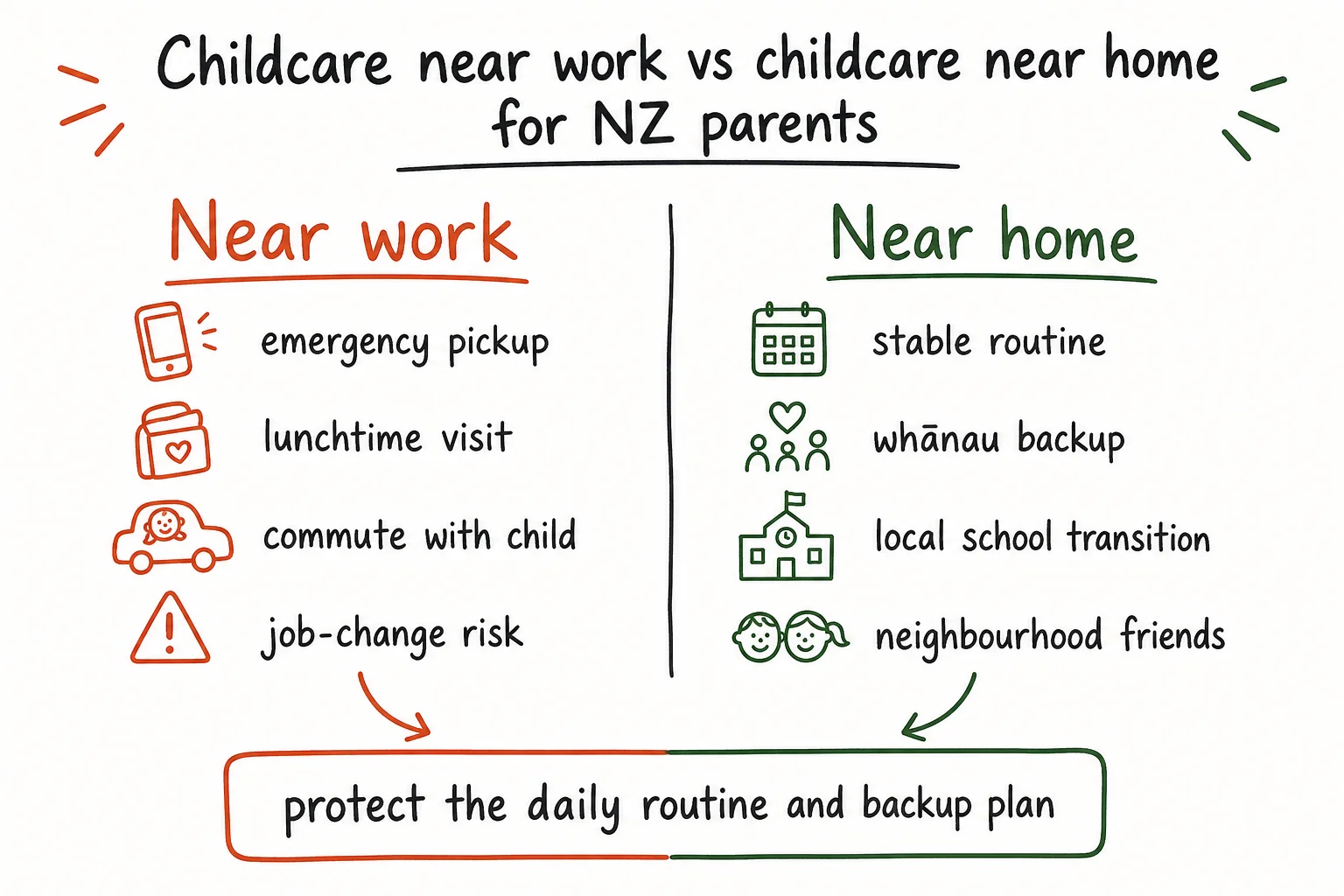
Choose childcare near work if emergency pickups, breastfeeding, or a long office day are your biggest pressure points. Choose childcare near home if you want stable routines, whānau backup, local friendships, and less disruption if your job or commute changes.

This is a routine decision before it is a map decision
Parents often start with distance: which centre is closest? That helps, but it is too shallow. Childcare location affects who does drop-off, who gets called when your child has a temperature, whether grandparents can help, how your child transitions to school, and how much of the day your toddler spends strapped into a car seat.
The Parent Circle lists 4,394+ licensed ECE providers across 1,026 NZ suburbs, so most urban families can compare more than one location. The harder part is choosing the location that survives real life: traffic, hybrid work, sick days, late meetings, new jobs, and the mornings when everyone leaves the house ten minutes behind.
The plain rule
When childcare near work makes sense
Childcare near work can be brilliant when one parent is physically close to the centre most days. If your office is five minutes away, a call about fever, vomiting, or an unsettled baby is easier to handle. You are not negotiating motorway traffic while a kaiako waits with a tired child in the office.
- You can pick up quickly when your child is unwell or distressed.
- Breastfeeding or lunchtime visits may be realistic for babies, if the centre supports them.
- One parent can handle drop-off and pickup around a fixed office schedule.
- CBD or business-park centres may suit parents who work long days and want the child close by.
- You may avoid racing from the office to a suburb before closing time.
The tradeoff is that your child commutes with you. That may be fine on a short train ride or calm local drive. It feels different when an under-2 is in the car through Auckland peak traffic twice a day, or when your workday starts with a packed bus and a stroller.
Ask before you fall in love with the centre
When childcare near home is the better bet
Childcare near home usually wins on continuity. Your child builds friendships near your neighbourhood. Whānau, grandparents, trusted neighbours, and another parent at home may be able to help. When school starts, the faces at ECE are more likely to overlap with the local school or kura.
- Your child avoids a long adult commute before and after care.
- Pickup can be shared with a partner, grandparent, or authorised whānau member.
- The arrangement survives job changes better than a centre tied to one office.
- Local friendships can carry into playdates, sport, school, and weekend life.
- Drop-off can still work on sick-parent days, annual leave days, and work-from-home days.
The weakness is emergency response. If both parents work far away, a call from the centre can trigger a stressful trip across town. This is where backup contacts matter. Licensed services will ask for authorised pickup people, but a name on a form is only useful if that person can actually arrive.
The side-by-side tradeoff
| Question | Near work usually helps | Near home usually helps |
|---|---|---|
| Who can pick up fastest if your child is sick? | A parent working nearby | A partner, grandparent, or local whānau member |
| What happens if your job changes? | The location may stop making sense | The location usually stays useful |
| How much does your child commute? | Often more time in car, bus, or train | Usually less daily travel for the child |
| Can you breastfeed or visit at lunch? | Often easier | Only if you work from home or nearby |
| Will friendships connect to local school? | Less likely unless work and home are close | More likely |
| Who can share drop-off and pickup? | Usually the office-based parent | Usually more flexible across family |
| What if you work hybrid? | Can be awkward on home days | Often simpler |
| What if you run late after work? | Nearby pickup helps | Traffic from work to suburb can hurt |
There is no moral victory in either column. Some families genuinely need the speed of a centre near work. Others need the stability of care near home. The mistake is choosing for an ideal week when the real test is a messy one.
Costs and subsidies do not care where the centre is
20 Hours ECE, FamilyBoost, and the Work and Income Childcare Subsidy are based on eligibility, hours, income, and the service, not whether the centre is near your office or your home. The Ministry of Education says 20 Hours ECE can cover up to 20 hours a week for 3, 4, and 5-year-olds, with a daily limit of 6 hours. It can also be split across more than one service if the total stays within the rules.
FamilyBoost is claimed quarterly through IRD. For quarters ending after 1 July 2025, eligible households can claim up to 40% of ECE costs, capped at $1,560 per quarter, with the amount reducing as quarterly household income rises above the IRD threshold. Work and Income support is a separate application and the provider needs to complete part of the form.
The cost difference is usually local rent, not the subsidy
- Do you offer 20 Hours ECE, and can we choose which hours are covered?
- Can your invoices be used for FamilyBoost claims?
- Do you help complete Work and Income Childcare Subsidy paperwork?
- Are meals, nappies, excursions, sunscreen, and late pickups included or charged separately?
- Is there a waiting-list fee, enrolment fee, or bond?
Test the commute at the actual time of day
Do not test the drive on a quiet Sunday. Try the route on a normal work morning and again near pickup time. Notice the small frictions: parking, pram access, bus transfers, rain, lift queues, and whether your child is calm or miserable by the time you arrive.
For babies and toddlers, the commute is not neutral. A centre near work might mean more time with you in the car, which some children handle well and others do not. A centre near home might mean less travel for the child but more pressure on parents to cross town before closing.
Closing time is the real deadline
Hybrid work changes the maths
Hybrid work has made home-based location decisions more attractive. If you work from home two or three days a week, a centre beside the office may create unnecessary travel on the days you are not there. It can also make sick-child pickups worse, because the centre is near an empty desk rather than near you.
The opposite can also be true. If your office days are fixed, intense, and difficult to interrupt, care near work might still be the calmer option. The real question is not how many days you work from home now. It is whether your work pattern is stable enough to design childcare around it for the next 12 to 24 months.
A simple decision framework
Score each option against your hardest days, not your easiest ones. Give one point for every statement that is true. If near work and near home tie, choose the location with the stronger backup pickup plan.
- Write down your real drop-off and pickup windows, including travel and handover time.
- List the people who can legally and practically collect your child.
- Test both routes at the time you will actually travel.
- Ask each centre about sick-child pickup, late fees, minimum hours, meals, and subsidy paperwork.
- Check ERO reports and visit in person before comparing fees.
- Choose the option that still works on a bad week.
Questions to ask centres before you decide
- What happens if my child becomes unwell and I cannot answer the first phone call?
- How quickly do you expect sick children to be collected?
- Can grandparents, relatives, or another trusted adult be authorised for pickup?
- What are your late pickup fees and closing-time rules?
- Do many children here live locally or are families mostly commuting in?
- How do you support tamariki moving on to nearby schools or kura?
- Can I visit for breastfeeding or settling if my workplace is nearby?
- What is your current waitlist for under-2s and over-2s?
- Are there minimum days or minimum daily hours?
- Do you support split enrolment if our family uses another service as well?
Listen for practical answers, not polished tours. A centre that explains exactly what happens at 3:40pm when your child has a fever is giving you useful information. A vague answer about being flexible is not enough.
So, which should you choose?
| Your situation | Start your search here |
|---|---|
| One parent works in the same place most days and can leave quickly | Near work |
| Both parents work far from home and no local backup is available | Near the parent with the most flexible workday |
| You work hybrid or from home several days a week | Near home |
| Grandparents or whānau can help locally | Near home |
| You have a baby and want breastfeeding visits | Near work, if the centre supports visits |
| Your job, office, or commute may change soon | Near home |
| The local centre feeds into the school you expect to use | Near home |
| Closing time is your biggest pressure | Whichever option gives the safest pickup buffer |
My bias for most families is home first, work second. Home-based location choices usually age better. But if the baby stage, breastfeeding, medical needs, or a brutal pickup deadline are your reality, near work can be the kinder choice for a season.
FAQ
Is childcare near work more expensive in NZ?
It can be, especially in CBDs or business districts where rent is higher, but subsidies are not based on whether a centre is near work or home. Ask for the full weekly cost after 20 Hours ECE, FamilyBoost-ready invoices, optional charges, meals, nappies, and late pickup fees.
Can I use 20 Hours ECE at a centre near work?
Yes, if your child is eligible and the licensed service offers it. The Ministry of Education says 20 Hours ECE can cover up to 20 hours a week for 3, 4, and 5-year-olds, with no more than 6 hours per day.
What if I work from home some days?
A centre near home usually works better for hybrid parents, because you avoid travelling to an office area on home days. Near work can still make sense if your office days are fixed and pickup near work is much easier.
Should I choose a centre near the school my child will attend?
If your child is three or four and you expect to stay in the area, yes, it is worth weighing heavily. Local ECE friendships can make school transition easier for tamariki and can help parents build a neighbourhood support network.
What matters most if both options look good?
Choose the option with the stronger emergency plan. The best centre on paper is not the best centre for your family if nobody can collect your child quickly when they are sick, hurt, or overwhelmed.
Once you have a shortlist, compare centres side by side and read recent ERO reports. If you are still mapping suburbs, start with our region-by-region childcare guide, then search The Parent Circle by suburb near home, near work, or along your commute so the decision is based on real options, not guesswork.
Search by suburb near home or work
Compare licensed ECE providers across 1,026 NZ suburbs and build a shortlist that fits your actual weekday routine.
Find childcare near youRelated guides
Find childcare near you
Search and compare providers by suburb, care type, cost, and availability.