
Resource Hub
Moving to a New City? How to Find Childcare When Relocating Within NZ
Published · Last updated · 7 min read

How do you find childcare when relocating within NZ?
Start researching 3 to 6 months before you move, shortlist services near both your likely home and work suburbs, and join waitlists before you have unpacked a single box. Use ERO reports, Ministry of Education licensing information, fee schedules, and remote centre calls to narrow the list, then book visits around house-hunting or school visits.
Moving city changes the childcare search
Moving house is annoying enough. Moving cities with a toddler or preschooler adds a second logistics puzzle: you need a new childcare place before your new routine exists. The centre that made sense in Auckland may not fit Wellington commuting, Christchurch suburb patterns, or Queenstown costs. Treat childcare as part of the relocation decision, alongside housing, work travel and school zones.
The good news is that New Zealand's ECE system is national. Licensed services follow Te Whāriki, official funding such as 20 Hours ECE moves with your child, and ERO reports are public. The hard part is local availability. A place that looks perfect online can still have a six-month waitlist.
Use local supply as your first filter
Start 3 to 6 months before the move
If you already know the city, start the childcare search as soon as the move becomes likely. For Auckland, Wellington, Christchurch, Hamilton, Tauranga and Queenstown-Lakes, 3 months is sensible. If you need under-2 care, unusual hours, or a specific philosophy, give yourself closer to 6 months. Under-2 places are often the pinch point because ratios are tighter and rooms have fewer spaces.
| When | What to do | Why it matters |
|---|---|---|
| 6 months out | Check likely suburbs, commute routes, service types and rough fees | This stops you falling in love with a suburb that has poor ECE fit |
| 3 months out | Contact centres, join waitlists, ask for fee schedules and availability by age | Waitlists are usually age-room specific, not one simple queue |
| 1 to 2 months out | Book visits during house-hunting trips or video calls if you cannot travel | You need to see the environment, not only the marketing photos |
| Moving week | Confirm start date, settling visits, enrolment paperwork and funding forms | A soft landing beats a rushed first full day |
| First month | Keep communication tight with kaiako and review whether the routine is working | Children often react after the novelty wears off |
Map care around real life, not only the new address
Before you shortlist centres, draw the ordinary weekday. Where will you live? Where will you work? Who does drop-off if one parent is sick, travelling, or stuck on the motorway? A centre five minutes from home can still be a bad fit if your workday starts across town at 7:30am. Do the boring route check in maps at real commute time, then add the time it takes to park, sign in, settle your child and leave again.
- Search near likely home suburbs and near the main work route, rather than only the city name.
- Check opening hours against your actual commute, including parking and lift time in CBD buildings.
- Ask whether the centre closes for teacher-only days, Christmas breaks, or extra holidays.
- Look at backup options: grandparents, home-based care, a nanny share, or casual care if your first choice has a waitlist.
- If you are still deciding between suburbs, compare childcare supply before signing the lease or sale agreement.
For a wider regional view, start with the region-by-region childcare guide. If cost is the pressure point, read the childcare costs by region guide before comparing fee sheets.
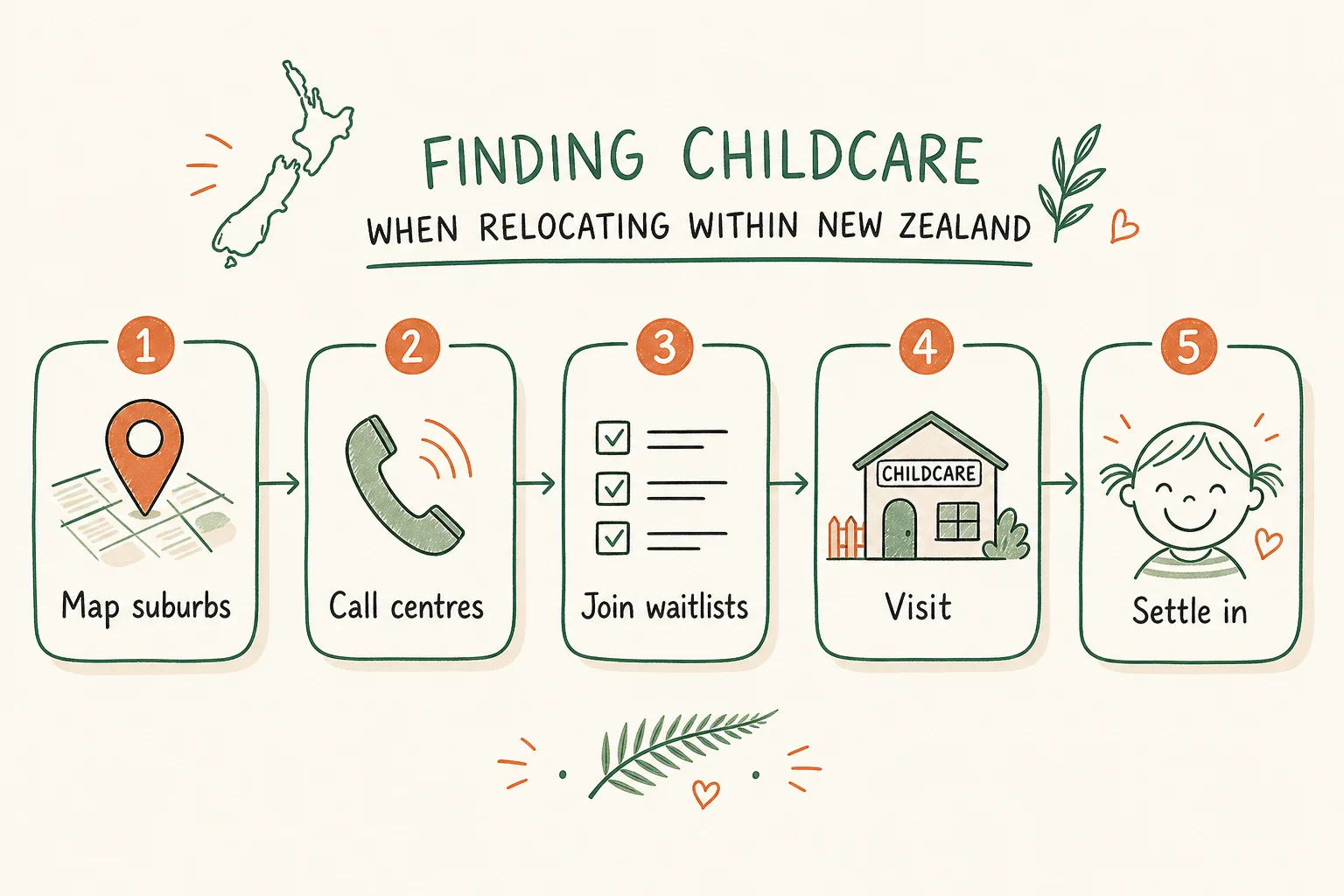
Join waitlists remotely, but ask better questions
Many centres will talk to relocating families by phone or email before you arrive. Do it. A ten-minute call can tell you more than an hour of scrolling, especially if you ask about the right age room. A centre may have places for over-3s but no space for toddlers until next term.
- What is your current wait time for my child's exact age group?
- Do you accept remote waitlist applications, and is there a fee?
- Can you hold a place if our move date shifts by two or three weeks?
- What are your full fees after 20 Hours ECE, including food, nappies, excursions and optional charges?
- Do you support settling visits before the official start date?
- Who will be my child's key kaiako during the first few weeks?
Do not wait for the perfect suburb
Use house-hunting trips for centre visits
When you travel to the new city to view houses, treat childcare visits as part of the trip, not an optional extra. Book two or three centres close together, then leave time to sit in traffic afterwards. The drive tells you almost as much as the tour. If a centre can only offer a video call, still ask them to show the entrance, outdoor area, sleep space, kai area and the room your child would actually join.
On the visit, watch the ordinary moments. How do kaiako respond when a child cries? Are children moving freely between indoor and outdoor play? Does the room feel calm enough for your child, or will the noise be too much during a big life change? Use the 30 centre visit questions if you want a structured list.
Compare costs before you compare houses
Childcare cost can change the real affordability of a move. A lower mortgage or rent does not help much if the only available ECE place costs more, finishes earlier, or adds long travel time. Ask for written fees and compare the full week your family actually needs.
| City | Active providers in The Parent Circle | Relocation note |
|---|---|---|
| Auckland | 1,183 | Huge choice, but popular suburbs can still be tight |
| Christchurch | 298 | Good suburban spread, useful if you can choose location around work |
| Hamilton | 186 | Strong option for families seeking regional-city balance |
| Wellington | 146 | Commute, hills and parking can matter as much as distance |
| Tauranga | 144 | Growth suburbs need early waitlist calls |
| Dunedin | 72 | Supply is smaller, so shortlist early |
| Queenstown-Lakes | Limited and expensive | Plan further ahead and budget carefully |
For children aged 3 to 5, 20 Hours ECE can reduce fees at participating licensed services. FamilyBoost may also help eligible families claim part of their ECE costs through Inland Revenue. WINZ childcare assistance is separate and income-tested. The boring admin matters here: update addresses, service details and payment arrangements as soon as the move is confirmed.
Help your child settle into the new service
A new centre after a house move is a lot for a small child. Keep the first week lighter if you can. Short settling visits, a consistent goodbye, familiar lunchbox items, and one trusted kaiako can make the change feel safer.
- Share sleep, food, toileting and comfort routines with the new kaiako.
- Tell them what your child calls important people and comfort objects.
- Share any allergies, medical plans, language needs, custody arrangements or cultural practices before day one.
- Ask the old centre for learning stories or transition notes you can pass on.
- Expect some regression. Tears, clinginess or tiredness do not automatically mean the centre is wrong.
If your child is moving from a much-loved centre, name the loss honestly. You do not need to oversell the new place. A simple line works: "We will miss your old friends, and your new kaiako will help you learn the new routine." Children can handle change better when adults stop pretending it is nothing.
Have an interim care plan
Sometimes the right centre is not available on moving week. That is frustrating, but not unusual. Build a temporary plan before you resign, start the new job, or book movers. Options might include home-based care, a nanny for a few weeks, help from whānau, casual education and care, or part-time hours until the full place opens.
Check licensing and safety, including short-term care
Before you enrol, check the paperwork
A relocating family can lose days because one form, custody note or medical plan is missing. Ask the new service for its enrolment pack early and return it before moving week if possible. You will usually need parent and emergency contact details, authorised pickup people, immunisation information, allergy or medication plans, and funding attestations for 20 Hours ECE if your child is eligible.
Read the latest ERO information for each serious option, then ask the centre what has changed since that review. ERO reports are not a substitute for a visit, but they give you a baseline for curriculum quality, leadership and how well the service knows its tamariki and whānau. If something in the report worries you, ask directly. Good centres are used to that conversation.
- Use ERO to read service review information.
- Use Ministry of Education information to understand licensed ECE service requirements.
- Check 20 Hours ECE, FamilyBoost and WINZ rules before comparing out-of-pocket fees.
- Keep copies of medical plans, custody notes and old learning stories in one folder during the move.
Adjust the strategy by city
The same search method works across New Zealand, but the emphasis changes by city. In Auckland, suburb and commute choices dominate. In Wellington, the route can be short on a map and still awkward with hills, parking or public transport. Christchurch gives many families more room to choose around suburban work patterns. Hamilton and Tauranga often suit families looking for a regional-city rhythm, though growth suburbs still need early calls.
Dunedin and smaller centres reward decisiveness because there are fewer services to compare. Queenstown-Lakes is its own beast: availability, rent, tourism work patterns and fees can collide. If you are moving there, make childcare calls before you treat any house as a done deal.
FAQ
How early should I look for childcare before moving within NZ?
Start 3 to 6 months before the move if you can. Use the longer end if you need under-2 care, full-time hours, a specific suburb, or a centre near a CBD commute.
Can I join childcare waitlists before I move?
Often, yes. Many centres will accept remote enquiries and waitlist forms by email. Ask whether there is a waitlist fee, what age room your child would enter, and how flexible they can be if your move date changes.
Does 20 Hours ECE move with my child?
Yes, the entitlement is national for eligible children aged 3 to 5 at participating licensed services. You still need to complete the new service's paperwork and check any optional charges or hours outside the funded allocation.
What should I check before choosing a centre in a new city?
Check licensing, ERO information, fees, opening hours, age-room availability, staff communication, settling-in support and the real commute. A good centre in the wrong place can still create daily stress.
What if no childcare place is available by moving day?
Use an interim plan rather than rushing into a poor fit. Consider home-based care, temporary nanny support, whānau help, casual care, or part-time hours while you wait for the preferred place.
Relocating with children is a timing problem as much as a childcare problem. Search early, ask precise questions, and choose the routine your actual weekdays can sustain. If you are still choosing suburbs, start with The Parent Circle search and compare care options before the move becomes urgent.
Search childcare in your new city
Compare licensed ECE providers across New Zealand before you move.
Start searchingRelated guides
Childcare for Every Family: Special Circumstances
A practical NZ guide to finding childcare around additional needs, shift work, single parenting, siblings and family change.
Your Child's First Illness from Daycare: What NZ Parents Need to Know
A calm NZ guide to the first daycare illness season: what is normal, when children need to stay home, when to call Healthline, and how working parents can plan for sick days.
The Childcare Settling-In Process: What NZ Centres Offer and What to Expect
A practical NZ guide to settling visits, key kaiako relationships, week-by-week transitions, and questions to ask before your child starts childcare.
Starting Childcare in NZ: A Complete Guide to Preparing Your Family
A practical NZ guide to preparing your child, yourself, and your daily routine for the first day, first week, and first month of childcare.
Find childcare near you
Search and compare providers by suburb, care type, cost, and availability.