
Resource Hub
Home-Based Childcare in NZ: A Parent's Guide (2026)
Published · Last updated · 7 min read

Contents
What is home-based childcare in NZ?
Home-based childcare (home-based ECE) is licensed early childhood education where an educator cares for a small group of tamariki in a home setting, usually up to 4 children at a time. It is overseen by a coordinating organisation (sometimes called a network or agency) that supports the educator, checks quality, and helps families with enrolment and subsidies.
Home-based childcare, explained
In New Zealand, licensed home-based childcare is a type of early childhood education and care delivered in a home. The educator can care for children in their own home, your home, or another home approved by the service.
The main difference from a childcare centre is group size. Home-based care is built around a small mixed-age group, often with the same educator across the week. For some families, that consistency is the whole point.
Home-based educator vs nanny: what is the difference?
How coordinating organisations (networks) work
Most home-based services in NZ run through a coordinating organisation. They hold the service licence, match families with educators, and make sure the service meets the rules under the Education (Early Childhood Services) Regulations 2008 and the home-based licensing criteria.
- Enrolments and paperwork (including support with 20 Hours ECE claims if the service offers it)
- Visits and guidance from a visiting teacher or coordinator (how often can vary)
- Programme planning support so the day links back to Te Whāriki (NZ's early learning curriculum)
- Health and safety checks, including home environment checks and policies
- Help with relief cover if the educator is sick or away (not always available, so ask)
- Collecting fees and paying the educator (some services do this; others leave it to families and educators)
If you are deciding between two home-based options, the coordinating organisation is worth checking as closely as the educator. Their training, visiting schedule, and how they handle concerns can make a big difference.
Ages, ratios, and what "up to 4" really means
Licensed home-based care is set up for children from birth to school age (and sometimes older children before and after school, depending on the service's licence and bookings). The headline ratio is simple: one educator can usually care for a maximum of 4 children at a time.
In practice, under-2s are the limiting factor. Most home-based licences restrict the number of under-2s an educator can have at once (commonly no more than 2). Many services also treat a child under 2 as taking up "two places" when they plan rosters, because younger children need more hands-on care.
If you have an under-2
Licensing, qualifications, and safety checks
A home-based service must be licensed by the Ministry of Education. That means the educator and the coordinating organisation must meet licensing criteria, have policies, and follow rules around supervision, safe sleep, food, outings, and emergencies. You can read the Ministry's early childhood regulations and licensing information here: MOE early childhood education.
From 1 January 2025, home-based educator qualification expectations tightened. The Ministry introduced new requirements so educators hold, or are working towards, recognised home-based qualifications (with staged deadlines for existing educators). If qualifications matter to you, ask what the educator holds and what training they are currently doing.
- Identity checking and safety checking for adults involved in the service (ask what the organisation does and how often it is refreshed)
- A home safety check (gates, hazards, safe sleep space, fire safety)
- Emergency planning and contact processes
- First aid (ask who holds it, what it covers, and when it expires)
- Outing rules: car seats, adult to child supervision, permission processes
Quality is not only paperwork. If you can, visit during a normal day and look for the basics: warm interactions, safe set-up, and an educator who is genuinely present with the children.
Costs in NZD, and which subsidies can apply
Home-based fees vary a lot by region, hours, and whether meals are included. As a rough guide, many families see home-based care priced a bit below centre-based daycare, because overheads are lower.
| Care type | Typical group size | Common fee shape | Ballpark cost (NZD) |
|---|---|---|---|
| Home-based | 1 educator, up to 4 children | Hourly or daily | $6–$10 per hour, or about $240–$360 per week for full-time (varies) |
| Daycare (centre-based) | Larger rooms | Daily | $300–$450+ per week for full-time is common (varies by region) |
| Kindergarten | Larger groups, sessional or all-day | Often optional charges | $0–$240 per week depending on hours and optional charges |
For a like-for-like view, compare costs based on the hours you actually need, including any late pick-up fees, food, and holiday closures. If you are weighing options, this guide can help: nanny vs daycare vs home-based care: cost comparison.
20 Hours ECE (and what to ask a home-based service)
20 Hours ECE is a government funding scheme for 3 to 5 year olds, up to 20 hours a week, for eligible services that choose to offer it. Home-based services can offer 20 Hours ECE, but not every service does. Start here for the official rules: MOE 20 Hours ECE.
Questions to ask
FamilyBoost and Work and Income support
If you pay for childcare, you may also be able to claim support outside ECE funding. Two common routes are FamilyBoost (through Inland Revenue) and childcare assistance through Work and Income (WINZ). Your eligibility depends on your family income, the type of care, and whether the care is approved/licensed.
- FamilyBoost (IRD): a quarterly payment based on a portion of childcare fees, with caps. Details and eligibility: IRD FamilyBoost.
- Work and Income (WINZ): childcare subsidy and related support for eligible families. Start here: Work and Income childcare support.
Because rules change and each service structures invoices differently, ask the coordinating organisation what documentation they provide and whether families commonly use FamilyBoost and/or WINZ with their service.
How to find home-based childcare near you
- Start with The Parent Circle search and filter to home-based providers in your suburb: search childcare.
- Check the Ministry of Education directory to confirm the service is licensed: Find an early childhood service.
- Shortlist two or three educators, not just one. Availability can change quickly.
- Visit during a normal day if possible. A quiet afternoon visit can look very different from a busy morning.
- Ask what happens on educator sick days and during school holidays.
- Talk through a trial or settling-in plan for the first 1 to 2 weeks.
What a typical day can look like
Every educator runs their day a little differently, but home-based care often follows a simple rhythm rather than a strict timetable. That can feel calmer for younger children.
- Morning: arrivals, free play, books, music, a snack
- Mid-morning: a planned activity (painting, baking, messy play) and/or a local outing (park, library, playgroup)
- Lunch: home-style meal or lunchboxes (ask which), then wind-down
- Early afternoon: naps or quiet time, especially for under-2s
- Late afternoon: outdoor play, pick-ups, short handover chat with parents
If outings matter to you, ask where they go, how often, and what the adult-to-child plan is when they are out of the house. A good service will be comfortable explaining their supervision approach.
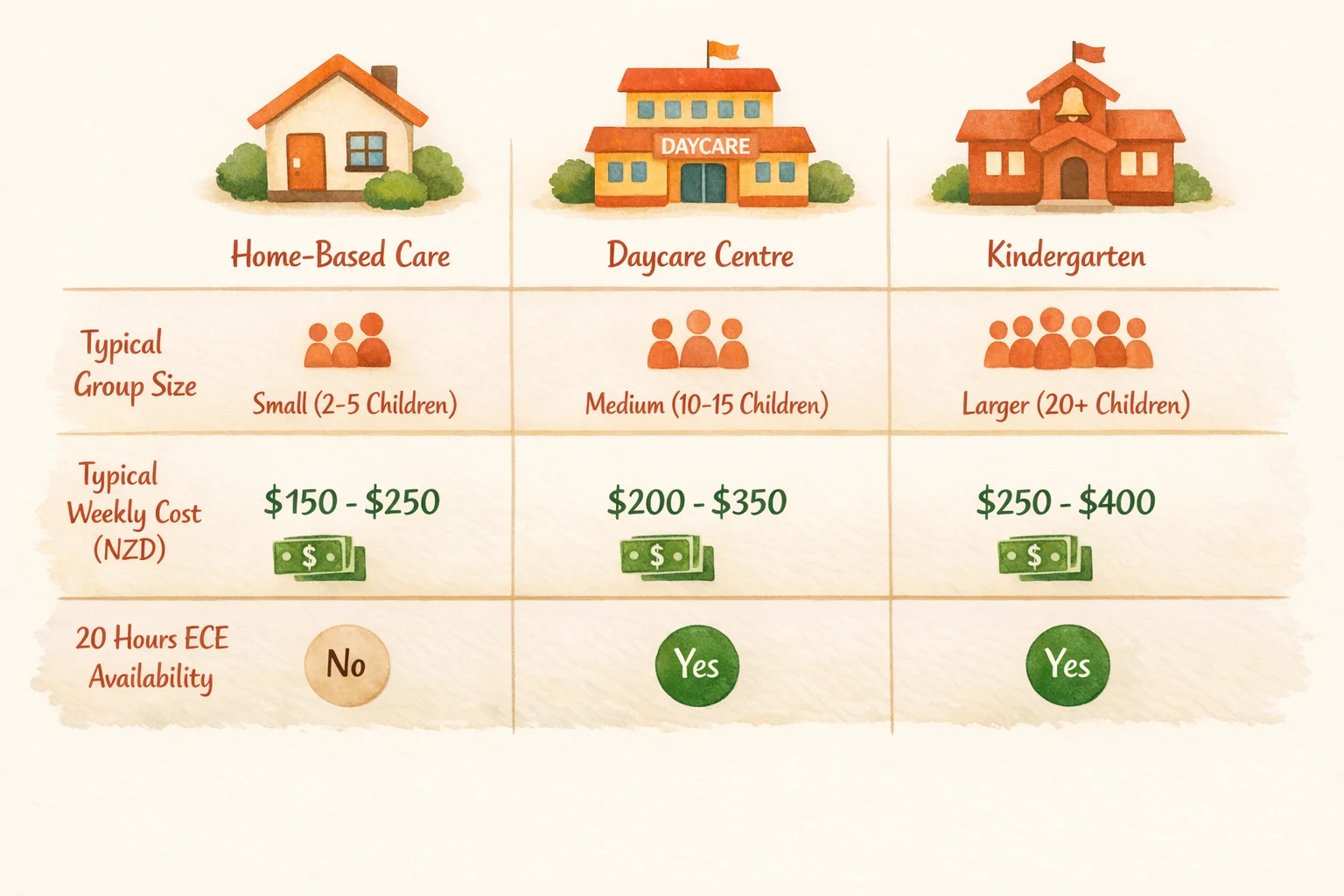
Pros and cons: home-based care compared with daycare centres and kindergarten
| Home-based care: often a good fit when… | Home-based care: think twice when… |
|---|---|
| You want a small group and consistent caregiver | You want lots of same-age peers and bigger group activities |
| You need flexibility for shift work or longer days | You need guaranteed cover every day if the educator is sick |
| Your child is young and does best with a calm, predictable setting | Your child is very social and thrives in busy environments |
| You like mixed-age play (older kids often model language and routines) | You prefer specialist spaces (larger outdoor areas, multiple rooms) |
There is no "best" option. There is only what works for your child and your week. If you are still comparing, the pillar guide is a good starting point: types of childcare in NZ: a complete guide.
Questions to ask when you are vetting an educator
- How many children are booked on the days my child would attend? How many are under 2?
- What training and qualifications do you have? What are you studying this year?
- Who is the coordinating organisation and how often do they visit?
- What is your approach to naps and safe sleep (especially for babies)?
- What is your sick policy for children, and what happens if you are unwell?
- How do you handle outings and transport? Do you use a car, and if so, how are car seats managed?
- What food is provided, and how do you manage allergies?
- How do you communicate during the day (messages, photos, daily notes)?
- Can I see your emergency plan, and where are supplies kept?
Check the service's track record
FAQ
Is home-based childcare licensed in NZ?
It can be. Licensed home-based ECE services are regulated by the Ministry of Education and must meet home-based licensing criteria. Some in-home care arrangements (for example, a privately employed nanny) are not licensed ECE services.
How many children can a home-based educator care for?
Commonly up to 4 children at a time, depending on the service's licence. Limits for under-2s usually apply, so ask how many babies and toddlers will be there on the same days as your child.
Can I use 20 Hours ECE at a home-based service?
Sometimes. Some home-based services offer 20 Hours ECE for 3 to 5 year olds, but others do not. Ask the coordinating organisation whether they offer it, which hours are funded, and what fees still apply.
Is home-based care good for babies and toddlers?
It can be a great fit for under-2s because the group is small and the day is often calmer. The key is the educator's experience with safe sleep, routines, and supervision, plus how many other under-2s are booked.
What is a coordinating organisation, and why does it matter?
They are the organisation that runs the home-based service (often called a network). They support and monitor educators, manage enrolments, and handle quality systems. If you ever have a concern, they are usually your first escalation point.
Where can I find home-based childcare near me?
You can search by suburb and filter by care type on The Parent Circle: [/search](/search). It is also worth checking the Ministry of Education's directory to confirm the service is licensed: https://www.educationcounts.govt.nz/find-an-early-childhood-service.
If you're leaning towards home-based care, it helps to start with a shortlist and a visit. You can also read the overview on our care type page: home-based childcare.
Find home-based childcare near you
Search by suburb, compare options, and contact providers directly.
Search home-based careVideo
Related guides
Childcare for Twins and Multiples in New Zealand
A practical guide to finding childcare for twins and multiples, with questions on places, routines, staffing and support.
Age-by-Age Guide: When Is the Best Time to Start Childcare?
There is no universal best age to start childcare. This NZ guide helps you weigh your child, care quality and family timing at every stage.
Casual and Drop-In Childcare in NZ: Your Complete Guide
Casual and drop-in childcare lets NZ families book sessions without a fixed enrolment. This guide explains where to find it, what it costs, how WINZ subsidies apply, and what to look for in a licensed provider.
Kindergarten in NZ: Free ECE Explained (2026)
Kindergarten can be low-cost or free for 3–5 year olds in NZ. Learn how 20 Hours ECE works, what optional charges mean, and how to enrol.
Find childcare near you
Search and compare providers by suburb, care type, cost, and availability.