
Resource Hub
Playcentre NZ: The Parent-Led Early Childhood Model
Published · Last updated · 6 min read

Contents
What is Playcentre in New Zealand?
Playcentre is a parent-led early childhood education option where you stay for the session and help run it alongside other parents and caregivers. It suits whānau who want to be hands-on, build a local community, and enjoy a play-based programme for tamariki from birth to school age (often described as 0–6).
What Playcentre is (and why it feels different)
Most early childhood services in NZ are drop-off. Playcentre isn’t. At Playcentre, a parent or caregiver stays, joins in, and shares responsibility for the session.
Think of it as a cooperative: the centre is run by families. You’ll usually have a rostered role (set-up, supervising an area, kai, pack-down), and you’ll get to know the other adults because you’re there together.
In one sentence
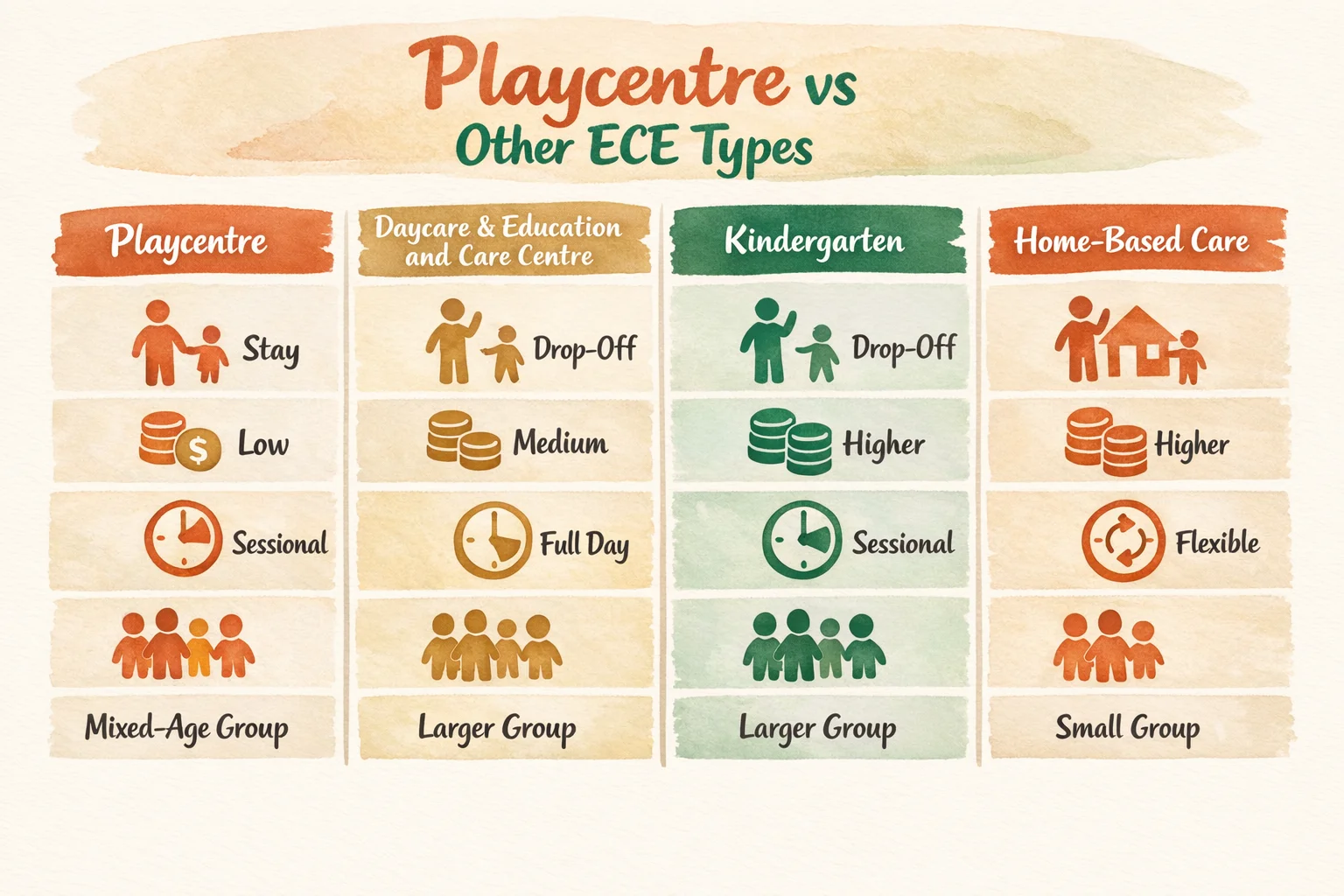
Playcentre vs other childcare types (quick comparison)
| Care type | Do parents stay? | Typical pattern | Cost feel (vs other options) | Best for |
|---|---|---|---|---|
| Playcentre | Yes (adult stays) | Sessional (often 2–3 hrs) | Usually low | Hands-on whānau, community, play-based learning |
| Education & care centre (daycare) | No (drop-off) | Full day, 5 days/week common | Often higher | Parents needing longer hours and consistent cover |
| Kindergarten | No (drop-off) | Sessional or all-day (varies) | Often low/optional charges | Older preschoolers, structured sessions |
| Home-based care | No (drop-off) | Smaller group in a home | Mid range | Babies/toddlers, flexible hours, small group feel |
| Te Kōhanga Reo | Often whānau involvement is expected | Immersion + tikanga-led | Often low | Whānau wanting te reo Māori immersion |
If you’re still weighing up options, start with our full overview: Types of childcare in NZ: a complete guide.
A very NZ origin story (founded in 1941)
Playcentre began in Wellington in 1941, created by mothers who wanted somewhere their young children could play and learn while parents learned too. It grew quickly during the 1940s, and the cooperative model became part of NZ’s early childhood story.
Today it’s still proudly home-grown. You’ll also see the approach referenced overseas, because the idea of parent-led early learning (with real training) is unusual in other countries.
- Playcentre Aotearoa history page: https://www.playcentre.org.nz/about/history/
- Te Ara (Encyclopedia of NZ) on early childhood education history: https://teara.govt.nz/en/early-childhood-education-and-care/print
- NZHistory entry: https://nzhistory.govt.nz/women-together/playcentre-aotearoa
Ages (0–6) and what sessions look like
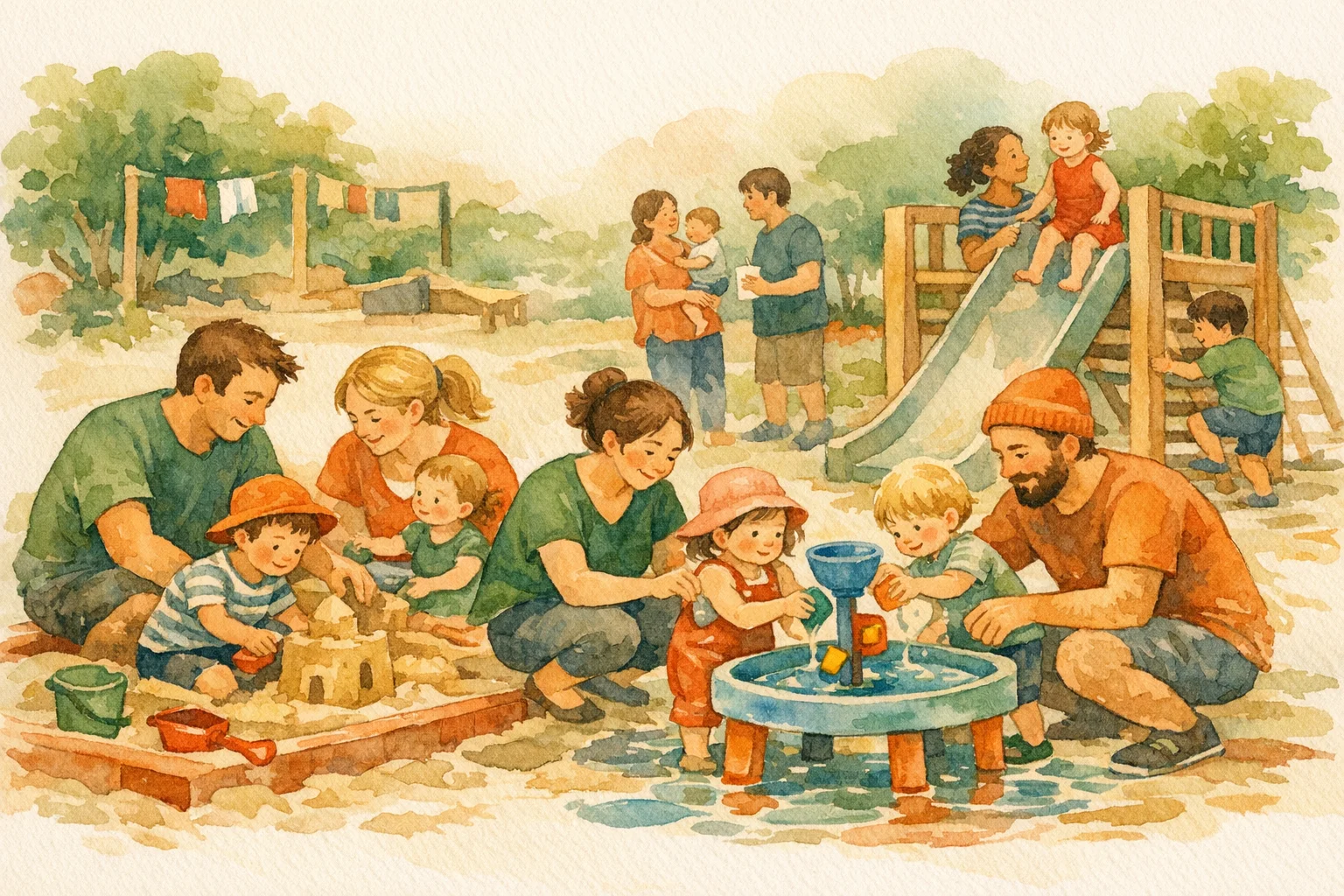
Playcentre sessions are usually mixed-age, with pēpi and older preschoolers in the same space (with adults supporting safety and learning). Many centres describe their age range as birth to school age, often written as 0–6.
Because it’s sessional, it tends to work well as your main option when you’re home with your child, or as a part-time choice alongside work, study, kindergarten, or another arrangement.
A typical Playcentre session (the real-life version)
- Arrive + settle in: you and your child choose where to start (blocks, art, water play, books, outdoor).
- Free play: tamariki move between areas. Adults support, talk, and keep everyone safe.
- Outdoor time: usually a big part of the morning, even in cooler weather (gumboots and raincoats are common!).
- Kai: children wash hands, sit together, and share food. Adults often take turns organising.
- Tidy-up + pack-down: everyone helps. It’s part of the culture, and kids get good at it fast.
- Quick adult chat: a few minutes to check rosters and anything the centre needs.
Mixed-age sessions can be magic (and a bit hectic)
The parent role: you’re not just watching
At Playcentre, the adult on session is part of the programme. You’ll help with supervision, support play, and share the practical jobs that keep the centre running.
This doesn’t mean you need to be an extrovert, or that you’ll be expected to “teach” in a school sense. It’s more about being present, getting to know your child’s play, and learning simple ways to support language, problem-solving, and friendships.
- Setting up play areas and materials
- Supporting messy play (paint, dough, water)
- Keeping an eye on the outdoor area
- Preparing and managing shared kai routines
- Cleaning and pack-down
- Committee and admin roles (rosters, finances, enrolments)
Parent education and training: the part people don’t expect
One of the big differences with Playcentre is that adults learn too. Many centres encourage parents to do Playcentre education modules over time, covering child development, positive guidance, and how to support play.
For some parents, that training is the whole point. You come for the kids, then you realise you’re getting a steady, practical education in parenting and early learning alongside a group who are in the same stage of life.
Where Te Whāriki fits
Costs, 20 Hours ECE, and help with fees
Playcentre is usually one of the more affordable ECE options in NZ because families contribute time as well as money. Many centres have low session fees or term donations, plus fundraising for extras.
If your child is 3, 4, or 5, ask the centre how they apply 20 Hours ECE (and whether there are any optional charges). The official rules are set out by the Ministry of Education: https://www.education.govt.nz/early-childhood/funding-and-data/funding-handbooks/ece-funding-handbook/20-hours-ece/
If you need extra support, it’s also worth checking whether you’re eligible for Work and Income (WINZ) Childcare Subsidy. Eligibility depends on income and your situation. Start here: https://www.workandincome.govt.nz
The trade-off is time
The whānau side: why people stay for years
A lot of parents join Playcentre for their child, then stay for themselves. It can be a built-in village: people who know your kid’s name, notice when you’re having a rough week, and share hand-me-downs, tips, and laughs.
Because adults are on session together, you get more chances for real conversation than you might in drop-off care. For parents new to an area (or new to NZ), that can be a lifeline.
- A steady routine during parental leave or part-time work
- Friendships for kids and adults
- Shared knowledge (sleep, feeding, toileting, settling)
- A place where siblings and mixed ages are normal
- Confidence from learning about child development as you go
Who Playcentre suits (and who it may not)
Playcentre tends to suit whānau who have some daytime flexibility and like being part of a community-run space. It can be a great match if you enjoy getting involved and you want to understand how your child learns through play.
A quick self-check before you commit
- Can I regularly stay for a 2–3 hour session (plus a little set-up/pack-down time)?
- Am I okay with shared responsibility (and the occasional messy moment)?
- Do I want my child in a mixed-age group?
- Would I enjoy doing some parent education over time?
- Am I comfortable with a cooperative where decisions are made together?
It may not suit families who need full-day childcare most days, or parents who can’t stay on session because of work. It also won’t be everyone’s cup of tea if you prefer a service where the organisation side is handled for you.
How to find (and join) a local Playcentre
- Start with The Parent Circle directory: browse Playcentres or search by suburb.
- Contact 2–3 centres if you can. Culture varies and it’s worth feeling it in person.
- Ask about session times, how rosters work, and what training they encourage.
- Do a couple of visits. Notice how adults support play and how welcome you feel.
- Check practicals: parking, nappies/toileting support, outdoor gear, what kai is expected.
Questions to ask on your first visit
Playcentre NZ FAQs
Can I drop my child off at Playcentre?
Usually no. The parent-led model is the point: an adult stays and takes part. Some centres may have specific arrangements in limited cases, but you should expect to stay for sessions.
What ages are Playcentres for?
Most Playcentres welcome tamariki from birth to school entry. Many describe this as 0–6, with mixed-age sessions.
How many sessions per week do we need to attend?
It varies by centre and by your family. Some attend one session a week, others do several. Ask what’s typical and what rosters look like for your preferred days.
Is Playcentre eligible for 20 Hours ECE?
Many Playcentres offer 20 Hours ECE for eligible 3–5 year olds, but how it’s applied can vary. Confirm with your local centre and check the Ministry of Education rules: https://www.education.govt.nz/early-childhood/funding-and-data/funding-handbooks/ece-funding-handbook/20-hours-ece/
What should I bring to a Playcentre session?
Expect to bring a water bottle, sunhat, gumboots or wet-weather gear in winter, a change of clothes, and any nappies/wipes you need. Some centres have shared kai routines, others ask you to bring your own.
Is Playcentre good preparation for school?
Playcentre builds a lot of the foundations schools care about: confidence, language, friendships, problem-solving, and independence with routines. If you want more teacher-led group time as your child gets older, some whānau combine Playcentre with kindergarten or another option.
Playcentre won’t suit every family, but if you like the idea of learning alongside your child and building a local village, it’s worth trying a visit or two. You can also compare it against other options in our main guide: Types of childcare in NZ.
Find a Playcentre near you
Search by suburb, compare options, and save centres you want to visit.
Search PlaycentresVideo
Related guides
Casual and Drop-In Childcare in NZ: Your Complete Guide
Casual and drop-in childcare lets NZ families book sessions without a fixed enrolment. This guide explains where to find it, what it costs, how WINZ subsidies apply, and what to look for in a licensed provider.
Kindergarten in NZ: Free ECE Explained (2026)
Kindergarten can be low-cost or free for 3–5 year olds in NZ. Learn how 20 Hours ECE works, what optional charges mean, and how to enrol.
Te Kōhanga Reo: Māori Language Immersion ECE in NZ
Te Kōhanga Reo is Māori language immersion early learning. Learn how it works, who it suits, costs, subsidies, and how to enrol in NZ.
Home-Based Childcare in NZ: A Parent's Guide (2026)
Home-based childcare is licensed ECE in a home setting, usually up to 4 children with one educator. Learn costs, ratios, subsidies, and what to ask.
Find childcare near you
Search and compare providers by suburb, care type, cost, and availability.