
Resource Hub
Kindergarten in NZ: Free ECE Explained (2026)
Published · Last updated · 8 min read

Contents
Is kindergarten free in NZ?
For most 3–5 year olds, kindergarten can be close to free because 20 Hours ECE funding covers up to 20 hours a week (max 6 hours a day) and services can't charge fees for those funded hours. Many kindergartens still ask for donations or optional charges (for things like trips or extra resources), and you may pay fees if your child attends more than the funded hours.
What a kindergarten is (and what it isn't)
In New Zealand, a kindergarten (often just called "kindy") is a teacher-led early childhood education (ECE) service, usually for children aged around 3 to 5. Some kindergartens enrol 2-year-olds too, depending on the association and how they run their sessions.
Kindy tends to feel a bit more like a school day than many full-day childcare centres. Sessions are often set hours, and many kindergartens follow school terms and close over school holidays.
Quick definition
Kindergarten vs daycare (education and care) vs Playcentre
These labels get used loosely, so it helps to focus on what the service is like day-to-day. The biggest differences are usually hours, the age mix, and how teacher-led the model is.
| Feature | Kindergarten | Daycare / ECE centre (education and care) | Playcentre |
|---|---|---|---|
| Who runs it | Teacher-led | Teacher-led (varies by provider) | Parent-led co-operative |
| Typical ages | Mostly 3–5 (some take 2-year-olds) | Often 0–5 (including infants) | 0–6 (mixed age) |
| Hours | Set sessions, often school terms | Longer days, year-round | Set sessions; parent roster |
| Costs | Often low-cost for 3+ because of 20 Hours ECE; may ask for donations/optional charges | Usually higher weekly fees; 20 Hours ECE can reduce costs for 3+ | Low fees; parent time commitment is the trade-off |
| Best fit | You want a set routine and a strong getting ready for school feel | You need longer hours and holiday cover | You want community and are able to take part regularly |
None of these options is better across the board. The right choice is the one that works for your child's temperament, your work hours, and what you can realistically commit to each week.
For the bigger picture, this cluster article links back to our full guide: Types of childcare in NZ: a complete guide.
How 20 Hours ECE works at kindergarten (and what you can be charged for)
The Ministry of Education's 20 Hours ECE scheme is for children aged 3, 4, and 5. It covers up to 20 hours a week, and it can only be used for up to 6 hours a day.
The key rule (and the one parents care about) is simple: you can't be charged fees for the 20 hours your child is signed up to receive.
Official info: 20 hours funding for early childhood education (MOE).
The 20 Hours ECE rule in plain language
So how can kindergarten be "free" and still ask for money? There are a few common scenarios:
- Donations: voluntary. A service can ask, but it can't call them fees or make them a condition of enrolment.
- Optional charges: payment for specific extras (think special activities, trips, or additional items). If you agree to an optional charge in the enrolment process, the service can enforce payment for that extra. If you don't agree, they can withhold that extra feature, but they can't penalise your child in other ways.
The Ministry of Education spells this out in the ECE Funding Handbook: Fees, donations and optional charges (MOE).
Ages, session lengths, and what "sessional" vs "all-day" means
Most kindergartens are aimed at children in the year or two before school, so you'll often hear "3–5". Some kindergartens do take 2-year-olds, but it's not universal. Always check the specific kindergarten's enrolment policy (and what sessions are available at your child's age).
In practice, you'll usually see one of these setups:
- Sessional kindergarten: set morning and/or afternoon sessions (often around 3 hours).
- All-day kindergarten: a longer day (often around 6 hours), which lines up neatly with the 20 Hours ECE daily limit.
Many kindergartens are term-time. That can be perfect if you're already in a school rhythm with older kids, and tricky if you need care year-round.
Costs: what to budget for (even when the sessions are "free")
If your child is 3 or older and you stick within funded hours, your weekly bill may be $0. But it's still worth budgeting for the extras that come with real life:
- optional charges (if you agree to them)
- donations (if you choose to give)
- lunchbox food (many kindergartens don't provide meals)
- holiday cover (if your kindy closes in the school holidays)
- extra hours (before/after sessions) if the service offers them.
If you need more than the usual session hours, it's worth comparing a kindergarten plus holiday care against a full-day education and care centre. The cheapest option on paper isn't always the cheapest once you add holiday cover and transport.
Who runs kindergartens: NZK, local associations, community providers, private
Kindergartens are often run by local kindergarten associations. The umbrella organisation is New Zealand Kindergartens (NZK), which represents a network of associations.
NZK says there are 27 local associations operating around 669 services, and that their teaching staff are 100% qualified and registered teachers. Source: New Zealand Kindergartens (NZK).
You will also see kindergartens that sit outside that network (community-based or private providers). The day-to-day experience can still be great, but the hours, fees, and policies can vary more.
- Association kindergartens (often NZK-linked): tend to follow term-time patterns and session structures, and commonly promote 20 Hours ECE clearly.
- Community-run kindergartens: can be very local and relationship-based; policies differ a lot (ask about governance, fees, and staffing stability).
- Private kindergartens: may offer longer hours or different schedules; check what is included in the fee and how they handle optional charges.
Teachers, qualifications, and adult-to-child ratios
Kindergartens are teacher-led, which usually means qualified, registered kaiako (teachers) and a fairly consistent teaching team. If you're comparing services, ask two practical questions: who is with the children most of the day, and how many adults are on the floor when it's busy.
Minimum adult-to-child ratios are regulated through the Education (Early Childhood Services) Regulations 2008. The Ministry of Education explains how ratios must be maintained (including during breaks and excursions) and points to the regulations for the specific ratio table: Adult-to-child ratios in early learning services (MOE).
A parent tip on ratios
NZK also states their teaching staff are registered teachers and 100% qualified. That can matter for consistency, curriculum knowledge, and how confident you feel leaving your child there. Source: New Zealand Kindergartens.
What a typical day at kindy looks like
Every kindergarten has its own vibe, but most days have a familiar rhythm. It's not rigid like school, but there are predictable anchors that help kids feel settled.
You might see:
- Drop-off and free play: indoor and outdoor choices from the start.
- Kai / morning tea: usually BYO, sometimes with shared fruit depending on the service.
- Small group moments: stories, songs, or a quick chat about what's happening that day.
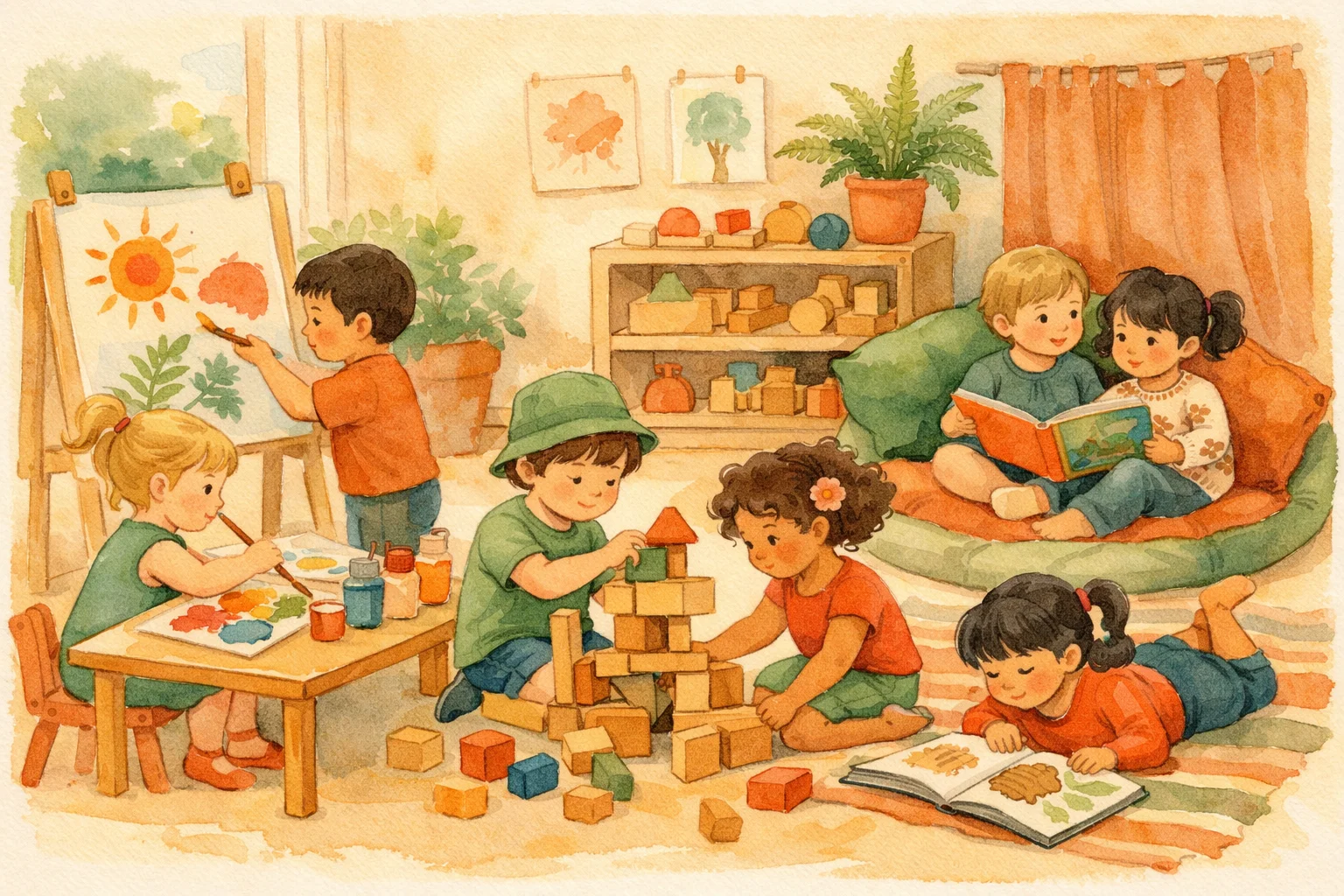
- Long stretches of play: sandpit, bikes, blocks, art, dramatic play, puzzles.
- Tidy-up and pack-up: a lot of kindergartens use this as part of the learning.
Many kindergartens use learning stories and portfolios so you can see what your child is working on over time, not just what they made that day.
Learning at kindergarten: Te Whāriki (play-based, but not anything goes)
All licensed early learning services, including kindergartens, use Te Whāriki as the curriculum. In plain language: play is the main way kids learn, but teachers are still planning, observing, and extending what your child is interested in.
If you're wondering what "school readiness" looks like in a Te Whāriki world, it's usually things like:
- coping with group routines (without melting down every time)
- taking turns and solving small conflicts
- confidence to have a go, even when it's hard
- language, storytelling, and early print awareness.
If you want to read the curriculum itself, the official site is https://tewhariki.tki.org.nz (sometimes blocked on work networks).
How to find a kindergarten and enrol (without the stress spiral)
Enrolment is simple in theory and messy in real life, especially if you're in an area with waitlists. My rule of thumb: start looking earlier than you think, even if your child is only two.
A practical step-by-step:
1. Shortlist a few nearby options. Use The Parent Circle's kindergarten page or jump straight to search.
2. Book a visit. Go at a normal time (not just the open day) so you can see the real rhythm.
3. Ask about session availability by age. Some kindergartens have specific sessions for younger kids.
4. Read the enrolment agreement carefully. This is where 20 Hours ECE hours, donations, and any optional charges should be clear.
5. Check holiday arrangements. If it's term-time, ask what local families do for school holidays.
6. Confirm start dates and settling. Many kindergartens do shorter visits first.
If you're weighing up a few options, it helps to compare them side-by-side. (We're building that into the platform, but for now, even a simple notes app list helps.)
How to do a quick quality check (including ERO reports)
If you want something more than a gut feeling, look up the Education Review Office (ERO) report for the service. ERO publishes review reports for early learning services on its website. Start here and search the kindergarten name: Education Review Office.
On top of that, ask a few simple, non-awkward questions on your visit:
- How do they handle kids who find drop-off hard?
- What happens when a child bites/hits (because it happens)?
- How do they communicate with parents during the week?
- What's the plan for children who might need extra support?
You're looking for calm, clear answers, not perfect marketing.
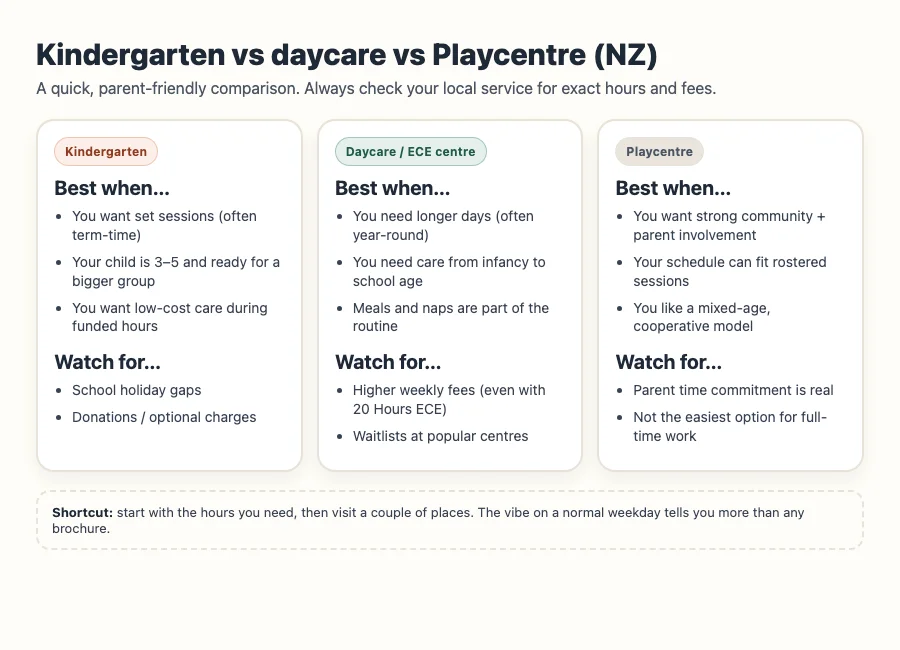
A quick visual: choosing between kindy, daycare, and Playcentre
If you're stuck between options, start with hours and holidays. Then think about what your child needs most right now: a smaller group, longer days, or a community where you're part of the programme.
FAQ
Do kindergartens take 2-year-olds in NZ?
Some do, some don't. Many kindergartens mainly enrol 3–5 year olds, but a number offer places for 2-year-olds depending on their association rules, licensing, and how they group sessions. Check the specific kindergarten's enrolment policy and what sessions are available at your child's age.
Can a kindergarten charge fees if it offers 20 Hours ECE?
A service can't charge fees for the hours claimed as 20 Hours ECE in your enrolment agreement. Fees can be charged for hours outside the 20-hours-a-week limit (and outside the 6-hours-a-day limit). Services may also request donations and can offer optional charges for specific extras, as long as parents have a real choice.
What's the difference between a kindergarten and an ECE centre?
Both are early learning services and both follow Te Whāriki. In day-to-day life, the difference is often hours and age mix: kindergartens commonly run set sessions and may be term-time, while education and care centres often provide longer days and year-round care, including infants.
How many hours a day can 20 Hours ECE cover?
The Ministry of Education says 20 Hours ECE can be used for up to 6 hours a day, up to a total of 20 hours a week for 3–5 year olds.
How do I check the quality of a kindergarten?
Start with a visit during a normal session and ask practical questions about routines, behaviour guidance, and communication. Then look up the service’s Education Review Office (ERO) report on https://ero.govt.nz by searching the service name.
What if my kindergarten closes for school holidays but I still need care?
This is common. Some families use a holiday programme, a casual ECE centre place, or family help. Remember you can split 20 Hours ECE across more than one service (within the 6-hours-a-day and 20-hours-a-week limits), which can help if you use a different service during holidays.
If you're weighing up kindy versus something with longer hours, it can help to list your non-negotiables first (hours, holidays, budget), then visit the services that fit. You'll get clarity quickly once you see how your child responds to the environment.
Find a kindergarten near you
Browse kindergartens in your suburb, check hours, and shortlist a few to visit.
Search kindergartensVideo
Related guides
Casual and Drop-In Childcare in NZ: Your Complete Guide
Casual and drop-in childcare lets NZ families book sessions without a fixed enrolment. This guide explains where to find it, what it costs, how WINZ subsidies apply, and what to look for in a licensed provider.
Te Kōhanga Reo: Māori Language Immersion ECE in NZ
Te Kōhanga Reo is Māori language immersion early learning. Learn how it works, who it suits, costs, subsidies, and how to enrol in NZ.
Playcentre NZ: The Parent-Led Early Childhood Model
Playcentre is NZ’s parent-led early learning option where you stay for the session. Learn how it works, costs, time commitment, and how to find one.
Home-Based Childcare in NZ: A Parent's Guide (2026)
Home-based childcare is licensed ECE in a home setting, usually up to 4 children with one educator. Learn costs, ratios, subsidies, and what to ask.
Find childcare near you
Search and compare providers by suburb, care type, cost, and availability.