
Resource Hub
Age-by-Age Guide: When Is the Best Time to Start Childcare?
Published · Last updated · 7 min read

Contents
What is the best age to start childcare in New Zealand?
There is no single best age. A good start is one that fits your family's needs, your child's temperament and a service that can offer warm, consistent care. For many NZ families, the timing is shaped by paid parental leave ending around six months, but quality and a gentle settling plan matter more than picking a magic age.
There is no magic age, but there are useful questions
Parents often ask this as though there is a hidden date on the calendar: six months, one year, three years. There is not. Some babies settle well with a familiar kaiako at six months. Some two-year-olds need more runway. A child who has happily stayed with grandparents may find a busy centre harder than a child who has already spent time with several trusted adults.
Start with the practical question, then make it human. When do you need care, how many hours do you need, and what kind of relationship can the service build with your child? The research does not support a universal perfect age. It does support paying close attention to responsive adults, group size, staff continuity and a settling process that does not rush a small person through a big change.
Video
Under six months: care can work, but the details matter
Starting before six months is not a verdict on your parenting. Some families need to return to work earlier, have limited leave, run a business, study or need support. At this age, look for a service that can follow your baby's feeding, sleep and comfort cues instead of forcing them into a generic room schedule. Ask who will usually greet your baby, who changes nappies, how bottle feeds are recorded, and what happens if the familiar person is away.
In a centre-based service, the legal minimum adult-to-child ratio for under-twos is 1:5. That is a floor, not a measure of warmth. During a visit, watch whether adults notice a baby's signals quickly and whether there is time for holding, floor play and unhurried feeds. If the room feels like everyone is moving at top speed, keep looking.
Ask about the ordinary moments
Six to 12 months: a common return-to-work window
For eligible parents, government-funded parental leave payments can run for up to 26 continuous weeks. That makes the six-month mark a common practical point for a childcare start, not a developmental deadline. Some families add annual leave, share care or use extended unpaid leave. Others cannot. Both situations deserve a plan rather than a guilt trip.
At this age, babies are becoming more mobile, interested in people and sensitive to changes in routine. Begin with short settling visits if the service offers them. Let your baby spend time with their usual kaiako while you are nearby, then build to a short separation. Send the same comfort item if allowed, use the same goodbye words, and ask for an update after the first handover rather than checking your phone every two minutes.
- Ask for a named main kaiako or a small, consistent caregiving group.
- Share your baby's current sleep, feeding and comfort routines in writing.
- Book settling visits before the first work week, not on the same morning as a new job starts.
- Plan a short first week if your budget and work arrangements allow it.
Twelve to 24 months: expect bigger feelings at drop-off
Toddlers know exactly who you are and are much more likely to protest when you leave. That does not mean they are too young for childcare. It means the goodbye needs to be clear, brief and predictable. A long negotiation at the door can accidentally teach a child that crying brings another round of farewell.
Look for a toddler room where adults get down to child level, name feelings and offer a simple activity after you leave. Ask what the service does during the first ten minutes after drop-off and how it will tell you whether your child settled. The legal minimum ratio changes at age two to 1:10 in centre-based services, so it is worth asking how the room is staffed at busy times, including meals, sleep transitions and staff breaks.
Two to three years: language and peer play start to change the day
Between two and three, many children are talking more, copying other children and testing every boundary within reach. They may enjoy a richer group environment, but that does not mean they will stride in without tears. Parallel play is still normal. Sharing is still a work in progress. A service should not sell you a toddler who is suddenly socially polished because they attend two days a week.
This can be a good age to try part-time care if you want a gentler start. The benefit is not that two days is inherently better than five. It is that the routine is predictable and the service has time to get to know your child. Try to keep the days regular. A Monday and Wednesday arrangement is usually easier for a toddler to understand than a different pattern every week.
Three years and older: more options, still no obligation
From age three, families may be able to use 20 Hours ECE through a participating service. It can cover up to six hours a day and 20 hours a week for eligible three, four and five-year-olds. It reduces fees through the provider, but it does not mean every child must start at three or attend full-time. Check the enrolment agreement for fees outside those funded hours and for any optional charges.
Some three-year-olds are ready for longer group days. Others are tired after a few hours, especially at the beginning. Kindergarten may be an option in your area, as may a preschool programme or a few regular days at a mixed-age centre. Visit at the time your child would actually attend. A quiet tour at 10am tells you very little about the late-afternoon pick-up rush.
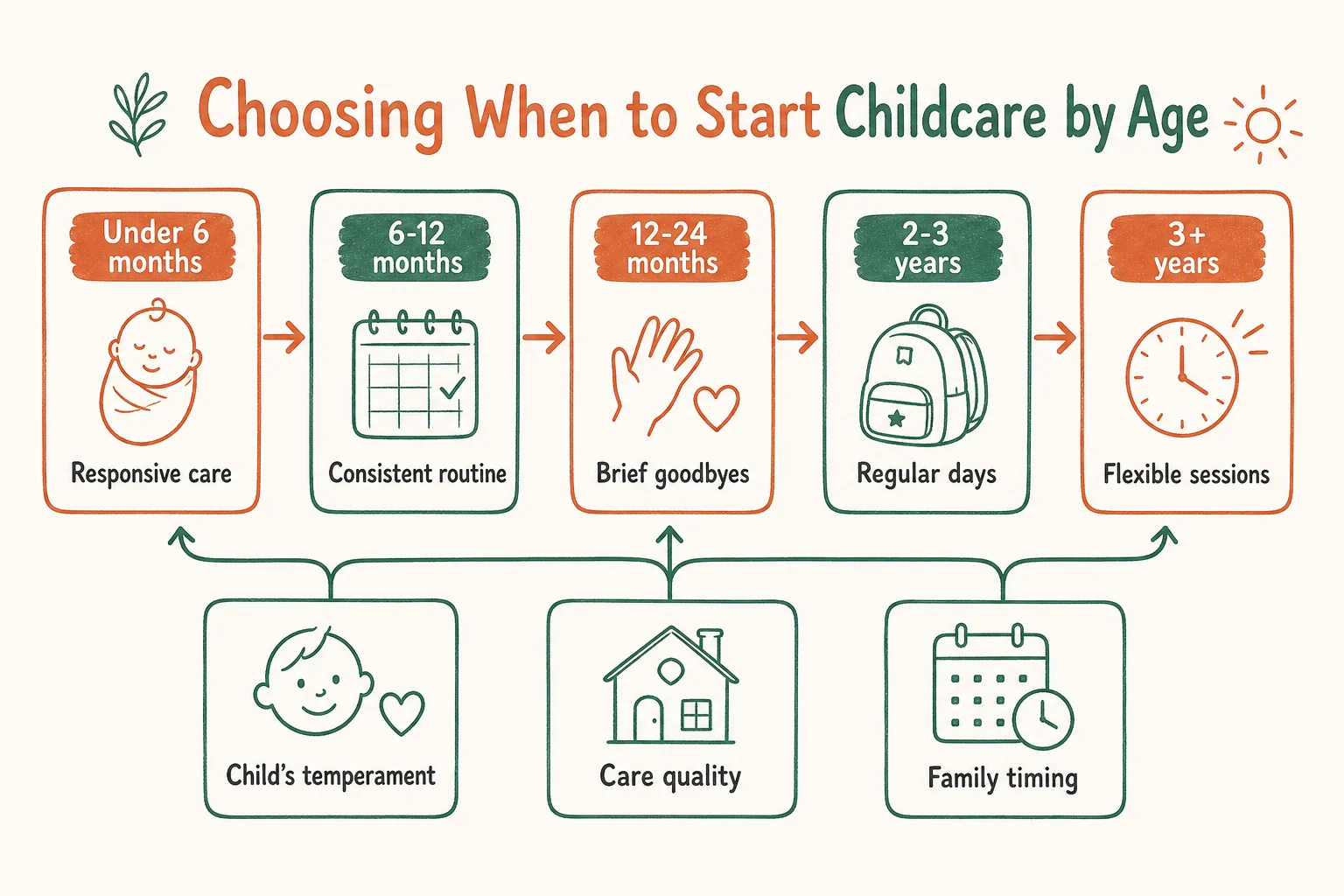
| Age band | What to look for | A sensible first step |
|---|---|---|
| Under 6 months | Responsive feeding, sleep and comfort care; low staff turnover | Short visits with the usual kaiako |
| 6-12 months | A consistent handover routine and clear daily updates | Build from a parent-present visit to a short separation |
| 12-24 months | Calm response to separation and a toddler-friendly arrival | Use the same brief goodbye each day |
| 2-3 years | Language-rich play, predictable days and staff who understand big feelings | Choose regular part-time days if that suits your family |
| 3+ years | A programme that fits energy, interests and your 20 Hours ECE plan | Start with manageable sessions and review after two weeks |
What the evidence says about age and outcomes
The honest answer is less dramatic than the internet makes it sound. Studies do not point to one age that reliably produces the best outcome for every child. Family income, parental wellbeing, the number of hours, the child's temperament and the quality of the setting all affect what researchers see.
The more consistent finding is that quality matters. Longitudinal research has linked better ratios, caregiver training and responsive interactions with stronger language and school-readiness outcomes. That does not let a centre hide behind a brochure. It gives you a reason to ask concrete questions about staff continuity, supervision and how kaiako respond when a child is distressed. If a place is a poor fit, waiting another six months may not fix it. Finding a better place might.
Minimum ratios are not the whole story
Choose the conditions, then choose the date
A useful decision has four parts: your care need, your child's current temperament, the quality of the available service, and how much time you can give the transition. Write down what you need from the arrangement before you start touring. Hours, commute, cost, language, food, sleep support and a child's additional needs all belong on the list.
Then give the arrangement a fair review period. The first few mornings are data, not a verdict. Ask the kaiako what happens after you leave, watch your child at home, and revisit the plan if the overall pattern is getting harder rather than easier. You are allowed to change the number of days, slow the handover or look for another provider.
Frequently asked questions
Is six months too young to start daycare in NZ?
No universal rule says six months is too young. It is a common return-to-work point because eligible parental leave payments can last up to 26 weeks. Focus on a service that can offer responsive, consistent infant care and use settling visits where possible.
What age is best for starting childcare?
The best age is the one that fits your family and a high-quality service. Research does not identify a single ideal age for every child. Caregiver responsiveness, ratios, staff continuity and a calm transition deserve more attention than a number on its own.
Can my child start childcare part-time?
Yes. Many services offer part-time enrolments where places are available. Regular days are usually easier for children to learn than a changing weekly pattern. Ask the service how it supports settling for children attending two or three days.
When can my child get 20 Hours ECE?
Eligible children can receive 20 Hours ECE from age three through participating services. It covers up to six hours a day and 20 hours a week. Confirm fees, hours and eligibility directly with the provider before enrolling.
What ratio should I expect at an early learning centre?
For centre-based services, the minimum adult-to-child ratio is 1:5 for children under two and 1:10 for children aged two and over. Ask how that works in your child's actual room, at drop-off, meals, sleep time and staff breaks.
You do not have to solve the whole childcare future today. Choose a service where the adults listen, the routine is clear and your child can build trust at their own pace. If you are planning the first few weeks, our complete guide to starting childcare, guide to settling in at childcare, and advice on daycare drop-off tears can help you make the first handovers less fraught.
Find age-appropriate care near you
Compare licensed early learning options that fit your family's timing and routine.
Search providersRelated guides
Childcare During Family Transitions: A NZ Parent's Guide
A practical NZ guide to supporting your child through separation, moving, grief and other family changes at childcare.
Childcare for Twins and Multiples in New Zealand
A practical guide to finding childcare for twins and multiples, with questions on places, routines, staffing and support.
Starting Childcare in NZ: A Complete Guide to Preparing Your Family
A practical NZ guide to preparing your child, yourself, and your daily routine for the first day, first week, and first month of childcare.
Casual and Drop-In Childcare in NZ: Your Complete Guide
Casual and drop-in childcare lets NZ families book sessions without a fixed enrolment. This guide explains where to find it, what it costs, how WINZ subsidies apply, and what to look for in a licensed provider.
Find childcare near you
Search and compare providers by suburb, care type, cost, and availability.