
Resource Hub
How to Handle Daycare Drop-Off Tears (Without Losing It Yourself)
Published · Last updated · 8 min read

Contents
How should you handle daycare drop-off tears?
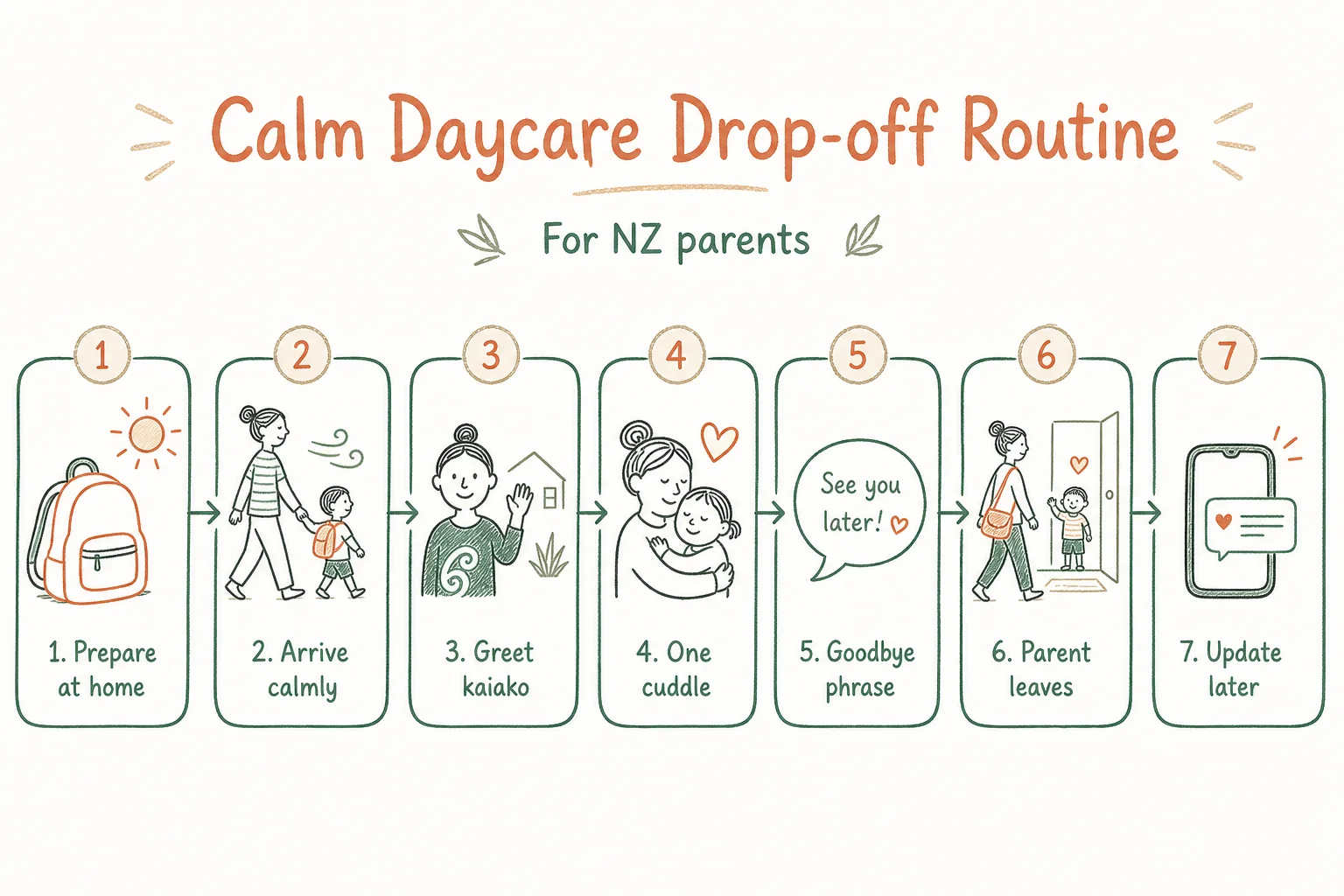
Keep the goodbye short, warm, and predictable, then let a trusted kaiako take over. Most tamariki settle faster when the routine is the same each day: arrive calmly, connect with one teacher, say the same goodbye phrase, leave once, and ask for a quick update later rather than hovering at the door.

First, breathe. Tears do not mean you have failed
Daycare drop-off tears can undo even the most organised morning. One minute you are holding a lunchbox and tiny gumboots. The next, your child is clinging to your leg and you are trying to look calm while your stomach drops.
For many children, crying at drop-off is a normal response to separation. It often means, "I love you, I want you, and this new place still feels big." It does not automatically mean the centre is wrong, the kaiako are cold, or you should cancel your return-to-work plan by 8:47am.
The job is not to make every tear vanish on day one. The job is to build a routine your child can trust. In New Zealand ECE, that should happen through warm relationships, whānau partnership, and a settling plan that respects your child as a whole person, not a problem to be processed.
What is normal at drop-off, and what needs attention
Normal drop-off distress is usually sharp but short. Your child cries as you leave, accepts comfort from a kaiako, then slowly joins play, kai, outside time, or a familiar routine. Some children settle in five minutes. Others need more time, especially after illness, holidays, room changes, or a patch of poor sleep.
| Age or stage | What you might see | What usually helps |
|---|---|---|
| Babies under 2 | Crying, reaching, needing a familiar adult and repeated comfort | A slower settling plan, one primary kaiako, familiar sleep and feeding cues |
| Toddlers around 2 to 3 | Big feelings, clinging, protest at the door, then play once you leave | A short goodbye script, the same handover spot, comfort object if allowed |
| Older preschoolers | Questions, bargaining, tears after a change, anxiety about when you return | Concrete pick-up markers such as after afternoon tea, visual routines, honest reassurance |
Age matters, but temperament and the centre relationship matter too.
What needs attention is distress that does not ease at all. If your child stays upset for long stretches every day, stops eating or sleeping well, has new toileting regression, complains of tummy aches before care, or seems frightened of a specific person or place, pause and review the plan with the centre.
Ask for specific facts
The seven-step drop-off routine that works
A good drop-off routine is boring in the best possible way. Same order. Same words. Same handover. Children borrow confidence from repetition.
Start earlier than you think you need to. A rushed parent often becomes a rushed child, and a rushed child has fewer emotional reserves at the door. If mornings are consistently ugly, move one decision to the night before: clothes, bag, lunchbox, sunscreen, shoes by the door. Tiny frictions become enormous when everyone is tired.
The best arrival time is not always the official start time. Some children settle better if they arrive before the room is busy and can attach to one kaiako. Others do better when the first activity is already underway and they can step into play. Ask the centre what they notice. A ten-minute shift can change the whole handover.
- Prepare before you leave home. Name the plan in simple language: "Breakfast, shoes, childcare, then Dad comes back after afternoon tea."
- Arrive with one small job. Let your child carry their hat, drink bottle, or comfort item so they enter with purpose.
- Greet one kaiako by name. This matters. Your child sees that you trust the adult who is taking over.
- Use the same goodbye ritual every time: one cuddle, one kiss, one wave, then you go.
- Say when you will return using a child-friendly marker, not clock time: after lunch, after rest time, after afternoon tea.
- Leave once. Do not come back for a second goodbye unless the centre has asked you to because of a real issue.
- Ask for a short update later. A photo, message, or honest note from the kaiako can stop your brain inventing disasters all morning.
Use a script your child can remember
Children do better with plain words than big speeches. Pick a sentence and keep it. You might say: "I love you. You are safe with Ana. I will come back after afternoon tea." Then hand over, smile, and go.
For toddlers, avoid vague promises like "I will be back soon". Soon means nothing when you are two. Link pick-up to the centre rhythm: kai time, sleep time, outside play, afternoon tea, then home.
Your calm does not have to be fake-perfect
Work with kaiako before the hard mornings happen
Te Whāriki, New Zealand's early childhood curriculum, puts relationships and belonging at the centre of learning. That matters at drop-off. Your child is not settling into a building. They are settling into relationships with kaiako, other tamariki, and the daily rhythm of the centre.
Before the first full day, tell the centre what actually helps at home. Do they like being held tightly or do they need space? Do they calm with songs, books, outside play, water, a soft toy, or helping with a job? Do they use te reo Māori, Nepali, Hindi, Samoan, Mandarin, or another home language for comfort words? Small details can make the handover gentler.
- Who will be the main kaiako during settling?
- What will you do if my child cries after I leave?
- How long do children usually take to settle here?
- Can we use a comfort item or family photo?
- Will you message me if they are still upset after a set time?
- What signs tell you my child is starting to feel safe?
If a centre treats your questions as annoying, notice that. Good settling is a partnership with whānau. You are allowed to ask for a plan, clear communication, and honest feedback.
What not to do, even when you are desperate
Some common moves make drop-off worse, even though they come from love. Sneaking out is the big one. It may avoid a scene today, but it teaches your child to watch you closely tomorrow because you might disappear.
- Do not sneak away while your child is distracted. Say goodbye every time.
- Do not stretch goodbye into ten more cuddles, two returns, and a negotiation at the gate.
- Do not promise treats for no crying. Your child needs safety, not a performance target.
- Do not threaten childcare as a consequence. The centre should not become the scary place in your family language.
- Do not change the routine every morning unless the current plan clearly is not working.
Long goodbyes are especially tempting because they feel kinder in the moment. Often they are kinder to the parent than the child. A calm, clean handover gives the kaiako room to help your child settle.
When does drop-off crying get better?
There is no magic number, but there is a pattern. The first few days can be emotionally noisy. By the second or third week, many children still protest at the door but settle faster after you leave. By the first month, you should usually see some sign of progress: shorter crying, a stronger bond with one kaiako, more play, better eating, or fewer anxious questions at home.
Attendance pattern matters here. Two short days a week can work beautifully for some families, but it can also stretch the settling period because each visit still feels new. If your child attends part-time and the tears are not easing, ask whether the days are too far apart, whether a run of consecutive settling visits would help, or whether a shorter day with a calm pick-up is better than pushing through one very long day.
| Timeframe | What may be normal | What to do |
|---|---|---|
| First week | Tears, clinginess, unsettled sleep, tired afternoons | Keep the routine consistent and ask for daily settling notes |
| Weeks 2 to 3 | Crying still happens, but recovery is faster | Fine-tune handover, comfort item, arrival time, or key kaiako support |
| After 4 weeks | Some wobble is normal, but there should be improvement | Book a proper review if distress is still intense or spreading into home life |
Progress can be uneven. Look for direction, not perfection.
If the pattern is getting worse, trust that information. It may be the timing, the hours, the room, the sleep load, the teacher match, or the centre fit. You do not need to panic, but you do need to investigate.
How to handle your own guilt
Drop-off tears hit parents hard because they happen in public and at the exact moment you have to walk away. That can feel brutal. Many working parents then spend the commute replaying the scene, wondering if everyone else has somehow found a calmer child, a better centre, or a stronger nervous system.
Be careful with that story. Your child's protest does not mean you are abandoning them. It means separation is hard today. If they are being comforted, included, and gradually settling, they are learning that you leave and come back. That is a real developmental skill.
A practical trick: agree with the centre on an update window. For example, "If he is still very upset after 20 minutes, please message me. Otherwise, send me a quick update by 10am." That gives your brain a container. Without one, worry will fill the whole morning.
When to get extra support
Get extra help if distress is intense, persistent, or affecting your child's wider life. That includes ongoing sleep changes, eating changes, repeated tummy aches, new aggression or withdrawal, toileting regression, or panic that starts well before you reach the centre.
Start with a meeting at the centre. Ask what they see after you leave and what they recommend changing. If you are still worried, talk with your GP, Plunket nurse, Well Child Tamariki Ora provider, or another child health professional. Children with additional needs, previous trauma, major family change, or sensory sensitivities may need a more individual transition plan.
Also watch your own instincts. Parents sometimes minimise a concern because they do not want to seem demanding. You do not need to apologise for asking how your child is being comforted. A good service will be able to describe its settling practice clearly and calmly.
Useful NZ links and next steps
For the wider transition, read our Starting childcare in NZ guide. If you are still choosing a service, our guide to daycare and centre-based care in NZ explains what centre routines usually look like. You can also use The Parent Circle to search for ECE providers near you and compare options before you enrol.
- Ministry of Education: Starting early childhood education
- Te Whāriki: New Zealand early childhood curriculum
- Education Review Office: early childhood education reviews
- Triple P Parenting: easier drop-offs
FAQ
Is it normal for my toddler to cry every daycare drop-off?
Yes, especially in the early weeks or after a change in routine. What matters is whether your child settles after you leave and whether the pattern gradually improves.
Should I stay until my child stops crying?
Usually no. A short, warm, predictable goodbye is often easier for children than a long goodbye that keeps restarting the separation.
Is it okay to sneak out if my child is distracted?
No. Sneaking out can make children more watchful and anxious next time. Say goodbye clearly, even if they cry.
How long should daycare settling take?
Many children improve over two to four weeks, but temperament, age, attendance pattern, sleep, and the centre relationship all matter. Look for steady progress rather than a perfect deadline.
What if my child keeps crying for weeks?
Book a meeting with the centre and ask for specific observations. If distress is intense, not improving, or affecting sleep, eating, behaviour, or home life, talk with a child health professional.
Drop-off tears are not easy. But with a steady routine, a trusted kaiako, and honest communication, most children learn the rhythm: my parent leaves, I am cared for, I play, and my parent comes back. That rhythm is the comfort.
Find a centre that supports gentle settling
Search 4,394+ licensed ECE providers across New Zealand and compare options near your home or work.
Find childcare near youRelated guides
Understanding Te Whāriki: How NZ's National Curriculum Shapes Every ECE Centre
A parent's guide to Te Whāriki, New Zealand's early childhood curriculum, and how its principles and strands shape daily learning at ECE.
Your Child's First Illness from Daycare: What NZ Parents Need to Know
A calm NZ guide to the first daycare illness season: what is normal, when children need to stay home, when to call Healthline, and how working parents can plan for sick days.
What to Pack for Daycare: The Complete Checklist for NZ Parents
A practical NZ daycare bag checklist covering spare clothes, nappies, bottles, lunchboxes, sun hats, comfort items, medication, labels, and what to leave at home.
Returning to Work After Parental Leave: Managing the Childcare Transition
A practical NZ guide to timing childcare, flexible work, breastfeeding, sick days, and the emotional jump back into work after parental leave.
Find childcare near you
Search and compare providers by suburb, care type, cost, and availability.