
Resource Hub
Teacher-to-Child Ratios in NZ: What the Numbers Actually Mean for Your Child
Published · Last updated · 5 min read

Contents
What are the teacher-to-child ratios for childcare in New Zealand?
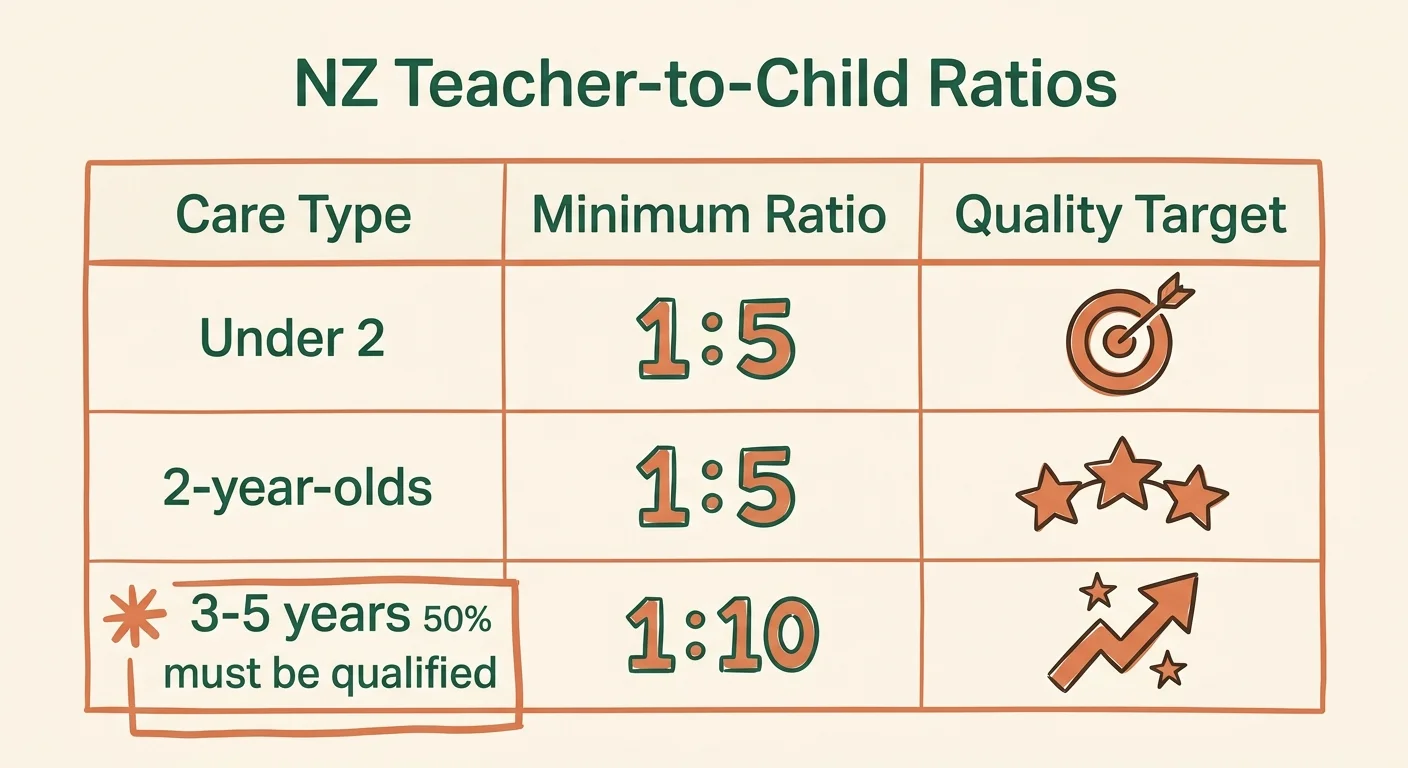
The legal minimum is 1 adult to 5 children for under-2s, and approximately 1:10 for children aged 2 and over in centre-based services. Home-based care allows a maximum of 4 children under 6 per educator. These are minimums — quality centres often do better, especially for infants where 1:3 or 1:4 is common. Always ask about 'effective ratios' during your visit, because the numbers on paper don't account for lunch breaks, nappy changes, and non-contact time.
Why ratios matter more than almost anything else
A teacher-to-child ratio isn't just a number on a licence. It's the difference between your toddler getting a comforting cuddle when they're upset and standing in a queue waiting for attention. It's whether a teacher notices your baby is off-colour at 10am or only realises at pickup.
Decades of research confirm what any parent already suspects: lower ratios (fewer children per adult) lead to better outcomes. More individual attention, stronger attachments, earlier identification of developmental concerns, and less teacher burnout. The question isn't whether ratios matter — it's whether New Zealand's legal minimums are good enough for your child.
NZ's legal minimum ratios
These ratios are set by the Ministry of Education and apply to all licensed teacher-led ECE centres in New Zealand.
Centre-based services (all-day and sessional)
| Age Group | Children | Minimum Adults Required | Effective Ratio |
|---|---|---|---|
| Under 2 years | 1-5 | 1 | 1:5 |
| Under 2 years | 6-10 | 2 | 1:5 |
| 2 years and over | 1-6 | 1 | 1:6 |
| 2 years and over | 7-20 | 2 | 1:10 |
| 2 years and over | 21-30 | 3 | 1:10 |
| 2 years and over | 31-40 | 4 | 1:10 |
Home-based care
- Maximum 4 children under 6 years per educator
- No more than 2 children under 2 at any time (unless they're siblings)
- If more than 3 siblings under 2 are present, 2 educators are required
These ratios date from the 1960s
Legal minimum vs what actually happens
Here's the gap most parents don't know about. The legal ratio must be maintained at all times — including during lunch breaks, nappy changes, and teacher non-contact time. In theory, centres need extra staff to cover these periods. In practice, many centres run right at the minimum.
That means when one teacher in a room of 20 two-year-olds steps away to change a nappy, the remaining teacher is supervising 19 children alone. Technically the ratio is still met across the centre. Practically, one adult is watching 19 toddlers.
Some centres also use Regulation 44A flexibility, which allows spare capacity in the under-2 area to be counted toward over-2 ratios. This is legal but dilutes supervision quality. Ask whether the centre uses this regulation — it's a fair question.
What quality centres actually do
Centres that take quality seriously don't just meet the minimum. Here's what better looks like:
| Age Group | Legal Minimum | Quality Target | Why It Matters |
|---|---|---|---|
| Under 2 | 1:5 | 1:3 or 1:4 | Infants need rapid response to distress, feeding, and developmental cues |
| 2-3 years | 1:10 | 1:5 or 1:6 | Toddlers are mobile, curious, and need constant active supervision |
| Over 3 | 1:10 | 1:8 | Older children benefit from more meaningful small-group interactions |
Quality centres also aim for 100% qualified ECE teachers in their ratios. The legal minimum is 50% qualified — meaning half the adults counting toward ratios may have no ECE qualification at all. That's a significant quality variable.
The 50% qualified teacher rule
Current regulations require at least 50% of the adults in ratios to hold a recognised ECE qualification (typically a diploma or degree). Additionally, a "person responsible" — a qualified and certificated teacher — must be present for every 50 children enrolled.
This means in a room with two adults and 10 toddlers, only one needs to be qualified. The other could be an unqualified teacher aide, a student, or a reliever with no ECE training. That's legal. Whether it's good enough for your child is a different question.
How to ask about ratios during a visit
Don't just ask "what are your ratios?" — every centre will recite the legal minimum. Ask questions that reveal what actually happens:
- "What's your effective ratio when teachers are on breaks or doing non-contact time?" — This reveals whether they staff above minimum to maintain quality during transitions.
- "What percentage of your teaching staff are fully qualified ECE teachers?" — Anything above 80% is strong. 50% is the legal floor.
- "Have you opted into Pay Parity?" — Centres that pay teachers at kindergarten/primary rates tend to attract and retain better qualified staff.
- "How do you handle it when a teacher calls in sick?" — Their answer tells you whether they have float staff or whether ratios take a hit on bad days.
- "Do you use Regulation 44A?" — Most parents won't know this exists. Asking it signals you've done your homework.
- "Can I see the daily roster?" — A confident centre will share it. You can count heads yourself.
How NZ compares internationally
NZ's 1:5 for under-2s and 1:10 for over-2s are criticised as outdated — rooted in 1960s-era standards that haven't kept pace with what we now know about early brain development. Many OECD countries mandate tighter ratios, particularly for infants.
The NZEI Te Riu Roa has been vocal that NZ's ratios contribute to teacher burnout, high turnover, and difficulty attracting new graduates into the ECE workforce. Better ratios would mean more teachers needed — which means more funding — which is where the political challenge lies.
Frequently asked questions
Are ratios the same for kindergartens and daycare centres?
Yes. Both fall under the same MOE regulations for teacher-led centres. The ratios are 1:5 for under-2s and up to 1:10 for children aged 2 and over, regardless of whether it's a kindergarten, daycare, or education and care centre.
What happens if a centre breaks the ratio requirements?
It's a breach of licensing conditions. MOE can issue warnings, impose provisional licence conditions, or in serious cases revoke the licence entirely. If you believe a centre is consistently understaffed, report it to the Ministry of Education.
Do ratios include parent helpers or volunteers?
No. Only paid staff members count toward the regulated adult-to-child ratio. Parent volunteers and visitors are extras — they can't be relied on to meet the minimum.
Why are infant care ratios stricter?
Babies need more individual attention — feeding, nappy changes, sleep monitoring, and emotional comfort take significant one-on-one time. The 1:5 ratio for under-2s reflects the higher physical care demands, though many experts argue it should be 1:3 or 1:4.
Can I find out a centre's actual ratios before visiting?
Centres aren't required to publish their ratios, but their licence (available on the MOE directory) shows the maximum number of children permitted. You can compare that against staff numbers. For real-time ratios, you'll need to ask during a visit or call.
Ratios are one of the clearest quality signals in childcare. A centre that exceeds the minimum is making a deliberate investment in your child's experience. One that scrapes by at the legal floor is cutting costs — and children feel the difference.
Want to compare centres on ratios and other quality factors? Use our comparison tool to evaluate your shortlist side by side, or search for providers near you to start building that list.
Compare centres on what matters
Use The Parent Circle's comparison tool to evaluate centres on ratios, fees, ERO ratings, and more.
Compare centresRelated guides
Childcare During Family Transitions: A NZ Parent's Guide
A practical NZ guide to supporting your child through separation, moving, grief and other family changes at childcare.
Childcare for Twins and Multiples in New Zealand
A practical guide to finding childcare for twins and multiples, with questions on places, routines, staffing and support.
Steiner/Waldorf ECE in NZ: A Parent's Guide
A practical guide to Steiner/Waldorf early childhood education in New Zealand, including Te Whāriki, centre visits and questions for parents.
Reggio Emilia in NZ: Understanding the Reggio-Inspired Approach to ECE
A practical NZ guide to Reggio-inspired early learning, from inquiry and documentation to questions for your centre visit.
Find childcare near you
Search and compare providers by suburb, care type, cost, and availability.