
Resource Hub
Childcare Waitlists in NZ: How to Get Off the List and Into a Spot
Published · Last updated · 7 min read

Contents
How long are childcare waitlists in New Zealand?
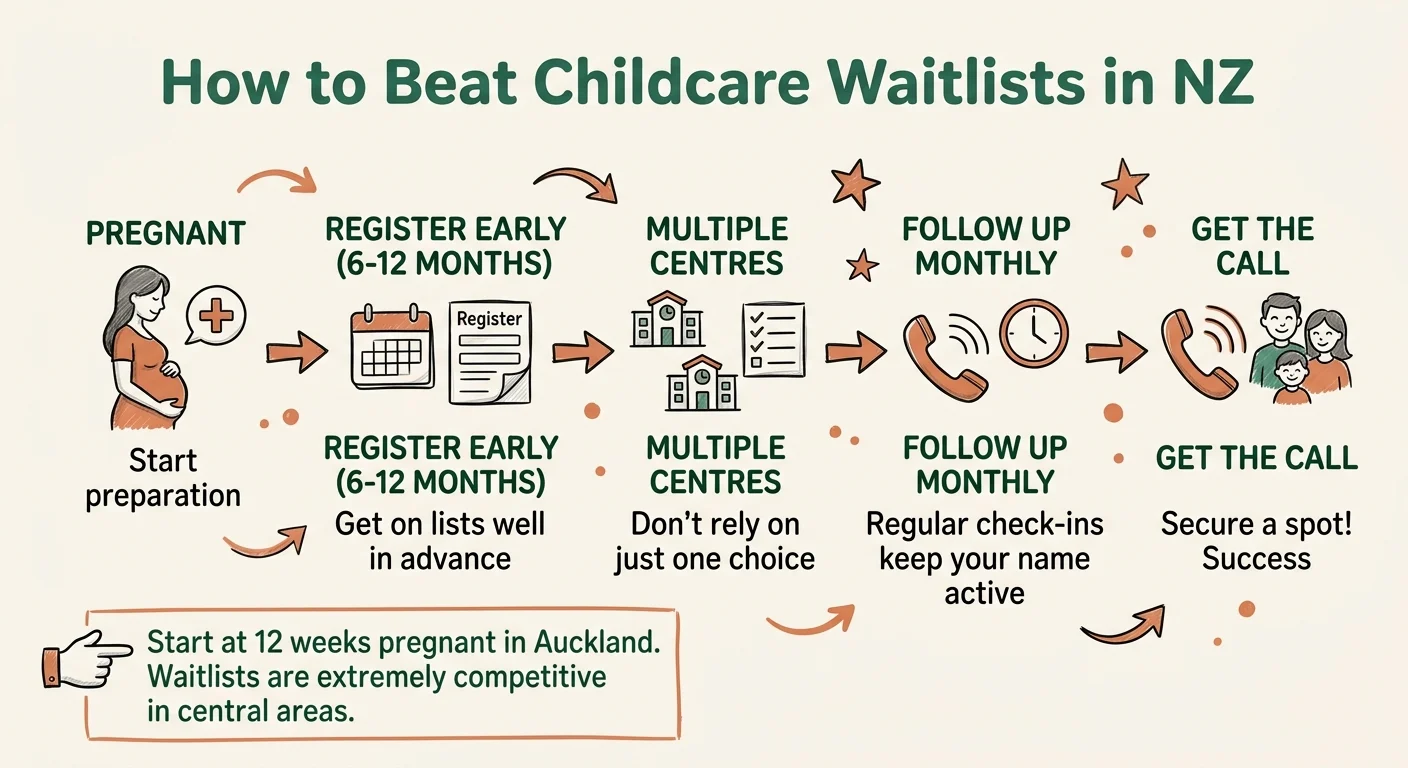
In Auckland and Wellington, expect to wait 6–12 months for under-2 care. Smaller centres and regional towns may have waits of 3–6 months. Over-3 spots are easier to find because more centres cater to that age group and 20 Hours ECE funding kicks in. The single best thing you can do is start looking during pregnancy and put your name on 5–10 waitlists.
The waitlist reality in NZ
Forty-three percent of NZ ECE facilities report waitlists for children aged two or younger. That's almost half of all centres turning families away — not because they don't want your child, but because they physically can't fit more tamariki into rooms that are already at capacity.
The maths behind it is simple. Licensed centres must maintain a ratio of 1 adult to every 5 children under 2. Infant rooms are small. Staff are expensive. And with teacher numbers dropping 1% in 2024 while enrolments rose 2%, the squeeze is getting tighter.
Across New Zealand's 4,662 licensed early learning services, occupancy rates tell the story. Kindergartens run at 82.5% capacity. Education and care centres — the ones most parents call "daycare" — are often above 90% for under-2 rooms. In Auckland's inner suburbs, some centres haven't had an infant vacancy in over a year.
When to start looking (by region)
The short version: earlier than you think. If you're pregnant and reading this, you're right on time. If your baby is already here and you haven't started, don't panic — but start today.
| Region | Under-2 Care | Over-2 / Over-3 Care | When to Start Looking |
|---|---|---|---|
| Auckland (central/inner) | 6–12+ months | 3–6 months | First trimester |
| Auckland (outer suburbs) | 4–9 months | 2–4 months | Second trimester |
| Wellington / Lower Hutt | 6–12 months | 2–4 months | First trimester |
| Christchurch | 3–6 months | 1–3 months | Second trimester |
| Hamilton / Tauranga | 3–6 months | 1–3 months | Second trimester |
| Smaller towns / rural | 1–3 months | Often immediate | Third trimester |
Under-2 spots are the bottleneck
How childcare waitlists actually work
There's no national waitlist system in NZ. Each centre manages its own, and the rules vary. Some large providers like BestStart or Lollipops have centralised online systems where you can register for multiple locations at once. Smaller community centres may still use a paper form you pick up at the front desk.
Waitlist fees
Most centres charge a waitlist or registration fee — typically between $25 and $100. This covers their admin costs and is almost always non-refundable, regardless of whether you ever get a spot. A few centres charge nothing. Others charge up to $150. If a centre asks for more than $200 as a "waitlist deposit," ask what exactly it covers and whether any portion is credited toward fees.
Priority systems
Waitlists aren't always first-come, first-served. Many centres use priority criteria that can bump families up the queue:
- Siblings of enrolled children — this is the most common priority. If your older child already attends, their baby brother or sister usually jumps the queue.
- Children of staff — teachers and administrators at the centre often get spots for their own kids.
- Employer-sponsored care — workplace-linked centres prioritise employees of the sponsoring organisation.
- Equity priorities — some centres give priority to Māori, Pacific, or lower-income whānau to boost participation rates in underserved communities.
- Age group needs — a centre might prioritise an 18-month-old over a 3-month-old if they need to fill a specific age band.
No cap on waitlist numbers
Most centres don't limit how many names go on the list. A waitlist of 40 families for 3 annual vacancies sounds grim, but it's misleading — many of those families are on multiple lists and will accept a spot elsewhere. Good centres will tell you honestly where you stand. If they won't, that tells you something too.
Seven strategies to improve your chances
- Cast a wide net. Put your name on 5–10 waitlists, not just your top pick. You can always decline a spot you don't want. Use The Parent Circle's search tool to find all licensed centres near you.
- Be flexible on days. If you need three days, say you'll take any three — not just Monday/Wednesday/Friday. Centres fill specific day patterns and flexibility makes you easier to slot in.
- Consider a mid-year start. January is when everyone wants to begin. Centres often have more openings in April, July, or October when other families move or change arrangements.
- Stay in touch. Don't pay your waitlist fee and disappear. Call or visit every 6–8 weeks. Be friendly, remember names, ask how things are going. The centre administrator who knows you is more likely to think of you when a spot opens.
- Be ready to move fast. When a spot is offered, you'll typically have 48 hours to 2 weeks to respond. Have your decision criteria sorted in advance so you're not scrambling. Our comparison tool can help you pre-rank your options.
- Try less obvious options. A centre two suburbs over might have no waitlist at all. The commute adds 10 minutes but saves you 6 months of waiting. Home-based care networks rarely have long waits.
- Ask about upcoming capacity changes. Some centres are expanding rooms, adding a new building, or adjusting age groups. If a centre is adding 10 infant spots in March, getting on that waitlist now is strategic.
What to do while you wait
Waiting for a childcare spot doesn't mean you have no options. Several alternatives can fill the gap — and some families discover they prefer these arrangements.
Home-based care
Home-based educators care for up to 4 children in their own home (or yours), with a maximum of 2 under-2s at a time. Networks like PORSE, Barnardos, and jigsaw run across NZ, providing training, oversight, and coordination. Waitlists are typically shorter because the educator-to-child ratio is already small. Costs are similar to centre-based care, and home-based services are eligible for 20 Hours ECE once your child turns 3.
Playcentre
Playcentre is a parent-led cooperative model unique to NZ. Parents stay and participate alongside their children, learning facilitation skills through the Playcentre education programme. Sessions run 2–3 times per week and fees are minimal (often under $100 per term). It's not a replacement for full-time care, but it's a great supplement — especially if you're on parental leave and want your child to socialise while you wait for a centre spot. There are over 400 Playcentres across NZ.
Nanny or au pair
A private nanny has no waitlist — you're the employer. Costs run $22–$30/hour, which is steep for one family but more manageable as a nanny share with another whānau. Au pairs from overseas cost less (around $250–$350/week plus board) but come with visa and pastoral care requirements. Both options buy you time while you wait for a centre-based spot.
Whānau and grandparents
If you have family nearby, informal care from grandparents or other relatives is the most common bridge. It's free, familiar, and your child already trusts the people involved. The trade-off is that it depends heavily on your family's availability and willingness. Be upfront about expectations and don't assume — ask.
When you get the call
The moment a centre offers you a spot, the clock starts. Most centres give you somewhere between 48 hours and two weeks to confirm. Some ask for an enrolment deposit (typically $100–$300, usually credited to your first invoice). Others just want a signed enrolment form.
Before you say yes, confirm these details:
- Start date — can you negotiate a later start if you're not quite ready?
- Days and hours available — do they match what you actually need?
- Settling-in process — most centres offer 2–4 free settling visits before your child's official start date.
- Fee structure — weekly or fortnightly? What's the daily rate? Are there charges for sick days or holidays?
- Notice period — typically 2–4 weeks if you decide to leave.
Don't drop your other waitlists too early
Frequently asked questions
Should I put my baby on waitlists before they're born?
Yes. In Auckland and Wellington, many parents register during the first or second trimester. Most centres accept waitlist applications before birth — you'll just provide an estimated due date. There's no downside to registering early.
Are childcare waitlist fees refundable?
Almost never. Waitlist fees ($25–$100) cover administrative costs and are non-refundable at most centres, whether or not you receive a spot. A few centres don't charge anything. Always ask before paying.
Can I be on multiple waitlists at the same time?
Absolutely. In fact, it's recommended. Most parents in high-demand areas register at 5–10 centres. Centres expect this — it's why their waitlists are longer than the actual number of families waiting.
Why is it so much harder to find care for under-2s?
Stricter ratios (1 adult to 5 children vs 1:10 for over-2s) mean infant rooms are smaller and more expensive to run. Fewer centres offer under-2 care at all, and those that do have limited spots. The 20 Hours ECE subsidy also doesn't kick in until age 3, making under-2 care the most expensive bracket.
What if I need care urgently and can't wait months?
Home-based care networks (PORSE, Barnardos, jigsaw) often have faster availability than centres. A private nanny has no waitlist. You can also check The Parent Circle for centres in nearby suburbs that may have shorter queues — sometimes a 10-minute drive makes a 6-month difference.
Do waitlists get shorter once my child turns 3?
Generally, yes. Over-3 rooms have more capacity because ratios allow 1:10 instead of 1:5. Plus, 20 Hours ECE funding makes places more financially viable for centres to run. Kindergartens (which mostly serve 3–5 year-olds) often have the shortest waits of any service type.
Waitlists are frustrating, but they're not random. Start early, register widely, stay in contact, and keep your options open with alternatives like home-based care or Playcentre while you wait. For a starting point, search for licensed providers near you on The Parent Circle — across 4,394+ centres and home-based services in 1,026 suburbs, there's a better chance of finding a spot than you might think.
For a broader look at how to evaluate and choose between your options once you do get offered a spot, read our complete guide to choosing childcare in NZ.
Find childcare near you
Search across 4,394+ licensed providers on The Parent Circle. Filter by age group, location, and availability to find centres with shorter waitlists in your area.
Search providersRelated guides
Faith-Based Childcare in NZ: What Parents Should Know
A practical guide to faith-based childcare in New Zealand, including licensing, Te Whariki, inclusion and questions to ask before enrolment.
Nature-Based and Forest Kindergartens in NZ: A Parent Guide
Curious about forest kindergarten or nature-based ECE in NZ? Learn how it works, what to ask, safety checks, costs, gear and whether it fits your child.
How Much Does Childcare Cost in NZ? The Complete 2026 Guide
Childcare in New Zealand costs between $150 and $450 per week for full-time care in 2026. This guide breaks down costs by care type, child age, and region — plus every subsidy available to reduce your bill.
When Should You Start Looking for Childcare? A Timeline for NZ Parents
Most NZ parents start looking too late. Here's a trimester-by-trimester timeline for finding childcare, with regional waitlist data and backup options if you're already behind.
Find childcare near you
Search and compare providers by suburb, care type, cost, and availability.