
Resource Hub
Pacific Language Immersion ECE in NZ: A'oga Amata, Punanga Reo & More
Published · Last updated · 7 min read

Contents
What is Pacific language immersion ECE in NZ?
Pacific language immersion ECE centres, including A'oga Amata (Samoan), Punanga Reo (Cook Islands Māori), and Tongan and Niuean equivalents deliver early childhood education entirely or mostly in a Pacific language. They're licensed ECE services, qualify for 20 Hours ECE funding, and follow Te Whāriki through the Pacific curriculum pathway Te Ara Whānui. Most are in Auckland, Wellington, and Christchurch.
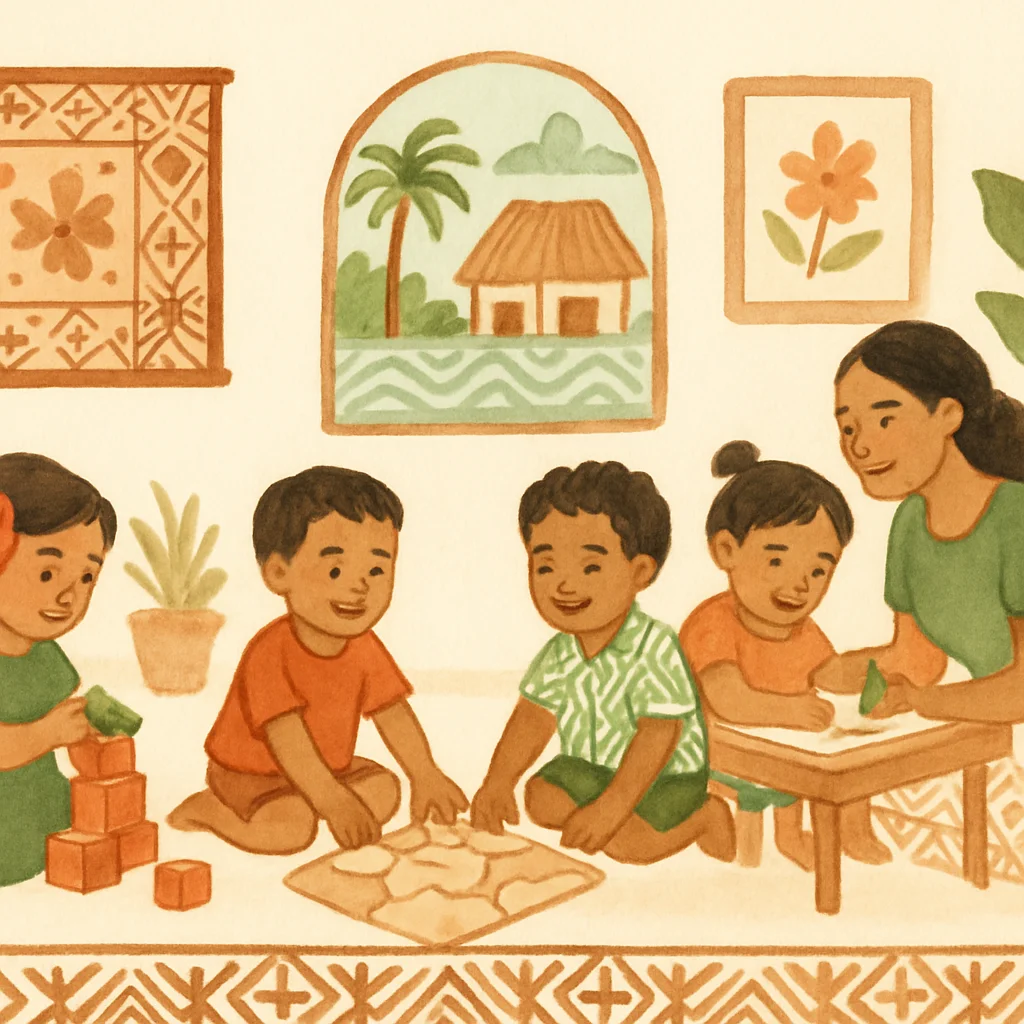
Language starts before school. That's the point.
For many Pacific families in Aotearoa, the home language is fading. Parents who grew up speaking Samoan, Tongan, or Cook Islands Māori at home now find their kids defaulting to English before they even start primary school. Pacific language immersion ECE was built specifically to interrupt that pattern.
These centres don't just teach a language as a subject. Children live and play in it, all day, every day. Research on language acquisition consistently shows that the early childhood years (0–5) are when the brain is most receptive to fluency. Once that window closes, heritage language recovery becomes much harder.
This is a small sector. Pacific immersion services make up roughly 0.1% of all licensed ECE providers in NZ. But for families who want them, they offer something no mainstream centre can: a full-immersion environment where Samoan or Cook Islands Māori is the default, not the exception.
The main types: A'oga Amata, Punanga Reo, and others
Each Pacific community has developed its own model, named in its own language:
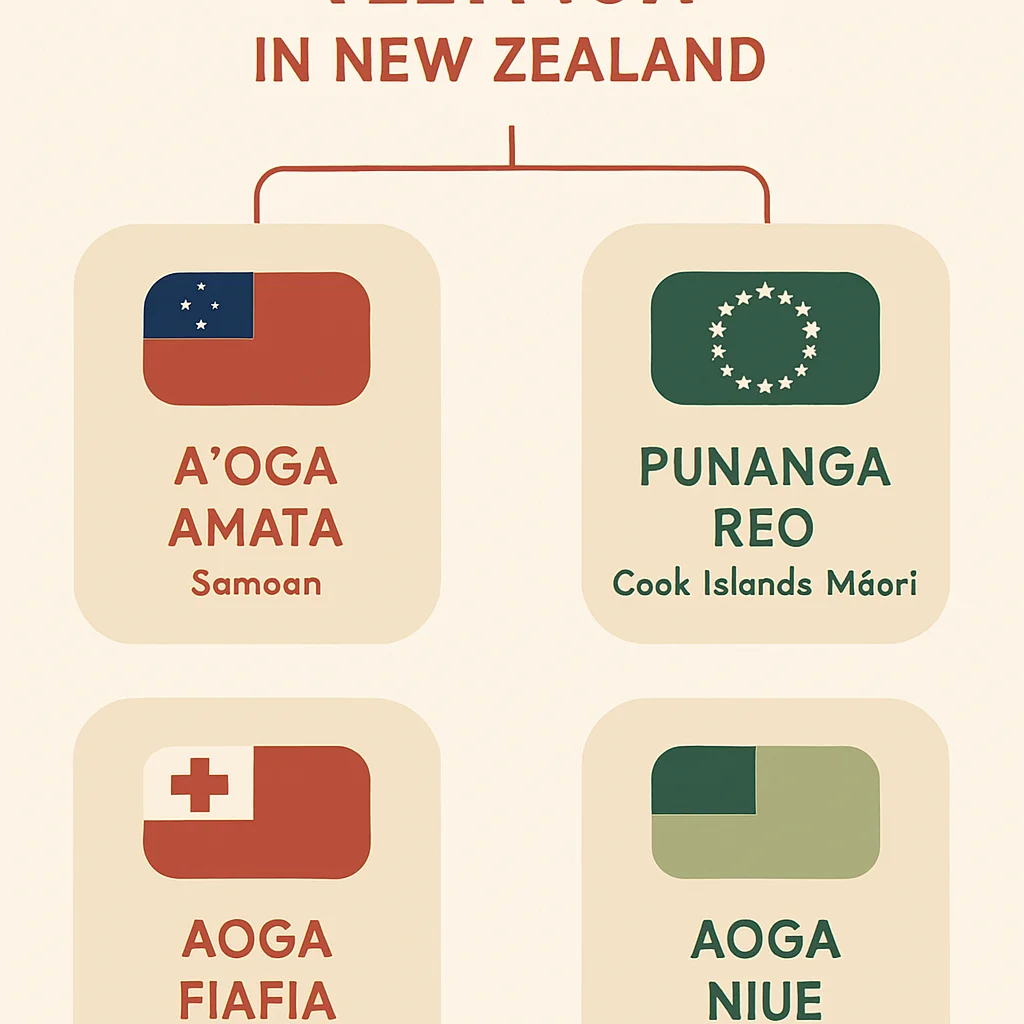
| Name | Language | Community | Model |
|---|---|---|---|
| A'oga Amata | Samoan (Gagana Samoa) | Samoan | Full or partial immersion; 'A'oga Amata' means 'early school' in Samoan |
| Punanga Reo | Cook Islands Māori (te reo Māori Kūki Āirani) | Cook Islands | Language nest model; 'Punanga Reo' means 'language nest' |
| Aoga Fiafia | Tongan (lea faka-Tonga) | Tongan | Bilingual/immersion; 'Fiafia' means 'happy' |
| Aoga Niue | Niuean (vagahau Niue) | Niuean | Immersion/bilingual; often smaller community-run centres |
| Aoga Tokelau | Tokelauan (gālue Tokelau) | Tokelauan | Small number of centres, mainly Auckland |
| Fijian-language ECE | Fijian / iTaukei | Fijian | Emerging; some bilingual programmes within broader Pacific centres |
Some centres operate as full immersion. The target Pacific language is used exclusively, with English introduced only gradually. Others are bilingual, moving between the Pacific language and English throughout the day. Full immersion is generally recommended for families where the language isn't spoken at home.
How they teach: Te Whāriki through a Pacific lens
From 1 May 2024, all Pacific language immersion ECE services in NZ are required to implement Te Whāriki (New Zealand's early childhood curriculum) through Te Ara Whānui (the Pacific pathway). This replaced earlier arrangements where some services were using older curriculum frameworks.
Te Ara Whānui weaves Pacific values directly into the five strands of Te Whāriki: Wellbeing, Belonging, Contribution, Communication, and Exploration. At a practical level, this means:
- Stories and songs in the target language, drawn from Pacific oral traditions
- Tikanga Pacific (cultural practices, values like fa'aaloalo (respect) in Samoan, or fefeka (strength) in Tongan)
- Whānau involvement as central to the programme, not optional
- Strong emphasis on community identity and belonging alongside individual learning
The Ministry of Education has developed Tāhūrangi curriculum guides in five Pacific languages (Samoan, Tongan, Cook Islands Māori, Niuean, and Tokelauan) to support kaiako (teachers) in delivering the curriculum in their community's language. For Cook Islands Māori specifically, the Pasifika Early Literacy (LEAP) project provides additional resources.
Where to find Pacific immersion ECE
The majority of Pacific language immersion ECE services are in Auckland, which has NZ's largest Pacific community, roughly 15% of Auckland's population identifies as Pacific. Wellington and Christchurch have smaller but established clusters of services.
Finding Pacific immersion ECE near you
- The Parent Circle: search by care type and filter for Pacific immersion across 4,394+ providers
- Ministry of Education's Find an ECE Service tool at educationcounts.govt.nz
- Your local Pacific community organisations: many A'oga Amata and Punanga Reo operate through church or cultural society networks
- Ministry for Pacific Peoples regional offices: they can advise on local services
Outside the main centres, options are limited. Regional cities like Hamilton and Tauranga have some Pacific bilingual ECE, but full-immersion services outside Auckland are rare. If you're in a smaller town with no local service, some whānau supplement mainstream ECE with Saturday language schools or home-based Pacific language groups.
Costs and subsidies
Pacific language immersion ECE services are licensed ECE providers and qualify for the same government funding as any mainstream centre. That means:
- 20 Hours ECE: children aged 3–5 are entitled to 20 funded hours per week, reducing or eliminating fees for part-time attendance
- WINZ Childcare Subsidy: income-tested subsidy for families who qualify, applicable to any licensed ECE service
- FamilyBoost: the 25% childcare tax rebate (up to $150/week) applies to fees at licensed Pacific immersion centres
- Pacific bilingual/immersion teacher allowance: since 2024, kaiako teaching in a Pacific language receive an additional remuneration allowance from MOE, which helps centres retain qualified staff
Weekly fees at Pacific immersion centres vary by service and region. Many community-run A'oga Amata and Punanga Reo centres charge lower rates than commercial daycare chains, partly because they're run on a not-for-profit or charitable basis, and partly because their funding model includes community contributions. Expect roughly $150–$280/week before subsidies for full-time care, though this varies significantly.
Why heritage language immersion works
Children in full-immersion programmes don't lose English. They gain a second language on top of it. Studies on bilingual development show that children who build strong heritage language foundations before age 5 have better literacy outcomes in both languages by the time they start primary school.
For Pacific children specifically, heritage language carries more than linguistic value. It connects children to:
- Extended whānau and community relationships that operate in the heritage language
- Cultural practices, ceremonies, and oral traditions that are inseparable from the language
- A strong sense of identity, which the ERO has identified as a protective factor for Pacific student achievement through school
The Pacific Languages Strategy 2022–2032 (Ministry for Pacific Peoples) frames early childhood as the most critical period for language transmission. Once a language generation is skipped, recovery is extremely difficult. Pacific ECE is one of the few interventions that can realistically interrupt language shift at scale.
Honest challenges: what families should know
This sector is under strain. Finding qualified kaiako who are fluent in a Pacific language and hold ECE qualifications is genuinely hard. Teacher shortages affect the entire ECE sector, but are more acute in specialist language services where the pool of eligible candidates is smaller.
Some services have irregular hours or limited days because they can't staff full-time programmes. Others have long waitlists, particularly well-established A'oga Amata in South Auckland. If you're planning to use Pacific immersion ECE, start looking early. Twelve months before your child's intended start date is not excessive.
If there's no Pacific immersion centre near you
- Saturday heritage language schools (Samoan, Tongan, and Cook Islands Māori community schools run widely in Auckland)
- Home-based care with a Pacific-language-speaking educator through a home-based network
- Reo Moana professional development resources, which some families access these informally through community networks
These won't replicate full immersion, but they can meaningfully support heritage language development alongside mainstream ECE.
What to ask when visiting a Pacific immersion centre
- What is the language policy? Full immersion (target language only) or bilingual (mixing with English)? What percentage of the day is in the Pacific language?
- What are kaiako qualifications? Teachers should hold an ECE qualification (or be working toward one) and be fluent in the target language
- How is Te Ara Whānui implemented? Ask to see examples of how Pacific values are embedded in daily routines, not just special cultural days
- What is the whānau involvement expectation? Many Pacific immersion services expect significant family participation, so understand the commitment before enrolling
- What is the current ERO report? All licensed services are reviewed by the Education Review Office. Ask to see the most recent report
- What are the hours and days? Some community-run services have limited hours that may not suit working parents
Do my children need to speak the Pacific language to enrol in immersion ECE?
No. Most A'oga Amata and Punanga Reo centres welcome children with no prior exposure to the language. That's often the entire point. The immersion environment does the work. Some families enrol specifically because they want their children to acquire the language they themselves don't speak fluently.
Will Pacific language immersion ECE delay my child's English development?
Research consistently says no. Children who develop strong foundations in any language in the early years transfer those literacy skills to English when they encounter it. Bilingual children may have slightly smaller vocabularies in each language at age 3-4 (they're splitting their word-learning across two systems), but by primary school they typically catch up and often outperform monolingual peers in metalinguistic awareness.
Are Pacific immersion ECE centres eligible for 20 Hours ECE?
Yes. All licensed Pacific immersion ECE services qualify for the 20 Hours ECE programme, which provides 20 funded hours per week for children aged 3-5. This applies regardless of whether the centre is full immersion or bilingual.
How is Pacific immersion ECE different from Te Kōhanga Reo?
Te Kōhanga Reo is a Māori language immersion model specifically for te reo Māori, operating since 1982. Pacific immersion ECE services use a different language (Samoan, Tongan, Cook Islands Māori, etc.) and follow the Te Ara Whānui Pacific pathway of Te Whāriki rather than the Māori pathway. Both share the principle of total immersion and strong family/community involvement.
Can non-Pacific families enrol their children?
In most cases, yes. These services are not legally restricted by ethnicity. However, parents should consider whether the cultural and community environment is a good fit. Some A'oga Amata communities are very whānau-centred and expect significant family involvement in the life of the centre, which is worth discussing with the centre before enrolling.
Pacific language immersion ECE won't suit every family. But for Pacific whānau who want their tamariki to grow up with a genuine connection to their heritage language and culture, it offers something genuinely irreplaceable. The earlier children start in an immersion environment, the stronger the language foundation they'll carry into school and beyond. See our full Types of Childcare guide for how Pacific immersion compares to other ECE options in New Zealand.
Find Pacific language immersion ECE near you
Search across 4,394+ licensed providers including Pacific language immersion services in your area.
Search providersFind childcare near you
Search and compare providers by suburb, care type, cost, and availability.