
Resource Hub
Choosing Between Two Childcare Centres: A Decision Framework for NZ Parents
Published · Last updated · 7 min read

Contents
How do I choose between two childcare centres?
Write down your three non-negotiables (the things you won't bend on), then score each centre across ten quality factors like teacher ratios, ERO history, fees, location, and settling-in policy. Weight those scores by what matters most to your whānau. If the numbers are close, use the Monday Morning Test: picture yourself doing the drop-off at each centre on a grey, rushed Monday. The one that makes your stomach unclench is probably the right fit.
Why comparing two centres feels impossible
You've done the hard work. You visited centres, asked the right questions, and somehow ended up with two options that are both... fine? Good, even? One has the gorgeous outdoor space but costs $40 more a week. The other has the teacher your friend raves about but is a 15-minute detour from your commute.
This is where most parents get stuck. With 4,394+ licensed ECE providers across New Zealand, narrowing down is the easy part. Deciding between your final two is where the real anxiety lives. The problem is that you're comparing apples to slightly different apples, and both will be feeding your child five days a week.
The good news: if both centres made your shortlist, you've already filtered out the bad options. This decision is between good and good. A structured framework takes the spinning out of it.
Step 1: Pin down your non-negotiables
Before you compare anything, get clear on what you won't compromise on. These are your dealbreakers — three maximum. More than three and everything becomes a non-negotiable, which means nothing is.
Common non-negotiables for NZ families: distance under 15 minutes from home or work. Fees under a specific weekly cap (the average sits between $5 and $8 per hour for children not on 20 Hours ECE, but under-2 rates run higher because of the 1:5 ratio requirement). A particular philosophy like Montessori or play-based. Te reo Māori in the programme. Opening hours that match your work schedule.
The partner test
If either centre fails a genuine non-negotiable, the decision is already made. Cross it off and stop second-guessing. The framework below is for when both centres pass your baseline.
Step 2: Score each centre on 10 quality factors
Rate each centre from 1 (poor) to 5 (excellent) on each of these factors. Be honest, not generous. A centre that's "fine" on something gets a 3, not a 4.
| Factor | What to look at | Centre A | Centre B |
|---|---|---|---|
| Teacher ratios | Legal minimum is 1:5 (under 2) and 1:10 (over 2). Better centres exceed this. Ask about effective ratios during lunch breaks and non-contact time. | ||
| Teacher qualifications & stability | At least 50% must be qualified — but the best centres sit at 80%+. Ask about staff turnover in the last 12 months. | ||
| ERO review history | Check the most recent ERO report for each centre. Look at whether they met quality thresholds or had areas flagged for improvement. | ||
| Fees & total cost | Compare the real weekly cost including optional charges, food fees, and holiday billing. Factor in 20 Hours ECE (if your child is 3+) and FamilyBoost. | ||
| Location & commute | Time the drive or walk at drop-off hour, not Saturday afternoon. Add 5 minutes for parking and signing in. | ||
| Outdoor space & environment | Look at the actual space, not the brochure. Is the outdoor area varied (sand, grass, climbing, garden)? Is it used daily? | ||
| Curriculum & philosophy | Every NZ centre follows Te Whāriki, but how they interpret it varies. Ask how the five strands (Mana Atua, Mana Whenua, Mana Tangata, Mana Reo, Mana Aotūroa) show up in daily practice. | ||
| Settling-in policy | Good centres offer graduated settling: short visits building to full days over 1-2 weeks, with a consistent key teacher assigned to your child. | ||
| Communication with parents | How will you know what your child did today? Daily app updates, a notebook, a chat at pickup? Ask to see an example. | ||
| Opening hours & flexibility | Do the hours match your actual life? What about early drop-off, late pickup fees, and their policy on part-time vs full-time spots? |
Weight the scores by your priorities
Not every factor matters equally. A parent who works shifts will weight opening hours heavily. A parent with a toddler who's had a rough time at another centre will weight settling-in policy at the top. Pick your top three factors and double their scores. That's your weighted total.
For example: if your top priorities are teacher stability, fees, and settling-in, double those three scores and add the rest normally. Centre A might score 52, Centre B might score 48. A four-point gap on a 100-point scale is close — but it's a signal.
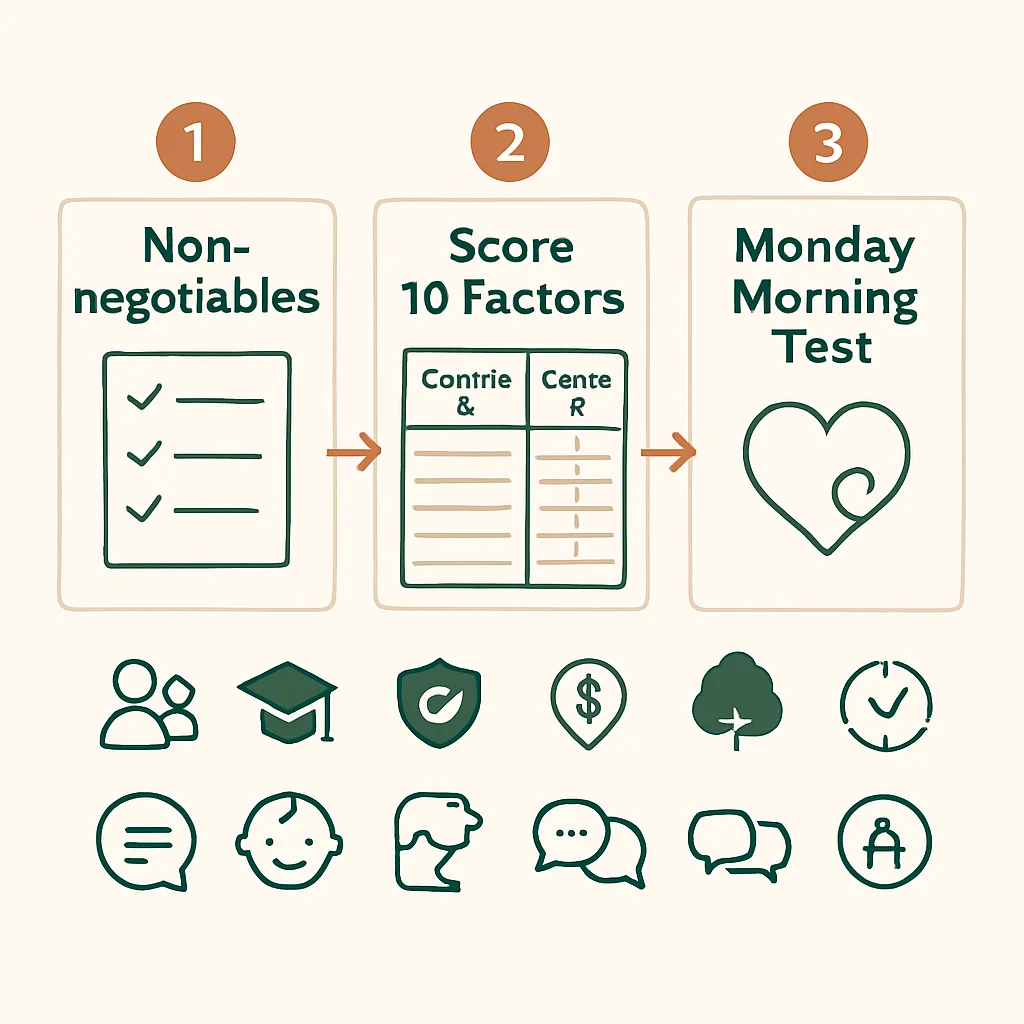
Step 3: The Monday Morning Test
Numbers help, but they don't capture everything. The Monday Morning Test fills the gap. Close your eyes and picture a wet, rushed Monday. You're running late, your child is grumpy, and you still need to get to work. You pull into the car park at Centre A. How does it feel? Now picture the same morning at Centre B.
This isn't woo. Your gut is processing information your spreadsheet can't: the warmth of the teacher who greeted you at the door, whether the other children looked happy and busy, whether the space felt calm or chaotic. If the scores are within a few points of each other, this test breaks the tie.
Common trade-offs (and how to think about them)
Every comparison involves trade-offs. Here are the ones NZ parents wrestle with most:
Cost vs location
The cheaper centre is 25 minutes away. The closer one costs $50 more per week. Do the maths on your commute: at current petrol prices and the value of your time, that 25-minute detour adds up fast. If you're claiming FamilyBoost (25% rebate on ECE fees, capped at $75/week per child), the cost gap might shrink enough to make the closer centre worth it.
Philosophy vs convenience
You love the Reggio Emilia-inspired centre, but the play-based one down the road has longer hours and a simpler drop-off. Remember: Te Whāriki underpins all licensed NZ centres. The difference between philosophies often matters less in practice than the quality of the teachers delivering them. A great teacher in a standard play-based centre will serve your child better than an average teacher in a centre with an impressive philosophy label.
Big centre vs small centre
Larger centres (50+ children) often have more resources: specialist rooms, bigger outdoor areas, relief teachers on tap. Smaller centres (under 30) tend to feel more like family, with less staff turnover and teachers who know every child's name. Neither is better. It depends on your child's temperament and what makes them feel safe.
For-profit vs community-based
Private for-profit centres charge more on average than community-based ones. But "for-profit" doesn't mean lower quality — some of the best centres in the country are privately owned. And "community-based" doesn't guarantee warmth. Check the ERO report and talk to current parents. The business model matters less than the people running the rooms.
When to involve your child in the decision
If both centres offer trial sessions or settling-in visits (and most good ones do), take them up on it before committing. Even one short visit gives you data you can't get any other way. Watch how the teachers interact with your child specifically — not just with the group. Do they get down to your child's level? Do they learn their name quickly? Do they check in with you at pickup?
For tamariki under two, your child won't give you a verbal verdict. Instead, watch their body language over the visit. Do they settle after the initial wobble? Do they show curiosity about the toys and space? For older children (3+), their reaction over two or three visits is a genuine signal — though keep in mind that some children resist all new places initially, and that's normal.
Don't skip the second visit
Do a real cost comparison (not just the headline rate)
The hourly rate on the website tells you very little. To compare costs properly, ask each centre for a full fee breakdown based on the exact hours you need. Include these in your calculation:
- Base hourly or sessional rate for your child's age group
- 20 Hours ECE deduction if your child is 3-5 years old (up to 6 hours per day, 20 hours per week of free ECE at any licensed provider)
- Food and nappy fees — some centres include meals, others charge $5-$10/day extra
- Statutory holiday charges — many centres bill for public holidays even when closed
- Absence fees — what happens when your child is sick for a week?
- Late pickup fees — typically $1-$2 per minute after closing time
- Minimum booking hours — some centres require a minimum of 3 or 4 days per week
After adding it all up, check what subsidies apply. The WINZ Childcare Subsidy pays up to $6.52 per hour per child for eligible families (income under $2,336/week gross for one child). FamilyBoost adds a 25% rebate on remaining fees, capped at $75 per week. Run the numbers for both centres — the cheaper headline rate doesn't always mean the cheaper real cost.
Frequently asked questions
Should I put my child on the waitlist at both centres while I decide?
Yes. Waitlists in NZ can be long, especially in Auckland and Wellington. Joining both costs nothing (or a small deposit, usually refundable). You can decline a spot later with no obligation. Don't let waitlist pressure rush your decision, but don't lose your place while you think either.
How much weight should I give the ERO report?
ERO reports are one useful data point, not the final word. They capture a snapshot from one review period. Half of NZ ECE services were rated below the quality threshold on at least one indicator in recent reviews. Check the report, but also talk to current parents and trust what you saw during your visit.
What if my partner and I disagree on which centre to choose?
Go back to the non-negotiables exercise. If you each wrote down your top three independently, you'll usually find overlap on the things that matter most. Where you disagree, try a trial day at each centre and see if the experience shifts anything. The parent doing most of the drop-offs and pickups should get a slight edge in the final call — they'll feel the daily impact most.
Can I switch centres later if I pick the wrong one?
Absolutely. Switching centres is more common than you'd think, and children are resilient. Most centres require 2-4 weeks' notice. If something isn't working after the settling-in period (usually 2-4 weeks), it's better to move early than to stick it out hoping things improve.
Does it matter if a centre is for-profit or not-for-profit?
Not as much as you'd think. Both models can deliver excellent care. Community-based centres tend to have lower fees because they reinvest revenue, while private centres may invest more in facilities and resources. Judge the centre on its teachers, ERO report, and the feel of the rooms — not its tax status.
Choosing between two good centres is a sign you've done your research well. Use this framework to make the decision feel less overwhelming, and remember: there's no single perfect centre. There's the centre that fits your family right now. For more on what to look for and what to avoid, read our complete guide to choosing childcare in NZ. And if you haven't compared your options side by side yet, our comparison tool lays it all out.
Compare your top centres side by side
Use The Parent Circle's comparison tool to see fees, ratios, ERO ratings, and more for any two centres in New Zealand.
Compare centres nowFind childcare near you
Search and compare providers by suburb, care type, cost, and availability.